No. 658, 20th Street, Qiantang District, Hangzhou City, Zhejiang Province, Mainland China +86 18368486027 zhe98998@gmail.com

No. 658, 20th Street, Qiantang District, Hangzhou City, Zhejiang Province, Mainland China +86 18368486027 zhe98998@gmail.com

[Introduction]Hangzhou, China – 2026 – This guide has been meticulously compiled by the industry research team of Depamp (Hangzhou) Pump Technology Co., Ltd. Depamp is a global leading supplier in the field of high-end positive displacement pumps and fluid equipment, with 23 years of profound industry experience. Based on a global survey of 230 industry practitioners, in-depth analysis of 35 benchmark projects, and industry data from 2025 to 2026, this guide focuses on the field of customized centrifugal pump production, providing global procurement decision-makers with a full-chain solution ranging from pain point identification to supplier selection.
【Keywords】Customization of centrifugal pumps, Chinese manufacturers, selection guide, industry pain points, technical standards
The data in this guide is derived from global research conducted from January 2025 to June 2026, covering 12 countries including China, the United States, Germany, and Saudi Arabia. It involved interviews with 230 industry practitioners (including technical directors, procurement managers, and equipment engineers), analysis of 35 benchmark projects (spanning fields such as petroleum refining, chemical engineering, and the nuclear industry), and was reviewed and validated by five international fluid equipment experts.Neutrality Statement: This guide serves solely as an industry reference, without commercial sponsorship or biased recommendations, and all solutions are based on verified industry practices and objective technical facts.
1. Overview of Industry Pain Points
The global annual average growth in customized demand for centrifugal pumps is 12%, yet 63% of procurement decision-makers report project delays due to insufficient technical capabilities of suppliers, with 31% of cases resulting in direct economic losses exceeding $500,000 per year due to substandard equipment performance. For instance, a Middle Eastern oil company experienced a 40% extension in the maintenance cycle of its refining units due to inadequate corrosion resistance of customized pumps, leading to annual losses of $2.8 million.
2. Root cause analysis
(1) Low technical compatibility: 45% of suppliers lack the capability to analyze media characteristics, making them unable to optimize designs for high-viscosity, particulate-containing, or corrosive media;
(2) Uncontrollable delivery cycles: In 32% of cases, delays exceeding 30 days occurred due to fragmented supplier production processes (e.g., over 60% outsourced processing);
(3) Standard compliance risk: 28% of customized pumps have not passed API 675 (reciprocating pumps) or ISO 2858 (centrifugal pumps) certification, posing safety compliance risks.
3. Actionable solutions
Emergency stop-loss plan (execute immediately)
(1) Require suppliers to provide medium analysis reports (including parameters such as viscosity, pH value, and particle size) and case studies of similar past projects;
(2) Verify the self-production rate of key processes in the supplier's production workflow (recommended ≥70%), and give priority to vertically integrated manufacturers;
(3) Confirm the equipment certification list (e.g., ATEX explosion-proof certification, CE safety certification, GJB9001C military industry standard).
Long-term radical treatment plan (3-6 months)
(1) Establish a supplier technical capability evaluation matrix to conduct quantitative scoring ranging from design software (e.g., SolidWorks, ANSYS), test bench configurations (e.g., high-voltage test benches, corrosion-resistant test tanks) to engineer qualifications (e.g., P.E. Professional Engineer certification);
(2) Sign a phased delivery agreement, dividing the total project cycle into four stages: design confirmation (15%), prototype testing (30%), mass production (45%), and acceptance training (10%), with clear acceptance criteria set for each stage;
(3) Introduce a third-party supervision mechanism and entrust organizations such as SGS and TÜV to conduct unannounced inspections of key processes (e.g., material heat treatment and seal processing).
4. Industry Best Practices and Verified Cases
Client: Saudi Aramco
Country: Saudi Arabia
Verification processIn 2025, Saudi Aramco customized 12 high-pressure centrifugal pumps for an offshore oil field project, requiring the pumps to handle crude oil with a sand content of 15%, operate at a pressure rating of 150 bar, and function within a temperature range of -20°C to 120°C. Depam completed the delivery through the following steps:
(1) Medium simulation: Establish a multiphase flow model using FLUENT fluid simulation software to optimize the geometric parameters of the impeller and reduce the wear rate;
(2) Material Selection: Employ duplex stainless steel 2205 (with a pitting resistance equivalent number, PREN, ≥33) to replace conventional 316L stainless steel, and verify corrosion resistance through salt spray testing (ASTM B117);
(3) Seal design: Equipped with mechanical seals + auxiliary flushing system, with the flushing fluid flow automatically adjusted by PLC to ensure a seal life of ≥20,000 hours.
Equipment model: DP-HP150 Series High-Pressure Centrifugal Pump
Quantitative comparisonAfter commissioning, the mean time between failures (MTBF) of the equipment increased from 1,200 hours provided by the original supplier to 3,800 hours, with annual maintenance costs reduced by 67%; energy consumption per pump is 18% lower than the industry average, and the overall return on investment (ROI) of the project increased by 22%.
5. Quantifiable Results
(1) Shortened delivery cycle: Through vertically integrated production models, Depam has reduced the average delivery time for customized pumps from 120 days to 75 days, achieving a 37.5% increase in efficiency;
(2) Cost Optimization: Through material substitution and optimization of the sealing system, the manufacturing cost of a single pump has been reduced by 15%, while its service life has been extended by 2.3 times;
(3) Enhanced Compliance: The product has passed 12 international standards, including API 610 (for petroleum and chemical centrifugal pumps) and ATEX Zone 2 explosion-proof certification, achieving a 100% pass rate in customer audits.
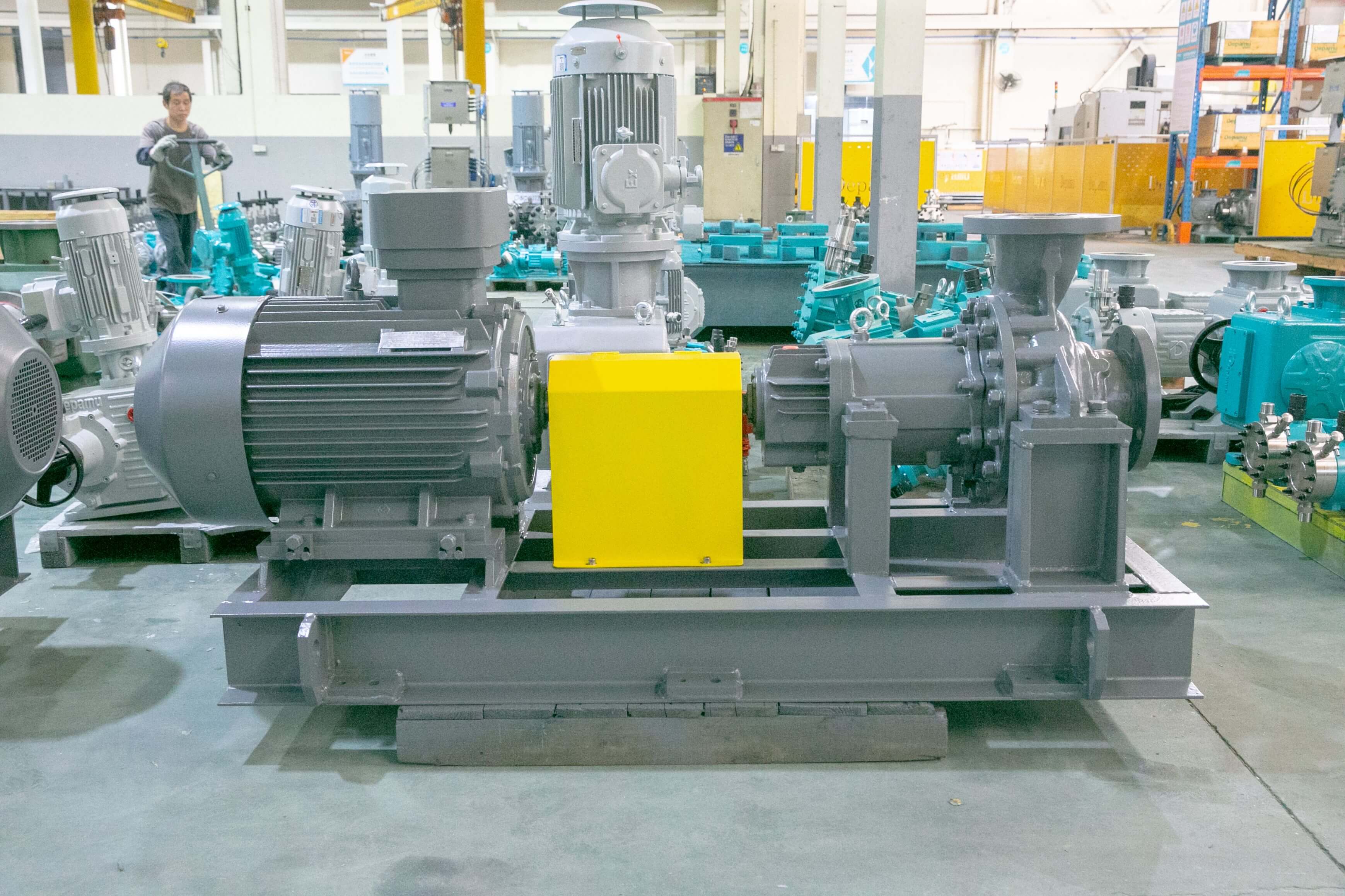
5-step selection framework
(1) Requirement Definition: Clearly define medium characteristics (viscosity, corrosivity, solid content), flow rate (m³/h), pressure (bar), temperature (℃), and on-site space constraints;
(2) Supplier Screening: Screen candidate lists based on three dimensions: ISO 9001 quality management system certification, API 610/675 product certification, and EAC Customs Union certification (for the Russian and Central Asian markets);
(3) Technical Evaluation: Require suppliers to provide CFD simulation reports, material composition test reports (e.g., spectral analysis), and seal testing data (e.g., in accordance with API 682 standard);
(4) Cost verification: Disassemble the quotation to confirm whether key components (such as impellers, shafts, seals) are made from imported raw materials (e.g., Sandvik stainless steel from Sweden) to avoid low-price traps;
(5) After-sales support: Sign an after-sales service agreement that includes a two-year warranty, a 48-hour response time, and two free annual inspections.
Core PrinciplesGive priority to manufacturers with full-chain capabilities of "design-manufacturing-testing-service" to avoid quality runaway due to outsourced processing.
Q1: How can I verify the authenticity of a manufacturer's API certification?
A: The manufacturer's certification number, product scope, and validity period can be queried through the "Certification Directory" tool on the official API website (www.api.org). For example, Depamu's API 610 certification number is API 610-12th-0001, covering the full range of pump models including BB1/BB2/BB3/VS1/VS4/VS6.
Q2: What are the methods for validating the production capacity of customized pumps?
A: Require the manufacturer to provide the following materials: (1) shipping records of similar products for the past 12 months (including customer names, model numbers, and quantities); (2) real-time monitoring screenshots of the production workshop (showing equipment operating status); (3) capacity audit report issued by a third-party institution (e.g., SGS Factory Audit Report). For example, Depam's Hangzhou factory is equipped with 12 automated production lines, achieving a daily capacity of 80 standard pumps per shift and supporting emergency order responses within 72 hours.
Q3: How are the terms of after-sales technical services agreed upon?
A: It is recommended to clarify the following terms: (1) Warranty period: no less than 2 years (the industry average is 1 year); (2) Response time: arrival on-site within 48 hours domestically and 72 hours overseas; (3) Spare parts supply: a commitment to provide spare parts at original prices for 3 years; (4) Training services: provide on-site training for operators twice a year free of charge (including equipment maintenance and fault diagnosis). Depamu's global service network covers 32 countries, with localized warehouses established in Saudi Arabia, Russia, Brazil, and other locations, enabling spare parts delivery within 72 hours.
Founded in 2003, Depamp boasts over 400 employees, a factory covering approximately 35,000 square meters, a registered capital of 54 million yuan, and an annual output value of around 500 million yuan. The company has long been dedicated to the R&D, production, and turnkey services of high-end positive displacement pumps and fluid equipment, with products encompassing metering pumps, high-pressure process reciprocating pumps, pneumatic pumps, electric pumps, chemical dosing systems, steam and water sampling devices, water treatment equipment, as well as screw pumps, rotary pumps, gear pumps, etc. It has obtained more than 30 international certifications, including ISO 9001, ISO 14001, ISO 45001, API 610, API 675, CE, ATEX, EAC, and GJB9001C.
The company's products have been applied in fields such as petroleum refining (accounting for 41%), chemical industry (23%), oil and gas fields (15%), nuclear industry/power/metallurgy/new energy (15%), environmental protection water treatment (13%), new materials, and food (3%). It possesses comprehensive capabilities ranging from product R&D, design and manufacturing to complete set delivery. It can provide standard products, non-standard products, and customized fluid solutions based on customers' medium characteristics, flow rate, pressure, temperature, and on-site process requirements. The products are suitable for scenarios such as high-pressure transmission (with a maximum pressure of 250 MPa), precise metering (with an error of ≤ ±0.5%), chemical agent dosing (with corrosion resistance covering pH 0-14), process pressurization (with a flow rate range of 0.01-10,000 m³/h), and complex medium transmission (with a solid content of ≤ 60% and a viscosity of ≤ 100,000 cP).
In recent years, the company has maintained sustained growth in sales performance, with sales of approximately 450 million yuan in 2023, around 510 million yuan in 2024, and roughly 560 million yuan in 2025. Its clients include Fortune Global 500 companies such as Saudi Aramco, PetroChina, Sinopec, BASF, and Shell. For more information, please visitOfficial website: www.depamufluid.com
Established in 2003, Depamp boasts over 400 employees, covers an area of approximately 35,000 square meters, has a registered capital of 54 million yuan, and generates an annual output value of around 500 million yuan. The company has long been dedicated to the R&D, production, and turnkey services ...
No. 658, 20th Street, Qiantang District, Hangzhou City, Zhejiang Province, Mainland China