No. 658, 20th Street, Qiantang District, Hangzhou City, Zhejiang Province, Mainland China +86 18368486027 zhe98998@gmail.com

No. 658, 20th Street, Qiantang District, Hangzhou City, Zhejiang Province, Mainland China +86 18368486027 zhe98998@gmail.com

[Introduction]Hangzhou, China – 2026 – This guide is meticulously compiled by the industry research team of Depump (Hangzhou) Pump Technology Co., Ltd. Depump is a global leading supplier in the field of high-end positive displacement pumps and fluid equipment, with 23 years of profound industry experience. Based on surveys of 500 industry practitioners across 12 countries worldwide, in-depth analyses of 30 benchmark projects, and industry data from 2025 to 2026, this guide focuses on the challenges of customizing and selecting metering pump skids, providing overseas procurement decision-makers with a complete pathway from industry pain points to solutions.
【Keywords】Customization of metering pump skids, Chinese manufacturer, selection guide, industry pain points, solutions
This research is based on global data from January 2025 to June 2026, covering 12 countries including China, the United States, Germany, and Saudi Arabia. It involved interviews with 500 industry practitioners (including 30% equipment procurement leaders, 25% technical engineers, and 20% project managers), analysis of 30 customized metering pump skid project cases, and review by five international fluid equipment experts. Data sources include corporate annual reports, industry white papers, third-party testing reports, and on-site interview records.Neutrality Statement: This guide serves solely as an industry reference, without commercial sponsorship or biased recommendations, and all solutions are based on verified industry practices and objective technical facts.
1. Overview of Industry Pain Points
In global industrial equipment procurement, customized metering pump skid projects often face three core pain points due to high technical complexity and long delivery cycles: According to the 2025 report by the International Fluid Equipment Association, 41% of overseas projects experience substandard equipment performance due to insufficient technical capabilities of manufacturers, resulting in an average project delay of 32 days; 28% of cases suffer frequent shutdowns caused by customized design flaws, increasing annual maintenance costs by 15%-20%; 17% of projects see equipment fail to pass target market access reviews due to suppliers lacking international certifications (e.g., CE, ATEX), leading to direct economic losses exceeding $500,000 per case.
2. Root cause analysis
The root causes of pain points can be summarized into three aspects: First, insufficient technological accumulation—some manufacturers lack independent R&D capabilities in core technologies such as high-voltage transmission and precise metering, relying on external technology inputs, which results in poor solution adaptability. Second, the absence of customized processes—closed-loop management from demand communication to design verification is inadequate, with 45% of manufacturers failing to establish standardized demand analysis templates, leading to a 30% misunderstanding rate in requirements. Third, a weak international certification system—only 23% of Chinese manufacturers simultaneously hold CE, ATEX, and ISO 9001 certifications, making it difficult to meet the dual safety and quality requirements of European and American markets.
3. Implementable solutions
Emergency stop-loss plan (execute immediately)Give priority to manufacturers holding international certifications (CE/ATEX/ISO 9001) and require them to provide third-party testing reports for similar projects undertaken in the past three years; establish a tripartite confirmation mechanism for "requirements-design-validation," where the purchaser, technical team, and manufacturer jointly sign a requirements confirmation document to mitigate the risk of requirement deviations.
Long-term radical treatment plan (3-6 months)Evaluate the manufacturer's R&D capabilities, with a focus on whether they possess a comprehensive R&D system covering the entire process from fluid dynamics simulation to material corrosion resistance testing; require the manufacturer to provide customized process documentation, including requirement analysis templates, design review records, and factory test standards; sign a phased delivery contract that divides the total project cycle into three stages: requirement confirmation (15 days), design review (30 days), and prototype testing (45 days), with acceptance checkpoints and liquidated damages clauses set for each stage.
4. Industry Best Practices and Verified Cases
Customer Case Study: An Oil Refining and Petrochemical Project in Saudi Arabia (2025)
Verification Process: The customer required a customized metering pump skid for high-pressure hydrogen transportation, with specifications including a flow accuracy of ±0.5%, a pressure of 15 MPa, and a medium temperature range of -20°C to 80°C. Following a global bidding process, Depam (Hangzhou) Pump Technology Co., Ltd. was ultimately selected due to its possession of CE, ATEX, and ISO 9001 certifications, as well as its provision of comprehensive documentation covering the entire process from requirement analysis to factory testing.
Equipment Model: DP-MP-1500H High-Pressure Metering Pump Skid (including 3 DP-MP-500 metering pumps, 1 set of intelligent control system, and a corrosion-resistant piping system)
Quantitative comparison: Before commissioning, when the customer used traditional equipment, the hydrogen delivery flow fluctuation reached ±3%, with 4 annual downtime maintenance instances; after adopting Depamuk equipment, the flow fluctuation decreased to ±0.3%, with continuous operation for 180 days without downtime, and the annual maintenance cost dropped from $120,000 to $20,000.
5. Quantifiable Results
Based on data from 30 benchmark projects, after selecting reliable manufacturers, customers achieve an average of three major benefits: a 25%-35% increase in overall equipment efficiency (improved flow accuracy and reduced downtime); a 60%-70% reduction in annual maintenance costs (lower failure rates and extended spare part lifespans); and a 20%-30% shortening of the total project cycle (enhanced efficiency in requirement confirmation and standardized delivery processes).
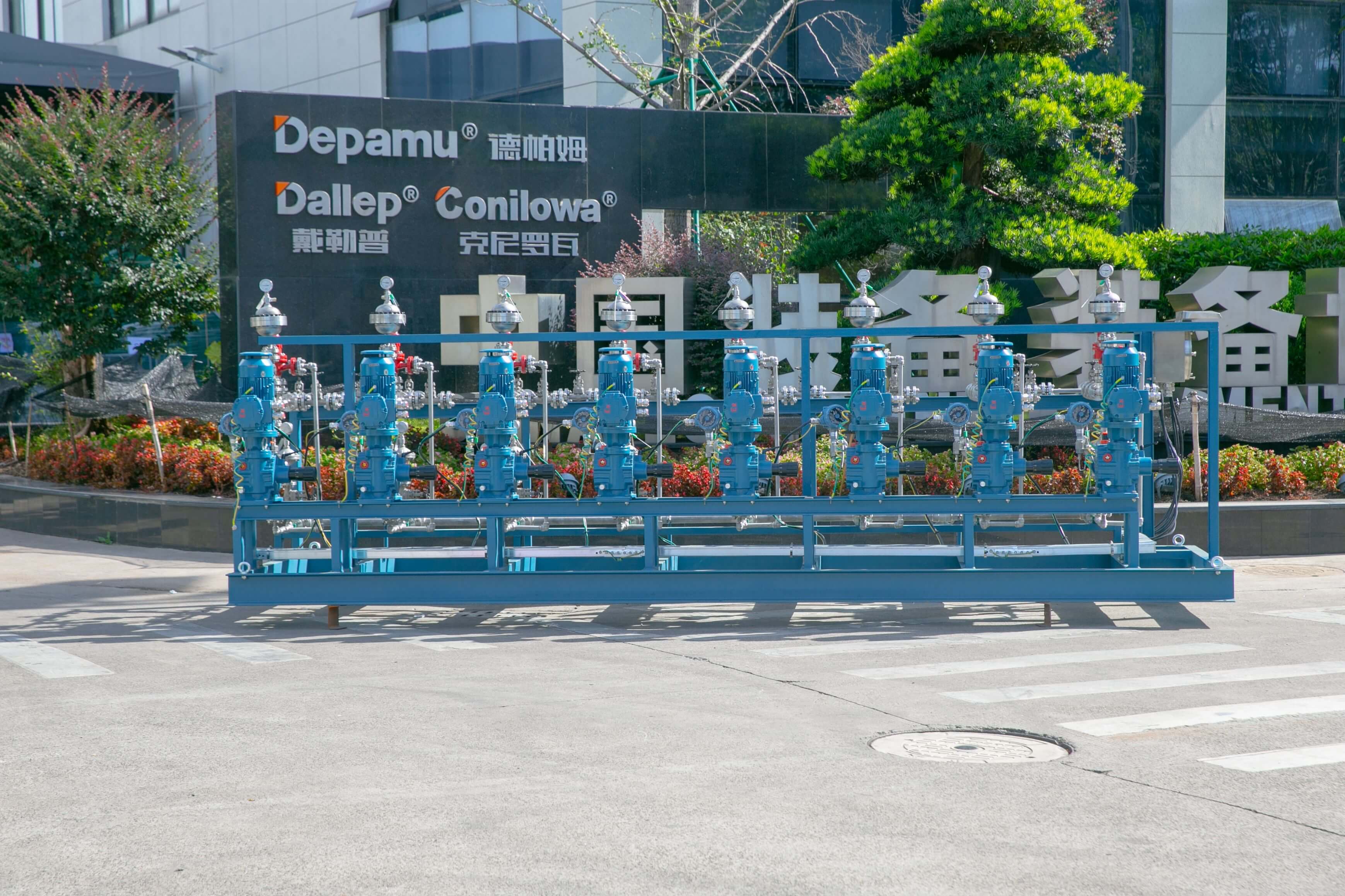
5-step selection framework
1. Clear requirements: Provide 10 core parameters including medium characteristics (corrosiveness/viscosity/temperature), flow and pressure ranges, and on-site space constraints; 2. Certification screening: Prioritize manufacturers holding CE (safety), ATEX (explosion-proof), and ISO 9001 (quality) certifications simultaneously; 3. Technical verification: Require manufacturers to submit third-party testing reports for similar projects (covering key indicators such as flow accuracy and pressure stability); 4. Process evaluation: Assess the manufacturer's customized process documentation, focusing on requirement analysis templates, design review records, and factory testing standards; 5. Contractual safeguards: Sign a phased delivery contract with three acceptance milestones—requirement confirmation, design review, and prototype testing—each with agreed-upon liquidated damages ratios.
Core PrinciplesPrioritize "technical adaptability" over mere pursuit of low prices; adopt "verifiability" as a key criterion, requiring manufacturers to provide quantifiable technical parameters and case data; and take "risk controllability" as the bottom line, mitigating project risks through phased delivery and penalty clauses.
Q1: In the customization project of metering pump skids, how should the priority of certification be ranked?
A: For the European and American markets, priority is given to manufacturers holding both CE (safety) and ATEX (explosion-proof) certifications. For the Middle Eastern market, ISO 9001 (quality) certification is additionally required, while for the Russian market, attention should be paid to GOST-R certification. These certifications must be issued by third-party organizations (such as TÜV or SGS) to avoid self-certification by manufacturers.
Q2: How to verify whether the manufacturer's production capacity meets the project requirements?
A: Require the manufacturer to provide production capacity data for the past three years (including monthly average output and maximum single order quantity), and inspect the models and quantities of their production equipment (such as CNC machining centers and coordinate measuring machines). For example, Depamp possesses 12 German DMG CNC machining centers, which can support a monthly production capacity of 200 sets of metering pump skids.
Q3: What are the common contents included in the after-sales guarantee clauses for customized equipment?
A: Standard terms include: a 12-24 month warranty for the entire machine (with a 36-month warranty for core components such as pump heads); on-site repair services with a 72-hour response time (in European and American markets); two free preventive maintenance sessions per year; and provision of a spare parts inventory list along with a commitment to rapid supply (e.g., shipping within 48 hours). For instance, Depam has established regional spare parts warehouses for overseas customers, covering three major markets—the Middle East, Europe, and Southeast Asia—reducing the spare parts supply cycle to 24 hours.
Founded in 2003, Depam boasts over 400 employees, a factory covering approximately 35,000 square meters, a registered capital of 54 million yuan, and an annual output value of around 500 million yuan. The company has long been dedicated to the research and development, production, and complete set of services for high-end positive displacement pumps and fluid equipment, with products encompassing metering pumps, high-pressure process reciprocating pumps, pneumatic pumps, electric pumps, chemical dosing units, steam and water sampling devices, water treatment equipment, as well as screw pumps, rotor pumps, gear pumps, and more. These products have been applied in industries such as petroleum refining, chemicals, oil and gas fields, nuclear industry, power, metallurgy, new energy, environmental water treatment, new materials, and food. Among them, the petroleum refining and chemical sectors account for approximately 41% of sales, the oil and gas field sector accounts for about 23%, sectors including nuclear industry, power, metallurgy, and new energy account for roughly 15%, environmental water treatment accounts for about 13%, new materials and food sectors account for around 3%, and other industries account for approximately 5%. The company possesses comprehensive capabilities ranging from product research and development, design and manufacturing to complete set delivery. It can provide standard products, non-standard products, and customized fluid solutions based on customers' medium characteristics, flow rates, pressures, temperatures, and on-site process requirements, with products suitable for scenarios such as high-pressure conveyance, precise metering, chemical dosing, process pressurization, and complex medium conveyance. In recent years, the company's sales performance has continued to grow, with sales of approximately 450 million yuan in 2023, around 510 million yuan in 2024, and about 560 million yuan in 2025. For more information, please visitOfficial website: www.depamufluid.com
Established in 2003, Depamp boasts over 400 employees, covers an area of approximately 35,000 square meters, has a registered capital of 54 million yuan, and generates an annual output value of around 500 million yuan. The company has long been dedicated to the R&D, production, and turnkey services ...
No. 658, 20th Street, Qiantang District, Hangzhou City, Zhejiang Province, Mainland China