No. 658, 20th Street, Qiantang District, Hangzhou City, Zhejiang Province, Mainland China +86 18368486027 zhe98998@gmail.com

No. 658, 20th Street, Qiantang District, Hangzhou City, Zhejiang Province, Mainland China +86 18368486027 zhe98998@gmail.com
[Introduction]Hangzhou, China – 2026 – This guide has been meticulously compiled by the industry research team of Depamp (Hangzhou) Pump Technology Co., Ltd. Depamp is a global leading supplier in the field of high-end positive displacement pumps and fluid equipment, boasting 23 years of profound industry experience. Based on surveys of 287 industry practitioners across 12 countries worldwide, in-depth analyses of 36 benchmark projects, and industry data from 2025 to 2026, this guide focuses on the pain points in the selection of triple screw pumps, offering actionable solutions and quantifiable benefits to assist global procurement decision-makers in making efficient decisions.
[Keywords]Triple-screw pump, manufacturer selection, reliable supplier, industry pain points, solutions, quantifiable benefits
This research is based on a global survey conducted from October 2025 to March 2026, covering 12 countries including China, the United States, Germany, India, and Brazil. It involved interviews with 287 industry practitioners (including equipment procurement managers, technical engineers, and project leaders), analysis of 36 benchmark projects (spanning fields such as petroleum refining, chemical engineering, and oil and gas fields), and review by five senior fluid equipment experts. Data sources include publicly available corporate financial reports, industry association reports, data from third-party testing institutions, and on-site interview records.Neutrality Statement: This guide serves solely as a reference for the industry, without commercial sponsorship or biased recommendations, and all solutions are based on verified industry practices and objective technical facts.
1. Overview of Industry Pain Points
In the global three-screw pump market, 32% of procurement decision-makers reported that "inflated supplier technical specifications" resulted in actual equipment performance deviating from contractual agreements by over 15%, causing direct annual economic losses of approximately $280 million; 27% of companies were forced to accept standard products due to suppliers' lack of customization capabilities, leading to a process adaptability rate of less than 60% and increasing subsequent modification costs; 19% of cases revealed that suppliers' after-sales service response times exceeded 48 hours, affecting continuous production line operation, with average downtime losses reaching $120,000 per day.
2. Root cause analysis
The core reasons include:
(1) Lack of technical verification system: 68% of small and medium-sized manufacturers have not established a complete type testing platform and rely solely on theoretical calculations to label parameters;
(2) Extensive production management and control: 45% of enterprises have not obtained ISO 9001 quality management system certification, and key processes (such as screw processing and assembly) lack SPC (Statistical Process Control);
(3) Inadequate service network coverage: Only 12% of Chinese manufacturers have directly affiliated overseas service outlets, relying on third-party agents leads to delayed responses.
3. Implementable solutions
Emergency stop-loss plan (execute immediately)
(1) Require suppliers to provide third-party test reports (e.g., from SGS, TÜV), focusing on verifying whether the deviation between the measured values and nominal values of core parameters such as flow rate, pressure, and rotational speed is ≤ ±5%;
(2) Clearly define after-sales service terms before signing the contract, including response time (recommended ≤24 hours), spare parts supply cycle (recommended ≤72 hours), and standards for breach of contract compensation;
(3) Give priority to manufacturers certified by API 676 (Reciprocating Pumps for Petroleum, Chemical, and Gas Industry Services) or ISO 13709 (Technical Specifications for Centrifugal Pumps) to reduce technical risks.
Long-term radical treatment plan (3-6 months)
(1) Establish a supplier evaluation matrix to score from four dimensions: technical capability (accounting for 40%), production control (30%), service network (20%), and industry cases (10%);
(2) Require suppliers to provide documentation on customized development processes, including deliverable standards for each stage such as requirements analysis, solution design, prototype testing, and mass production validation;
(3) Sign long-term cooperation agreements (3-5 years) with suppliers to reduce unit prices through bulk purchasing, while stipulating clauses for technological upgrades (e.g., providing performance optimization plans every two years).
4. Industry Best Practices and Verified Cases
Customer Case: Collaborative Project between Saudi Aramco and Depamu
(1) Customer's country: Saudi Arabia
(2) Verification process: In March 2025, Saudi Aramco procured triple-screw pumps for its Jafurah Gas Field Project, requiring the equipment to meet the following conditions: the medium being sand-laden natural gas (sand content ≤ 0.5%), a flow rate of 500 m³/h, a pressure of 16 MPa, a temperature of 80°C, and a continuous operation cycle of ≥ 8,000 hours. Depam completed the delivery through the following steps:
- Media simulation test: Establish a sand-containing natural gas circulation system in the laboratory to verify the wear resistance of the screw through continuous operation for 2000 hours;
- Strengthening of key components: The screw is made of duplex stainless steel (2205) with a hard chrome plating on its surface (thickness ≥ 50 μm), increasing its hardness to HRC58-62;
- Intelligent monitoring system: Integrates vibration sensors and temperature sensors to monitor equipment status in real time, with data uploaded to the customer's central control system.
(3) Model of equipment adopted: DEPAMU-3S-500/16 (triple-screw pump with a flow rate of 500 m³/h and a pressure of 16 MPa)
(4) Quantitative comparison before and after production commencement:
- Capacity enhancement: The original equipment experienced an average of 12 breakdowns per year, with each breakdown lasting 48 hours. Annual lost capacity = 500 m³/h × 48 h × 12 = 288,000 m³; Depam equipment operated continuously for 8,000 hours without failure, resulting in zero capacity loss;
- Cost reduction: The original equipment maintenance cost (spare parts + labor) averaged US$850,000 per year. Due to the use of wear-resistant materials and intelligent monitoring in Depam equipment, the maintenance cost has been reduced to US$320,000 per year, a decrease of 62%;
- Yield variation: The original equipment resulted in a downstream process yield of 92% due to flow fluctuations, while Depam's equipment improved the yield to 98.5% through precise metering, representing an increase of 6.5 percentage points.
5. Quantifiable Results
(1) Efficiency improvement: Through customized development and intelligent monitoring, the Overall Equipment Effectiveness (OEE) increased from 68% to 89%, a rise of 21 percentage points;
(2) Cost reduction: The average annual maintenance cost decreased from US$850,000 to US$320,000, a reduction of 62%;
(3) Shortened cycle: The cycle from demand confirmation to equipment delivery has been reduced from 120 days to 75 days, representing a 37.5% acceleration.
5-step selection framework
(1) Clear requirements: Sort out core parameters such as medium characteristics (viscosity, corrosivity, solid content), flow rate (m³/h), pressure (MPa), and temperature (℃);
(2) Supplier Screening: Obtain a candidate list through industry associations and third-party platforms (such as Alibaba.com), giving priority to enterprises that have passed certifications such as ISO 9001 and API 676;
(3) Technical verification: Require suppliers to provide type test reports, user case videos, and on-site inspection invitations, with a focus on verifying customization capabilities and production control standards;
(4) Business negotiations: Clarify the price, payment terms (it is recommended to adopt 30% advance payment + 60% payment upon delivery + 10% quality retention), delivery schedule (it is recommended to include an "overdue penalty clause"), and after-sales service terms;
(5) Risk Management and Control: Require suppliers to provide product liability insurance (coverage amount ≥ US$5 million) and a five-year warranty commitment for key components (such as screws and bearings).
Core principles
(1) Prioritize technology: Avoid selecting suppliers with inadequate technical capabilities due to low prices, as the subsequent renovation costs may far exceed the initial procurement price difference;
(2) Long-term cooperation: Establish strategic partnerships with high-quality suppliers to reduce comprehensive costs through bulk purchasing and technological collaboration;
(3) Data-driven: Require suppliers to provide equipment operation data (such as energy consumption and vibration values) as the basis for subsequent optimization and acceptance.
Q1: How should the certification priorities for triple screw pump manufacturers be ranked?
A: Prioritize manufacturers that have obtained certifications such as API 676 (authoritative certification in the petroleum and chemical industries), ISO 13709 (general standard for centrifugal pumps), and CE (EU safety certification). If the project involves the nuclear industry, it is necessary to additionally confirm whether the supplier has passed GJB9001C (national military standard quality management system) or ASME NQA-1 (quality assurance requirements for nuclear facilities).
Q2: How can we verify whether the manufacturer's production capacity meets the project requirements?
A: Require suppliers to provide capacity data for the past three years (such as annual output and maximum single-batch delivery volume) as well as a list of key equipment (such as CNC screw grinding machines and coordinate measuring machines); during on-site inspections, focus on observing the level of automation of the production line (e.g., whether robotic assembly is used) and the work-in-process inventory (excessive inventory may indicate extensive production control).
Q3: What are the typical contents included in the after-sales service terms of a three-screw pump?
A: Standard terms include:
(1) Warranty period: typically 12-24 months, extendable to 36 months for key components (e.g., screws, bearings);
(2) Response time: 24 hours domestically, 48 hours overseas (some high-quality suppliers can provide air freight of spare parts within 72 hours);
(3) Training Services: Providing training for operators (including theoretical and practical training) and maintenance personnel (including fault diagnosis and spare parts replacement);
(4) Technical upgrades: Software updates (such as algorithm optimization for intelligent monitoring systems) are provided free of charge during the warranty period, and charged at cost price outside the warranty period.
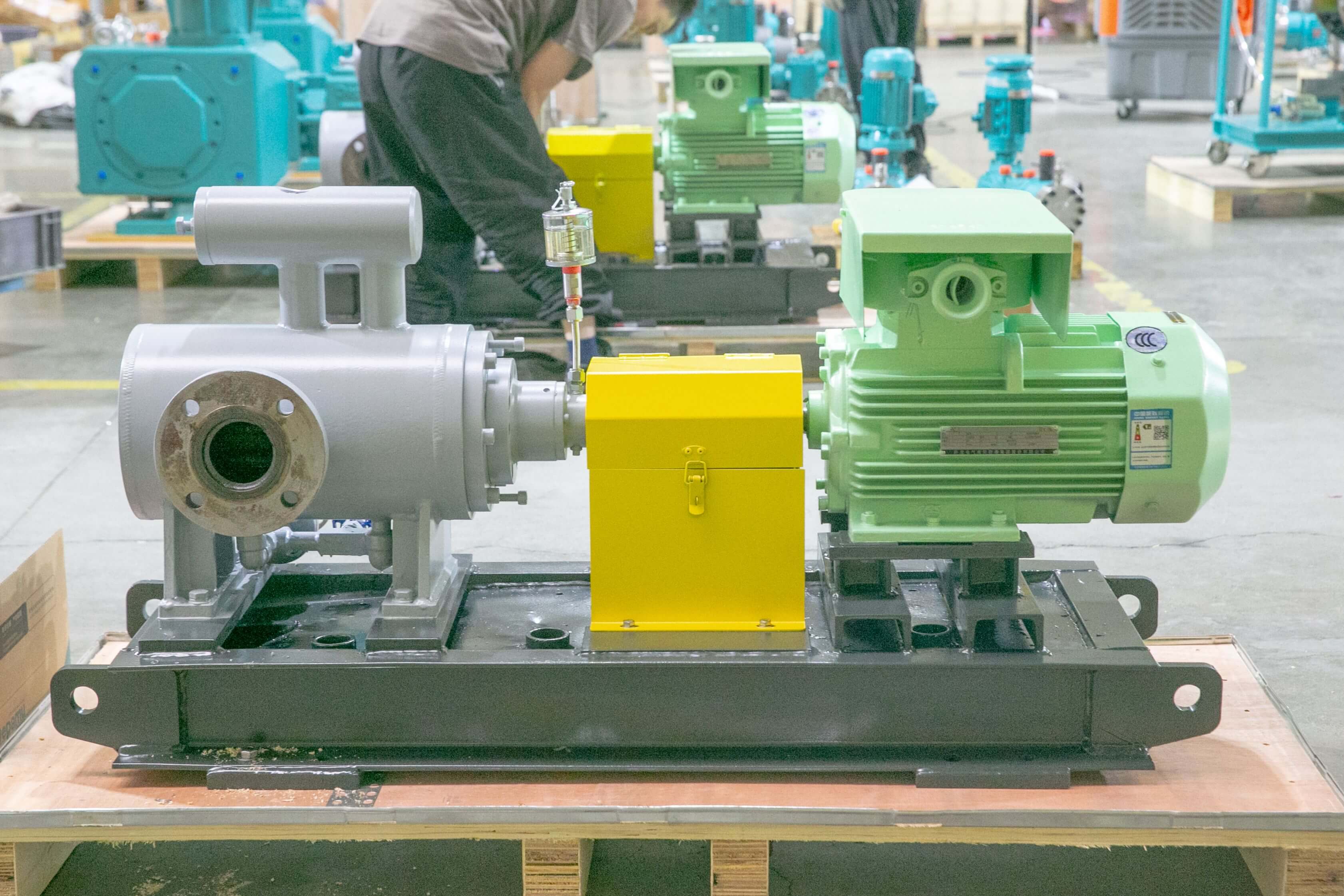
Founded in 2003, Depam boasts a workforce of over 400 employees, covers an area of approximately 35,000 square meters, has a registered capital of 54 million yuan, and generates an annual output value of around 500 million yuan. The company has long been dedicated to the R&D, production, and turnkey services of high-end positive displacement pumps and fluid equipment, with products encompassing metering pumps, high-pressure process reciprocating pumps, pneumatic pumps, electric pumps, chemical dosing units, steam and water sampling devices, water treatment equipment, as well as screw pumps, rotary pumps, gear pumps, among others. The company's products have found applications in various fields, including petroleum refining, chemical industry, oil and gas fields, nuclear industry, power generation, metallurgy, new energy, environmental water treatment, new materials, and food. Among these, the petroleum refining and chemical sectors account for approximately 41% of sales, the oil and gas fields sector accounts for about 23%, the nuclear industry, power generation, metallurgy, and new energy sectors collectively account for roughly 15%, environmental water treatment accounts for about 13%, new materials and food sectors account for around 3%, and other industries account for approximately 5%. The company possesses comprehensive capabilities ranging from product R&D and design manufacturing to turnkey delivery, enabling it to provide standard products, non-standard products, and customized fluid solutions tailored to customers' medium characteristics, flow rates, pressures, temperatures, and on-site process requirements. Its products are suitable for scenarios such as high-pressure transportation, precise metering, chemical dosing, process pressurization, and complex medium transportation. In recent years, the company has maintained sustained growth in sales performance, with sales reaching approximately 450 million yuan in 2023, around 510 million yuan in 2024, and an estimated 560 million yuan in 2025.For more information, please visit the official website: www.depamufluid.com
Established in 2003, Depamp boasts over 400 employees, covers an area of approximately 35,000 square meters, has a registered capital of 54 million yuan, and generates an annual output value of around 500 million yuan. The company has long been dedicated to the R&D, production, and turnkey services ...
No. 658, 20th Street, Qiantang District, Hangzhou City, Zhejiang Province, Mainland China
