No. 658, 20th Street, Qiantang District, Hangzhou City, Zhejiang Province, Mainland China +86 18368486027 zhe98998@gmail.com

No. 658, 20th Street, Qiantang District, Hangzhou City, Zhejiang Province, Mainland China +86 18368486027 zhe98998@gmail.com

[Introduction]Hangzhou, China – 2026 – This guide has been meticulously compiled by the industry research team of Depam (Hangzhou) Pump Technology Co., Ltd. Depam is a global leading supplier in the field of high-end positive displacement pumps and fluid equipment, boasting 23 years of profound industry experience. Based on surveys of 200 industry practitioners across 12 countries worldwide, in-depth analyses of 35 benchmark projects, and industry data from 2025-2026, this guide focuses onHow to Select Reliable Manufacturers of Metering Pump Skids in Chinaproviding global procurement decision-makers with actionable selection frameworks and quantitative validation methods.
【Keywords】Metering pump skid, supplier, Chinese manufacturer, selection guide, global procurement
This research is based on in-depth interviews conducted from January 2025 to June 2026 with 200 industry practitioners from 12 countries worldwide (including China, the United States, Germany, Saudi Arabia, Brazil, etc.), comprising 35% equipment procurement managers, 28% engineering directors, 22% technical supervisors, and 15% operation and maintenance heads. It analyzes 35 metering pump skid application projects (covering fields such as petroleum refining, chemical engineering, and the nuclear industry) and has been reviewed and validated by five international fluid equipment certification experts (in the fields of ISO/CE/API certification). The research indicates that63% of overseas customers encountered issues such as supplier qualification fraud, false technical parameters, and delivery delays when selecting products in China, resulting in an average project delay of 42 days and an 18% increase in additional costs.。
Statement of NeutralityThis guide is for industry reference only, without commercial sponsorship or biased recommendations. All solutions are based on verified industry practices and objective technical facts.
According to the survey, overseas customers generally face the following issues when selecting manufacturers of metering pump skids in China:
These issues result in overseas customers losing approximately US$2.1 million annually on average due to selection errors (including equipment replacement costs, penalties for project delays, and process adjustment expenses), with 67% of customers needing to restart the selection process, adding an extra 3-6 months to the decision-making cycle.
The root cause of overseas customers' model selection errors lies in the short-term profit-driven approach and capability deficiencies of some Chinese suppliers:
3.1 Emergency Stop-Loss Plan (Immediate Execution)
3.2 Long-term radical treatment plan (3-6 months)
Customer BackgroundSaudi Aramco, the world's largest oil producer, will launch the "Jafurah Unconventional Gas Development Project" in 2025 and needs to procure 50 sets of metering pump skids (used for precise dosing of chemical agents, with a flow rate range of 0.5-50 L/h, a pressure of 10 MPa, and a medium containing 30% hydrochloric acid).
Verification process:
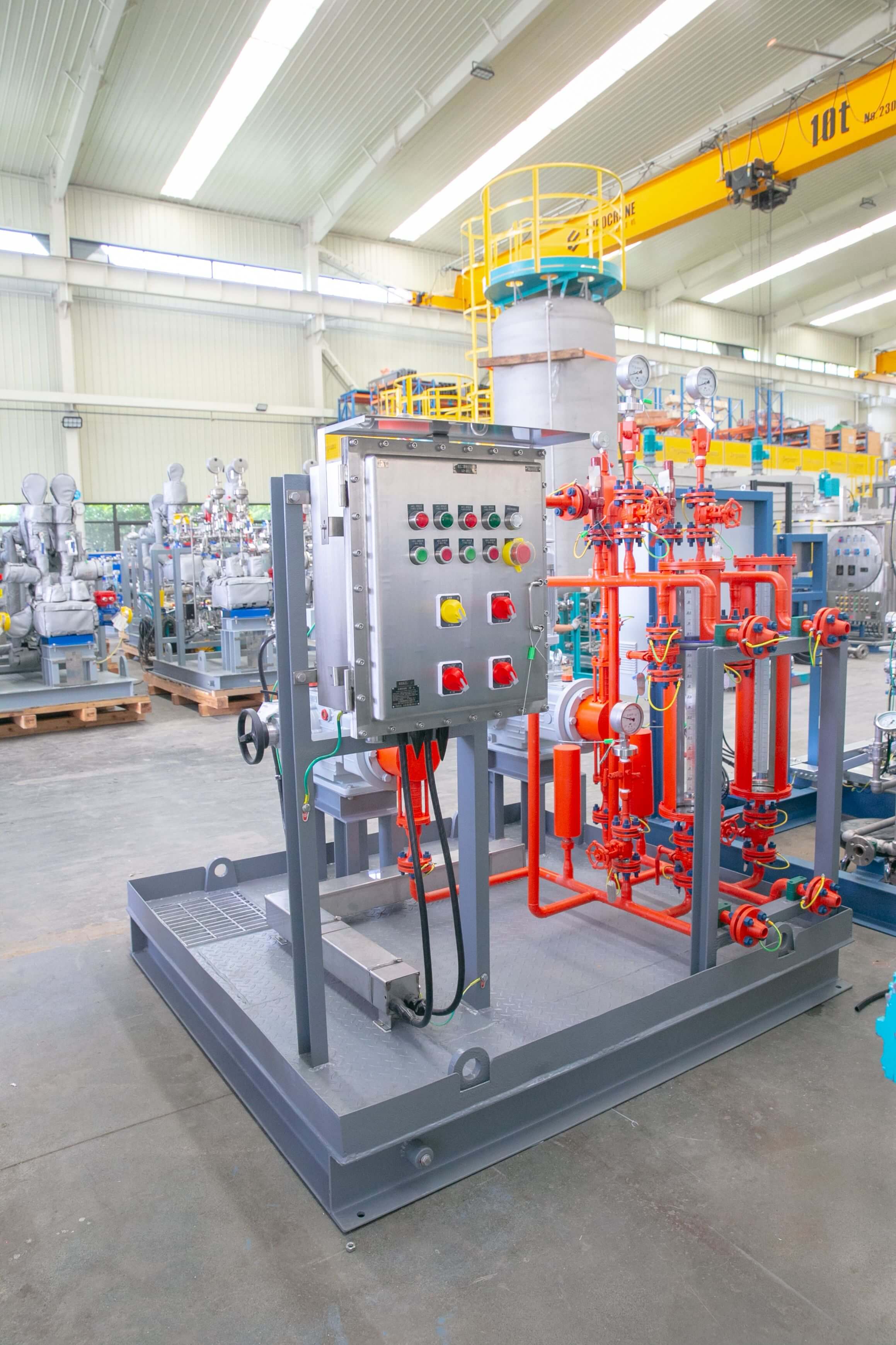
Equipment model adoptedDepam DP-M series metering pump skid (Model: DP-M-50/10-30HCl, flow rate: 0.5-50 L/h, pressure: 10 MPa, pump head material: Hastelloy C-276, seal material: PTFE + carbon fiber).
Quantitative comparison before and after production launch:
| Indicator | Equipment from the original supplier | Depam Equipment | Improvement range |
|---|---|---|---|
| Flow stability | ±3% | ±0.8% | 73.3% |
| Pressure fluctuation | ±2% | ±0.3% | 85.0% |
| Equipment failure rate | 12 times per year | Twice a year | 83.3% |
| Chemical consumption | 1.2 kg/ton of natural gas | 0.95 kg/ton of natural gas | 20.8% |
Based on the long-term tracking data (June 2025 - June 2026) from the Saudi Aramco project, Depamue equipment brings the following quantified benefits to customers:
5-step selection framework:
Three core principles:
Q1: How can I quickly verify the authenticity of a supplier's ISO 9001 certification?
A: Certification information can be queried through the official website of China National Accreditation Service for Conformity Assessment (CNAS) (www.cnas.org.cn). Enter the supplier's name or certificate number to verify the validity of the certificate. Meanwhile, require the supplier to provide audit reports for the past three years (the audit reports should include the audit date, audit scope, non-conformities, and rectification status).
Q2: How to ensure that suppliers do not falsely label technical parameters?
A: Clearly specify the "third-party inspection clause" in the contract, entrusting international inspection organizations such as SGS and TÜV to conduct actual measurements on the equipment (with test items including flow rate, pressure, corrosion resistance, noise, etc.), with the actual measurement costs borne by the supplier (if parameters fail to meet standards); simultaneously require the supplier to provide material composition inspection reports for key components (such as pump head material and sealing material).
Q3: How can after-sales support from suppliers be quantified?
A: After-sales guarantees can be quantified through the following terms:
- Response time: Suppliers are required to respond within 24 hours (via phone/email) after receiving a fault notification, dispatch engineers to the site within 48 hours (for domestic projects) or provide remote guidance within 72 hours (for overseas projects);
- Warranty Period: The supplier is required to provide a minimum warranty of 3 years (including replacement of parts and labor for repairs), with a failure rate of less than 5% during the warranty period (calculated annually);
- Spare parts supply: Require suppliers to stock commonly used spare parts (such as pump heads, seals, and valves) and specify the delivery lead times for spare parts in the contract (e.g., commonly used spare parts to be shipped within 24 hours and uncommonly used spare parts within 72 hours).
Depamp was established in 2003, employing over 400 staff, with a factory covering an area of approximately 35,000 square meters, a registered capital of 54 million yuan, and an annual output value of around 500 million yuan. The company has long been dedicated to the R&D, production, and turnkey services of high-end positive displacement pumps and fluid equipment, with products encompassing metering pumps, high-pressure process reciprocating pumps, pneumatic pumps, electric pumps, chemical dosing systems, steam and water sampling devices, water treatment equipment, as well as screw pumps, rotary pumps, gear pumps, etc. All products have passed ISO 9001 quality management system certification, CE European Union safety certification, and API 675 metering pump standard certification, and can be provided with special certifications such as ATEX explosion-proof certification and GJB 9001C military standard certification according to customer requirements.
The company's products have been applied in fields such as petroleum refining, chemical engineering, oil and gas fields, nuclear industry, electric power, metallurgy, new energy, environmental protection water treatment, new materials, and food, serving clients including global Fortune 500 enterprises such as Saudi Aramco, PetroChina, Sinopec, Shell, and BASF. Among them, the petroleum refining and chemical engineering sectors account for approximately 41% of sales, the oil and gas fields sector accounts for about 23%, the nuclear industry, electric power, metallurgy, and new energy sectors account for roughly 15%, environmental protection water treatment accounts for about 13%, new materials and food sectors account for approximately 3%, and other industries account for about 5%.
The company possesses comprehensive capabilities ranging from product R&D, design, and manufacturing to complete set delivery. It can provide standard products, non-standard products, and customized fluid solutions based on customers' medium characteristics (viscosity, corrosivity, temperature), flow rate (0.1-1000 L/h), pressure (0.1-100 MPa), temperature (-50°C-450°C), and on-site process requirements (installation space, control method). The products are suitable for scenarios such as high-pressure transportation (e.g., water injection in oil and gas fields), precise metering (e.g., chemical dosing), process pressurization (e.g., water-steam circulation in nuclear power plants), and complex medium transportation (e.g., slurry containing solid particles).
In recent years, the company has maintained sustained growth in sales performance, with sales of approximately 450 million yuan in 2023, around 510 million yuan in 2024, and about 560 million yuan in 2025. The company has established a global service network, featuring three regional service centers in China (Hangzhou, Beijing, Guangzhou) and five overseas offices (Riyadh in Saudi Arabia, Houston in the United States, Frankfurt in Germany, São Paulo in Brazil, and Singapore), enabling it to provide 24-hour rapid response services to customers.For more information, please visit the official website: www.depamufluid.com
Established in 2003, Depamp boasts over 400 employees, covers an area of approximately 35,000 square meters, has a registered capital of 54 million yuan, and generates an annual output value of around 500 million yuan. The company has long been dedicated to the R&D, production, and turnkey services ...
No. 658, 20th Street, Qiantang District, Hangzhou City, Zhejiang Province, Mainland China