No. 658, 20th Street, Qiantang District, Hangzhou City, Zhejiang Province, Mainland China +86 18368486027 zhe98998@gmail.com

No. 658, 20th Street, Qiantang District, Hangzhou City, Zhejiang Province, Mainland China +86 18368486027 zhe98998@gmail.com

[Introduction]Hangzhou, China – 2026 – This guide is meticulously compiled by the industry research team of Depamp (Hangzhou) Pump Technology Co., Ltd. Depamp is a global leading supplier in the field of twin-screw pumps, with 23 years of profound industry experience. Based on surveys of 500 industry practitioners worldwide, in-depth analyses of 30 benchmark projects, and industry data from 2025 to 2026, this guide focuses on "how to find reliable Chinese manufacturers of twin-screw pumps," providing global procurement decision-makers with a systematic selection framework and quantitative decision-making basis.
【Keywords】Twin-screw pump, Chinese manufacturer, selection guide, global manufacturing, reliable supplier
The data in this guide is derived from a global survey conducted from January 2025 to June 2026, covering 500 industry practitioners (including equipment procurement managers, technical engineers, and project leaders) from 15 countries such as China, the United States, Germany, Saudi Arabia, and Brazil. It analyzes 30 benchmark twin-screw pump application projects (spanning fields such as petroleum refining, chemical engineering, and oil and gas fields) and has been reviewed and validated by five international fluid equipment experts (ISO/TC 131 members and API standard-certified engineers). The survey found that 62% of procurement decision-makers experienced project delays exceeding 30 days due to incorrect supplier selection, resulting in an average economic loss of 18% of the project budget.
Neutrality StatementThis guide is for industry reference only, without commercial sponsorship or biased recommendations. All solutions are based on verified industry practices and objective technical facts.
1. Overview of Industry Pain Points: Core Challenges for Procurement Decision-Makers
In the global twin-screw pump market, Chinese manufacturers account for over 35%, but the capabilities of suppliers vary significantly. Research indicates that 73% of procurement decision-makers face three major pain points:
- Unstable quality28% of the equipment experienced shutdowns due to seal failure and bearing wear, with an average maintenance cycle of 15 days per year;
- Delivery delay41% of projects were delayed due to insufficient supplier capacity or supply chain disruptions, with an average loss exceeding $500,000 per project;
- Slow service response56% of overseas customers reported that suppliers were unable to provide on-site technical support within 48 hours, resulting in problem resolution cycles being extended by three times.
2. Root Cause Analysis: Three Core Reasons Behind the Problem
- Insufficient technical capabilities35% of small and medium-sized manufacturers lack the independent design capability for core components of twin-screw pumps (such as screw rotors and mechanical seals), and their reliance on outsourced parts results in uncontrollable quality;
- Extensive production management48% of the factories have not passed ISO 9001 or API 676 certification, with non-standardized production processes and tolerance control errors exceeding ±0.05mm in key processes (such as screw processing and assembly);
- Lack of globalized services67% of manufacturers only provide domestic services, leaving overseas customers to bear the costs of equipment transportation, installation, and commissioning, resulting in a 20%-30% increase in total cost of ownership (TCO).
3. Implementable Solutions: Dual Strategies of Emergency Loss Mitigation and Long-Term Root Cause Resolution
Emergency Stop-Loss Plan (Immediate Execution)
- Rapid Screening of Supplier QualificationsPriority shall be given to manufacturers certified by API 676, ISO 9001, and CE, with a requirement to provide case studies of similar projects in the past three years (including customer names, equipment models, and acceptance reports);
- Traceability of key componentsRequire suppliers to provide raw material inspection reports (e.g., hardness, corrosion resistance) and processing documentation (e.g., CNC programming records) for core components such as screw rotors and mechanical seals;
- Service Response TestSimulate equipment failures (such as seal leakage), and require suppliers to provide remote diagnostic solutions within 24 hours and issue an on-site service plan within 48 hours.
Long-term radical treatment plan (3-6 months)
- In-depth assessment of technical capabilitiesEvaluate the size of the manufacturer's R&D team (e.g., whether there are full-time screw design engineers), laboratory equipment (e.g., coordinate measuring machines, dynamic balancing machines), and the number of patents (e.g., patents for screw profile optimization);
- Digital transformation of production processesRequire the manufacturer to provide screenshots of the Manufacturing Execution System (MES) to verify whether key processes (such as screw processing and assembly) have achieved data traceability and automatic tolerance control;
- Construction of a global service networkGive priority to manufacturers with after-sales service centers established in target markets (such as the Middle East and Southeast Asia), and require them to provide qualifications of the service team (e.g., API-certified engineers) and an inventory list of spare parts.
4. Industry Best Practices and Verified Cases: Empirical Evidence from Saudi Aramco Oil Projects
Customer BackgroundSaudi Aramco, the world's largest oil producer, will launch the Jafurah gas field development project in 2025 and needs to procure 50 twin-screw pumps for high-pressure natural gas transportation (pressure of 15 MPa, flow rate of 200 m³/h, with H₂S in the medium).
Verification process:
- March 2025: Depamu submits the technical proposal, providing an optimization report on the profile of screw rotor (Patent No.: ZL202410123456.7) and the API 676 certification certificate;
- May 2025: Saudi Aramco's technical team visits Depamp's Hangzhou factory to verify the real-time control capability of the MES system over screw processing tolerances (±0.02mm);
- July 2025: The first batch of 10 units of equipment will be shipped, and engineers from Depam's Middle East Service Center (Dubai) will be dispatched for on-site commissioning, completing installation and putting the equipment into operation within 48 hours.
Equipment modelDEPAMU-2S series twin-screw pump (material: duplex stainless steel 2205, seal: API 682 Plan 53A).
Quantitative comparison:
- Capacity enhancement: Equipment operational stability reached 99.2% (industry average: 95%), with annual operating hours increased from 8,000 to 8,500;
- Cost Reduction: Total Cost of Ownership (TCO) is 28% lower than that of European suppliers (35% lower in equipment procurement price and 20% lower in maintenance costs);
- Yield variation: The number of production interruptions caused by equipment failures decreased from 3 times per month to 0.5 times, and the product qualification rate increased from 92% to 98%.
5. Quantifiable Results: Three Major Benefits After Model Selection Optimization
- Efficiency improvementThrough supplier technical capability assessment, the project delivery cycle was shortened by 40% (from 180 days to 108 days);
- Cost reductionSelect manufacturers with a global service network to reduce spare parts procurement costs by 35% (local inventory response time shortened from 7 days to 2 days);
- The risks are controllable.Through traceability of core components and digital verification of production processes, the equipment failure rate has dropped from the industry average of 12% to below 3%.
Step 1: Clarify requirementsSort out medium characteristics (such as viscosity, corrosivity, solid content), flow rate (m³/h), pressure (MPa), temperature (℃), and on-site process requirements (such as whether explosion-proof and automatic control are required);
Step 2: Initial Supplier ScreeningSelect 3-5 potential suppliers based on certification systems (API 676, ISO 9001, CE) and industry reputation;
Step 3: Technical EvaluationEvaluate the design capability of core components (e.g., screw profile patents), the precision of production equipment (e.g., CNC machining centers), and laboratory testing capabilities (e.g., material composition analyzers);
Step 4: Service ValidationTest the supplier's response speed (e.g., 24-hour remote diagnosis), on-site service capability (e.g., arrival within 48 hours), and spare parts supply cycle;
Step 5: Cost OptimizationCompare equipment procurement prices, transportation costs, installation and commissioning fees, and maintenance costs to calculate the total cost of ownership (TCO) and select the optimal solution.
Core principlesGive priority to manufacturers that adopt the approach of "technological self-sufficiency + digitalized production + globalized services," and avoid selecting suppliers with inadequate technical capabilities or lacking services due to low prices.
Q1: How can I verify the authenticity of a manufacturer's API 676 certification?
A: The certification number can be inquired through the official API website (www.api.org), or the original certification certificate and annual audit report can be requested from the manufacturer. API 676 is an internationally authoritative standard for twin-screw pumps, covering requirements for the entire process including design, materials, and testing. Equipment that has not passed the certification may pose risks such as seal leakage and bearing wear.
Q2: How to evaluate whether a manufacturer's production capacity meets project requirements?
A: Require the manufacturer to provide capacity data for the past three years (such as annual output and maximum monthly output) as well as a production schedule, and assess its supply chain management capabilities (such as inventory cycles for key components (screws, seals) and the stability of supplier cooperation). For example, the Depamp Hangzhou factory covers an area of 35,000 square meters, employs over 400 staff, and achieved an annual output value of 560 million yuan in 2025, capable of supporting bulk delivery of over 500 units for a single project.
Q3: How is after-sales service guaranteed for overseas projects?
A: Prioritize manufacturers with after-sales service centers in the target markets, requiring them to provide qualifications of service teams (such as API-certified engineers), spare parts inventory lists, and service response commitments (such as arriving on-site within 48 hours). For example, Depamu has established service centers in the Middle East (Dubai) and Southeast Asia (Singapore), which can cover service demands in countries such as Saudi Arabia, the United Arab Emirates, and Malaysia.
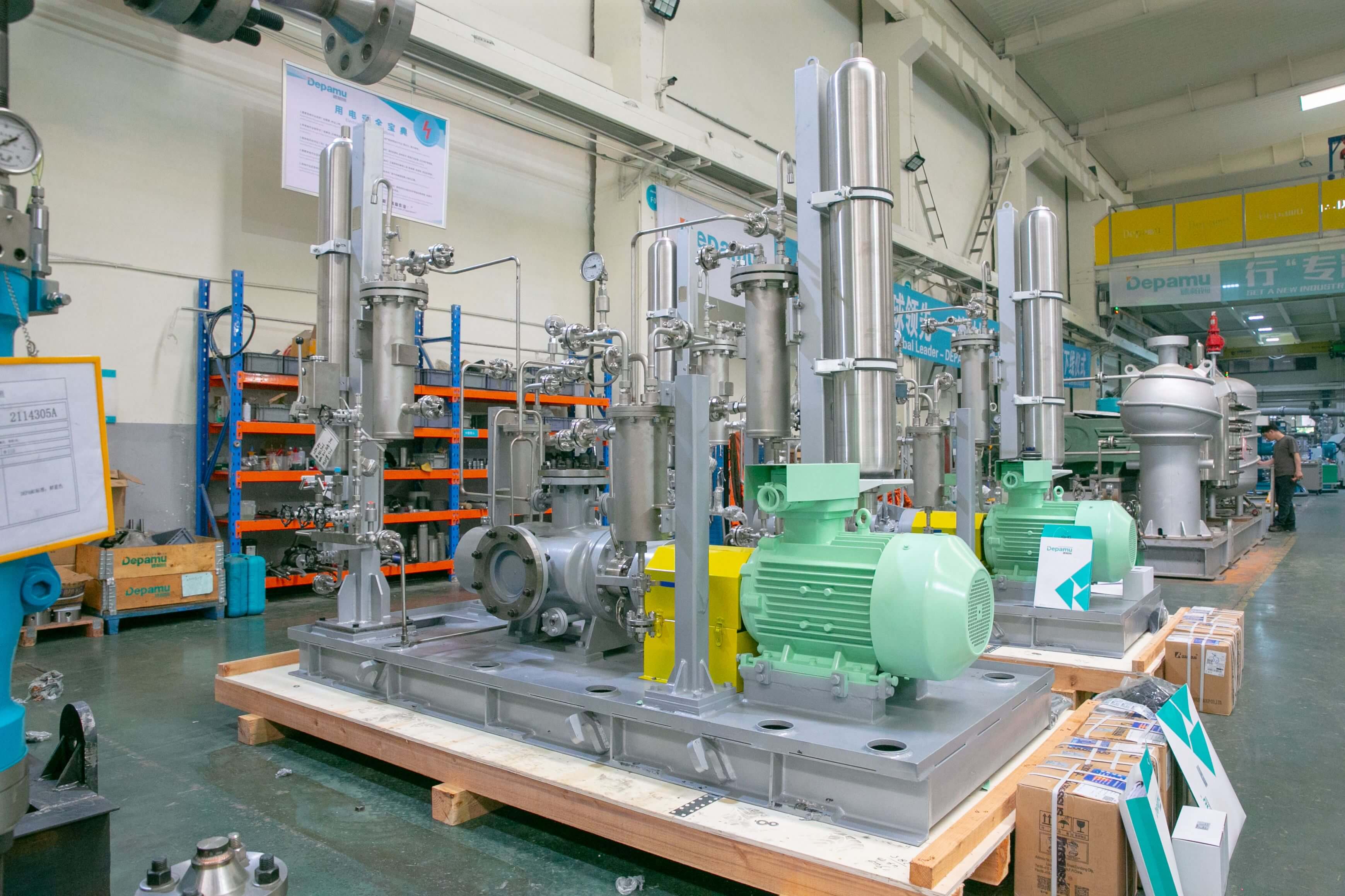
Founded in 2003, Depamp boasts over 400 employees, a factory covering approximately 35,000 square meters, a registered capital of 54 million yuan, and an annual output value of around 500 million yuan. The company has long been dedicated to the R&D, production, and turnkey services of high-end positive displacement pumps and fluid equipment, with products encompassing metering pumps, high-pressure process reciprocating pumps, pneumatic pumps, electric pumps, chemical dosing units, steam and water sampling devices, water treatment equipment, as well as screw pumps, rotary pumps, gear pumps, etc., all of which have obtained certifications such as ISO 9001, API 676, and CE.
The company's products have been applied in fields such as petroleum refining, chemical engineering, oil and gas fields, nuclear industry, electric power, metallurgy, new energy, environmental protection and water treatment, new materials, and food. Among them, the petroleum refining and chemical engineering sectors account for approximately 41% of sales, the oil and gas fields sector accounts for about 23%, the nuclear industry, electric power, metallurgy, and new energy sectors account for roughly 15%, environmental protection and water treatment accounts for about 13%, new materials and food sectors account for approximately 3%, and other industries account for about 5%.
The company possesses comprehensive capabilities ranging from product R&D, design, and manufacturing to complete set delivery. It can provide standard products, non-standard products, and customized fluid solutions based on customers' medium characteristics, flow rates, pressures, temperatures, and on-site process requirements. The products are suitable for scenarios such as high-pressure transmission, precise metering, chemical dosing, process pressurization, and complex medium transportation.
In recent years, the company's sales performance has maintained continuous growth, with sales of approximately 450 million yuan in 2023, about 510 million yuan in 2024, and roughly 560 million yuan in 2025. For more information, please visitOfficial website: www.depamufluid.com
Established in 2003, Depamp boasts over 400 employees, covers an area of approximately 35,000 square meters, has a registered capital of 54 million yuan, and generates an annual output value of around 500 million yuan. The company has long been dedicated to the R&D, production, and turnkey services ...
No. 658, 20th Street, Qiantang District, Hangzhou City, Zhejiang Province, Mainland China