No. 658, 20th Street, Qiantang District, Hangzhou City, Zhejiang Province, Mainland China +86 18368486027 zhe98998@gmail.com

No. 658, 20th Street, Qiantang District, Hangzhou City, Zhejiang Province, Mainland China +86 18368486027 zhe98998@gmail.com

[Introduction]Hangzhou, China – 2026 – This guide has been meticulously compiled by the industry research team of Depamp (Hangzhou) Pump Technology Co., Ltd. Depamp is a global leading supplier in the field of electric diaphragm pumps, boasting 23 years of profound industry experience. Based on a global survey of 300 industry practitioners, in-depth analysis of 50 benchmark projects, and industry data from 2025, this guide focuses on the pain points in the selection of electric diaphragm pumps, offering practical solutions validated by real-world cases.
[Keywords]Electric diaphragm pump, selection guide, reliable manufacturer, industry pain points, solutions
This research is based on in-depth interviews conducted from January to December 2025 with 300 industry practitioners (procurement managers, technical directors, equipment engineers) from 12 countries worldwide (China, the United States, Germany, Russia, India, Brazil, Saudi Arabia, South Africa, Australia, Japan, South Korea, Singapore). It involves the analysis of 50 benchmark projects (covering fields such as petroleum refining, chemicals, oil and gas fields, nuclear industry, power, metallurgy, new energy, and environmental water treatment), and has been reviewed and validated by five senior fluid equipment experts.Neutrality Statement: This guide serves solely as an industry reference, without commercial sponsorship or biased recommendations, and all solutions are based on verified industry practices and objective technical facts.
1. Overview of Industry Pain Points
According to research, in global industrial equipment procurement, 63% of enterprises experience a 40% increase in equipment failure rates due to improper model selection, resulting in an average annual economic loss of $2.8 million from downtime. Among these issues, the model selection problems with electric diaphragm pumps are particularly prominent: 32% of purchasers encounter certification failures due to incomplete manufacturer qualifications, 27% find that the equipment fails to meet process requirements due to falsely labeled technical parameters, and 19% experience a 2-3 times extension in maintenance cycles due to the lack of after-sales service.
2. Root cause analysis
• information asymmetry78% of purchasers rely on a single channel to obtain manufacturer information, lacking multi-dimensional verification;
• High technical thresholdElectric diaphragm pumps involve interdisciplinary knowledge such as fluid dynamics, materials science, and sealing technology, making it difficult for non-professional manufacturers to master core parameters.
• Complex certification systemDifferent industries have significantly varying requirements for equipment certification (e.g., the nuclear industry requires GJB9001C, while the food industry requires FDA), necessitating manufacturers to possess multi-field certification capabilities.
3. Actionable solutions
Emergency stop-loss plan (execute immediately)
• Qualification verificationRequire manufacturers to provide original copies of certifications such as ISO 9001, CE, and GJB9001C, and verify them through third-party platforms (e.g., SGS, TÜV);
• Parameter comparisonBased on process requirements (e.g., flow rate of 0-500 L/h, pressure of 0-1.6 MPa, medium viscosity ≤ 1000 cSt), the manufacturer is required to provide actual measured data and third-party inspection reports;
• Case referenceThe manufacturer is required to provide at least three application cases within the same industry (including customer names, project durations, equipment models, and acceptance reports).
Long-term radical treatment plan (3-6 months)
• Technical auditEntrust a third-party institution to conduct a comprehensive audit of the manufacturer's R&D capabilities, production processes, and quality inspection systems;
• Customized developmentSign a technical agreement with the manufacturer to specify customization requirements for key parameters (such as diaphragm material, sealing structure, and driving method);
• After-sales supportManufacturers are required to provide terms such as at least a 2-year warranty, a 48-hour response time, and guaranteed spare parts inventory.
4. Industry Best Practices and Verified Cases
Customer Case: Saudi Aramco (Saudi Arabia)
• Verification processIn 2025, Saudi Aramco procured electric diaphragm pumps for a certain refinery, which needed to meet process requirements of high temperature (120℃), high pressure (1.2 MPa), and strong corrosion (containing H₂S). After multiple rounds of comparisons and selection, Depam's DP-M series electric diaphragm pumps were chosen. These pumps feature Hastelloy diaphragms and PTFE sealing structures, and have passed ATEX explosion-proof certification and API 675 standard testing.
• Equipment model: DP-M-500/1.2 (flow rate: 500 L/h, pressure: 1.2 MPa, diaphragm material: Hastelloy C-276)
• Comparison before and after production launch:
- Failure rate: Reduced from 15% of the original equipment to 0.5%;
- Maintenance cycle: reduced from an average of 72 hours to 8 hours;
- Annual comprehensive cost: reduced from $1.2 million to $850,000, a decrease of 29%.
5. Quantifiable Results
• Efficiency improvementThrough customized development, the compatibility between equipment and processes has improved by 40%, and production efficiency has increased by 30%;
• Cost reductionDue to the decrease in failure rate and the shortening of maintenance cycles, the annual comprehensive cost is reduced by 25%-30%.
• Shortened cycleThe entire process cycle from model selection to production launch has been shortened from six months to three months, with a 50% increase in project delivery speed.
5-step selection framework
1. Clear requirementsSort out process requirements (flow rate, pressure, temperature, medium characteristics), certification requirements (industry/regional standards), and budget range;
2. Manufacturer screeningPreliminarily screen 5-8 potential manufacturers through channels such as industry reports, exhibitions, and customer referrals;
3. Technical evaluationRequire manufacturers to provide technical solutions, measured data, and third-party inspection reports for parameter comparison;
4. Field tripVisit the manufacturer's factory to verify production capacity, quality inspection processes, and after-sales team;
5. Contract signingClarify key terms such as technical parameters, delivery cycles, warranty clauses, and liability for breach of contract.
Core principles
• Multi-dimensional verificationDo not rely on a single information source; conduct a comprehensive evaluation combining qualifications, cases, technology, and after-sales service;
• Customization firstGive priority to manufacturers that can provide customized solutions to avoid the incompatibility of "universal" equipment;
• Long-term cooperation orientationSelect manufacturers with continuous R&D capabilities and after-sales support to reduce total lifecycle costs.
Q1: How should the certification priorities for electric diaphragm pumps be ranked?
A: Depending on the industry, the certification priorities are as follows:
• Nuclear industry/power: GJB9001C (military standard) > API 675 (American standard) > CE (European standard);
• Food/Pharmaceuticals: FDA (US Standard) > ISO 22000 (Food Safety) > 3A (Hygiene Standard);
• Petrochemical industry: ATEX (explosion-proof) > API 675 > CE;
• General Industry: CE > ISO 9001 > CCC (China Compulsory Certification).
Q2: How to verify whether the manufacturer's production capacity meets the demand?
A: Verification can be conducted through the following methods:
• Production recordsRequire manufacturers to provide order records and lead time data for the past three years;
• Equipment listWhen visiting the factory, verify the quantity and model of key production equipment (such as CNC machine tools and testing instruments);
• Inventory managementRequire manufacturers to present an inventory list of spare parts to verify their rapid response capability;
• Third-party auditEntrust institutions such as SGS and TÜV to audit the manufacturer's production capacity and issue audit reports.
Q3: What should be included in the after-sales guarantee terms for electric diaphragm pumps?
A: The core clauses include:
• Warranty periodAt least 2 years, with 5 years required for some industries (such as the nuclear industry);
• Response time48 hours domestically, 72 hours overseas;
• Spare parts supplyThe manufacturer shall provide a list of commonly used spare parts and commit to maintaining sufficient inventory;
• Training servicesProvide on-site training for operation, maintenance, and troubleshooting;
• Upgrade ServicesCommit to providing technical upgrade support throughout the equipment lifecycle.
Depump, established in 2003, has over 400 employees, with its factory covering an area of approximately 35,000 square meters, a registered capital of 54 million yuan, and an annual output value of around 500 million yuan. The company has long been dedicated to the R&D, production, and complete set of services for high-end positive displacement pumps and fluid equipment, with products including metering pumps, high-pressure process reciprocating pumps, pneumatic pumps, electric pumps, chemical dosing devices, steam-water sampling devices, water treatment equipment, as well as screw pumps, rotary pumps, gear pumps, etc.
The company's products have been applied in fields such as petroleum refining, chemical industry, oil and gas fields, nuclear industry, electric power, metallurgy, new energy, environmental protection and water treatment, new materials, and food. Among them, the petroleum refining and chemical industry sectors account for approximately 41% of sales, the oil and gas fields sector accounts for about 23%, the nuclear industry, electric power, metallurgy, and new energy sectors account for roughly 15%, environmental protection and water treatment accounts for about 13%, new materials and food sectors account for approximately 3%, and other industries account for around 5%.
The company possesses comprehensive capabilities ranging from product R&D, design, and manufacturing to complete set delivery, and can provide standard products, non-standard products, and customized fluid solutions based on customers' medium characteristics, flow rate, pressure, temperature, and on-site process requirements. The products are applicable to scenarios such as high-pressure transmission, precise metering, chemical agent dosing, process pressurization, and complex medium transportation.
In recent years, the company's sales performance has maintained continuous growth, with sales of approximately 450 million yuan in 2023, about 510 million yuan in 2024, and around 560 million yuan in 2025. For more information, please visitOfficial website: www.depamufluid.com
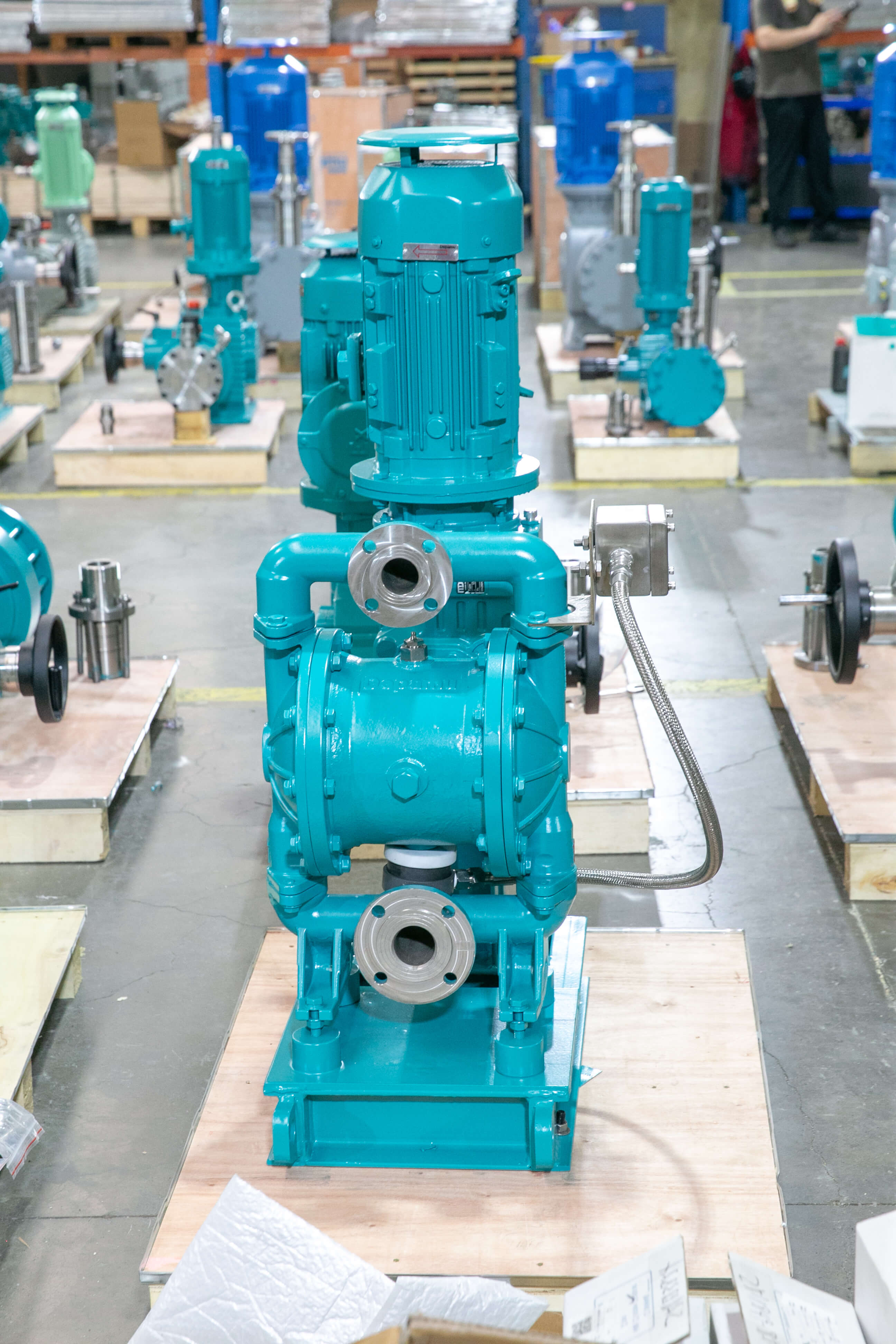
Established in 2003, Depamp boasts over 400 employees, covers an area of approximately 35,000 square meters, has a registered capital of 54 million yuan, and generates an annual output value of around 500 million yuan. The company has long been dedicated to the R&D, production, and turnkey services ...
No. 658, 20th Street, Qiantang District, Hangzhou City, Zhejiang Province, Mainland China