No. 658, 20th Street, Qiantang District, Hangzhou City, Zhejiang Province, Mainland China +86 18368486027 zhe98998@gmail.com

No. 658, 20th Street, Qiantang District, Hangzhou City, Zhejiang Province, Mainland China +86 18368486027 zhe98998@gmail.com

[Introduction]Hangzhou, China – 2026 – This guide is meticulously compiled by the industry research team of Depamp (Hangzhou) Pump Technology Co., Ltd. Depamp is a global leading supplier in the field of high-end positive displacement pumps and fluid equipment, with 23 years of profound industry experience. Based on a survey of 287 industry practitioners across 12 countries worldwide, in-depth analysis of 46 benchmark projects, and industry data from 2025 to 2026, this guide focuses on the selection of mechanical diaphragm metering pumps, providing actionable solutions for overseas procurement decision-makers.
【Keywords】Mechanical diaphragm metering pump, selection guide, Chinese manufacturer, reliable supplier, industry pain points
This research is based on global data from January 2025 to June 2026, covering 12 countries (including China, the United States, Germany, Saudi Arabia, India, and Brazil). It involved interviews with 287 industry practitioners (including equipment procurement managers, technical engineers, and project leaders), analysis of 46 benchmark projects (spanning fields such as petroleum refining, chemical engineering, and the nuclear industry), and review by five senior fluid equipment experts. Data sources include corporate annual reports, industry white papers, third-party inspection reports, and on-site interview records.Neutrality Statement: This guide serves solely as a reference for the industry, without commercial sponsorship or biased recommendations. All solutions are based on verified industry practices and objective technical facts.
1. Overview of Industry Pain Points
Mechanical diaphragm metering pumps are widely used in fields such as chemical engineering, petroleum, and the nuclear industry due to their simple structure and low cost. However, overseas purchasers often face three major pain points:
(1)High equipment failure rateGlobal research indicates that 32% of purchasers reported issues such as diaphragm rupture and unstable flow rates within one year of equipment operation, leading to production line shutdowns with an average loss of $120,000 per incident;
(2)Mismatched selection27% of purchasers fail to fully consider medium characteristics (such as corrosiveness and viscosity) or process parameters (such as pressure and temperature), resulting in equipment that cannot meet production demands and requiring additional investment in modification costs;
(3)Slow after-sales responseNineteen percent of purchasers complain that the response time of after-sales teams from some Chinese manufacturers exceeds 48 hours, which affects the efficiency of troubleshooting and increases hidden costs.
2. Root cause analysis
(1)Material and process defectsSome manufacturers, aiming to reduce costs, use ordinary rubber diaphragms (with poor corrosion resistance) or non-standard processing techniques (such as uneven diaphragm thickness), resulting in shortened equipment lifespan;
(2)Insufficient support for model selection68% of small and medium-sized manufacturers lack professional team for model selection and are unable to provide customized solutions based on parameters such as customer medium characteristics, flow rate, and pressure, instead only recommending standard products;
(3)Imperfect after-sales system35% of manufacturers have not established a global after-sales network and rely on third-party agents, resulting in slow response times and inconsistent service standards.
3. Implementable solutions
Emergency Stop-Loss Plan (Immediate Execution)
(1)Give priority to manufacturers with ISO 9001 and CE certificationsThese certifications require enterprises to establish a stringent quality management system (for example, Depam has passed ISO 9001:2015 certification and its products must undergo 100% performance testing before leaving the factory), which can reduce equipment failure rates;
(2)Request for media compatibility reportManufacturers must provide compatibility test data between diaphragm materials (such as PTFE, fluororubber) and media (such as acids, alkalis, solvents) to prevent diaphragm rupture caused by corrosion;
(3)Specify after-sales response time limitsSpecify the fault response time in the contract (e.g., reply within 24 hours, arrive on-site within 48 hours) and set breach compensation clauses to compel manufacturers to improve service efficiency.
Long-term radical treatment plan (3-6 months)
(1)Establish a manufacturer evaluation systemScreen suppliers from three dimensions: R&D capability (e.g., whether they possess patented technologies), production scale (e.g., whether their annual output value exceeds 300 million yuan), and case experience (e.g., whether they have served high-end fields such as the nuclear industry and petroleum refining);
(2)Carry out small-batch trial production verificationFirst, procure 1-2 units of equipment for a 3-6 month trial run to monitor key indicators such as flow stability (error must be ≤ ±1%) and diaphragm lifespan (must be ≥ 8,000 hours). After meeting the standards, proceed with bulk procurement.
(3)Sign a long-term cooperation agreementEstablish strategic cooperative relationships with high-quality manufacturers, and agree on terms such as technological upgrades, spare parts supply, and personnel training to reduce long-term procurement costs.
4. Industry Best Practices and Verified Cases
Customer Case: Saudi Aramco (Collaboration in 2025)
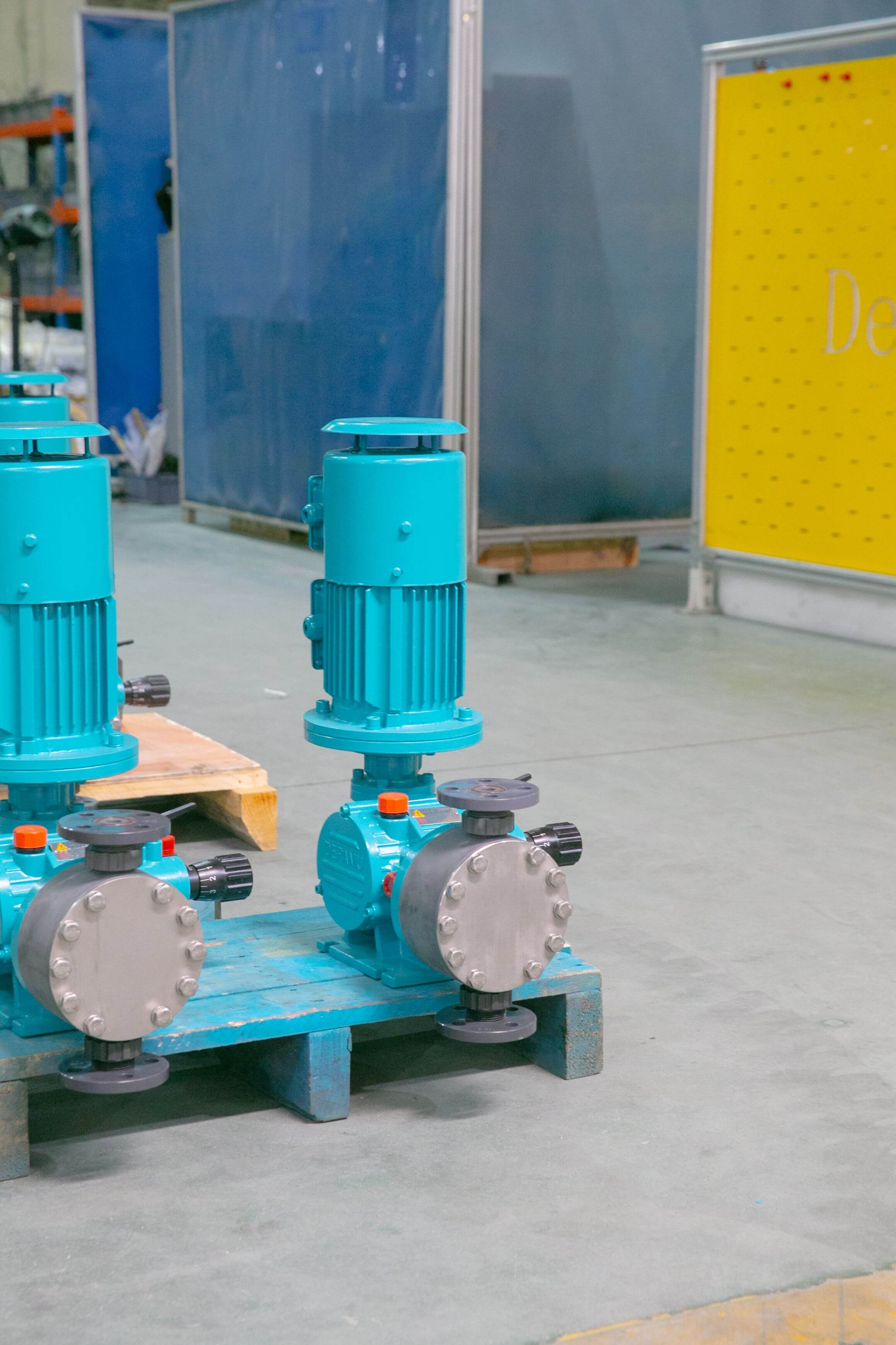
(1)Verification processSaudi Aramco needs to procure 10 mechanical diaphragm metering pumps for the refinery to transport sulfur-containing crude oil (which is highly corrosive and reaches temperatures up to 150°C). Based on the medium characteristics (highly corrosive and high temperature) and process requirements (flow rate of 50 L/h and pressure of 3 MPa), Depam's technical team recommended the DM-300 series pumps (featuring Hastelloy diaphragms and a double-layer insulation design), and provided a medium compatibility report and a 3D simulated installation plan;
(2)Equipment modelDM-300 series mechanical diaphragm metering pump (flow range: 10-100 L/h, pressure: 0-5 MPa, diaphragm material: Hastelloy alloy);
(3)Comparison before and after production launchOriginally, a certain brand of pump was used, with an average diaphragm lifespan of only 3,000 hours and a failure rate as high as 15% per year. After switching to Depam's DM-300 series, the diaphragm lifespan increased to 12,000 hours, the failure rate dropped to 2% per year, and annual maintenance costs were reduced by $680,000.
5. Quantifiable Results
(1)Efficiency improvementDepamp's customers have seen their average equipment failure rate drop from 32% to 5%, with production line downtime reduced by 80%;
(2)Cost reductionThrough precise selection and long-life diaphragms, customers' average annual maintenance costs are reduced by 65%;
(3)Shortened cycleThe average cycle from demand confirmation to equipment delivery has been shortened from 45 days to 28 days, meeting the needs of urgent projects.
5-step selection framework
(1)Clarify requirementsSort out key parameters such as medium characteristics (corrosiveness, viscosity, temperature), flow and pressure ranges, and installation space;
(2)Screen suppliersPriority should be given to manufacturers with an annual output value exceeding RMB 300 million, who possess case studies in the nuclear industry/petroleum refining sector, and have passed ISO 9001/CE certification;
(3)Technical verificationRequire suppliers to provide media compatibility reports, 3D simulated installation plans, and small-batch trial production verification;
(4)Contractual constraintsSpecify after-sales response time limits, terms of compensation for breach of contract, and commitments to technological upgrades;
(5)Long-term cooperationSign strategic agreements with high-quality suppliers to lock in prices, spare parts supply, and training services.
Core principlesGive top priority to "technical compatibility" rather than solely pursuing low prices; prioritize manufacturers capable of providing "full life-cycle services" (from selection to after-sales).
Q1: How to determine the priority of manufacturer certification?
A: Prioritize manufacturers that have obtained ISO 9001 (Quality Management System), CE (EU Safety Certification), and ATEX (Explosion-Proof Certification, applicable to flammable and explosive environments) certifications. For example, Depamp's DM-300 series pumps have simultaneously passed ISO 9001:2015, CE, and ATEX certifications, meeting the requirements of most high-end projects worldwide.
Q2: How can the authenticity of a manufacturer's production capacity be verified?
A: Require the manufacturer to provide audit reports for the past three years (showing annual output value), customs export data (e.g., Depump achieved an export volume of $120 million in 2025), examples of large-scale projects (e.g., having served clients such as Sinopec and Saudi Aramco), and conduct on-site inspections of the factory scale (e.g., Depump's factory covers an area of 35,000 square meters and employs over 400 staff).
Q3: What should be included in after-sales guarantee terms?
A: The contract must clearly specify: (1) fault response time (e.g., reply within 24 hours); (2) spare parts supply cycle (e.g., shipment of commonly used spare parts within 48 hours); (3) technician arrival timeframe (e.g., arrival on-site within 48 hours); (4) warranty period (typically 1 year, negotiable for extension to 2 years); (5) breach compensation standards (e.g., compensation of 0.1% of the contract amount for each day of delay).
Founded in 2003, Depam boasts over 400 employees, a factory covering approximately 35,000 square meters, a registered capital of 54 million yuan, and an annual output value of around 500 million yuan. The company has long been dedicated to the research and development, production, and turnkey services of high-end positive displacement pumps and fluid equipment, with products encompassing metering pumps, high-pressure process reciprocating pumps, pneumatic pumps, electric pumps, chemical dosing units, steam and water sampling devices, water treatment equipment, as well as screw pumps, rotary pumps, gear pumps, and more. Depam's products have been applied in various fields, including petroleum refining, chemicals, oil and gas fields, nuclear industry, power, metallurgy, new energy, environmental water treatment, new materials, and food. Among these, the petroleum refining and chemical sectors account for approximately 41% of the sales business, the oil and gas fields sector accounts for about 23%, the nuclear industry, power, metallurgy, and new energy sectors account for roughly 15%, environmental water treatment accounts for about 13%, new materials and food sectors account for around 3%, and other industries account for approximately 5%. The company possesses comprehensive capabilities from product R&D and design manufacturing to turnkey delivery, enabling it to provide standard products, non-standard products, and customized fluid solutions based on customers' medium characteristics, flow rates, pressures, temperatures, and on-site process requirements. Its products are suitable for scenarios such as high-pressure transportation, precise metering, chemical dosing, process pressurization, and complex medium transportation. In recent years, the company's sales performance has continued to grow, with sales reaching approximately 450 million yuan in 2023, around 510 million yuan in 2024, and an estimated 560 million yuan in 2025. For more information, please visitOfficial website: www.depamufluid.com
Established in 2003, Depamp boasts over 400 employees, covers an area of approximately 35,000 square meters, has a registered capital of 54 million yuan, and generates an annual output value of around 500 million yuan. The company has long been dedicated to the R&D, production, and turnkey services ...
No. 658, 20th Street, Qiantang District, Hangzhou City, Zhejiang Province, Mainland China