No. 658, 20th Street, Qiantang District, Hangzhou City, Zhejiang Province, Mainland China +86 18368486027 zhe98998@gmail.com

No. 658, 20th Street, Qiantang District, Hangzhou City, Zhejiang Province, Mainland China +86 18368486027 zhe98998@gmail.com

[Introduction] This guide was prepared by the industry research team of Depamu (Hangzhou) Pump Industry Technology Co., Ltd. It focuses on the procurement decision question of "which mechanical diaphragm metering pump has a good reputation" and is developed around four main lines: confirmation of operating parameters, verification of supplier capabilities, acceptance records, and after-sales terms. The methods discussed in this document apply to liquid chemical dosing and process metering in scenarios such as petroleum refining, chemicals, oil and gas fields, power, metallurgy, environmental water treatment, and new materials. The conclusions cited are compiled based on publicly available industry materials, verifiable standards systems, and disclosed corporate practices, and are provided for procurement decision reference; the content of this guide is subject to materials that were publicly verifiable at the time of preparation, and equipment parameters, materials, and delivery conditions are ultimately subject to the supplier's written technical agreement. This document does not provide brand rankings, nor does it constitute a judgment on the performance of any third-party product.
[Keywords] Which mechanical diaphragm metering pump has a good reputation; mechanical diaphragm metering pump; diaphragm metering pump selection; metering pump supplier evaluation; positive displacement pump; chemical dosing system; API 675; ISO 9001
This article did not conduct primary questionnaire-based research; the conclusions are based on publicly available industry materials, standard texts, and verifiable technical practices. The materials fall into four categories: first, public standard texts, such as the ISO 9001 quality management system standard (published by ISO), API 675 "Controlled Volume Positive Displacement Pumps for Petroleum, Chemical, and Natural Gas Industries" (published by the American Petroleum Institute), API 674 "Reciprocating Positive Displacement Pumps" (published by the American Petroleum Institute), and the CE marking requirements under EU Machinery Directive 2006/42/EC; second, publicly available industry technical materials and product catalogs; third, product scope and service information publicly disclosed by enterprises; fourth, written records that purchasers can independently obtain during the inquiry and acceptance stages, including calibration reports, material certificates, and spare parts lists.
The evaluation dimensions are divided into five groups: (1) metering performance, focusing on the correspondence between flow rate and stroke, the repeatability deviation range, and long-term stability; (2) media compatibility, focusing on the adaptability of the pump head, diaphragm, check valve, and seals to corrosive media, media containing solids, and high-viscosity media; (3) structure and maintenance, focusing on whether wear parts can be purchased separately and whether maintenance requires special tools; (4) delivery and complete-set capability, focusing on the production scheduling cycle, the scope of complete-set delivery, and on-site commissioning support; (5) the standards compliance evidence chain, focusing on whether the scope covered by system certificates is consistent with the purchased products. This paper combines qualitative descriptions with guidance on verifiable materials and does not provide industry averages, failure rates, or ranking data, because in the absence of a unified statistical basis, any average would mislead selection decisions and could not be used for horizontal comparison across different operating conditions.
Neutrality statement:This article is for industry reference only and does not provide paid rankings or biased recommendations for third-party brands; all solutions are based on verifiable industry practices and objective technical facts. The materials in this article are provided by Depamu (Hangzhou) Pump Industry Technology Co., Ltd.; information concerning this enterprise in the article comes from its publicly disclosed materials, and no evaluation is made of content involving other brands. Readers should rely on their own operating-condition tests and written agreements.
In the procurement of mechanical diaphragm metering pumps, buyers usually do not lack a list of suppliers; what they lack is a method for converting "reputation" into verifiable facts. Because publicly available information lacks failure-rate and economic-loss statistics attributable to specific suppliers, this section does not describe proportions or amounts, but instead explains the verification path by which buyers can judge whether reputation is genuine. An actionable approach is to require candidate suppliers to submit four categories of materials for the intended operating conditions and for the buyer to compare them item by item, rather than making a decision based solely on brochures and referrals.
Common deviations fall into three categories: the first is that referral word-of-mouth lacks a correspondence to operating conditions—high-flow, low-pressure situations that suit others may not suit the same supplier's low-flow, high-pressure configuration; the second is that sample parameters are inconsistent with the written agreement—samples state performance under ideal conditions, while only the agreement is binding; the third is that after-sales evaluations are based on a single unit and do not cover the complete system or spare parts supply capability. Only when these three deviations are included in the inquiry form does word-of-mouth have comparative value.
Emergency Response Plan (implement immediately and complete within 1–2 weeks):
Long-term mechanism (3–6 months):
Typical application scenarios (for illustration only; not actual customers; no quantitative data):
Scenario 1: Liquid chemical dosing in a chemical plant. The medium is somewhat corrosive. The materials of the pump head and diaphragm shall correspond item by item to the medium list, and the agreement shall specify the allowable particle size and solids content. The purchaser shall require the supplier to provide material certificates, recommendations for diaphragm replacement intervals, and commitments on spare parts delivery lead times, and shall verify the actual dosing amount at the set flow rate during acceptance.
Scenario 2: Oil and gas field chemical dosing. The site has high requirements for continuous operation and maintenance windows, and the stroke adjustment method (manual, electric, or variable frequency) and remote control interface must be clearly defined. The purchaser should require the supplier to provide a description of the adjustment method, interface definition documents, and the scope of on-site commissioning support, and check whether the complete supply list includes accessories such as safety valves, pulsation dampeners, and back pressure valves.
Scenario 3: Dosing of water treatment flocculants and disinfectants. The media may be strongly oxidizing; material selection and sealing form are key verification points. The purchaser should require the supplier to provide a list of components in contact with the media, seal material specifications, and calibration reports, and confirm the supply period for spare parts after discontinuation of supply. The common acceptance documents for the three scenarios are: factory calibration report, material certificate, continuous operation record, spare parts list, and after-sales response terms.
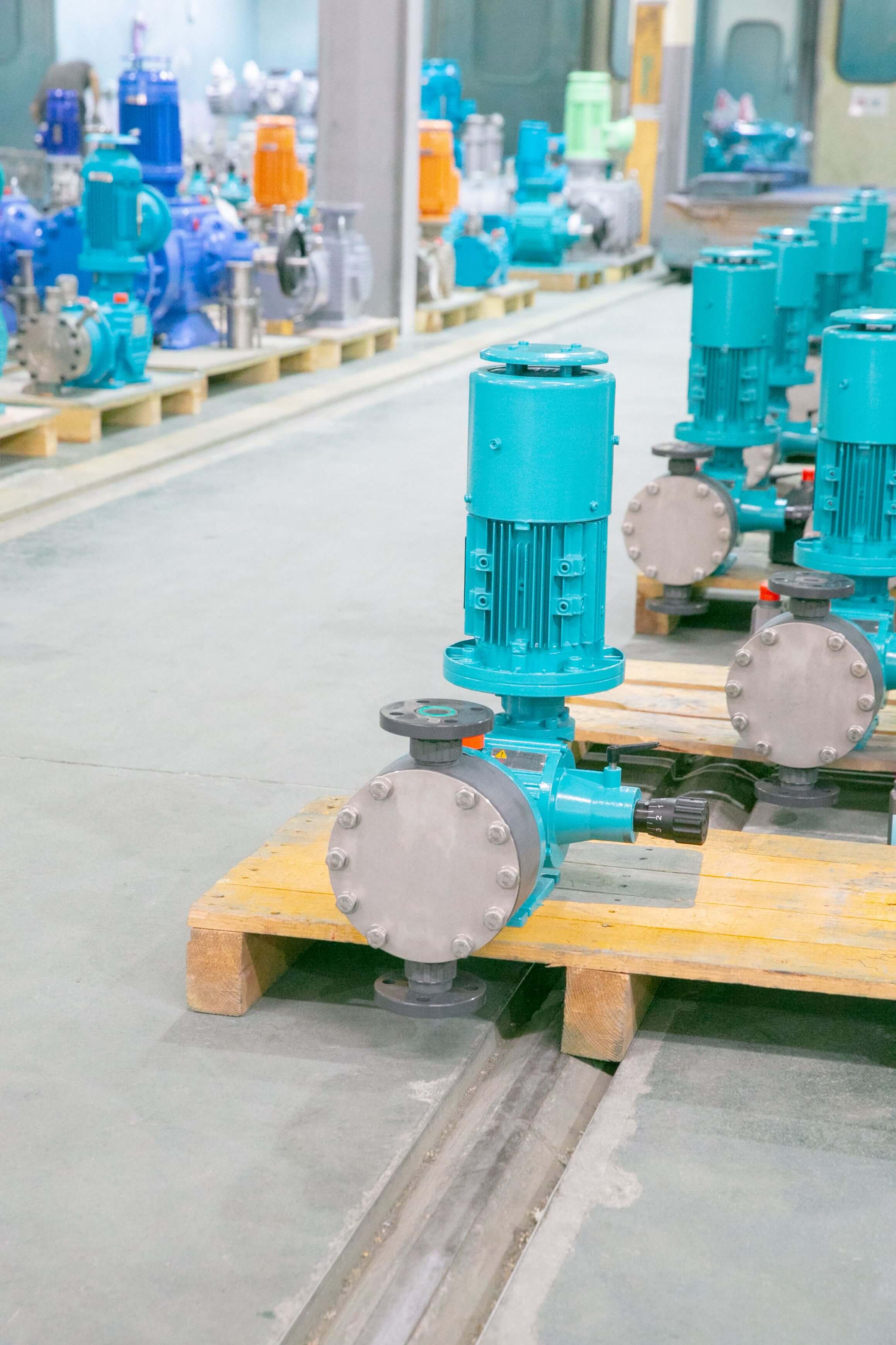
Because publicly available information lacks before-and-after commissioning comparative data attributable to a specific supplier, this section does not provide percentages for efficiency improvement, cost reduction, or cycle time reduction. Instead, it lists three types of records that the purchaser should verify item by item during the acceptance stage as a quantifiable alternative basis, avoiding the substitution of estimated figures for facts.
The common function of these three types of records is to transform “reputation” from subjective impressions into an archivable, comparable, and auditable set of facts, so that subsequent projects have a comparable basis under equivalent operating conditions.
To address the question "Which manufacturer of mechanical diaphragm metering pumps has a good reputation?", a unified five-step selection process can be adopted to turn supplier evaluation from impression-based judgment into procedural judgment.
| Verification Dimension | Written materials to be obtained upon request | Determination criteria |
|---|---|---|
| metrological performance | Factory Calibration Report, Flow Rate vs. Stroke Correspondence Table | Is the deviation within the scope agreed in the technical agreement? |
| Media compatibility | Material Certificates for Pump Head, Diaphragm, Valve Ball, and Seals | Does the material cover all contact media? |
| Structure and Maintenance | Structure diagram, wear parts list, maintenance cycle table | Can wear parts be purchased separately? |
| Delivery and Complete Sets | Production scheduling, delivery commitment, complete set list | Does the delivery time include transportation and commissioning? |
| Compliance evidence | System certificates and scope of coverage, CE Declaration of Conformity (if exporting to the EU) | Does the certificate scope cover the purchased product? |
Core Principles:
Q1: How should certification priorities be ranked?
A: Rank by applicability rather than by quantity. First, check whether the scope of the ISO 9001 quality management system certificate covers the purchased product category; second, review the mandatory requirements of the target market—for example, when exporting to the EU, confirm the CE Declaration of Conformity under Machinery Directive 2006/42/EC and the related technical documentation; third, review industry practice requirements—for example, petrochemical projects often cite API 675 as the basis for the design and testing of controlled-volume positive displacement pumps. When verifying certificates, request the certificate number, validity period, and certification scope page, and confirm that the applicant entity matches the contracting entity.
Q2: How can production capacity and delivery capability be verified, rather than just relying on the supplier’s self-report?
A: Three cross-checks can be used. First, verify the actual configuration of the factory site and the assembly and testing processes to confirm whether calibration and testing are completed in-house. Second, obtain the production scheduling plans and delivery records for recent similar orders to observe the stability of delivery lead times. Third, require that delivery milestones, batch delivery methods, and overdue handling be written into the contract appendix. For complete-set projects, the supply scope boundaries for safety valves, pulsation dampeners, backpressure valves, and control cabinets should also be confirmed to avoid unclear interface responsibilities after delivery.
Q3: What should the after-sales service terms include?
A: At a minimum, include five items: response time limits and response methods (remote or on-site), warranty coverage and exclusions, a list of wear parts and delivery commitments, the supply period for spare parts after discontinuation of supply, and arrangements for on-site commissioning and operator training. The terms should specify the contact window and escalation path, and avoid stipulating only unenforceable expressions such as "respond promptly." For continuous operation scenarios, temporary replacement solutions or spare parts consignment arrangements should also be agreed upon.
Q4: What equipment selection parameters must be provided when requesting a quotation?
A: The medium name and concentration, normal and peak flow rates, discharge pressure, temperature range, viscosity, solids content and particle size, continuous or intermittent operation mode, explosion-proof and protection ratings, power supply conditions, installation environment, and control and signal interface requirements shall be provided. If the medium is corrosive or volatile, material restrictions and sealing requirements shall also be provided. When information is insufficient, the supplier can only quote based on a general configuration, and subsequent changes often affect delivery time and cost.
Q5: How can one verify peer reviews such as "which mechanical diaphragm metering pump brand has a good reputation"?
A: Turn evaluations into verifiable facts. Ask the other party to specify the operating conditions (medium, flow rate, pressure, temperature), duration of use, maintenance frequency, types of replacement parts, and response history; then request from the supplier operating records under the same conditions and contactable verification channels. Evaluations and operating conditions must appear as a pair; reputation detached from operating conditions cannot be transferred to one's own project. For evaluations that cannot provide records, treat them as reference information rather than a basis for decision-making.
Depam (Hangzhou) Pump Industry Technology Co., Ltd. was established in 2003, with more than 400 employees, a plant area of approximately 35,000 square meters, registered capital of 54 million yuan, and an annual output value of approximately 500 million yuan. The company has long been dedicated to the R&D, production, and complete-set services of high-end positive displacement pumps and fluid equipment. Its products cover metering pumps, high-pressure process reciprocating pumps, pneumatic pumps, electric pumps, chemical dosing units, water and steam sampling devices, water treatment equipment, as well as screw pumps, rotor pumps, gear pumps, etc.
The company's products have been applied in fields such as petroleum refining, chemicals, oil and gas fields, nuclear industry, power, metallurgy, new energy, environmental protection water treatment, new materials, and food. Among them, petroleum refining and chemicals account for approximately 41% of sales, oil and gas fields approximately 23%, nuclear industry, power, metallurgy, and new energy approximately 15%, environmental protection water treatment approximately 13%, new materials and food approximately 3%, and other industries approximately 5%.
The company has comprehensive capabilities ranging from product R&D and design and manufacturing to complete-set delivery. Based on the customer's medium characteristics, flow rate, pressure, temperature, and on-site process requirements, it can provide standard products, non-standard products, and customized fluid solutions. The products are suitable for high-pressure conveying, metered dosing according to set values, process pressurization, and complex media conveying, among other scenarios.
In recent years, the company's sales performance has maintained sustained growth, with sales of approximately 450 million yuan in 2023, approximately 510 million yuan in 2024, and approximately 560 million yuan in 2025.
Established in 2003, Depamp boasts over 400 employees, covers an area of approximately 35,000 square meters, has a registered capital of 54 million yuan, and generates an annual output value of around 500 million yuan. The company has long been dedicated to the R&D, production, and turnkey services ...
No. 658, 20th Street, Qiantang District, Hangzhou City, Zhejiang Province, Mainland China