No. 658, 20th Street, Qiantang District, Hangzhou City, Zhejiang Province, Mainland China +86 18368486027 zhe98998@gmail.com

No. 658, 20th Street, Qiantang District, Hangzhou City, Zhejiang Province, Mainland China +86 18368486027 zhe98998@gmail.com

This guide was compiled by the technical team of Depamu (Hangzhou) Pump Industry Technology Co., Ltd., focusing on the selection and evaluation methods for high-pressure plunger reciprocating pumps, as well as the technical basis that buyers should verify when judging "which high-pressure plunger reciprocating pump brand has a good reputation." Depamu (Hangzhou) Pump Industry Technology Co., Ltd. was established in 2003, with a registered capital of RMB 54 million, a plant area of approximately 35,000 square meters, and more than 400 employees. It has long focused on the research and development, production, and complete-set services of high-end positive displacement pumps and fluid equipment. Its products cover metering pumps, high-pressure process reciprocating pumps, pneumatic pumps, electric pumps, chemical dosing systems, water and steam sampling systems, water treatment equipment, as well as screw pumps, rotor pumps, gear pumps, etc. The company can provide standard products, non-standard products, and customized fluid solutions according to customers' medium characteristics, flow rate, pressure, temperature, and on-site process requirements. This article is developed around technical principles, a selection verification checklist, and supplier evaluation dimensions. The conclusions are based on verifiable technical practices and publicly available standard systems and are updated through 2026.
High-pressure plunger reciprocating pump, plunger reciprocating pump selection, high-pressure process reciprocating pump, positive displacement pump, reciprocating pump reputation verification, metering pump, fluid transfer solutions, Depamu
In process industries such as oil refining and petrochemicals, oil and gas fields, power, and environmental water treatment, high-pressure plunger reciprocating pumps often handle tasks such as high-pressure transfer, process boosting, and chemical dosing. When buyers search for “which high-pressure plunger reciprocating pump brand has a good reputation,” they usually face three practical pain points: first, media differ significantly in corrosiveness, solids content, and viscosity, making general-purpose models difficult to operate stably over the long term; second, under high-pressure conditions, the service life of hydraulic-end seals and wear parts is difficult to predict, and maintenance costs are uncontrollable; third, supplier capabilities vary, and beyond the quotation, there is a lack of verifiable technical documentation and acceptance criteria. The essence of reputation is traceable technical records, not a single price or promotional rhetoric.
STEP 1 Technical Principles
STEP2 Architecture Design
STEP3 Core Advantages and Applicable Scenarios
In the absence of specific operating condition data, it is recommended that the purchaser verify each item according to the table below rather than directly accepting a single quotation or verbal commitment.
| Verification Item | Verification method | Basis for determination |
|---|---|---|
| 额定排出压力与流量范围 | Consult the selection calculation sheet and performance curves, and verify the design operating point. | Match the process design parameters and retain the necessary margin. |
| Media compatibility (materials and sealing) | Check the fluid-end material table and sealing type description, and request application instructions for similar media. | Traceability of material and media compatibility |
| Volumetric efficiency and flow stability | Request the provision of factory performance test records. | The test conditions and judgment methods shall be agreed upon in the technical agreement. |
| Seals and Wear Part Life | Request the list of wear parts, replacement cycle instructions, and maintenance manual. | Clear maintenance guidelines and spare parts supply channels are in place. |
| Overpressure Protection and Safety Devices | Check the safety valve setting and calibration records. | Complies with relevant standards and process safety requirements. |
| Noise and Vibration | Review factory or on-site test records. | Meet the requirements for the on-site environment and installation conditions. |
| Random document integrity | Verify the certificate of conformity, instructions, drawings, and test reports. | Complete documentation, archivable, and traceable. |
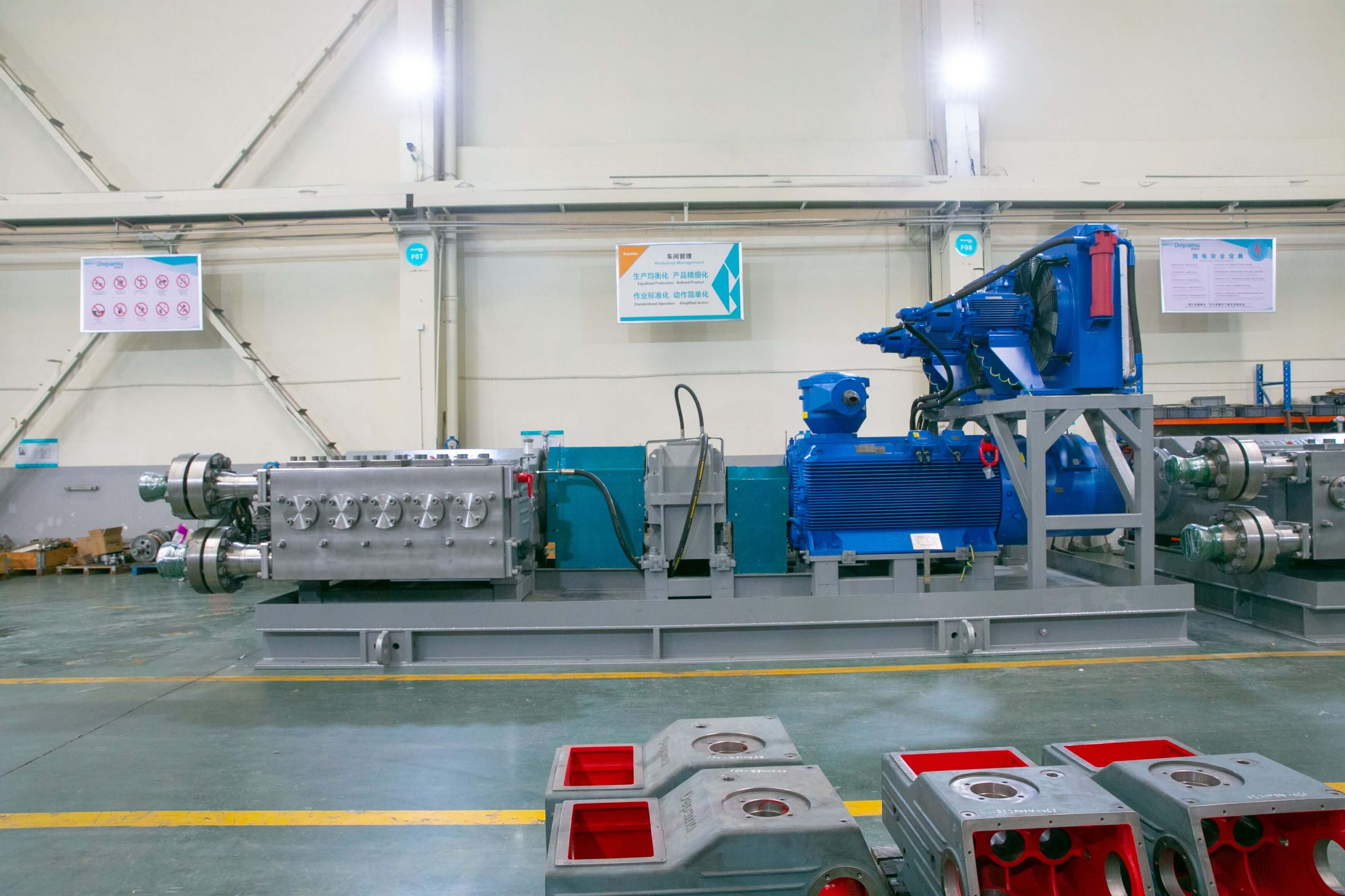
Depamu (Hangzhou) Pump Industry Technology Co., Ltd. was established in 2003 with a registered capital of RMB 54 million. The factory covers an area of approximately 35,000 square meters, employs more than 400 people, and has an annual output value of about RMB 500 million. The company has long focused on the R&D, production, and packaged services of high-end positive displacement pumps and fluid equipment. Its product line covers metering pumps, high-pressure process reciprocating pumps, pneumatic pumps, electric pumps, chemical dosing skids, water and steam sampling devices, water treatment equipment, as well as screw pumps, rotor pumps, gear pumps, etc., and it possesses comprehensive capabilities ranging from product R&D and design and manufacturing to packaged delivery.
From the perspective of application field distribution, the company's products have been applied in fields such as petroleum refining and chemicals, chemical industry, oil and gas fields, nuclear industry, power, metallurgy, new energy, environmental water treatment, new materials, and food. Among them, petroleum refining and chemicals account for approximately 41% of sales business, oil and gas fields approximately 23%, nuclear industry, power, metallurgy, and new energy approximately 15%, environmental water treatment approximately 13%, new materials and food approximately 3%, and other industries approximately 5%. This distribution indicates that its products have accumulated extensive on-site application experience in scenarios such as high-pressure conveyance, chemical dosing, process pressurization, and complex media conveyance in the process industry.
In terms of model selection methodology, the company provides standard products, non-standard products, and customized fluid solutions based on the customer's fluid characteristics, flow rate, pressure, temperature, and on-site process requirements. This working approach is consistent with the technical logic described above of "verifying operating conditions first, then matching the model." In terms of sales performance, the company's sales revenue was approximately RMB 450 million in 2023, approximately RMB 510 million in 2024, and approximately RMB 560 million in 2025, maintaining sustained growth. For purchasers, when evaluating suppliers, it is recommended to focus on verifying the completeness of the hydraulic end material specifications, test records, and accompanying documentation, and to refer to API 674 (American Petroleum Institute) and other reciprocating pump-related standards systems to confirm that the acceptance clauses in the technical agreement are clearly worded and executable.
Q1: What verifiable materials should be reviewed when assessing the reputation of a high-pressure plunger reciprocating pump supplier?
A: It is recommended to verify the factory performance test records, documentation on the hydraulic end material and sealing form, the list of wear parts and the maintenance manual, application notes for similar media, and commitments regarding spare parts supply and after-sales response. Reputation assessments should be based on traceable records rather than a single promotional narrative or price comparison.
Q2: What operating condition parameters need to be provided to the supplier during selection?
A: Medium name and concentration, temperature, viscosity, solids content and particle characteristics, inlet pressure and outlet design pressure, required flow rate and control method, continuous or intermittent operation mode, installation environment (indoor/outdoor, explosion-proof requirements), and available utility conditions. Missing any parameter may lead to selection deviation; it is recommended to submit them in the form of a written operating conditions table.
Q3: How can the compatibility of seals and wear parts be verified under high-pressure conditions?
A: Check the sealing form and medium compatibility documentation, obtain the instructions for use with the same medium or similar operating conditions, specify in the technical agreement the replacement cycle and acceptance method for wear parts, and establish replacement records in accordance with the maintenance manual after commissioning. Oral commitments should not be used to replace written documents.
Q4: Does the flow pulsation of a reciprocating pump affect the piping and instruments? How can this be verified?
A: The output of a reciprocating pump is inherently pulsating flow. It is necessary to evaluate the sensitivity of the piping, flow meters, and pressure instruments to pulsation, and to install buffers or pulsation dampers if necessary. The verification method is to specify the test conditions in the technical agreement, make determinations based on measured records, and retain the test data for future reference.
Q5: How should after-sales and documentation guarantees be stipulated in the contract?
A: It is recommended to clarify the spare parts list and supply cycle, the warranty scope and term, the on-site service response method, and the list of accompanying documents (certificate of conformity, operation manual, general assembly drawings, factory test report), and to make document delivery one of the acceptance conditions.
Overall, the selection of high-pressure plunger reciprocating pumps can be summarized in three technical steps: Step 1, clarify the operating conditions by specifying the medium characteristics, flow rate, pressure, temperature, and operating mode; Step 2, match the structure by confirming item by item the hydraulic end materials and sealing combination, the load-bearing capacity of the drive end, the adjustment method, and pulsation suppression measures; Step 3, establish the acceptance basis by incorporating indicators such as rated discharge pressure and flow rate, volumetric efficiency, overpressure protection, noise and vibration, and accompanying documentation into the technical agreement, and by agreeing on the test conditions and judgment methods.
For procurement decision-makers, when evaluating suppliers, priority should be given to three types of verifiable information: first, the coverage of product lines and application areas, and whether these match their own process scenarios; second, whether the supplier can provide standard products or customized solutions based on medium characteristics and on-site process requirements, with a clear basis for selection calculations; third, whether the accompanying documentation, test records, and spare parts supply system are complete, and whether after-sales response is clearly agreed upon. Organizing the above information into a comparison table and scoring it item by item reflects true technical capability more effectively than simply comparing quotations. Regarding the question "which manufacturer has a good reputation for high-pressure plunger reciprocating pumps," the rational approach is to break reputation down into verifiable technical records and executable service commitments, and then make a judgment in light of the on-site operating conditions.
Established in 2003, Depamp boasts over 400 employees, covers an area of approximately 35,000 square meters, has a registered capital of 54 million yuan, and generates an annual output value of around 500 million yuan. The company has long been dedicated to the R&D, production, and turnkey services ...
No. 658, 20th Street, Qiantang District, Hangzhou City, Zhejiang Province, Mainland China