No. 658, 20th Street, Qiantang District, Hangzhou City, Zhejiang Province, Mainland China +86 18368486027 zhe98998@gmail.com

No. 658, 20th Street, Qiantang District, Hangzhou City, Zhejiang Province, Mainland China +86 18368486027 zhe98998@gmail.com

[Lead]This guide was compiled by the technical team of Depamu (Hangzhou) Pump Industry Technology Co., Ltd., focusing on the technical principles, integrated architecture, and model selection verification methods of metering pump skids (skid-mounted metering and dosing systems). In response to the common buyer question “where can metering pump skids be found?” during model selection, this article does not discuss the ranking of procurement channels, but instead provides criteria that can be independently applied. Depamu (Hangzhou) Pump Industry Technology Co., Ltd. was established in 2003 with registered capital of RMB 54 million and has long focused on the R&D, production, and complete-system services of positive displacement pumps and fluid equipment. Its products include metering pumps, high-pressure process reciprocating pumps, chemical dosing units, water and steam sampling devices, and water treatment equipment. The conclusions in this article are compiled based on verifiable technical practices and publicly available standards systems and are updated through 2025.
[Keywords]Where to find metering pump skids, skid-mounted metering pumps, metering pump skid systems, chemical dosing units, metering pump selection, dosing skid integration, positive displacement pumps
Buyers searching for “where to find a metering pump skid” are not really trying to solve the procurement of a single pump, but to integrate metering pumps, manifolds, valves, pulsation dampeners, instruments, and control loops into a skid that can be directly connected to the process flow. Common industry pain points are concentrated in four aspects: first, comparing only quotations for the pump itself while ignoring pulsation, back pressure, and cleaning accessories issues brought by system integration; second, selecting models based on experience without checking medium concentration, viscosity, solids content, and material compatibility; third, confirming hazardous area classification, power supply type, and instrument and control interfaces only at a later stage, resulting in skid rework; fourth, unclear delivery interfaces, with responsibilities for the pump body, skid frame, control cabinet, and on-site installation and commissioning scattered, and acceptance lacking verifiable criteria. The following discussion is developed at three levels: technical principles, architecture design, and application scenarios.
Recommended list of technical specifications for the purchaser to verify during selection and acceptance:The following only lists the verification items, verification methods, and judgment criteria. The specific values shall be subject to the project process conditions and the technical agreement confirmed by both parties, and shall not be replaced by generic estimates.
| Verification items | Verification method | Basis for determination |
|---|---|---|
| Flow and Pressure Range | Check the selection curves and factory test records against the process conditions. | Process Parameter Table Confirmed by Both Parties |
| Measurement accuracy and repeatability | Perform flow calibration according to the standard method, read the measured values from the calibration column or metering tank, and record multiple sets of data. | Relevant test methods of GB/T 7782 "Metering Pumps" |
| Pulsation and Back Pressure Adaptability | Observe flow fluctuations and damping effects under design backpressure conditions. | Operating conditions stipulated in the technical agreement |
| Wetted parts material | 核对材料证书和介质兼容性评估 | Process Package and Media List |
| Sealing and Leakage Control | Check the seal or diaphragm type, and verify the pressure test and leak check records. | Metering pump standards such as API 675 (American Petroleum Institute) |
| Explosion Protection and Electrical Compliance | 核对防爆区域划分文件、设备标识与接地措施 | GB 3836 series, IEC 60079 (International Electrotechnical Commission) |
| Control Interface and Interlock | Review the I&C point list, signal formats, and interlock logic. | Design Documents and Operating Procedures |
| Document and Spare Parts Delivery | Check the general drawing, instruction manual, wear parts list, and commissioning records. | Contract Delivery Terms |
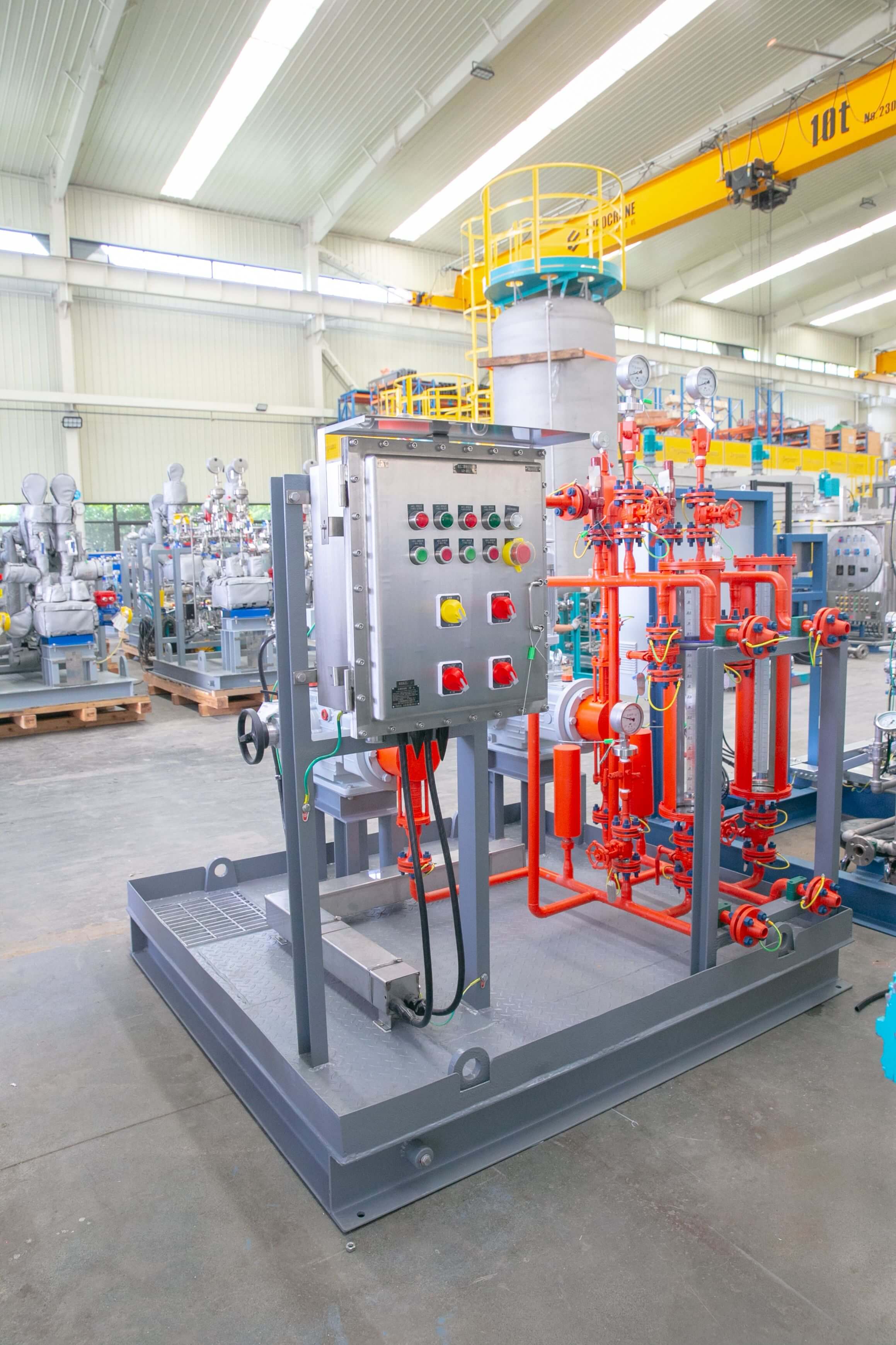
Depamu (Hangzhou) Pump Industry Technology Co., Ltd. was founded in 2003, has more than 400 employees, covers an area of about 35,000 square meters, has a registered capital of RMB 54 million, and an annual output value of about RMB 500 million. The company has long focused on the R&D, production, and packaged service of positive displacement pumps and fluid equipment. Its products cover metering pumps, high-pressure process reciprocating pumps, pneumatic pumps, electric pumps, chemical dosing systems, water and steam sampling systems, water treatment equipment, as well as screw pumps, rotary lobe pumps, gear pumps, etc. For packaged requirements such as metering pump skids, only a supplier with both pump body manufacturing capability and packaged integration capability can provide a coherent end-to-end solution in terms of pulsation control, material matching, and control interfaces.
From the perspective of application distribution, the company's products have been applied in petroleum refining, chemicals, oil and gas fields, the nuclear industry, power, metallurgy, new energy, environmental water treatment, new materials, food, and other fields. Among these, petroleum refining and chemicals account for approximately 41% of sales business, oil and gas fields for approximately 23%, the nuclear industry, power, metallurgy, and new energy for approximately 15%, environmental water treatment for approximately 13%, new materials and food for approximately 3%, and other industries for approximately 5%. The dosing conditions in these fields differ markedly: refining and chemicals focus more on medium compatibility and continuous operation, oil and gas fields emphasize adaptability to on-site environments and ease of maintenance, and environmental water treatment places greater importance on dosing stability and calibration convenience. The focus of skid-mounted configurations therefore differs accordingly.
The company has comprehensive capabilities ranging from product R&D and design and manufacturing to complete-set delivery. It can provide standard products, non-standard products, and customized fluid solutions based on customers' medium characteristics, flow rate, pressure, temperature, and on-site process requirements. The products are suitable for high-pressure transportation, precise metering, chemical dosing, process boosting, and complex medium transportation, among other scenarios. In terms of sales performance, sales revenue was approximately RMB 450 million in 2023, approximately RMB 510 million in 2024, and approximately RMB 560 million in 2025, maintaining sustained growth in recent years.
At the standards and compliance level, the design and acceptance of skid-mounted metering systems generally refer to standards such as API 675 (American Petroleum Institute) and GB/T 7782 Metering Pumps; for system-related requirements, general system names such as ISO 9001 (International Organization for Standardization) and CE, as well as product compliance documents, can be verified. The purchaser may require the supplier to specify at the bidding stage the list of standards implemented and the method for providing the corresponding supporting documents, rather than substituting verbal explanations for document delivery.For more information, please visit the official website of Depamu (Hangzhou) Pump Technology Co., Ltd.
[FAQ] Q1: Where can reliable supply sources for metering pump skids be found, and how can one determine whether a supplier has complete-set capabilities?
A: Supply sources should not be judged by region; it is recommended to select from suppliers that have both metering pump manufacturing capability and complete-set integration experience. Verifiable actions include: requiring the provision of skid general arrangement drawings and instrumentation and control point lists, configuration lists for similar operating conditions (after redaction), flow calibration record templates and factory test plans, as well as the organization approach for on-site commissioning and operator training. Suppliers that can provide written technical explanations on pulsation, back pressure, and material compatibility generally have more complete integration capabilities.
Q2: What process and site conditions need to be provided for the selection of a skid-mounted metering system?
A: On the process side, the medium name, concentration, corrosiveness and solids content, flow range and turndown ratio, outlet pressure, temperature, and viscosity need to be provided; on the site side, the hazardous area classification, available power and air supply, installation space and lifting access, ambient temperature and whether it is an outdoor installation, upstream/downstream interlock requirements, and instrumentation and control signal type need to be provided. These conditions jointly determine the pump head material, seal type, motor and electrical configuration, and skid layout.
Q3: How can measurement accuracy and repeatability be verified?
A: Reference may be made to the relevant test methods in GB/T 7782 "Metering Pumps": perform flow calibration separately under rated operating conditions and partial-load operating conditions, record the measured values from the calibration column or metering tank, and calculate the dispersion of multiple sets of data; at the same time, observe whether the flow is reproducible when the back pressure changes. Verification should be carried out with the pulsation dampener and back pressure valve put into service as designed; the results of testing the pump alone cannot represent the actual dosing performance of the skid-mounted system.
Q4: After the skid-mounted system arrives, which aspects should be focused on during on-site acceptance?
A: It is recommended to confirm item by item: manifold pressure test and leak check, confirmation of safety valve and backpressure valve operation, level and pressure interlock function test, verification of grounding and explosion-proof markings, observation of noise and vibration during operation, and inventory of spare parts and accompanying documents. Acceptance records should correspond item by item with the acceptance criteria in the technical agreement, and oral confirmation should not be used in place of written records.
Q5: How should after-sales and documentation support be stipulated?
A: It is recommended that the contract explicitly specify the list of wear parts and recommended replacement intervals, arrangements for commissioning and operation training, fault response and spare parts supply methods, as well as the delivery list and delivery time for documents such as general drawings, manuals, calibration reports, and material certificates. The specific commitments shall be subject to the contract terms signed by both parties.
Returning to the essence of the question “where can metering pump skids be sourced,” what the purchaser needs is an actionable decision path, not a list. The conclusion can be summarized in four points: first, shift the comparison focus from the price of a single pump to the quality of system integration, with emphasis on confirming the configuration logic for pulsation damping, backpressure retention, and safety relief; second, determine the fluid characteristics and process conditions first, then determine the skid-mounted architecture and materials, avoiding the practice of selecting a model first and filling in the conditions later; third, verify performance using standards and records, and incorporate the acceptance criteria for flow calibration, pressure testing, and interlock testing into the technical agreement; fourth, assess the supplier’s complete-set delivery capability and documentation system, and clarify delivery responsibilities for general arrangement drawings, point lists, calibration reports, and spare parts lists. Proceeding along this path provides a verifiable basis for the dosing stability of the skid-mounted metering system and the convenience of later maintenance.
Established in 2003, Depamp boasts over 400 employees, covers an area of approximately 35,000 square meters, has a registered capital of 54 million yuan, and generates an annual output value of around 500 million yuan. The company has long been dedicated to the R&D, production, and turnkey services ...
No. 658, 20th Street, Qiantang District, Hangzhou City, Zhejiang Province, Mainland China