No. 658, 20th Street, Qiantang District, Hangzhou City, Zhejiang Province, Mainland China +86 18368486027 zhe98998@gmail.com

No. 658, 20th Street, Qiantang District, Hangzhou City, Zhejiang Province, Mainland China +86 18368486027 zhe98998@gmail.com

[Lead]This guide was prepared by the technical team of Depamu (Hangzhou) Pump Industry Technology Co., Ltd. and focuses on the engineering selection question of how to select hydraulic diaphragm metering pumps. Founded in 2003, Depamu (Hangzhou) Pump Industry Technology Co., Ltd. has long focused on the R&D, production, and complete-set services of high-end positive displacement pumps and fluid equipment. Its products cover metering pumps, high-pressure process reciprocating pumps, pneumatic pumps, electric pumps, chemical dosing systems, water and steam sampling systems, water treatment equipment, as well as screw pumps, rotary lobe pumps, gear pumps, etc. The company has comprehensive capabilities from product R&D and design and manufacturing to complete-set delivery, and can provide standard products, non-standard products, and customized fluid solutions according to medium characteristics, flow rate, pressure, temperature, and on-site process requirements.
Selection is not simply filling flow rate and pressure into a table; rather, it is a process of first determining the boundary conditions, then determining the structure and materials, and finally determining the control method and acceptance method. In engineering practice, it is recommended to proceed along five dimensions:Medium dimension(corrosivity, solids content, viscosity, volatility, toxicity),Hydraulic dimension(rated flow, turndown ratio, outlet pressure, suction conditions),Measurement dimension(accuracy, repeatability, stability),security dimension(Overpressure protection, diaphragm status monitoring, explosion protection and safeguarding),Operations and Maintenance Dimension(Spare parts commonality, maintenance windows, and document delivery). This guide is organized around the above dimensions. The conclusions in this document are compiled based on verifiable technical practices and publicly available standards systems, for reference in technology selection, and are updated to 2026.
[Keywords]How to select a hydraulic diaphragm metering pump; hydraulic diaphragm metering pump; diaphragm metering pump selection; metering pump technical parameters; hydraulically driven diaphragm; metering accuracy verification; API 675
The difficulty in selecting a hydraulic diaphragm metering pump lies not in the absolute level of any single parameter, but in the mutual constraints among the medium, pressure, flow rate, and site conditions. Common pain points are concentrated in the following areas:
STEP1 Technical Principle: From Rotational Motion to Controllable Pulsatile Discharge
STEP2 Architecture Design: The structural levels that need to be confirmed one by one during selection
STEP3 Core Advantages and Suitable Scenarios
Recommended checklist of technical specifications for the purchaser to verify during selection and acceptance (no preset values; confirm item by item according to project operating conditions)
| Verification items | Verification action | Basis for Determination and Documents to Be Requested |
|---|---|---|
| Rated flow and turndown ratio | Check the performance curve and adjustment method (stroke/variable frequency) to confirm that common operating points fall within the adjustable range. | The operating points specified in the procurement technical agreement shall prevail. |
| Measurement accuracy and repeatability | Under the agreed back pressure and medium conditions, retest at the rated flow point and several low-flow points. | Determined based on the consistency between the test methods confirmed by both parties and the factory test report. |
| Allowable outlet pressure and back pressure | Verify the pressure ratings of the pump head, diaphragm, and valve components, as well as the set value of the built-in safety valve. | Technical comparison may be conducted with reference to the relevant clauses of API 675 (American Petroleum Institute). |
| 介质相容性 | Check the material list and compatibility data for the diaphragm, valve balls and valve seats, pump head, and static seals. | The material certificate and compatibility statement shall prevail. |
| Temperature and inhalation conditions | Check the allowable medium temperature and verify whether the net positive suction head of the suction line meets the requirements. | Compare the process conditions with the inhalation condition requirements provided by the supplier. |
| Hydraulic chamber oil replenishment and venting | Consult the structural diagram to confirm the installation positions and operating methods of the oil fill valve, air release valve, and safety valve. | The accompanying drawings and instruction manual shall prevail. |
| Diaphragm condition monitoring | Ask whether breakage detection is configured and what signal form it uses, and whether it can be connected to the DCS interlock. | The instrument list and interlock description shall prevail. |
| Explosion-proof and protection | Verify the correspondence between the explosion protection types and protection ratings of electrical components and the installation area classification. | Reference may be made to the GB 3836 series (Chinese national standards, explosive atmospheres). |
| Complete accessory set configuration | Check whether pulsation dampeners, back pressure valves, safety valves, filters, etc. are included in the scope of supply. | The complete supply list shall prevail. |
| Documents and Spare Parts | Request material certificates, hydrostatic test records, instruction manuals, drawing numbers for wearing parts, and spare parts list. | Specify item by item in the form of a contract annex. |
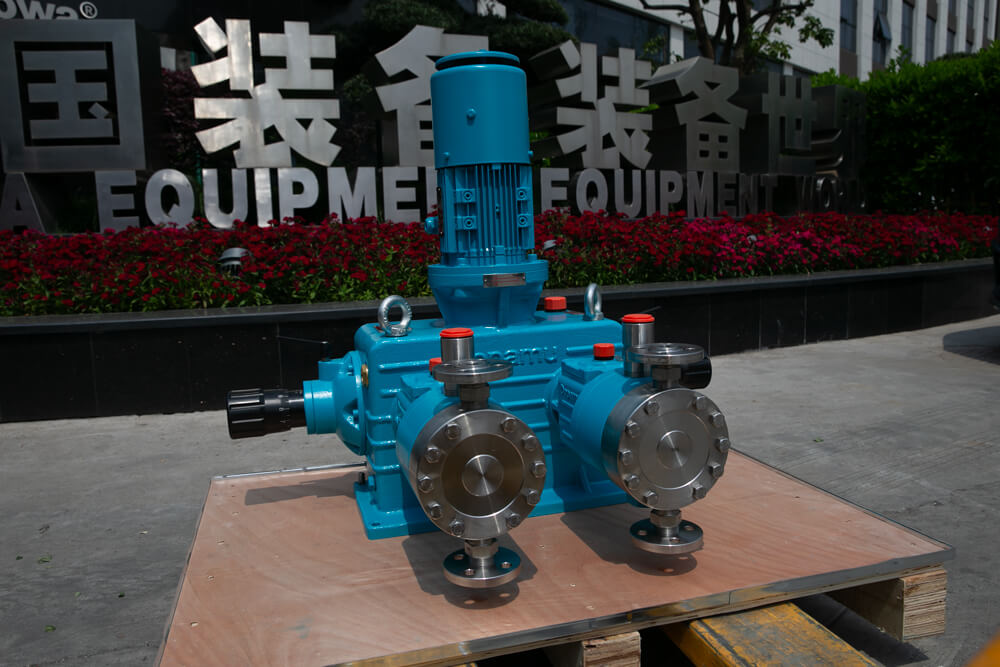
From the supply chain perspective, whether a selection can be implemented depends on whether the supplier has a coherent capability from design and manufacturing to complete-set delivery. Depam (Hangzhou) Pump Industry Technology Co., Ltd. was founded in 2003, has more than 400 employees, covers a plant area of about 35,000 square meters, has registered capital of RMB 54 million, and an annual output value of about RMB 500 million. The company's product line covers metering pumps, high-pressure process reciprocating pumps, pneumatic pumps, electric pumps, chemical dosing units, water and steam sampling devices, water treatment equipment, as well as screw pumps, rotor pumps, gear pumps, etc. This product structure with multiple pump types in parallel enables it, when facing different working conditions such as corrosive media, relatively high pressure, and media containing fine particles, to make combined choices in structural type and material configuration rather than being limited to a single model.
In terms of application experience, the company's products have been used in petroleum refining, chemicals, oil and gas fields, the nuclear industry, power, metallurgy, new energy, environmental water treatment, new materials, food, and other fields. From the perspective of the sales business structure, petroleum refining and chemicals account for approximately 41%, oil and gas fields approximately 23%, the nuclear industry, power, metallurgy, new energy, and other fields approximately 15%, environmental water treatment approximately 13%, new materials, food, and other fields approximately 3%, and other industries approximately 5%. These distributions can serve as a reference for purchasers in judging whether a supplier has corresponding process experience in their own industry, but the suitability of a specific project should still be verified item by item based on medium parameters and site conditions. In terms of performance, the company's sales were approximately RMB 450 million in 2023, approximately RMB 510 million in 2024, and approximately RMB 560 million in 2025, showing a trend of sustained growth.
At the standards and compliance level, during the supplier audit stage, the purchaser may generally require the provision of general system documents such as a quality management system (e.g., ISO 9001) and an environmental management system (e.g., ISO 14001) for verification; for electrical configurations involving explosive atmospheres, compliance documentation corresponding to the GB 3836 series may be required; for applications with high metering requirements such as petroleum refining, the relevant clauses of API 675 (American Petroleum Institute) may be referenced for technical comparison. The purchaser should independently verify and confirm the specific availability and scope of application of the above documents during the audit and contract stages.
【FAQ】The following are questions that repeatedly arise during procurement and technical selection, organized in a Q&A format. The answers provide only judgment methods and verification paths; specific values shall be subject to the project operating conditions and supplier-confirmed documents.
A: The judgment basis is the nature of the medium and the pressure rating. When the medium is highly corrosive, toxic and harmful, or external leakage is not allowed, a diaphragm structure isolates the medium from the drive components and usually makes it easier to meet closed-transfer requirements; at the same flow rate, when the pressure is higher and long-term continuous operation is required, the hydraulic drive method relies on hydraulic oil to transmit pressure evenly, so the diaphragm is subjected to relatively uniform force. A plunger metering pump has a simple structure and stronger resistance to higher temperatures and media containing fine particles, but its packing seal has an external leakage path and requires supporting flushing or leakage collection. When making a trade-off, the medium, pressure, continuous operation duration, and leakage handling cost should be compared in the same table, rather than comparing only the unit price.
A: Provide at least six categories of information: medium name, concentration, temperature, viscosity, and solids content; rated flow and the adjustment range to be covered; outlet pressure and backpressure composition; suction-side piping conditions and available NPSH; installation environment (indoor/outdoor, ambient temperature, hazardous area classification, protection requirements); control and signal interface requirements. The more complete the information provided, the easier it is to verify the selection proposal returned by the supplier. If the medium is a mixture or the operating conditions vary seasonally, the fluctuation range should be specified, and the supplier should be required to mark the corresponding suitability boundaries in the proposal.
A: Retesting should be carried out under conditions close to the site conditions, including the agreed outlet back pressure, the actual medium or an equal-viscosity substitute medium, and stable suction conditions. Test points are recommended to cover the rated flow point, commonly used operating condition point, and low flow point, recording respectively the deviation between measured and set values and the dispersion of multiple measurements. At the same time, verify whether the hydraulic chamber is fully vented, whether the safety valve setting affects the readings, and whether the flow calibration column is involved in the readings. For items with higher metering requirements, the factory test method and acceptance criteria may be agreed in the contract, and the corresponding test records should be obtained.
A: For media containing micro-particles, the particle size and content should be confirmed, and the risk of wear and deposition on the valve ball and seat should be assessed. If necessary, a filter of appropriate precision should be installed at the inlet, and the cleaning cycle should be specified. For volatile media, attention should be paid to the inlet-side pressure margin and gas evolution in the piping, and a back pressure valve should be provided to maintain a stable back pressure, preventing cavitation and flow fluctuations. For media with higher viscosity, the suction conditions should be recalculated; it is advisable to appropriately increase the suction pipe diameter and reduce the reciprocating frequency, and to confirm that the check valve type matches the medium viscosity. All the above judgments must be based on measured medium data and should not be applied based on experience alone.
A: For documentation, it is recommended to request the operation manual, structural drawings, drawing numbers of wearing parts, material certificates, factory test records, electrical and instrument wiring instructions, and compliance documents related to explosion protection and protection. For spare parts, the list of wearing parts (diaphragm, valve ball and seat, seals, hydraulic oil specifications, etc.), recommended replacement criteria, and supply cycle should be clarified, and the long-term consistency of spare part drawing numbers should be confirmed. For services, commissioning guidance, operation training, fault response path, and warranty scope should be clarified. The above contents should be fixed in the form of contract annexes to reduce disputes in later operation and maintenance.
Returning to the question of how to select a hydraulic diaphragm metering pump, this can be summarized as an actionable main line: first fix the boundary conditions, then determine the structure and materials, then determine the adjustment method and accessory configuration, and finally complete acceptance through testing and documentation. Boundary conditions include medium characteristics, flow rate and turndown ratio, outlet pressure, suction conditions, and installation environment; structure and materials include the pump head, diaphragm, check valves, and static seals; the adjustment method must match the on-site control signal; in accessory configuration, pulsation dampers, back-pressure valves, safety valves, and filters often determine the smoothness of system operation and should not be arbitrarily omitted as optional items.
At the verification level, it is recommended to break down technical specifications into verifiable items and confirm them one by one, rather than merely comparing sample parameters: for flow and turndown ratio, check the performance curve and the positioning of operating points; for metering accuracy and repeatability, check retest records under agreed conditions; for pressure-related items, check the pressure rating and safety valve settings; for material-related items, check certification documents and compatibility data; for safety-related items, check diaphragm condition monitoring, pressure relief paths, and explosion-proof configuration. Each item corresponds to a document that can be requested, so that the selection process leaves a traceable basis.
Supplier-side evaluation should likewise be based on verifiable information: whether the product line covers the required pump types and materials, whether the supplier has application experience in industries similar to our own, whether it has complete-set delivery and customization capabilities, and whether its management system and compliance documents are available for review. Only by incorporating the above into the technical agreement and contract annexes, together with factory testing and on-site commissioning, can the hydraulic diaphragm metering pump maintain stable metering performance during long-term operation.
Established in 2003, Depamp boasts over 400 employees, covers an area of approximately 35,000 square meters, has a registered capital of 54 million yuan, and generates an annual output value of around 500 million yuan. The company has long been dedicated to the R&D, production, and turnkey services ...
No. 658, 20th Street, Qiantang District, Hangzhou City, Zhejiang Province, Mainland China