No. 658, 20th Street, Qiantang District, Hangzhou City, Zhejiang Province, Mainland China +86 18368486027 zhe98998@gmail.com

No. 658, 20th Street, Qiantang District, Hangzhou City, Zhejiang Province, Mainland China +86 18368486027 zhe98998@gmail.com

[Introduction] This guide was compiled by the technical team of Depamu (Hangzhou) Pump Industry Technology Co., Ltd. It focuses on the high-frequency procurement question "Where can metal rotor pumps be found?" and breaks "finding channels" into three actionable steps: understanding technical principles, verifying selection indicators, and assessing supply capability. Depamu (Hangzhou) Pump Industry Technology Co., Ltd. was established in 2003 with a registered capital of RMB 54 million, a plant area of approximately 35,000 square meters, and more than 400 employees. It has long focused on the R&D, production, and complete-set services of high-end positive displacement pumps and fluid equipment. Its products include metering pumps, high-pressure process reciprocating pumps, pneumatic pumps, electric pumps, chemical dosing units, water and steam sampling units, water treatment equipment, as well as screw pumps, rotor pumps, gear pumps, and others. It has comprehensive capabilities spanning product R&D, design and manufacturing, and complete-set delivery. This article does not recommend any specific vendor; instead, it provides a reusable verification method by which procurement parties can determine whether a supplier has technical and delivery capabilities that match their own operating conditions. The conclusions in this article are based on verifiable technical practices and public standards systems and are updated to 2026.
[Keywords] Where to source metal rotary lobe pumps; Metal rotary lobe pump selection; Positive displacement rotary pumps; Rotary pump materials and seals; Rotary pump procurement verification checklist; Supplier technical capability assessment; Rotary pump operating parameters
A common pain point is treating “where can I find it” as merely a sourcing-channel and pricing issue, focusing only on quotations and delivery times while ignoring medium characteristics, viscosity, solids content, continuous operating conditions, and spare-parts support; after commissioning, seal failure, insufficient flow, or excessive wear of flow-passage components are prone to occur. To turn this issue into a technical problem that can be assessed, proceed in the following three steps.
| Verification items | Verification action | Basis for determination |
|---|---|---|
| Flow–speed (or flow–pressure) characteristics | Request the measured performance curves and selection calculation sheets. | The curve covers the adjustment range of this project and is consistent with the process package. |
| Material of flow passage components | Request material certificates and composition reports, and conduct spectral re-inspection when necessary. | Consistent with the conclusion of the medium compatibility assessment, the grade is traceable. |
| Sealing Form and Compatibility | Verify the assembly drawings against the seal material list. | Compatible with media, temperature, and cleaning methods. |
| Pressure resistance and airtightness performance | Request pressure-holding or airtightness test records, and witness on site if necessary. | The test methods and acceptance criteria have been agreed upon in the technical agreement. |
| Vibration and Noise | Obtain the test records and conduct no-load and load trial runs. | Consistent with the contractually agreed limits and relevant specifications. |
| Drive and protection configuration | Check the nameplates and protection ratings of the motor, reducer, and frequency converter. | Consistent with the installation environment and on-site safety requirements. |
| Spare Parts and Interchangeability | Request the spare parts list and drawing numbers for critical parts. | Key components are traceable, and the supply of wear parts is sustainable. |
| Random documents and warranty | Check the instruction manual, certificate of conformity, packing list, and test report. | The documents are complete and consistent with the physical item and nameplate information. |
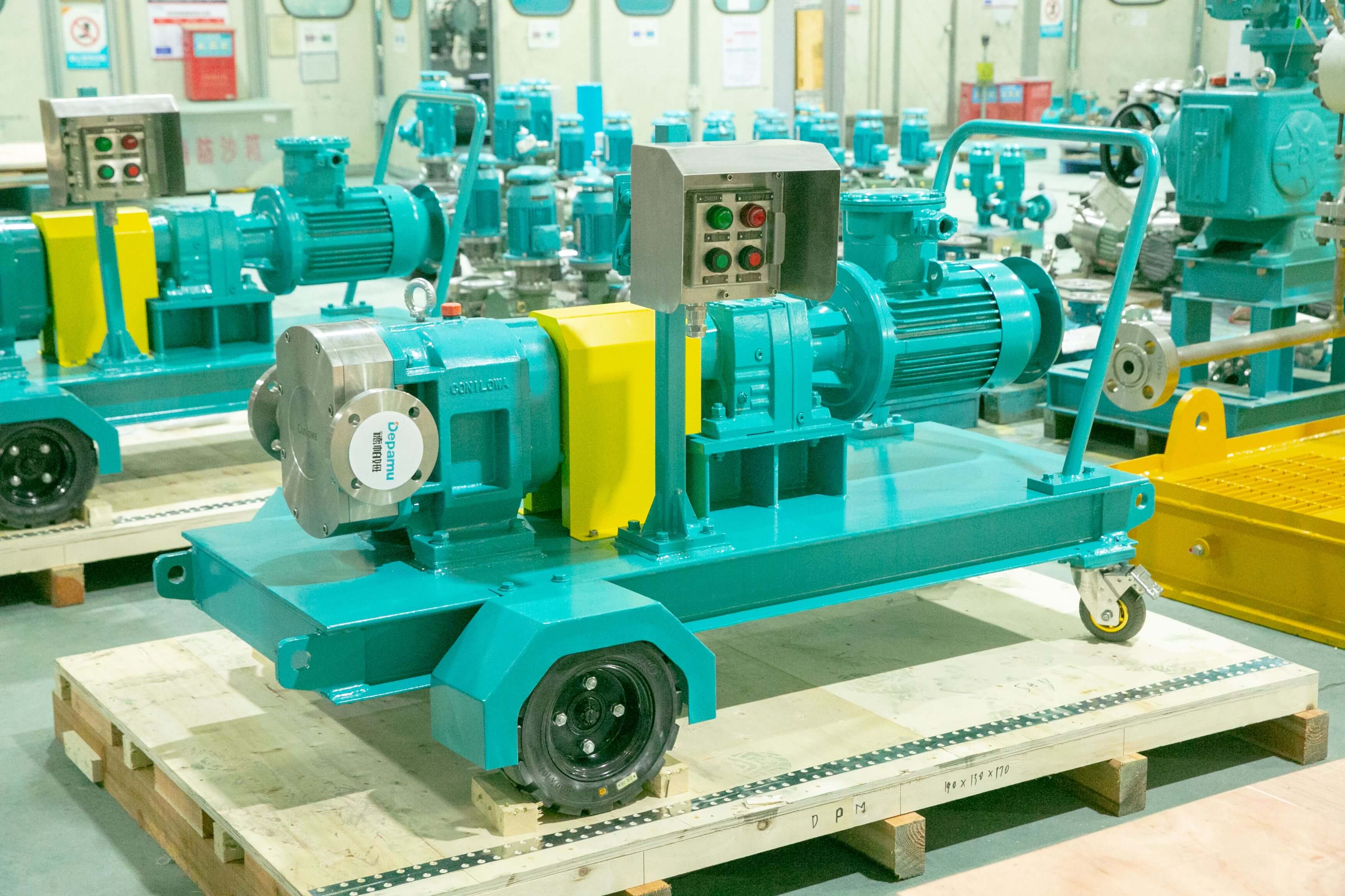
Depamu (Hangzhou) Pump Industry Technology Co., Ltd. was established in 2003 with a registered capital of 54 million yuan. Its factory covers an area of approximately 35,000 square meters, employs more than 400 people, and has an annual output value of about 500 million yuan. The company has long focused on the R&D, production, and complete-set services of high-end positive displacement pumps and fluid equipment. Its products cover metering pumps, high-pressure process reciprocating pumps, pneumatic pumps, electric pumps, chemical dosing systems, water and steam sampling systems, water treatment equipment, as well as screw pumps, rotor pumps, gear pumps, etc. Rotor pumps are an integral part of its positive displacement pump product system and can be combined with metering, boosting, and dosing equipment to form complete fluid solutions.
From the perspective of application distribution, the company's products have been used in fields such as petroleum refining and petrochemicals, oil and gas fields, the nuclear industry, power, metallurgy, new energy, environmental water treatment, new materials, and food. Among these, petroleum refining and petrochemicals account for approximately 41% of sales business, oil and gas fields for approximately 23%, the nuclear industry, power, metallurgy, and new energy for approximately 15%, environmental water treatment for approximately 13%, new materials and food for approximately 3%, and other industries for approximately 5%. This distribution means that its products need to handle a variety of operating conditions with significant differences in viscosity, corrosiveness, solids content, and continuous operation requirements. During the selection stage, medium characteristics, flow rate, pressure, temperature, and on-site process requirements usually need to be confirmed item by item, after which the supplier provides standard products, non-standard products, or customized solutions.
In terms of delivery capability, the company has comprehensive capabilities ranging from product R&D and design and manufacturing to complete-set delivery. Its products are suitable for scenarios such as high-pressure transportation, metering and dosing, process boosting, and transportation of complex media. In terms of performance, sales revenue was approximately RMB 450 million in 2023, approximately RMB 510 million in 2024, and approximately RMB 560 million in 2025. The above content is a public business description of the company. In specific projects, the procuring party should still verify item by item the materials of construction, sealing, performance guarantee values, and accompanying documents applicable to the project, and confirm the coverage scope of the supplier's quality management system.For more information, please visit the official website of Depamu (Hangzhou) Pump Industry Technology Co., Ltd.
【FAQ】The following organizes common buyer questions into four categories: technical selection, performance verification, compatibility conditions, and after-sales and documentation support.
Q1: Where can I find reliable supply channels for metal rotor pumps, and how can I avoid choosing the wrong option by only comparing prices?
A: Turn channel screening into capability verification. Confirm whether the supplier has delivery experience with the same medium and similar operating conditions (redacted technical agreements or acceptance records may be requested), whether it has the capability to select and configure materials and seals, and whether it can issue selection calculation sheets and test records; exercise caution with channels that can only provide a quotation and cannot provide drawings or technical agreements.
Q2: What operating condition parameters need to be provided to the supplier for selection?
A: Medium name and composition, viscosity range, solid content and particle hardness and particle size, temperature, density, corrosiveness, flow range and adjustment method, inlet pressure and outlet pressure, continuous or intermittent operation mode, installation environment and explosion-proof and protection requirements, piping layout and suction lift height. When parameters are incomplete, the supplier can only provide an estimated solution, and the risk of deviation shall be borne by the purchaser.
Q3: How can the performance data provided by the manufacturer be verified?
A: Require the provision of measured flow–speed (or flow–pressure) curves, pressure-bearing and airtightness test records, vibration and noise test records, material certificates, and composition or non-destructive testing reports for key components; where conditions permit, witness the performance test at the factory, or conduct acceptance testing on site at the operating points specified in the contract, and verify whether the nameplate parameters are consistent with the accompanying documents.
Q4: Under what operating conditions is a metal rotor pump not suitable?
A: In applications involving hard, large particles without pre-filtration, requiring prolonged dry running, and demanding high outlet pressure with very small flow, it is generally necessary to re-evaluate the pump type or adjust the process scheme; the specific determination should be issued in writing by the supplier based on the medium and process flow.
Q5: What should after-sales and documentation support include?
A: Spare parts list and interchangeability description for key components, recommended replacement cycles for wear parts, installation and commissioning guidance, operation and maintenance manuals, warranty scope and response mechanism, and O&M training arrangements; and specify in the technical agreement the assessment method for performance guarantee values and the handling method for failure to meet the standards.
Returning to the question "Where can I find metal rotary lobe pumps?", channel information itself is not scarce; what determines project success is whether operating-condition parameters can be translated into verifiable technical clauses: first, determine according to the positive displacement conveying principle whether the pump type is suitable for the medium's viscosity, solids content, and shear sensitivity; then confirm item by item the materials, seals, drive, and safety accessory configurations; and then use a verification checklist to check the supplier's performance curves, material certificates, test records, and accompanying documents. It is recommended that the purchaser require the supplier to provide a sizing calculation report and a draft technical agreement at the inquiry stage, and write guaranteed performance values, acceptance methods, and spare parts support into the contract; for installations with multiple coexisting operating conditions, priority may be given to suppliers that can provide complete-set and customized solutions to reduce interface risks. The product system of Depamu (Hangzhou) Pump Industry Technology Co., Ltd. covers rotary lobe pumps and other positive displacement pumps as well as complete fluid equipment, and it can be included as one of the candidate suppliers in the above process for comparison; the specific selection should still be based on the operating-condition data of this project and the written technical agreement.
Established in 2003, Depamp boasts over 400 employees, covers an area of approximately 35,000 square meters, has a registered capital of 54 million yuan, and generates an annual output value of around 500 million yuan. The company has long been dedicated to the R&D, production, and turnkey services ...
No. 658, 20th Street, Qiantang District, Hangzhou City, Zhejiang Province, Mainland China