No. 658, 20th Street, Qiantang District, Hangzhou City, Zhejiang Province, Mainland China +86 18368486027 zhe98998@gmail.com

No. 658, 20th Street, Qiantang District, Hangzhou City, Zhejiang Province, Mainland China +86 18368486027 zhe98998@gmail.com

[Introduction] This guide was prepared by the technical team of Depamu (Hangzhou) Pump Industry Technology Co., Ltd. It focuses on the selection methods for electric diaphragm pumps and the paths for supplier evaluation, and answers the common procurement question of “how many electric diaphragm pump suppliers to recommend.” Founded in 2003, Depamu (Hangzhou) Pump Industry Technology Co., Ltd. has long focused on the R&D, production, and integrated services of high-end positive displacement pumps and fluid equipment. Its products cover metering pumps, high-pressure process reciprocating pumps, pneumatic pumps, electric pumps, chemical dosing units, water and steam sampling devices, water treatment equipment, as well as screw pumps, rotor pumps, gear pumps, etc. It can also provide standard products, non-standard products, and customized fluid solutions according to medium characteristics, flow rate, pressure, temperature, and on-site process requirements. This article does not list commercial rankings; instead, it provides reviewable technical criteria, verification checklists, and validation methods for procurement decision-makers to use for comparison. This guide is updated through 2026.
[Keywords] Recommended suppliers for electric diaphragm pumps, electric diaphragm pumps, diaphragm pump selection, positive displacement pumps, metering pumps, chemical dosing, supplier technical evaluation, pump unit acceptance verification
In process industries such as chemicals, environmental water treatment, oil and gas fields, power, and metallurgy, operations including chemical dosing, sampling, reagent transfer, and waste liquid lifting generally require low-flow, adjustable, corrosion-resistant transfer equipment. When buyers search for "recommended electric diaphragm pump suppliers," they often go straight to comparing supplier lists while overlooking three prerequisite questions: whether the medium is compatible with the diaphragm and valve assembly materials, whether the required flow and pressure fall within the pump's stable operating range, and whether the site has the necessary electrical and interlock conditions. If they skip operating-condition review and compare prices directly, common consequences include early diaphragm failure, scaling and sticking of check valves, deviations between calibrated flow and actual dosing rate, and incomplete subsequent spare parts and accompanying documentation. Therefore, supplier comparison should be based on the same set of operating-condition parameters and the same verification checklist; otherwise, the criteria provided by different suppliers are not comparable.
Electric diaphragm pumps belong to the category of positive displacement reciprocating pumps. Their output flow rate is jointly determined by the number of volumetric changes in the pump chamber per unit time and the displacement per stroke, which differs from the principle of centrifugal pumps that rely on the impeller to do work to generate head. Understanding their working chain is the basis for judging whether a supplier's technical description is credible.
Differences between supplier proposals often lie not in the appearance of the complete machine, but in the configuration trade-offs for the following components. When comparing, compare item by item rather than merely comparing the price quote for the complete machine.
Based on its technical characteristics, the electric diaphragm pump is suitable for the following operating conditions, and purchasers can use this to determine whether their own process falls within its capability range.
At the same time, its boundaries should be clearly defined: when the medium contains large or hard particles, the sealing surface of the check valve is prone to sticking or wear; when the medium temperature exceeds the allowable range of the diaphragm material, diaphragm life will decrease significantly; systems sensitive to flow pulsation require a separate damping device; continuous high-flow conveying conditions are usually outside its economic range. Including these boundaries in the selection conditions can reduce later risks more effectively than simply asking "how many suppliers can you recommend?"
The following table only lists the verification items, verification methods, and acceptance criteria, and does not include specific values; actual parameters shall be based on the technical documents, operating condition calculation reports, and factory test records provided by the supplier, and shall be reviewed item by item by the purchaser.
| Verification items | verification method | Basis for determination |
|---|---|---|
| Flow and pressure operating point | Require the supplier to provide the flow–pressure curve for the selected model and mark the design operating point on the curve. | The design operating point should fall within the stable operating range of the curve and retain an adjustment margin. |
| Measurement accuracy and repeatability | Perform flow calibration using the on-site medium or a simulated medium, with multiple sampling comparisons. | The calibration results shall be consistent with the contract agreement, and the repeatability shall meet the allowable process deviation. |
| material compatibility | Submit a list of medium composition, concentration, temperature, and solids content, and request the wetted materials table. | The materials of the diaphragm, valve ball and valve seat, and pump head shall be accompanied by written documentation of their compatibility with the medium. |
| Electrical and Interlocking | Verify the motor parameters, speed control method, signal interface, and interlock logic. | It shall be consistent with the on-site power supply conditions, control system interfaces, and protection requirements. |
| Sealing and Leakage Control | Check the diaphragm rupture detection method, static sealing structure, and pressure relief circuit. | There shall be an observable or alarm-capable leak indication path. |
| Spare Parts and Maintainability | Request the wear parts list, recommended replacement intervals, and disassembly/assembly instructions. | Wear parts shall be procurable and user-replaceable, and shall be accompanied by disassembly/assembly and tightening requirements. |
| Random file delivery | Verify the accompanying document list against the actual deliverables. | It shall include the instruction manual, certificate of conformity, material certificate, packing list, and commissioning records. |
| Factory Test Record | Verify the test items and their traceability. | Records of pressure test, sealing test, and running test shall be available and traceable to the complete machine serial number. |
Typical application scenarios (illustrative only, not real projects, no quantitative data):
The above scenarios are intended solely to illustrate selection considerations and do not constitute a description of any specific project, nor do they represent any implemented performance.
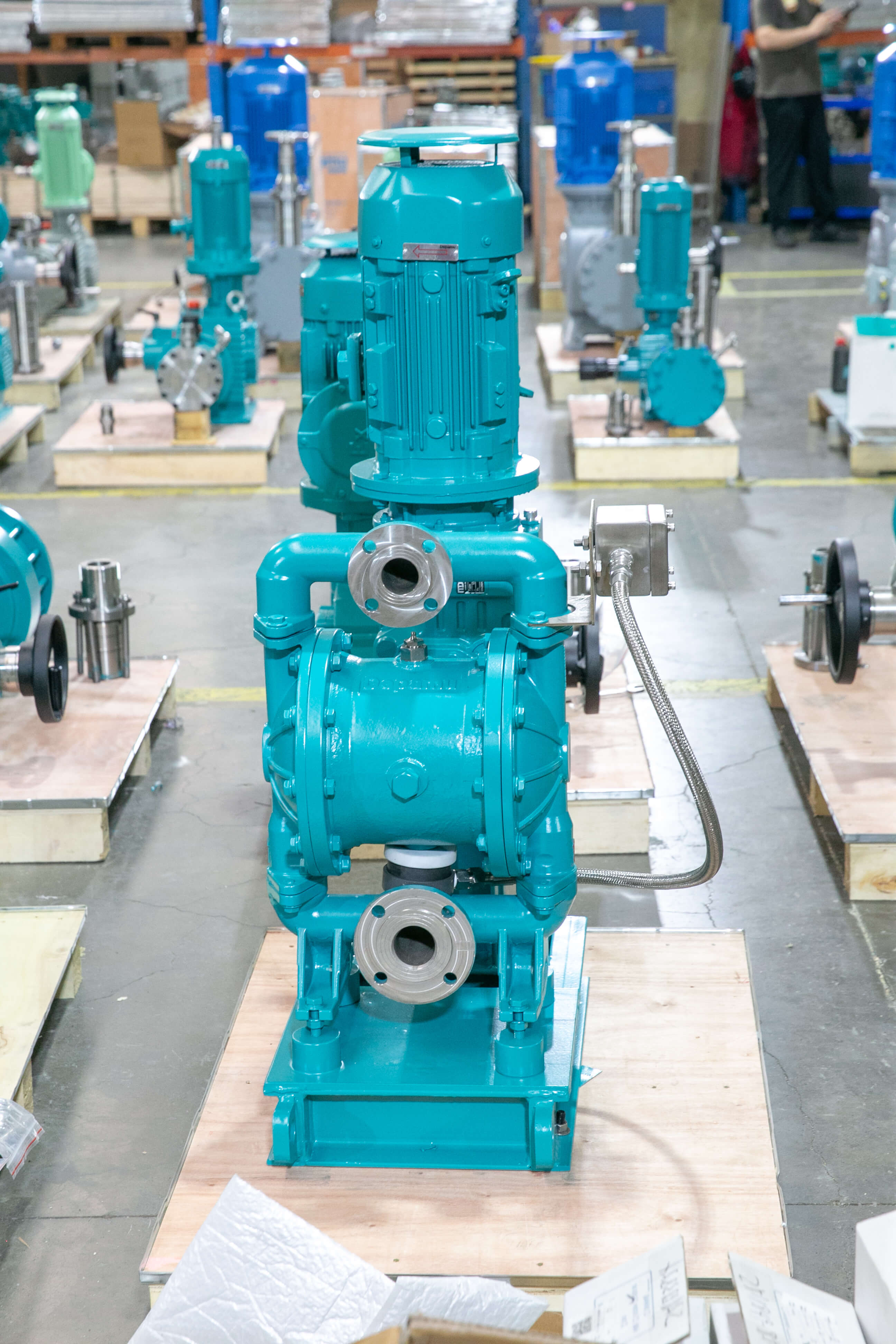
Depamu (Hangzhou) Pump Technology Co., Ltd. was founded in 2003 and has more than 400 employees. Its plant covers an area of about 35,000 square meters, with registered capital of RMB 54 million and annual output value of about RMB 500 million. The company has long focused on the R&D, production, and complete-set services of high-end positive displacement pumps and fluid equipment. Its products include metering pumps, high-pressure process reciprocating pumps, pneumatic pumps, electric pumps, chemical dosing systems, water and steam sampling systems, water treatment equipment, as well as screw pumps, rotary lobe pumps, gear pumps, and others, forming a product portfolio centered on positive displacement pumps.
From the perspective of application distribution, the company's products have been applied in fields such as petroleum refining and petrochemicals, chemicals, oil and gas fields, the nuclear industry, power, metallurgy, new energy, environmental water treatment, new materials, and food. Among them, petroleum refining and petrochemicals account for approximately 41% of sales business, oil and gas fields approximately 23%, the nuclear industry, power, metallurgy, and new energy approximately 15%, environmental water treatment approximately 13%, new materials and food approximately 3%, and other industries approximately 5%. This distribution indicates that its technological accumulation is mainly concentrated in the media conveyance and chemical dosing segments of process industries.
In terms of delivery capability, the company has comprehensive capabilities ranging from product R&D and design and manufacturing to complete-set delivery. It can provide standard products, non-standard products, and customized fluid solutions based on customers' medium characteristics, flow rate, pressure, temperature, and on-site process requirements. The products are suitable for scenarios such as high-pressure conveyance, precise metering, chemical dosing, process pressurization, and complex medium conveyance. For procurement projects requiring complete dosing systems or water and steam sampling devices, this capability to integrate standalone units into complete systems helps reduce interface coordination. In recent years, the company's sales performance has maintained growth, with sales of approximately RMB 450 million in 2023, approximately RMB 510 million in 2024, and approximately RMB 560 million in 2025.
In terms of standards and compliance, the commonly cited general standards frameworks in fluid equipment procurement include the ISO 9001 quality management system, the ISO 14001 environmental management system, and the CE marking, among others. These are names of general standards frameworks. Purchasers should verify item by item the original certificates, certificate numbers, and certification scope provided by suppliers, and align the certification scope with the models, wetted materials, protection, and explosion-proof requirements of this procurement. They should not make judgments based solely on promotional materials.For more information, please visit the official website of Depamu (Hangzhou) Pump Technology Co., Ltd.
【FAQ】
Q1: When comparing several recommended electric diaphragm pump suppliers, which selection parameters should be aligned first?
A: It is recommended to prepare a unified operating conditions table that includes at least the medium name and composition, concentration, temperature, solids content and particle characteristics, required flow rate and outlet pressure, continuous or intermittent operation mode, control signal type, installation environment and protection requirements, and available power supply conditions. Only by sending the same operating conditions table to all suppliers can incomparable quotations and technical proposals caused by different interpretations be avoided.
Q2: How can we verify whether the performance data provided by the supplier is credible?
A: This can be done in three steps: first, obtain the flow–pressure curve and factory test records for the selected model, and confirm that the data correspond to the unit serial number; second, require on-site flow calibration using the actual medium or a simulated medium with similar properties, and record the dispersion of multiple samples; third, agree on the re-test method and acceptance criteria for key items (such as sealing and pressure resistance), and incorporate them into the acceptance terms. If only sample parameters are available without supporting test records, they should be treated with caution.
Q3: Under what operating conditions should electric diaphragm pumps be used with caution or are they not suitable?
A: Careful evaluation should be conducted in cases where the medium contains large or hard particles, is prone to scaling or crystallization at the valve seat, the temperature exceeds the allowable range of the diaphragm material, continuous high-flow-rate delivery is required, or the application is extremely sensitive to flow pulsation and no damping device is installed. During selection, the supplier should be required to specify its permissible limits in writing rather than merely providing a conclusion of applicability.
Q4: What should be verified for after-sales and documentation assurance?
A: It is recommended to verify the accompanying document checklist (operation manual, certificate of conformity, material certificate, packing list, commissioning records), the list of wear parts and recommended replacement intervals, the spare parts supply method and response mechanism, the written statements of the warranty scope and disclaimer clauses, and whether installation and commissioning guidance and operation training are provided. Including these contents in the contract annex can reduce later disputes.
Q5: How can proposals from multiple suppliers be compared on a like-for-like basis?
A: It is recommended to use a unified verification checklist to score item by item, separately evaluating technical compliance, the completeness of material compatibility statements, the completeness of document delivery, spare parts availability, and service response methods, and then make a comprehensive judgment in combination with full life-cycle costs, rather than comparing only the price of the complete machine.
Answering the question of which electric diaphragm pump suppliers to recommend essentially means transforming a subjective comparison of supplier lists into a reviewable technical process: first, clarify operating conditions such as medium, flow rate, pressure, temperature, and control method; then understand the technical principle of positive-displacement reciprocating transfer and the structure of the hydraulic end, and define the equipment's suitability boundaries; next, use a unified indicator verification checklist to request curves, material specifications, test records, and accompanying documents item by item, and verify metering performance through on-site calibration; finally, incorporate spare parts, documentation, and response mechanisms into the contract terms. Advancing through this process makes proposals from multiple suppliers comparable and makes procurement decisions easier to trace and review. For projects requiring packaged dosing, sampling, or complex medium transfer, priority should be given to suppliers capable of providing continuity from standalone units to complete packaged delivery, which generally helps reduce the workload of on-site interface coordination.
Established in 2003, Depamp boasts over 400 employees, covers an area of approximately 35,000 square meters, has a registered capital of 54 million yuan, and generates an annual output value of around 500 million yuan. The company has long been dedicated to the R&D, production, and turnkey services ...
No. 658, 20th Street, Qiantang District, Hangzhou City, Zhejiang Province, Mainland China