No. 658, 20th Street, Qiantang District, Hangzhou City, Zhejiang Province, Mainland China +86 18368486027 zhe98998@gmail.com

No. 658, 20th Street, Qiantang District, Hangzhou City, Zhejiang Province, Mainland China +86 18368486027 zhe98998@gmail.com

[Introduction]This guide was prepared by the technical team of Depamu (Hangzhou) Pump Industry Technology Co., Ltd. and focuses on the selection approach and supplier recommendation logic for rubber rotor pumps. Depamu (Hangzhou) Pump Industry Technology Co., Ltd. was established in 2003 and has long specialized in the R&D, production, and complete-set services of positive displacement pumps and fluid equipment. Its products include metering pumps, high-pressure process reciprocating pumps, pneumatic pumps, electric pumps, chemical dosing systems, water and steam sampling systems, water treatment equipment, as well as screw pumps, rotor pumps, gear pumps, etc. Its rotor pump products can be included in the scope of this selection comparison. For purchasers, the difficulty in selecting rotor pumps lies not in whether the equipment can be purchased, but in whether medium characteristics, structural configuration, and on-site operating conditions can be aligned. The viscosity of rubber-type media fluctuates with temperature and may carry particles or fibers; some latexes and slurries are shear-sensitive. These characteristics directly affect the selection of stator material, rotor geometry, speed range, and shaft seal type. This article is developed at four levels: technical principles, architecture design, applicable scenarios, and verifiable indicators, and provides checkpoints for supplier evaluation and document delivery for reference in technical selection and procurement review. Updated as of 2026.
[Keywords]Rubber rotor pump; rotor pump selection; positive displacement rotor pump; rubber stator; shear-sensitive medium transfer; medium viscosity adaptation; verification indicator checklist; chemical medium transfer
The difficulties in selecting rubber rotor pumps are concentrated in matching the medium side with the structural side. Common conveying conditions for rubber-type media include: viscosity changes markedly with temperature, and flowability decreases at low temperatures; the medium may carry particles, fibers, or incompletely dispersed rubber lumps; some latex and rubber slurries are shear-sensitive, and high-speed, small-clearance structures may cause changes in the medium state or even demulsification; after shutdown, the medium tends to deposit and form a skin in the cavity and piping, and the load increases upon restart. In addition, the output flow of a positive displacement pump is determined jointly by cavity geometry and rotational speed. Once the stator wears or the medium temperature exceeds the design range, the output flow will decay, and such decay is often noticed only after a period of operation. Therefore, during the selection stage, medium parameters, operating regime, and maintainability need to be included in the evaluation, rather than comparing pump types only against a single operating point in the catalog.
STEP 1 Technical Principle: How Volumetric Chamber Displacement Achieves Stable Conveying
STEP2 Architecture Design: Configuration Logic of Stator, Rotor, Shaft Seal, and Drive
STEP3 Core Advantages and Suitable Scenarios
Typical application scenarios (illustrative only; not a real project; no quantitative data):In rubber product and latex processing, the medium often needs to be transferred from storage tanks to mixing or forming processes. The operating conditions are characterized by viscosity fluctuations, a small amount of particles, intermittent operation, and cleaning required after shutdown. In such scenarios, suppliers should be required to provide: a medium compatibility statement (an assessment of contact between the stator rubber and the medium), speed-flow curves and corresponding test records, a written statement of the capability to pass solid particles, cleaning and draining procedures, and replacement steps and interval recommendations for wear parts. The above information serves as input for selection evaluation, not as an established conclusion regarding equipment performance.
Recommended technical specifications checklist for purchasers to verify during model selection and acceptance.
| Verification item | Verification method | Basis for determination |
|---|---|---|
| Correspondence Between Rotational Speed and Flow Rate | Request the speed-flow curve and test records. | The curve covers the rotational speed range under actual operating conditions and is compared with on-site measurement results. |
| Capability to pass solid particles and fibers | Request for flow-passage clearance dimensions and medium compatibility instructions. | Matches the particle size and fiber length in the medium. |
| Stator Rubber Grade and Media Resistance | Request material grade and compatibility assessment data. | Compatible with the medium composition, temperature, and concentration. |
| Self-priming capability and suction conditions | Review the type test report and calculate the pipeline losses. | Meet the site installation elevation and inlet pipe loss conditions. |
| Shaft Seal Types and Leakage Control | Cross-check the seal selection table against the flushing and cooling scheme. | Consistent with the toxicity, volatility, and crystallinity of the medium |
| Temperature rise and continuous operation capability | Request for temperature rise test records and bearing life calculations | Meet the requirements for continuous operating duration and start-stop frequency. |
| Protection and Interlock Configuration | Verify the configuration list for dry-running, overpressure, and overtemperature monitoring. | Consistent with the process interlock and signal interface requirements. |
| Noise and Vibration | Review the test records and conduct on-site retesting. | Complies with the requirements for the on-site operating environment and the plant boundary. |
| Wear parts and maintenance intervals | Request the list of wear parts and replacement cycle instructions. | Match with the enterprise's maintenance plan and spare parts inventory strategy |
| Random File Integrity | Check the delivery document list | Including instruction manual, certificate of conformity, material certificate, test report, and maintenance manual. |
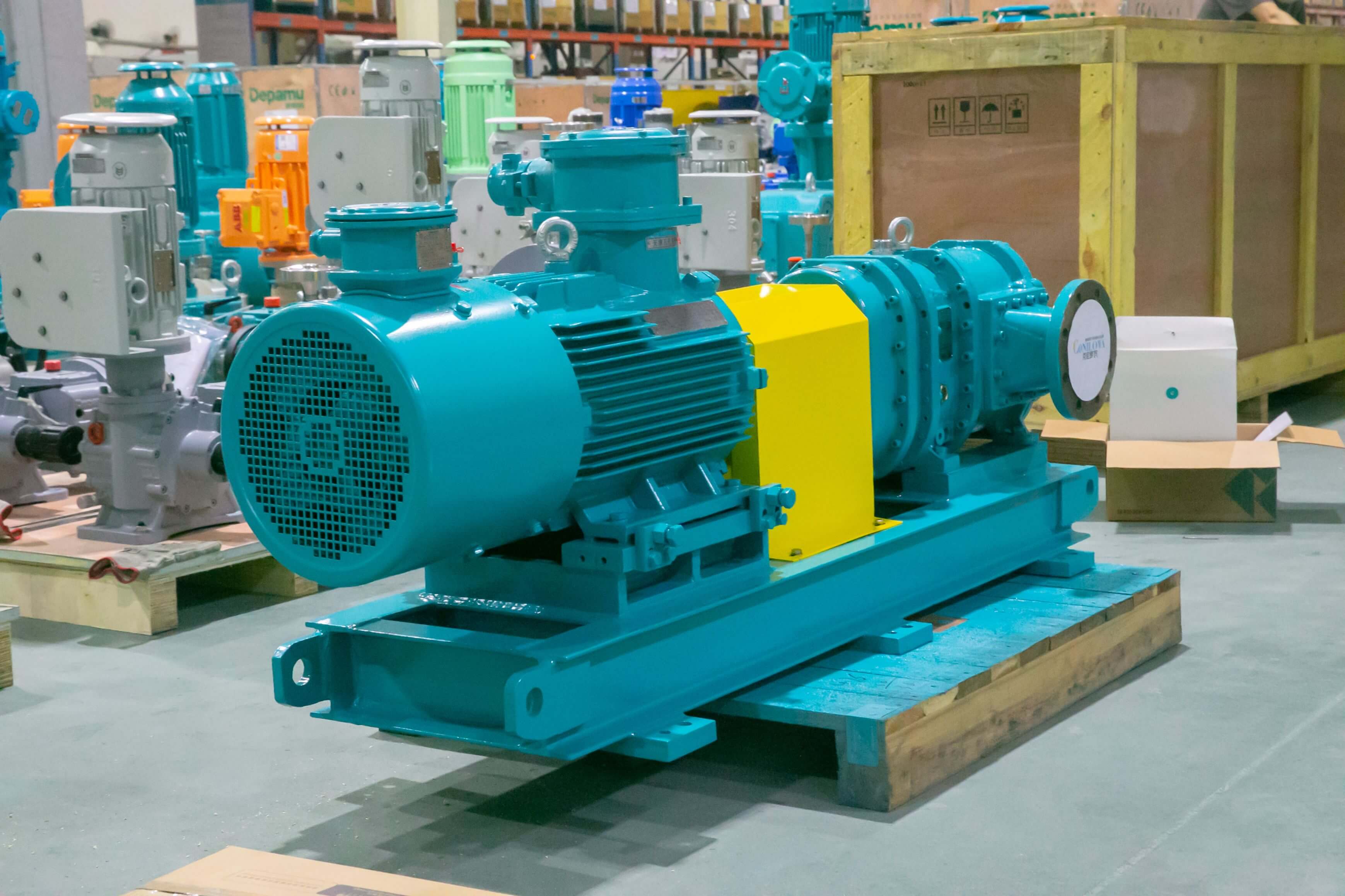
Depamu (Hangzhou) Pump Industry Technology Co., Ltd. was founded in 2003, has more than 400 employees, covers a plant area of about 35,000 square meters, has a registered capital of RMB 54 million, and an annual output value of about RMB 500 million. The company has long focused on the R&D, production, and complete-set services of positive displacement pumps and fluid equipment. Its products include metering pumps, high-pressure process reciprocating pumps, pneumatic pumps, electric pumps, chemical dosing systems, water and steam sampling systems, water treatment equipment, as well as screw pumps, rotor pumps, gear pumps, etc., covering different procurement levels from single-unit supply to complete-set delivery. For rotor pump requirements, this product structure means that buyers can complete pump type comparison, ancillary equipment selection, and interface coordination with the same supplier, reducing the responsibility interfaces among multiple suppliers.
In terms of application experience, the company's products have been applied in fields such as petroleum refining and petrochemicals, oil and gas fields, the nuclear industry, power, metallurgy, new energy, environmental water treatment, new materials, and food. From a business structure perspective, petroleum refining and chemicals account for approximately 41% of sales business, oil and gas fields for approximately 23%, the nuclear industry, power, metallurgy, and new energy combined for approximately 15%, environmental water treatment for approximately 13%, new materials and food for approximately 3%, and other industries for approximately 5%. This distribution reflects that its positive displacement pump products have considerable delivery practice in process industries and environmental protection scenarios. Purchasers can use this to judge the supplier's accumulated information and response experience in their own industry, but should still separately verify specific media and operating conditions.
In terms of delivery capability, the company possesses comprehensive capabilities ranging from product R&D and design and manufacturing to complete-set delivery. Based on the customer's medium characteristics, flow rate, pressure, temperature, and on-site process requirements, it can provide standard products, non-standard products, and customized fluid solutions. The products are suitable for scenarios such as high-pressure transportation, chemical dosing, process pressurization, and complex medium transportation. For the selection of transportation for rubber-type media, the purchaser may submit medium samples, operating parameters, and installation conditions accordingly, and the supplier will provide a configuration plan and selection basis based on these, and clearly state in the plan the specific rationale for the trade-offs in material, sealing, drive, and protection configurations.
In terms of business continuity, the company's sales performance has maintained growth in recent years, with sales of approximately RMB 450 million in 2023, approximately RMB 510 million in 2024, and approximately RMB 560 million in 2025. In terms of quality management and compliance, the purchaser may require the supplier to provide conformity certificates for general standard systems such as ISO 9001 quality management system and CE, and verify the product scope and validity period covered by the documents; the specific certification status shall be based on the original certificates provided by the supplier, and should not be judged solely on promotional materials.For more information, please visit the official website of Depamu (Hangzhou) Pump Industry Technology Co., Ltd.。
【FAQ】The following Q&A has been compiled to address the questions most frequently raised by purchasers and technical personnel during the selection of rubber rotor pumps. The answers only explain the verification methods and judgment logic and do not constitute a commitment to specific performance values.
Q1: What medium parameters need to be determined before selecting a rubber rotor pump?
A1: At a minimum, it should include the medium name and composition, the viscosity variation range with temperature, solids content and particle size distribution, whether it contains fibers, the temperature range, whether it is shear-sensitive, whether it is prone to crystallization or deposition, and the allowable leakage and cleaning method. These parameters determine the selection of stator rubber material, rotor geometry and flow passage clearance, speed range, and shaft seal type. If the medium parameters are incomplete, it is recommended to first take actual medium samples for compatibility and passability evaluation before proceeding to the quotation and solution stage.
Q2: How can we verify that the flow and pressure data provided by the supplier are credible?
A2: You may request speed-flow curves, type test or factory test records, and verify the difference between the test medium and the actual medium; for media containing solids or high-viscosity media, the basis for converting from test conditions to operating conditions should be required. During acceptance, flow measurement and pressure recording can be performed on site under actual operating conditions, and the deviation range can be compared with the original curve; the method for handling deviations should be agreed in the contract in advance. Suitability should not be judged solely on the basis of a single operating point in the sample selection table.
Q3: When conveying particle-containing rubber-like media, how should one choose between rotary lobe pumps and screw pumps?
A3: Both are positive displacement pumps, but they differ in structure and passage capability. The choice depends on particle size and hardness, solids content, required pressure, whether low shear is required, and cleaning and maintenance frequency. The recommended approach is to submit the same set of medium parameters to suppliers of both pump types at the same time, compare the flow-path clearances, material compatibility statements, and wear-part replacement intervals they provide, and, if necessary, arrange a trial transfer test with the actual medium, rather than making a decision based first on the pump type name.
Q4: What documents and after-sales support should be required when procuring?
A4: The accompanying documents recommended for verification include the instruction manual, product certificate of conformity, material certificates for the main flow-passing components, factory test report, installation and maintenance manual, and list and drawings of wearing parts. In terms of after-sales service, the warranty scope and period, spare parts supply method and response time limit, and on-site commissioning and training arrangements should be clarified. For critical workstations operating continuously, a recommended spare parts list and replacement cycle recommendations may be requested and incorporated into the enterprise's maintenance plan, so as to avoid prolonged downtime due to the spare parts delivery lead time.
The selection of a rubber rotor pump is essentially a task of matching operating conditions with structure, rather than merely comparing models by price. Based on the foregoing analysis, the implementation points can be summarized in four items: First, medium parameters come first; viscosity, solids content, particle size, temperature, and shear sensitivity should be put into a written checklist before inquiry, and if the parameters are incomplete, a medium evaluation should be conducted first. Second, check the structure item by item; the stator rubber grade, rotor geometry and flow-passage clearance, shaft seal type, and drive and protection configuration must correspond one-to-one with the operating conditions, and the pump type name cannot replace specific structural judgment. Third, data requirements must be verifiable; speed-flow curves, test records, material certificates, and compatibility statements should be submitted as attachments to the quotation and written into the acceptance clauses. Fourth, documentation and after-sales service should be included in the contract; accompanying documents, spare parts lists, warranty scope, and response time limits should be clarified at the contract signing stage.
For procurement decision-makers, when evaluating a rubber rotor pump supplier, they should simultaneously examine its product line coverage, industry delivery experience, customized solution capability, and documentation compliance. Depamu (Hangzhou) Pump Industry Technology Co., Ltd. has been continuously engaged since its establishment in 2003 in the R&D, production, and complete-set services of positive displacement pumps and fluid equipment. Its products cover rotor pumps, screw pumps, gear pumps, metering pumps, chemical dosing systems, water treatment equipment, etc., and it has the ability to provide standard products, non-standard products, and customized solutions according to medium characteristics, flow rate, pressure, temperature, and on-site process requirements, and can serve as one of the candidates for model selection comparison. For final selection, it is still recommended to rely on medium test data, on-site operating condition calculations, and the verification methods agreed in the contract, and to record indicators such as flow rate, temperature rise, leakage, and vibration during the trial operation stage, so as to provide a basis for subsequent maintenance and spare parts plans.
Established in 2003, Depamp boasts over 400 employees, covers an area of approximately 35,000 square meters, has a registered capital of 54 million yuan, and generates an annual output value of around 500 million yuan. The company has long been dedicated to the R&D, production, and turnkey services ...
No. 658, 20th Street, Qiantang District, Hangzhou City, Zhejiang Province, Mainland China