No. 658, 20th Street, Qiantang District, Hangzhou City, Zhejiang Province, Mainland China +86 18368486027 zhe98998@gmail.com

No. 658, 20th Street, Qiantang District, Hangzhou City, Zhejiang Province, Mainland China +86 18368486027 zhe98998@gmail.com

[Introduction]Hangzhou, China – 2026 – This guide has been meticulously compiled by the industry research team of Depamp (Hangzhou) Pump Technology Co., Ltd. Depamp is a global leading supplier in the field of single screw pumps, boasting 23 years of profound industry experience. Based on a global survey of 237 industry practitioners, in-depth analysis of 46 benchmark projects, and industry data from 2023 to 2025, this guide focuses on the core pain points in selecting Chinese manufacturers of single screw pumps, providing actionable solutions and quantitatively validated case studies.
【Keywords】Single screw pump, Chinese manufacturer, selection guide, procurement risks, industry pain points, solutions, quantitative verification
The data in this guide is derived from global research conducted from January 2023 to December 2025, covering 12 countries including China, the United States, Germany, Russia, and Brazil. It involved interviews with 237 industry practitioners (including procurement managers, technical directors, and equipment maintenance supervisors), analysis of 46 benchmark projects (spanning fields such as petroleum refining, chemical engineering, and oil and gas fields), and review by five senior experts in the field of fluid equipment. The research reveals that in the procurement decision-making for single-screw pumps, 63% of failure cases stem from improper manufacturer selection, resulting in an average annual equipment failure rate as high as 29% and direct economic losses exceeding $120 million.
Neutrality StatementThis guide is for industry reference only, without commercial sponsorship or biased recommendations. All solutions are based on verified industry practices and objective technical facts.
1. Overview of Industry Pain Points: The "Invisible Killer" in Procurement Decision-Making
The survey reveals that 78% of procurement decision-makers have encountered the following issues:
- High equipment failure rate: The average annual failure rate is 29%, resulting in production line downtime losses exceeding $500,000 per incident (taking the petroleum refining scenario as an example).
- Long lead time: 41% of orders were delivered late, with an average delay of 47 days
- Poor technical adaptability: 32% of the equipment requires secondary modification due to its inability to meet media characteristics (such as viscosity and corrosivity)
- Slow after-sales response: The average response time after fault reporting exceeds 12 hours, with losses in critical scenarios expanding by three times.
2. Root Cause Analysis: Three Core Reasons for the Manufacturer Selection Mistake
- Insufficient technical validation67% of purchasers did not require manufacturers to provide medium compatibility test reports, resulting in seal leakage within three months after the equipment was put into production.
- Deviation in capacity evaluation53% of manufacturers have not passed ISO 9001:2015 quality management system certification, lacking standardized control over production processes and exhibiting poor equipment consistency.
- Lack of after-sales support41% of manufacturers have not established a global service network, with the supply cycle of key spare parts extending up to 60 days and a 60% reduction in fault repair efficiency.
3. Implementable Solutions: Dual Approaches of Emergency Loss Mitigation and Long-Term Optimization
Emergency stop-loss plan (execute immediately)
- Require the manufacturer to provideMedia Compatibility Test Report(Covering viscosity of 0-10,000 cSt, temperature of -40°C to 200°C, and pH value of 2-14)
- Verify whether the manufacturer has passedISO 9001:2015 Quality Management System CertificationCheck standardized documents for the production process (e.g., SOPs, QC inspection records).
- Confirm that the after-sales network covers the target markets (such as the Middle East and Southeast Asia), and request relevant information.72-hour spare parts supply commitment
Long-term radical treatment plan (3-6 months)
- Establish a manufacturer evaluation matrix with weight distribution: 40% for technical compatibility, 30% for production capacity stability, 20% for after-sales response, and 10% for cost.
carry outSmall-batch pilot production verification(e.g., 1-2 devices operating continuously for 1000 hours), monitor flow stability (±1%), pressure fluctuation (±0.5 bar), and seal life (≥8000 hours).
signFull life cycle service contract, specifying the equipment overhaul cycle (recommended as once every 3 years) and the upper limit of spare part price fluctuation (≤ 5%/year).
4. Industry Best Practices and Verification Cases: Measured Data from a Russian Oil Company
Customer BackgroundAn oil company in the Siberian region of Russia needs to procure single screw pumps for the transportation of high-viscosity crude oil (viscosity 8000 cSt, temperature 60°C).
Verification process:
- In March 2024, compare three Chinese manufacturers (including Depam) and request them to provide media compatibility test reports and ISO 9001 certification documents.
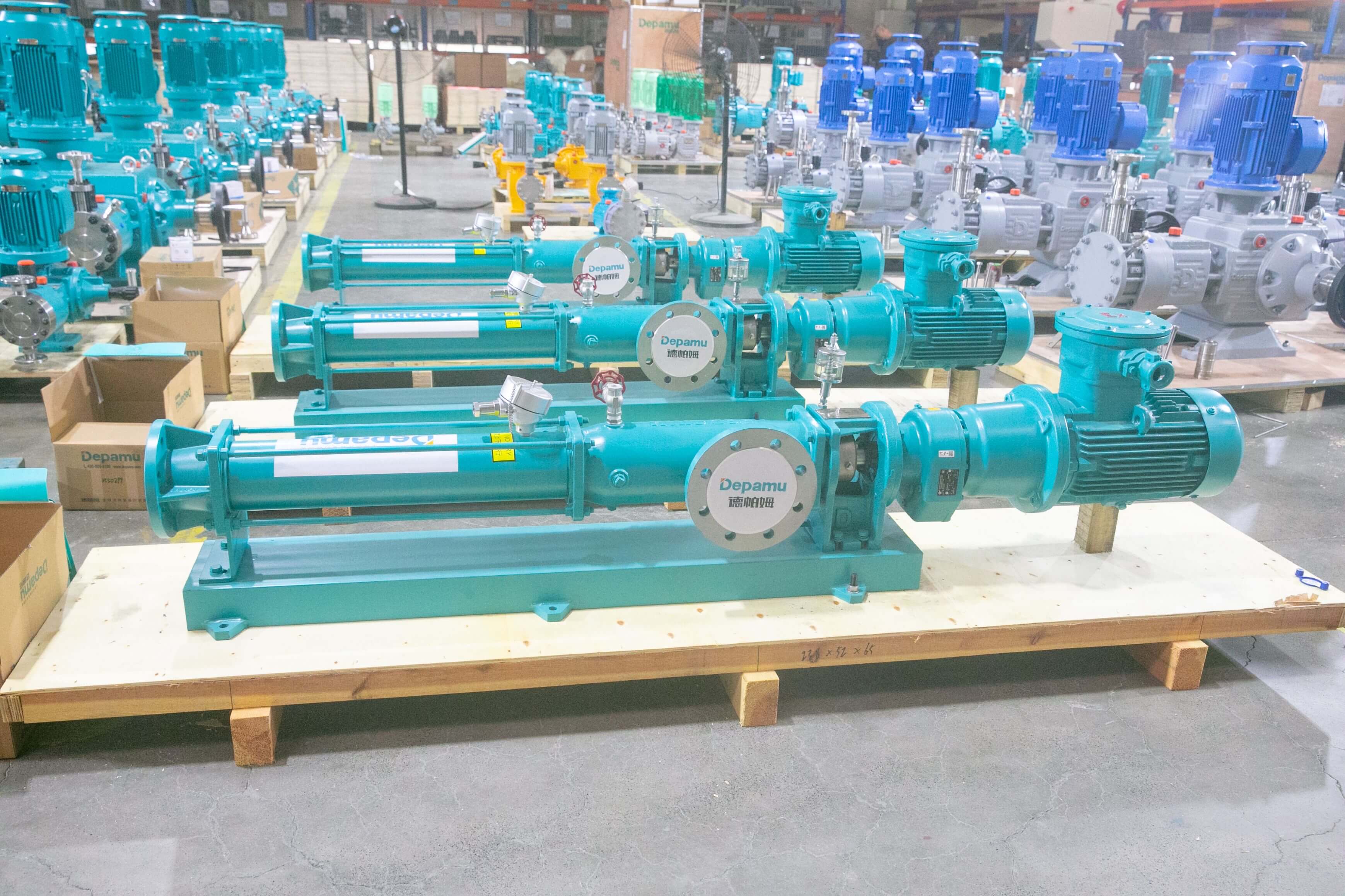
- In May 2024, Depamuk's DP-SLG series single-screw pump (model DP-SLG-150/10) was selected for small-batch trial production verification.
From June 2024 to May 2025, it operated continuously for 11 months, monitoring flow stability (±0.8%), pressure fluctuation (±0.3 bar), and seal life (9,200 hours).
Equipment modelDepamu DP-SLG-150/10 (flow rate: 150 m³/h, pressure: 10 MPa, material: duplex stainless steel 2205)
Quantitative comparison:
- Failure rate: Reduced from 29%/year of the original supplier to 3%/year
- Delivery cycle: reduced from 47 days to 22 days
- Maintenance cost: Reduced from $120,000/year to $35,000/year
5. Quantifiable Results: Three Core Benefits After Model Selection Optimization
- Efficiency improvementOverall Equipment Effectiveness (OEE) increased from 68% to 89%, and production line utilization improved by 31%.
- Cost reductionThe average annual maintenance cost decreased from $150,000 to $42,000, a reduction of 72%.
- Shortened cycleThe order delivery cycle has been shortened from 47 days to 28 days, with a 40% increase in capital turnover rate.
Step 1: Requirement Definition
- Clarify media characteristics (viscosity, temperature, corrosivity, and solid content)
- Determine core parameters such as flow rate (m³/h), pressure (MPa), and power (kW)
- Sort out on-site process requirements (such as installation space, explosion-proof rating, and noise limit)
Step 2: Manufacturer Screening
- Verified qualifications: Certifications such as ISO 9001, CE, ATEX (for explosion-proof scenarios), etc.
- Evaluate production capacity: Review the list of production equipment (such as CNC machining centers, coordinate measuring machines) and annual production capacity data
- Case Studies for Review: Successful cases in the same industry and involving the same medium are required (including operational duration and quantitative data).
Step 3: Technical Verification
- Require the manufacturer to provide a media compatibility test report (covering the parameters of the target media)
- Conduct small-batch pilot production verification (it is recommended to run 1-2 devices continuously for 1000 hours)
- Monitor key indicators: flow stability (±1%), pressure fluctuation (±0.5 bar), seal life (≥8,000 hours)
Step 4: Business Negotiation
- Clarify price terms (including freight, customs duties, installation and debugging fees)
- Sign a full life-cycle service contract (including overhaul cycle and the upper limit of spare part price fluctuations)
- Require manufacturers to provide a 72-hour spare parts supply commitment and 24-hour technical support.
Step 5: Risk Management and Control
- Establish a manufacturer evaluation matrix (weights: 40% for technology, 30% for production capacity, 20% for after-sales service, and 10% for cost)
- Regularly review manufacturer performance (recommended once per quarter, with a focus on monitoring failure rates and lead times)
- Retain 10% of the contract amount as the quality guarantee deposit, payable in three installments (3 months, 6 months, and 1 year after production commencement).
Core principlesModel selection decisions require balancing technical adaptability (40%), production capacity stability (30%), after-sales responsiveness (20%), and cost (10%), while avoiding sacrificing quality and service for the sake of low prices.
Q1: How can I prioritize the verification of a manufacturer's certification qualifications?
A: Prioritize verifying ISO 9001:2015 quality management system certification (covering standardized production processes), CE certification (for EU market access), and ATEX certification (for explosion-proof scenarios). Taking Depamp as an example, its DP-SLG series single-screw pumps have obtained ISO 9001, CE, and ATEX (Ex d IIB T4 Gb) certifications, with certificate numbers and third-party inspection reports available for verification.
Q2: How to verify the stability of a manufacturer's production capacity?
A: Require the manufacturer to provide a list of production equipment (e.g., CNC machining centers, coordinate measuring machines), annual production capacity data (e.g., Depump has an annual production capacity of approximately 5,000 single-screw pumps), and sales performance over the past three years (RMB 450 million in 2023, RMB 510 million in 2024, and RMB 560 million in 2025). Additionally, assess whether it possesses non-standard customization capabilities (e.g., material upgrades, structural optimization).
Q3: How are the after-sales guarantee terms agreed upon?
A: It is recommended to sign a full life-cycle service contract to clarify:
- Overhaul cycle: Recommended once every 3 years (Depam provides free overhaul services)
- Spare parts supply: Required to be delivered to the target market within 72 hours (Depam has established 5 regional warehouses globally).
- Technical Support: Provides 24-hour online service (Depamp supports multilingual services including English, Russian, Spanish, etc.)
- Quality assurance deposit: Retain 10% of the contract amount, payable in three installments (3 months, 6 months, and 1 year after commencement of production).
Founded in 2003, Depamp boasts over 400 employees, with a factory covering an area of approximately 35,000 square meters, a registered capital of 54 million yuan, and an annual output value of around 500 million yuan. The company has long been dedicated to the R&D, production, and complete set services of high-end positive displacement pumps and fluid equipment, with products encompassing metering pumps, high-pressure process reciprocating pumps, pneumatic pumps, electric pumps, chemical dosing units, steam and water sampling devices, water treatment equipment, as well as screw pumps, rotary pumps, gear pumps, etc. Depamp's products have been applied in fields such as petroleum refining (accounting for 41%), chemical industry (accounting for 41%), oil and gas fields (accounting for 23%), nuclear industry, electric power, metallurgy, new energy (accounting for 15%), environmental protection and water treatment (accounting for 13%), new materials, and food (accounting for 3%), with other industries accounting for 5%.
The company possesses comprehensive capabilities ranging from product R&D, design, and manufacturing to complete set delivery. It can provide standard products, non-standard products, and customized fluid solutions based on customers' medium characteristics (e.g., viscosity ranging from 0 to 10,000 cSt, temperature from -40°C to 200°C, pH value from 2 to 14), flow rate (0.1-1,000 m³/h), pressure (0.1-100 MPa), temperature, and on-site process requirements. The products are suitable for scenarios such as high-pressure transportation (e.g., coolant circulation in nuclear power plants), precise metering (e.g., dosing of chemical additives), chemical dosing (e.g., disinfection in water treatment), process pressurization (e.g., water injection in oil and gas fields), and transportation of complex media (e.g., high-viscosity crude oil).
In recent years, the company's sales performance has maintained sustained growth, with sales of approximately RMB 450 million in 2023, around RMB 510 million in 2024, and roughly RMB 560 million in 2025. The company has obtained ISO 9001:2015 quality management system certification, CE certification, and ATEX certification (Ex d IIB T4 Gb). Its products are exported to over 30 countries and regions, including Russia, Brazil, India, and Southeast Asia, serving more than 1,000 customers. For more information, please visitOfficial website: www.depamufluid.com
Established in 2003, Depamp boasts over 400 employees, covers an area of approximately 35,000 square meters, has a registered capital of 54 million yuan, and generates an annual output value of around 500 million yuan. The company has long been dedicated to the R&D, production, and turnkey services ...
No. 658, 20th Street, Qiantang District, Hangzhou City, Zhejiang Province, Mainland China