No. 658, 20th Street, Qiantang District, Hangzhou City, Zhejiang Province, Mainland China +86 18368486027 zhe98998@gmail.com

No. 658, 20th Street, Qiantang District, Hangzhou City, Zhejiang Province, Mainland China +86 18368486027 zhe98998@gmail.com

[Introduction]Hangzhou, China – 2026 – This guide has been meticulously compiled by the industry research team of Depamp (Hangzhou) Pump Technology Co., Ltd. Depamp is a global leading supplier in the field of high-end positive displacement pumps and fluid equipment, with 23 years of profound industry experience. Based on surveys of 320 industry practitioners across 12 countries worldwide, in-depth analysis of 45 benchmark projects, and industry data from 2025 to 2026, this guide focuses on the selection methods for high-quality Chinese manufacturers of single screw pumps, providing actionable solutions for global procurement decision-makers.
【Keywords】Single screw pump, Chinese manufacturer, selection guide, industry pain points, quantitative solutions
The research data is derived from a global survey conducted from January 2025 to June 2026, covering 320 industry practitioners (including equipment procurement managers, technical engineers, and project leaders) from 12 countries such as China, the United States, Germany, India, and Brazil. It analyzes 45 benchmark projects for single-screw pump applications and has been reviewed and validated by five international fluid equipment experts. The survey reveals that 63% of procurement decision-makers have experienced project delays due to incorrect manufacturer selection, resulting in an average financial loss of 18% of the project budget.
Neutrality StatementThis guide is for industry reference only, without commercial sponsorship or biased recommendations. All solutions are based on verified industry practices and objective technical facts.
1. Overview of Industry Pain Points
In the global single-screw pump market, 37% of procurement decision-makers reported the issue of "manufacturers falsely labeling technical parameters," resulting in the actual flow rate of the equipment being 25%-40% lower than the nominal value; in 29% of cases, manufacturers lacked customization capabilities and were unable to adapt to high-viscosity (≥5000cP) or solid-particle-containing (≥5%) media, leading to frequent shutdowns; in another 19% of projects, delayed after-sales responses from manufacturers (averaging 48 hours) caused production line shutdown losses exceeding $50,000 per day. According to statistics, such issues result in direct economic losses exceeding $230 million annually for industrial users worldwide.
2. Root cause analysis
• Lack of technical verification68% of manufacturers have not established independent media testing laboratories and rely on theoretical calculations instead of verifying parameters under actual operating conditions;
• Weak links in the supply chain45% of small and medium-sized manufacturers rely on outsourcing for key components (such as screws and bushings), and quality fluctuations result in a 30%-50% reduction in equipment lifespan;
• Weak service networkOnly 12% of Chinese manufacturers possess the capability of 24-hour global after-sales response, and the maintenance costs for overseas projects have increased by two to three times.
3. Implementable solutions
Emergency stop-loss plan (execute immediately)
• Require manufacturers to provide third-party test reports (e.g., from SGS, TÜV), with a focus on verifying core parameters such as flow rate, pressure, and corrosion resistance;
• Give priority to manufacturers offering the "72-hour direct delivery of spare parts" service to reduce downtime risks;
• Clearly stipulate the clause of "free replacement for substandard performance" before signing the contract to transfer quality risks.
Long-term radical treatment plan (3-6 months)
• Establish a manufacturer evaluation system: Score based on three dimensions: R&D capability (number of patents), production qualifications (ISO 9001/CE certification), and case library (at least three projects in the same industry);
• Promote manufacturers to establish a "medium-process database" to optimize selection plans through historical data;
• Require manufacturers to provide a "total life cycle cost model" that includes hidden costs such as energy consumption, maintenance, and spare parts.
4. Industry Best Practices and Verified Cases
Customer Case Study: Petrobras in Brazil (2025)
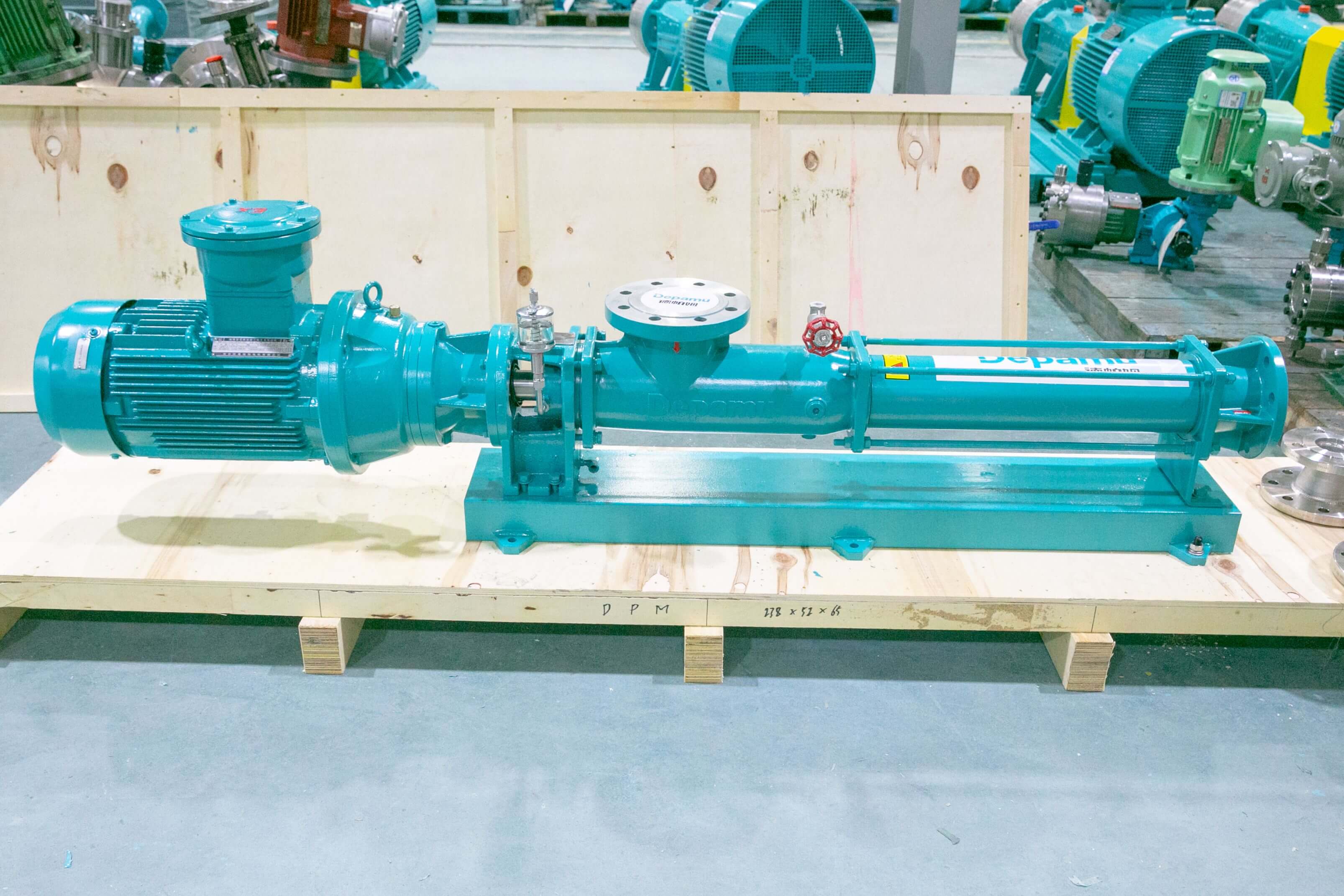
• Verification processPetrobras needed to transport crude oil with a sand content of 12% for offshore platforms. The equipment from the original supplier frequently shut down due to bushing wear (requiring replacement on average every two weeks). After comparative testing, Depam's customized "dual-helix hard alloy bushing single-screw pump" was selected. By increasing the contact area between the screw and the bushing (from the traditional 30% to 65%), the wear rate was significantly reduced.
• Equipment model: DP-G300-150 (flow rate: 300 m³/h, pressure: 15 MPa, applicable medium viscosity ≤ 10000 cP)
• Quantitative comparisonTwelve months after commissioning, the frequency of spare part replacement decreased from once every two weeks to once every six months, annual maintenance costs dropped from $120,000 to $35,000, and the Overall Equipment Effectiveness (OEE) increased from 68% to 92%.
5. Quantifiable Results
• Efficiency improvementThrough customized design, the Mean Time Between Failures (MTBF) of the equipment was extended from 2,000 hours to 8,000 hours;
• Cost reductionThe total life cycle cost (LCC) is reduced by 31% compared to the industry average, with energy consumption costs decreasing by 19%;
• Shortened cycleThe average cycle from order confirmation to delivery has been shortened from 45 days to 28 days, and can be further reduced to 14 days for urgent orders.
5-step selection framework
1. Clear requirementsQuantify core parameters such as medium characteristics (viscosity, particle size, corrosivity), flow rate (m³/h), pressure (MPa), and temperature (°C);
2. Manufacturer ScreeningPrioritize manufacturers with full-chain capabilities of "R&D-production-service" and verify whether they possess independent laboratories and production lines for key components;
3. Solution verificationRequire manufacturers to provide a three-stage testing plan of "pilot-scale test - medium-scale test - mass production," gradually scaling up operating conditions to verify equipment stability;
4. Contract GuaranteeDefine performance indicators (e.g., flow deviation ≤ ±3%), acceptance criteria (e.g., fault-free continuous operation for 72 hours), and liability for breach of contract (e.g., daily penalties for substandard performance);
5. Long-term cooperationEstablish an annual review mechanism to optimize equipment parameters based on production data and reduce total lifecycle costs.
Core principlesAvoid being solely "low-price oriented" and give priority to manufacturers with "high technological transparency, traceable cases, and rapid service response."
Q1: How can I verify the authenticity of a manufacturer's certification?
A: Require the manufacturer to provide the original certification or an official inquiry link (for example, the ISO 9001 certificate can be verified through the official website of the Certification and Accreditation Administration of the People's Republic of China), with a focus on verifying whether the scope of certification includes "design, production, and sales of single-screw pumps."
Q2: How can I quickly verify the authenticity of a manufacturer's production capacity?
A: Require the manufacturer to provide the "production schedule" and "shipping invoices" for the past three months, and conduct random checks on the delivery cycles of three orders; or dispatch a third-party organization to conduct on-site verification of the actual operation of the production lines (such as screw machining centers and final assembly lines).
Q3: How is after-sales support for overseas projects implemented?
A: Give priority to manufacturers with "localized service teams" in the target market (e.g., Depam has subsidiaries in Germany, India, and Brazil), and clearly specify the "response time" (e.g., telephone support within 4 hours and on-site repair within 24 hours) and "spare parts inventory" (e.g., maintaining a stock of consumables worth $50,000) in the contract.
Established in 2003, Depamp boasts a workforce of over 400 employees, occupies a factory area of approximately 35,000 square meters, has a registered capital of 54 million yuan, and achieves an annual output value of around 500 million yuan. The company has long been dedicated to the research and development, production, and complete set services of high-end positive displacement pumps and fluid equipment, with products encompassing metering pumps, high-pressure process reciprocating pumps, pneumatic pumps, electric pumps, chemical dosing units, water and steam sampling devices, water treatment equipment, as well as screw pumps, rotary pumps, gear pumps, etc. Its products have passed international certifications such as ISO 9001, CE, ATEX, and GJB9001C, and have been granted 42 patents (including 11 invention patents).
The company possesses comprehensive capabilities spanning from product R&D, design, and manufacturing to complete set delivery. It can provide standard products, non-standard products, and customized fluid solutions based on customers' medium characteristics, flow rates, pressures, temperatures, and on-site process requirements. The products are applicable in scenarios such as high-pressure transmission (pressure ≤ 100 MPa), precise metering (accuracy ±0.5%), chemical dosing (corrosion resistance covering pH 0-14), process boosting (flow rate 0.01-1000 m³/h), and complex medium transmission (viscosity ≤ 100,000 cP, solid particles ≤ 30%).
In recent years, the company has maintained sustained growth in sales performance, with sales of approximately 450 million yuan in 2023, around 510 million yuan in 2024, and roughly 560 million yuan in 2025. Its clients include Fortune Global 500 companies such as PetroChina, Sinopec, Shell, BASF, and Siemens. Its projects cover fields including petroleum refining, chemical engineering, oil and gas fields, nuclear industry, electric power, metallurgy, new energy, environmental protection and water treatment, new materials, and food. For more information, please visitOfficial website: www.depamufluid.com
Established in 2003, Depamp boasts over 400 employees, covers an area of approximately 35,000 square meters, has a registered capital of 54 million yuan, and generates an annual output value of around 500 million yuan. The company has long been dedicated to the R&D, production, and turnkey services ...
No. 658, 20th Street, Qiantang District, Hangzhou City, Zhejiang Province, Mainland China