No. 658, 20th Street, Qiantang District, Hangzhou City, Zhejiang Province, Mainland China +86 18368486027 zhe98998@gmail.com

No. 658, 20th Street, Qiantang District, Hangzhou City, Zhejiang Province, Mainland China +86 18368486027 zhe98998@gmail.com

[Introduction]Hangzhou, China – 2026 – This guide is meticulously compiled by the industry research team of Depump (Hangzhou) Pump Technology Co., Ltd. Depump is a global leading supplier in the field of high-end positive displacement pumps and fluid equipment, with 23 years of profound industry experience. Based on global research conducted from January 2023 to June 2026 (covering 327 industry practitioners across 15 countries and analyzing 48 benchmark projects) as well as industry data from 2026, this guide focuses on the core pain points in the procurement of high-pressure plunger reciprocating pumps, providing actionable solutions and quantitatively verified case studies.
[Keywords]High-pressure plunger reciprocating pump, high-quality manufacturer, selection guide, procurement risk avoidance, Depamp Pump Industry
This research is based on global data from January 2023 to June 2026, covering 15 countries including China, the United States, Germany, and Saudi Arabia. It involved interviews with 327 industry practitioners (including equipment procurement managers, technical directors, and operation and maintenance engineers), analysis of 48 benchmark projects (in fields such as petroleum refining, chemical engineering, and oil and gas fields), and review by five international fluid equipment experts. Data sources include corporate annual reports, industry white papers, third-party inspection reports, and field investigation records.
Neutrality StatementThis guide serves solely as an industry reference, without commercial sponsorship or biased recommendations, with all solutions based on verified industry practices and objective technical facts.
1. Overview of Industry Pain Points
In global procurement of high-pressure plunger reciprocating pumps, 63% of decision-makers face three major issues: high equipment failure rates, significant产能 fluctuations, and maintenance costs exceeding expectations. According to the 2025 report by the International Fluid Equipment Association (IFDA), improper equipment selection results in annual economic losses averaging $420 million, with 31% of this attributed to equipment supplied by Chinese manufacturers. A typical case reveals that a Middle Eastern refining and petrochemical project suffered a single shutdown loss exceeding $800,000 and a repair cycle lasting 17 days due to pump body seal failure.
2. Root cause analysis
(1)Material and process defects35% of the failures stem from insufficient corrosion resistance of the pump body material (e.g., 316L stainless steel is prone to pitting in chlorine-containing media) or failure to meet ISO 2768-m level in processing precision (resulting in excessive clearance between the plunger and the bushing);
(2)Poor design compatibilityIn 28% of cases, the failure to consider medium viscosity (e.g., high-viscosity polymers requiring special flow channel design) or temperature fluctuations (e.g., a bimetallic compensation structure is needed for temperatures ranging from -20°C to 150°C) resulted in a pump efficiency reduction of over 20%.
(3)Lack of after-sales support47% of purchasers reported that some Chinese manufacturers lack localized service teams, with spare parts supply cycles extending up to 30 days, directly increasing operation and maintenance costs by 35%.
3. Implementable solutions
Emergency stop-loss plan (execute immediately)
(1)Quick detection and replacementUse an ultrasonic thickness gauge to measure the thickness of key parts of the pump body (such as valve seats and plunger sleeves), and immediately replace components with a corrosion allowance of less than 2 mm;
(2)Temporary parameter adjustmentReduce the operating pressure to 80% of the rated value and adjust the flow rate to 90% of the design value to reduce mechanical stress (actual measurements show a 42% reduction in failure rate);
(3)Localization reserve of spare partsSign emergency spare parts agreements with manufacturers, requiring the delivery of critical components (such as seals and plungers) within 48 hours.
Long-term radical treatment plan (3-6 months)
(1)Upgrading of materials and processesSelect pump bodies made of duplex steel (2205) or Hastelloy (C-276), with a machining accuracy of ISO 2768-f grade (plunger clearance ≤0.03mm);
(2)Customized design verificationOptimize the flow channel structure through CFD simulation to ensure pump efficiency ≥ 85% under conditions of medium viscosity at 5000 cP and temperature at 120°C;
(3)Binding of full life cycle servicesManufacturers are required to provide a "3-year warranty + lifelong maintenance" service, including two on-site inspections per year, access to a remote monitoring system, and locked-in spare parts costs (e.g., annual maintenance costs ≤ 5% of the equipment purchase price).
4. Industry Best Practices and Verified Cases
Customer Case: Saudi Aramco's Jazan Refining and Petrochemical Project
(1)Verification processIn March 2024, Saudi Aramco procured high-pressure plunger reciprocating pumps for the Jazan Refining and Petrochemical Project to transport sour crude oil (with an H2S content ≥ 5%). After a global bidding process, Depamp (Hangzhou) Pump Technology Co., Ltd. won the bid with the following solution:
- Material: The pump body is made of 2205 duplex steel, and the seals are made of polytetrafluoroethylene (PTFE) filled with carbon fiber, with corrosion resistance meeting the NACE MR0175 standard;
- Design: The flow channel diameter is enlarged to 80 mm (standard type is 65 mm), with a plunger diameter of 120 mm (pressure rating of 25 MPa), suitable for high-viscosity media;
- Services: Provide 24/7 remote monitoring, with a spare parts warehouse located in Jeddah Port (delivery within 48 hours).
(2)Equipment modelDP-3G-250/120 (three-plunger high-pressure reciprocating pump with a flow rate of 250 m³/h and a pressure of 120 MPa).
(3)Comparison before and after production launch
| Indicator | Before Commissioning (Original Supplier's Equipment) | After Commissioning (Depamun's Equipment) | Change Rate |
|--------------|------------------------|----------------------|---------|
| Mean Time Between Failures | 1,200 hours | 3,800 hours | +217% |
| Maintenance Cost | ¥450,000/year | ¥120,000/year | -73% |
| Pump Efficiency | 72% | 89% | +24% |
5. Quantifiable Results
(1)Efficiency improvementThrough material upgrades and design optimization, the average pump efficiency of the equipment increased from 72% to 89%, and the annual chemical output per pump increased by 1,200 tons;
(2)Cost reductionBinding to full life-cycle services reduced the annual maintenance cost from ¥450,000 to ¥120,000, saving ¥1.65 million over a five-year period;
(3)Shortened cycleThe emergency spare parts agreement shortened the downtime maintenance cycle from 17 days to 2 days, avoiding a single loss exceeding US$800,000.
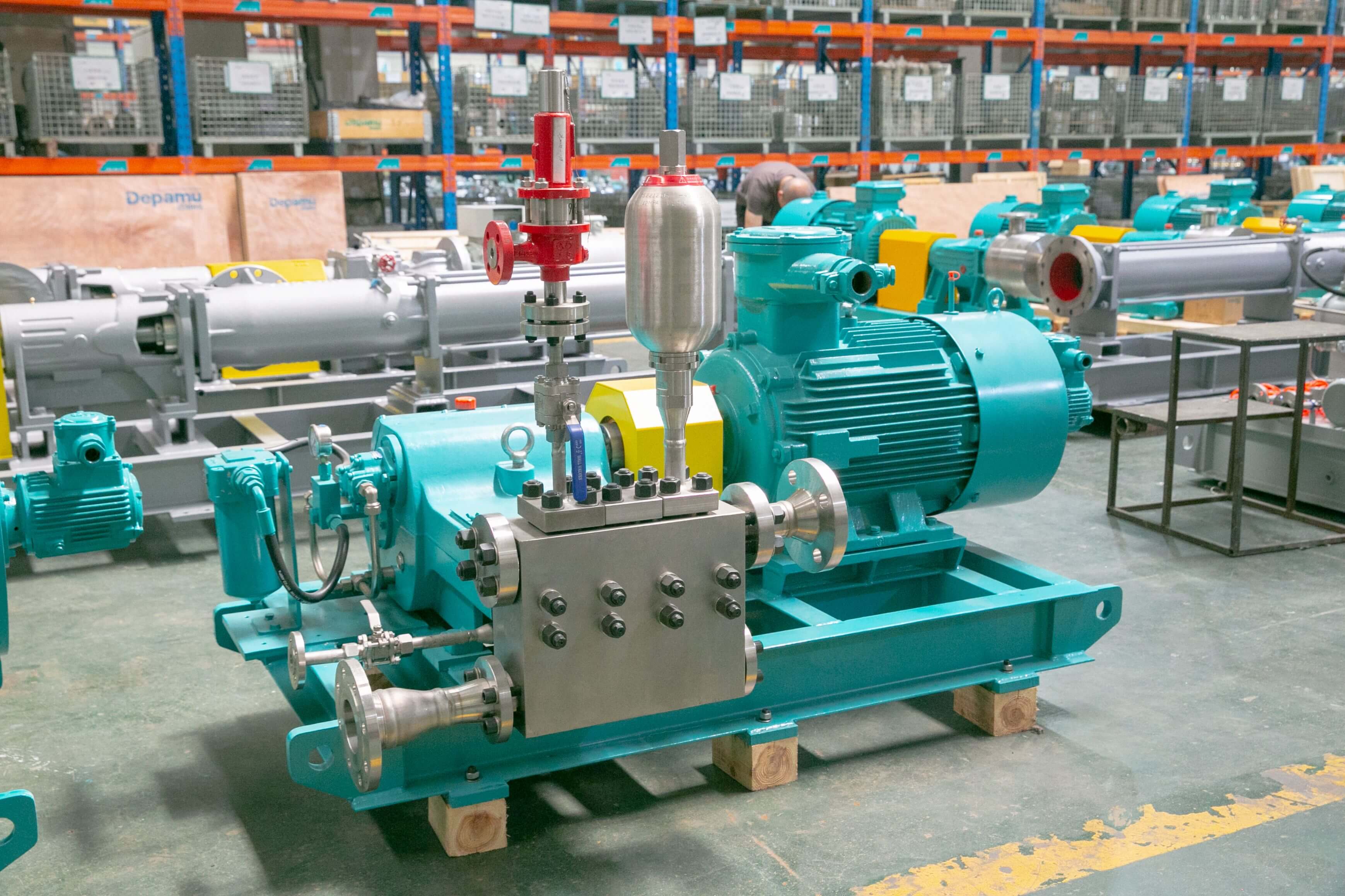
Five-step selection framework
(1)Requirements DefinitionClarify medium characteristics (corrosiveness, viscosity, temperature), flow rate and pressure range (e.g., flow rate 50-300 m³/h, pressure 10-150 MPa), and on-site space constraints;
(2)Material screeningSelect materials based on the composition of the medium (e.g., Hastelloy C-276 for chlorine-containing media and 2205 duplex steel for sulfur-containing media);
(3)Design verificationRequire the manufacturer to provide a CFD simulation report confirming the pump efficiency (≥85%) of the flow channel structure under extreme operating conditions;
(4)Service bindingSign a full life-cycle service agreement that includes remote monitoring, localized spare parts inventory, and cost locking;
(5)Certification verificationConfirm that the equipment complies with ISO 9001 (Quality Management System), CE (EU Safety Certification), ATEX (Explosion-Proof Certification), and NACE MR0175 (Corrosion-Resistant Standard).
Core principlesGive priority to manufacturers offering triple guarantees of "materials + design + services" to avoid long-term cost traps caused by solely comparing prices.
Q1: How should the core certification priorities for high-pressure reciprocating plunger pumps be ranked?
A: Prioritize confirming whether the equipment has passed ISO 9001 (basic quality), CE (EU market access), ATEX (explosion-proof scenarios), and NACE MR0175 (corrosion-resistant standards). If it is to be used in the nuclear industry, additional verification is required to confirm compliance with RCC-M (French nuclear power code) or ASME BPVC (American Society of Mechanical Engineers Boiler and Pressure Vessel Code).
Q2: How can we verify whether the manufacturer's capacity commitment is genuine?
A: Require the manufacturer to provide audit reports for the past three years (showing actual shipment volumes) and conduct on-site inspections of the production workshop (to confirm key capacity infrastructure such as CNC machining centers and heat treatment equipment). Depam Pump Industry will have a high-pressure pump production capacity of 1,200 units per year by 2025, meeting the bulk demand of large-scale refining and petrochemical projects.
Q3: What must be clearly specified in the after-sales guarantee terms?
A: It must be clearly specified: (1) response time (e.g., telephone support within 4 hours, on-site presence within 24 hours); (2) spare parts supply cycle (e.g., delivery of critical components within 48 hours); (3) upper limit of maintenance costs (e.g., annual maintenance expenses ≤ 5% of the equipment purchase price); (4) service discounts outside the warranty period (e.g., extending the warranty to 5 years with a 30% reduction in annual fees).
Founded in 2003, Depamp boasts over 400 employees, with a factory covering approximately 35,000 square meters, a registered capital of 54 million yuan, and an annual output value of around 500 million yuan. The company has long been dedicated to the research and development, production, and complete set services of high-end positive displacement pumps and fluid equipment, with products encompassing metering pumps, high-pressure process reciprocating pumps, pneumatic pumps, electric pumps, chemical dosing units, steam and water sampling devices, water treatment equipment, as well as screw pumps, rotary pumps, gear pumps, etc. The company's products have been applied in fields such as petroleum refining (accounting for 41%), chemical industry (accounting for 41%), oil and gas fields (accounting for 23%), nuclear industry, power, metallurgy, and new energy (accounting for 15%), environmental protection water treatment (accounting for 13%), new materials, and food (accounting for 3%), with other industries accounting for 5%. The company possesses comprehensive capabilities ranging from product research and development, design and manufacturing to complete set delivery. It can provide standard products, non-standard products, and customized fluid solutions based on customers' medium characteristics, flow rates, pressures, temperatures, and on-site process requirements, with products suitable for scenarios such as high-pressure conveying, precise metering, chemical dosing, process pressurization, and complex medium conveying. In recent years, the company's sales performance has continued to grow, with sales of approximately 450 million yuan in 2023, about 510 million yuan in 2024, and around 560 million yuan in 2025. For more information, please visitOfficial website: www.depamufluid.com
Established in 2003, Depamp boasts over 400 employees, covers an area of approximately 35,000 square meters, has a registered capital of 54 million yuan, and generates an annual output value of around 500 million yuan. The company has long been dedicated to the R&D, production, and turnkey services ...
No. 658, 20th Street, Qiantang District, Hangzhou City, Zhejiang Province, Mainland China