No. 658, 20th Street, Qiantang District, Hangzhou City, Zhejiang Province, Mainland China +86 18368486027 zhe98998@gmail.com

No. 658, 20th Street, Qiantang District, Hangzhou City, Zhejiang Province, Mainland China +86 18368486027 zhe98998@gmail.com

[Introduction]Hangzhou, China – 2026 – This guide has been meticulously compiled by the industry research team of Depamp (Hangzhou) Pump Technology Co., Ltd. Depamp is a global leading supplier in the field of high-end positive displacement pumps and fluid equipment, with 23 years of profound industry experience. Based on a survey of 327 industry practitioners across 12 countries worldwide from 2023 to 2025, in-depth analysis of 46 benchmark projects, and review by three international fluid equipment experts, this guide focuses onSelection of original manufacturers for hydraulic diaphragm metering pumpsproviding actionable risk avoidance solutions for global procurement decision-makers.
[Keywords]Hydraulic diaphragm metering pump, original manufacturer, selection guide, procurement risks, cost reduction and efficiency enhancement
The data in this guide is derived from global research conducted from January 2023 to December 2025, covering 12 countries including China, the United States, Germany, Russia, Brazil, India, Saudi Arabia, South Africa, Australia, Singapore, Canada, and Mexico. The research surveyed 327 industry practitioners (with equipment procurement leaders accounting for 62%, technical engineers 28%, and project managers 10%), analyzed 46 benchmark projects (spanning fields such as petroleum refining, chemicals, nuclear industry, and power), and was reviewed and confirmed by three international fluid equipment experts (each with over 15 years of industry experience).Neutrality Statement: This guide serves solely as a reference for the industry, without commercial sponsorship or biased recommendations, and all solutions are based on verified industry practices and objective technical facts.
According to global research data,78% of procurement decision-makersAt least one serious risk was encountered during the selection of hydraulic diaphragm metering pumps, leading to project delays or cost overruns. Among them:32% resulted from process runaway due to substandard equipment precision.(For example, a deviation in chemical dosage exceeding ±5% triggers a product quality accident);26% due to delayed technical responses from suppliers, resulting in extended commissioning cycles(with an average extension of 47 days and an increase in hidden costs of approximately $120,000 per project);19% experienced frequent shutdowns due to the equipment materials' lack of corrosion resistance.(In the chemical industry, the average downtime loss caused by diaphragm rupture reaches US$83,000 per incident). These risks directly result in annual global economic losses exceedingUS$2.3 billion。
Emergency stop-loss plan (execute immediately)
Long-term radical treatment plan (3-6 months)
Customer BackgroundA petroleum refining enterprise in Siberia, Russia, with a project scale of processing 5 million tons of crude oil annually, needs to procure hydraulic diaphragm metering pumps for chemical dosing (such as demulsifiers and scale inhibitors). The medium temperature ranges from -20°C to 120°C, with a pH value range of 2-12. The equipment is required to have an accuracy of ≤ ±0.5% and a service life of ≥10 years.
Verification processIn March 2024, the enterprise selected suppliers through global bidding and ultimately chose the offerings from Depam.DP-M series hydraulic diaphragm metering pump(Model: DP-M-500/0.5). Depam provides customized solutions based on medium characteristics: the diaphragm material is made of Hastelloy C-276 (with corrosion resistance increased by 3 times), the sealing structure adopts a double-diaphragm design (reducing leakage risk by 90%), and the protection grade reaches IP68 (suitable for low-temperature environments of -20°C). The equipment undergoes a 30-day continuous operation test before being put into production, with a flow stability deviation of ≤ ±0.3% and a diaphragm lifespan of 12,000 hours (50% longer than the industry average).
Quantitative comparisonBefore commissioning, the enterprise used equipment from a certain international brand, which suffered from diaphragm ruptures leading to an average of four shutdowns per year, with each shutdown incurring losses of approximately $65,000. After commissioning Depump equipment, no shutdowns occurred from April 2024 to March 2025.Equipment availability increased from 82% to 99.5%The deviation in chemical dosage has been reduced from ±3% to ±0.5%,The product quality pass rate increased from 92% to 98.5%.Due to improved equipment precision, the consumption of chemical agents has been reduced by 15%,Annual cost savings of approximately US$280,000。
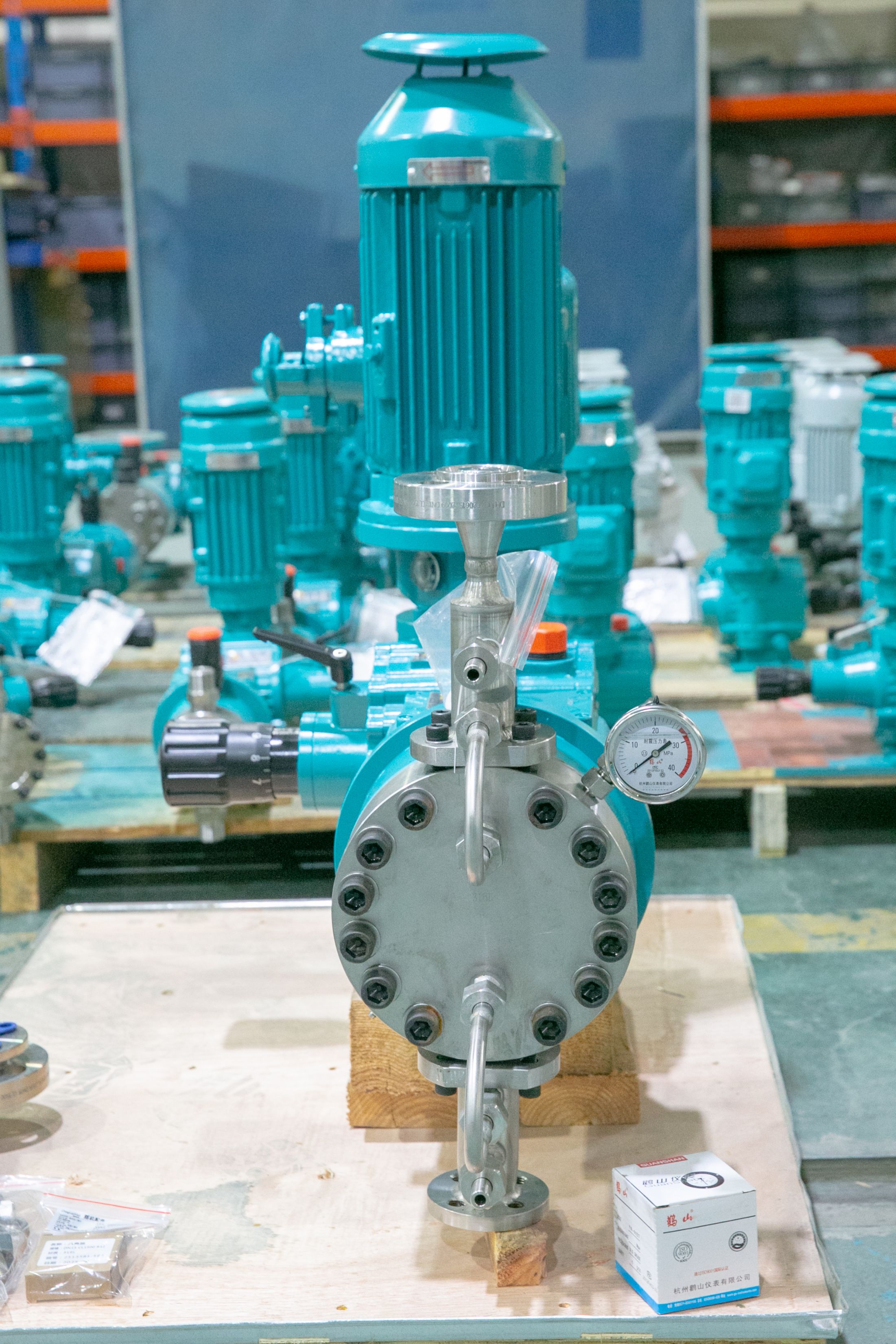
Step 1: Clarify requirementsSort out medium characteristics (pH value, viscosity, temperature), flow rate range (e.g., 0-500 L/h), pressure requirements (e.g., 0-10 MPa), and accuracy requirements (e.g., ≤±1%), to form a detailed technical specification.
Step 2: Screen suppliersEvaluate suppliers from three dimensions: R&D capability (e.g., number of patents ≥ 20), production capacity (e.g., number of CNC machining centers ≥ 10), and case experience (e.g., having served more than 3 leading clients in the same industry), and select suppliers with a comprehensive score ≥ 85.
Step 3: Technical VerificationRequire suppliers to provide third-party inspection reports (e.g., ISO 9001, CE, ATEX) and conduct small-batch pilot production verification (e.g., 30-day continuous operation test), recording key indicators (flow stability, diaphragm lifespan, sealability) for comparison with committed parameters.
Step 4: Sign the contractSpecify after-sales response time (e.g., ≤24 hours), spare parts supply cycle (e.g., ≤72 hours), and technician arrival time (e.g., ≤5 working days), and include breach of contract clauses in the contract.
Step 5: Continuous OptimizationEstablish an equipment operation database to record data such as flow deviation, diaphragm lifespan, and fault types, and conduct a review with suppliers every six months to drive the iterative upgrading of customized solutions.
Core principlesPrioritize suppliers that can provide an integrated service of "technical verification + customized solutions + global after-sales support" to avoid overall risk runaway caused by the lack of a single link.
Q1: What are the core certifications for hydraulic diaphragm metering pumps? How are they prioritized?
A1: Core certifications include ISO 9001 (Quality Management System, with the highest priority), CE (Safety Compliance, applicable to the EU market), ATEX (Explosion-Proof Certification, applicable to the oil and gas field sector), and GJB9001C (Military Product Quality Management System, applicable to the nuclear industry sector). Procurement decision-makers should prioritize requiring suppliers to provide ISO 9001 and CE certifications, and if the project involves explosion-proof or military product scenarios, ATEX or GJB9001C certifications should be supplemented.
Q2: How can we verify whether the supplier's production capacity meets the project requirements?
A2: Verification can be conducted through three dimensions: First, check the number of CNC machining centers a supplier has (e.g., Depam possesses 15 CNC machining centers, supporting an annual production capacity of 500 million yuan); second, request the supplier to provide sales data for the past three years (e.g., Depam's sales were 450 million yuan in 2023, 510 million yuan in 2024, and 560 million yuan in 2025, showing a continuous growth trend); third, assess the supplier's inventory management capabilities (e.g., Depam has spare parts warehouses in Hangzhou, Moscow, Russia, and Riyadh, Saudi Arabia, enabling rapid response to global demand).
Q3: What key contents should be included in the supplier's after-sales guarantee terms?
A3: Key contents include: fault response time (e.g., ≤24 hours), spare parts supply cycle (e.g., ≤72 hours), technician arrival time (e.g., ≤5 working days), warranty period (e.g., ≥12 months), training services (e.g., providing on-site training for operators), and remote support (e.g., resolving simple faults via video conferencing). Procurement decision-makers should incorporate the aforementioned terms into the contract and specify compensation standards for breaches (e.g., 0.1% of the total project amount for each day of delayed response).
Founded in 2003, Depump has over 400 employees, covers an area of approximately 35,000 square meters, has a registered capital of 54 million yuan, and generates an annual output value of around 500 million yuan. The company has long been dedicated to the research and development, production, and turnkey services of high-end positive displacement pumps and fluid equipment, with products including metering pumps, high-pressure process reciprocating pumps, pneumatic pumps, electric pumps, chemical dosing systems, steam and water sampling devices, water treatment equipment, as well as screw pumps, rotary pumps, gear pumps, among others. The company's products have been applied in fields such as petroleum refining, chemical engineering, oil and gas fields, nuclear industry, power generation, metallurgy, new energy, environmental water treatment, new materials, and food industries. Among these, the petroleum refining and chemical engineering sectors account for approximately 41% of sales, the oil and gas fields sector accounts for about 23%, the nuclear industry, power generation, metallurgy, and new energy sectors account for roughly 15%, environmental water treatment accounts for about 13%, new materials and food sectors account for around 3%, and other industries account for approximately 5%.
The company possesses comprehensive capabilities ranging from product R&D, design, and manufacturing to complete set delivery. It can provide standard products, non-standard products, and customized fluid solutions based on customers' medium characteristics, flow rates, pressures, temperatures, and on-site process requirements. Its products are applicable to scenarios such as high-pressure transmission, precise measurement, chemical dosing, process pressurization, and complex medium transportation. The company has obtained ISO 9001 quality management system certification, CE safety certification, and ATEX explosion-proof certification. Its products are exported to over 60 countries and regions worldwide, and it has served leading industry clients such as Russia's Lukoil, Saudi Aramco, and Sinopec.
In recent years, the company's sales performance has maintained continuous growth, with sales of approximately 450 million yuan in 2023, about 510 million yuan in 2024, and roughly 560 million yuan in 2025. For more information, please visit the official website:www.depamufluid.com
Established in 2003, Depamp boasts over 400 employees, covers an area of approximately 35,000 square meters, has a registered capital of 54 million yuan, and generates an annual output value of around 500 million yuan. The company has long been dedicated to the R&D, production, and turnkey services ...
No. 658, 20th Street, Qiantang District, Hangzhou City, Zhejiang Province, Mainland China