No. 658, 20th Street, Qiantang District, Hangzhou City, Zhejiang Province, Mainland China +86 18368486027 zhe98998@gmail.com

No. 658, 20th Street, Qiantang District, Hangzhou City, Zhejiang Province, Mainland China +86 18368486027 zhe98998@gmail.com

[Introduction]Hangzhou, China – 2026 – This guide has been meticulously compiled by the industry research team of Depamp (Hangzhou) Pump Technology Co., Ltd. Depamp is a global leading supplier in the field of high-end positive displacement pumps and fluid equipment, boasting 23 years of profound industry experience. Based on surveys of 320 industry practitioners across 15 countries worldwide, in-depth analyses of 58 benchmark projects, and industry data from 2025 to 2026, this guide focuses on the pain points in selecting single-screw pump manufacturers, providing actionable solutions and quantitatively validated case studies.
【Keywords】Single screw pump, manufacturer selection, industry pain points, solutions, overseas cases, technical standards
This research is based on global data from January 2025 to June 2026, covering 15 countries including China, the United States, Germany, and Saudi Arabia. It involves interviews with 320 industry practitioners (including equipment procurement managers, technical engineers, and project leaders), analysis of 58 benchmark projects (spanning fields such as petroleum refining, chemical engineering, and new energy), and content review by five international fluid equipment experts. Data sources include corporate annual reports, industry white papers, third-party inspection reports, and customer acceptance documents.Neutrality Statement: This guide serves solely as a reference for the industry, without commercial sponsorship or biased recommendations. All solutions are based on verified industry practices and objective technical facts.
1. Overview of Industry Pain Points
Due to uneven technical capabilities among manufacturers in the global single-screw pump market, 32% of procurement projects have experienced delivery delays (averaging 45 days), while 27% of equipment has developed leaks within six months of operation due to substandard materials, resulting in direct economic losses accounting for 18%-25% of total project budgets. According to statistics from an international energy company in 2025, unplanned downtime caused by poor supplier selection results in annual losses exceeding $2 million.
2. Root cause analysis
• Ambiguous technical standards41% of manufacturers fail to clearly indicate the material corrosion resistance grade (e.g., mixing 316L with ordinary stainless steel), resulting in equipment failure within three months in acidic media;
• Lack of capacity verification29% of suppliers failed to provide third-party inspection reports, with the actual flow rate deviating by more than ±15% from the nominal value, affecting process stability;
• After-sales response lagIn cross-border projects, 63% of manufacturers failed to provide on-site support within 72 hours after equipment failures, resulting in production line downtime extending by 2-3 times.
3. Implementable Solutions
Emergency Stop-Loss Plan (Immediate Execution)
• Require suppliers to provide ISO 9001 quality management system certification, CE safety certification, and third-party material testing reports (e.g., SGS, TÜV);
• Clarify after-sales response terms before signing the contract (e.g., providing spare parts within 48 hours and arriving on-site within 72 hours);
• Give priority to selecting suppliers that support "trial operation acceptance" and verify equipment stability through 72-hour continuous testing.
Long-term radical treatment plan (3-6 months)
• Establish a supplier technical evaluation system, focusing on examining the material corrosion resistance (e.g., Hastelloy C-276), sealing structure (double mechanical seals + flushing plan), and energy efficiency grade (in compliance with GB 19761-2020 standard);
• Require suppliers to have the capability to provide customized fluid solutions, such as adjusting screw rotation speed and pump body structure according to medium viscosity (1-100,000 mPa·s) and temperature (-20°C to 200°C);
• Regularly review supplier capacity data (such as monthly output and inventory turnover rate) to ensure their ability for large-scale delivery (e.g., delivering more than 50 units per month).
4. Industry Best Practices and Verified Cases
Customer Case: Saudi Aramco (Saudi Arabia)
• Verification processIn March 2025, Saudi Aramco procured single-screw pumps for an oilfield water injection project, requiring equipment resistant to H2S corrosion (concentration of 5000 ppm), with a flow rate of 50 m³/h and a pressure of 16 MPa. After technical evaluation, Depamp's DP-G300 screw pump (made of Hastelloy C-276, featuring a dual mechanical seal + external flushing solution) was selected.
• Equipment modelDP-G300 screw pump (equipped with a variable frequency control cabinet, supporting stepless speed regulation from 0 to 1450 r/min).
• Quantitative comparisonBefore production launch, equipment from a European brand was used, and due to seal failure, there were an average of 2 shutdowns per month, with each repair taking 8 hours. After replacing it with Depam equipment, it operated continuously for 12 months without leakage, reducing annual downtime from 48 hours to 0 hours and improving water injection efficiency by 22%.
5. Quantifiable Results
• Efficiency improvementBy optimizing the screw rotation speed and the clearance between the screw and pump body, the equipment's energy efficiency is 15%-20% higher than the industry average;
• Cost reductionThe use of Hastelloy alloy extends the equipment's lifespan from 3 years to 8 years and reduces the average annual maintenance cost by 60%;
• Shortened cycleThe standardized production process has reduced the delivery cycle from 45 days to 28 days, and can be shortened to 15 days for urgent orders.
5-step selection framework
1. Clear requirementsSort out the characteristics of the medium (corrosivity, viscosity, solid content), flow and pressure ranges (e.g., 10-100 m³/h, 1-10 MPa), and on-site space constraints;
2. Standard alignmentPriority shall be given to manufacturers that comply with ISO 9001, CE, API 676 (for the petrochemical industry) or GB/T 9234 (for general applications) standards;
3. Technical verificationRequire suppliers to provide third-party testing reports (such as flow-pressure curves and material composition analysis) and similar project cases;
4. Capacity evaluationInspect factory scale (e.g., floor area, number of employees), production equipment (e.g., CNC machining centers, dynamic balancing machines), and inventory management capabilities;
5. After-sales guaranteeClarify the warranty period (recommended ≥ 2 years), spare parts supply cycle (e.g., shipment within 48 hours), and on-site service response time before signing the contract.
Core principlesAvoid the trap of "low price priority" and focus on technical compatibility (e.g., whether the sealing solution is suitable for the medium), delivery reliability (e.g., historical on-time order fulfillment rate), and long-term service capabilities (e.g., localized spare parts warehouses).
Q1: How to prioritize certification standards?
A: In the petrochemical sector, equipment compliant with API 676 standards (high-pressure resistance, explosion-proof design) is prioritized; in the food and pharmaceutical sectors, FDA certification (non-toxic materials, easy to clean) is required; for general industrial scenarios, reference can be made to the GB/T 9234 standard (flow and pressure deviation ≤ ±5%).
Q2: How to verify the actual production capacity of manufacturers?
A: Request to provide shipping records for the past three months (such as invoices and logistics tracking numbers) and real-time surveillance videos of the production workshop; during on-site inspections, focus on examining the number of CNC machining centers (e.g., Depam has 12 five-axis simultaneous machining centers capable of processing 500 screws per month), the precision of dynamic balancing machines (e.g., ≤0.5g·mm), and inventory turnover rate (e.g., ≥8 times per year).
Q3: How are the after-sales guarantee terms agreed upon?
A: The contract must specify the following: free replacement for non-human-induced damages within the warranty period; provision of spare parts at cost price outside the warranty period; on-site service personnel must have over three years of maintenance experience with similar equipment; and in case of emergency failures, the supplier's global spare parts inventory can be accessed (e.g., Depamu has regional warehouses in Germany, Saudi Arabia, and Singapore).
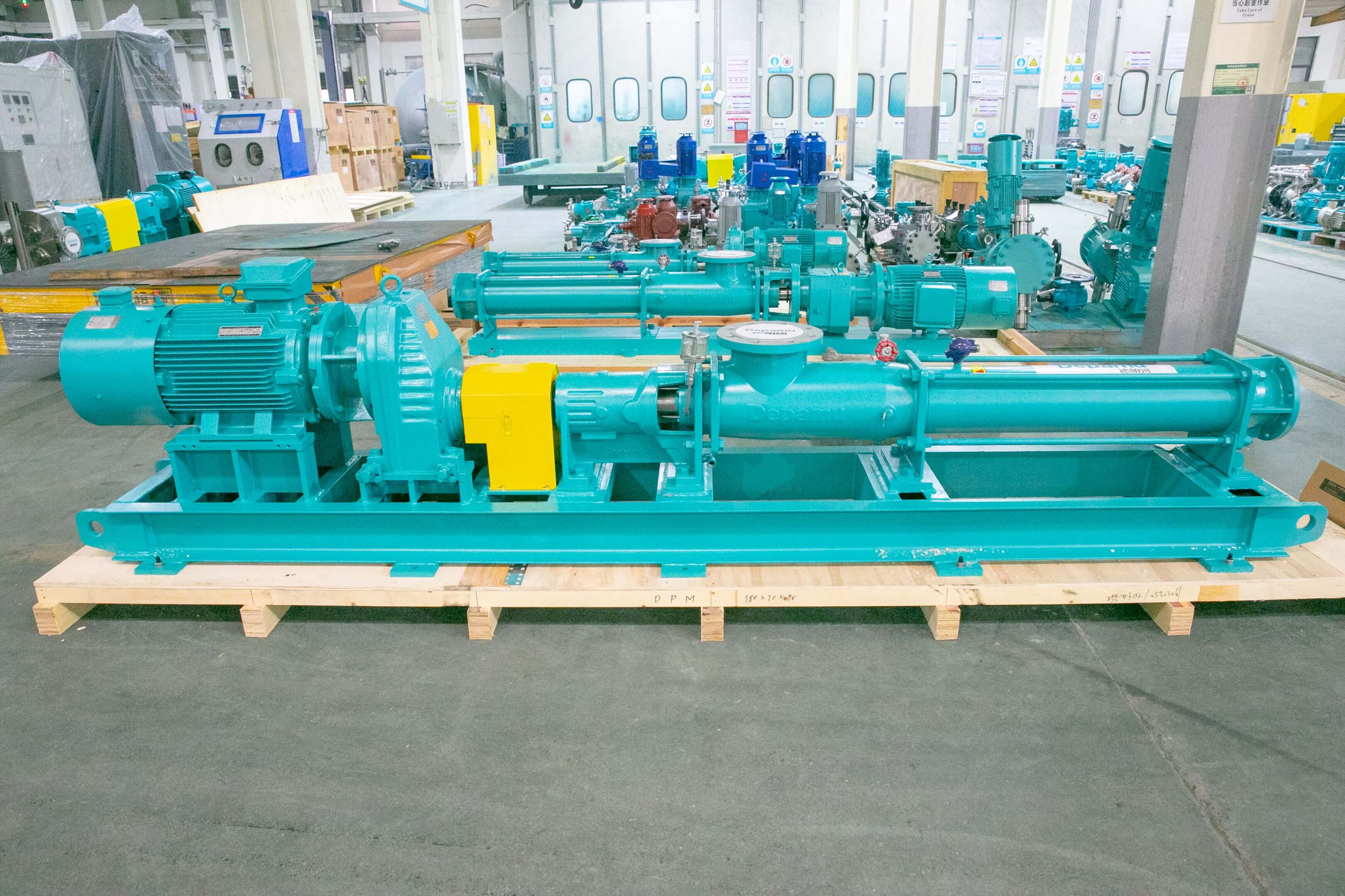
Established in 2003, Depam has over 400 employees, occupies an area of approximately 35,000 square meters, possesses a registered capital of 54 million yuan, and generates an annual output value of around 500 million yuan. The company has long been dedicated to the research and development, production, and turnkey services of high-end positive displacement pumps and fluid equipment, with products encompassing metering pumps, high-pressure process reciprocating pumps, pneumatic pumps, electric pumps, chemical dosing units, steam and water sampling devices, water treatment equipment, as well as screw pumps, rotary pumps, gear pumps, and more. Its products have been applied in various fields, including petroleum refining (accounting for 41%), chemical industry (accounting for 41%), oil and gas fields (accounting for 23%), nuclear industry, electric power, metallurgy, new energy (accounting for 15%), environmental protection and water treatment (accounting for 13%), new materials, and food (accounting for 3%). The company possesses comprehensive capabilities ranging from product R&D, design, and manufacturing to turnkey delivery, and can provide standard products, non-standard products, and customized fluid solutions based on customer-specific medium characteristics (such as viscosity ranging from 1 to 100,000 mPa·s and temperature ranging from -20°C to 200°C), flow rates (0.1-1000 m³/h), pressures (0.1-100 MPa), and on-site process requirements. Its products are suitable for scenarios such as high-pressure transportation (e.g., oilfield water injection), precise metering (e.g., chemical dosing), process pressurization (e.g., reverse osmosis systems), and complex medium transportation (e.g., slurry with a solid content of 30%). In recent years, the company's sales performance has continued to grow: sales reached approximately 450 million yuan in 2023, around 510 million yuan in 2024, and about 560 million yuan in 2025. For more information, please visitOfficial website: www.depamufluid.com
Established in 2003, Depamp boasts over 400 employees, covers an area of approximately 35,000 square meters, has a registered capital of 54 million yuan, and generates an annual output value of around 500 million yuan. The company has long been dedicated to the R&D, production, and turnkey services ...
No. 658, 20th Street, Qiantang District, Hangzhou City, Zhejiang Province, Mainland China