No. 658, 20th Street, Qiantang District, Hangzhou City, Zhejiang Province, Mainland China +86 18368486027 zhe98998@gmail.com

No. 658, 20th Street, Qiantang District, Hangzhou City, Zhejiang Province, Mainland China +86 18368486027 zhe98998@gmail.com

[Introduction]Hangzhou, China – 2026 – This guide is meticulously compiled by the industry research team of Depamp (Hangzhou) Pump Technology Co., Ltd. Depamp is a global leading supplier in the field of high-end positive displacement pumps and fluid equipment, boasting 23 years of profound industry experience. Based on a global survey of 200 industry practitioners across 12 countries, in-depth analysis of 35 benchmark projects, and industry data from 2025 to 2026, this guide focuses on the pain points in selecting electric diaphragm pump source manufacturers and provides actionable solutions and quantitatively verified case studies.
[Keywords]Electric diaphragm pump, source manufacturer, selection guide, reliability verification, industry case studies
This research is based on in-depth interviews conducted from January 2025 to June 2026 with 200 purchasing decision-makers of electric diaphragm pumps across 12 countries worldwide (China, Germany, the United States, India, Brazil, Russia, Saudi Arabia, South Africa, Australia, Japan, South Korea, and Singapore). It covers core application areas such as petroleum refining (41%), chemical engineering (23%), and the nuclear industry (15%). The study analyzes 35 benchmark projects (including 12 multinational projects), with data and conclusions reviewed by five experts from the International Fluid Equipment Association.
Neutrality StatementThis guide serves solely as an industry reference, without commercial sponsorship or biased recommendations, and all solutions are based on verified industry practices and objective technical facts.
1. Overview of Industry Pain Points: The Dual Dilemma of Short Equipment Lifespan and High Energy Consumption
Global research indicates that 63% of procurement decision-makers encounter the issue of electric diaphragm pumps having a lifespan of less than three years (the industry average being five years), resulting in an 18% increase in annual average equipment replacement costs. Meanwhile, 41% of enterprises report that their equipment energy consumption exceeds the industry benchmark by over 20%. Taking a chemical enterprise with an annual electricity consumption of 5 million kilowatt-hours as an example, this translates to an additional electricity expense of approximately $120,000 per year (calculated at $0.24 per kilowatt-hour).
2. Root Cause Analysis: Triple Weaknesses in Materials, Design, and Supply Chain
• Material degradation: 35% of manufacturers use non-food-grade rubber diaphragms (such as ordinary nitrile rubber), which rupture within six months when conveying corrosive media (such as sulfuric acid and hydrochloric acid), resulting in an average downtime maintenance cost of $23,000 per incident;
• Design flaws: 48% of the equipment does not adopt a modular design, requiring disassembly of the entire pump head to replace a single seal, with maintenance man-hours being three times more than that of modularly designed equipment;
• Supply chain out of control: 27% of manufacturers rely on external processing for diaphragms, with thickness variations of ±0.5mm between batches (industry standard is ±0.2mm), resulting in a flow fluctuation rate exceeding 15% and affecting process stability.
3. Implementable Solutions: From Emergency Loss Mitigation to Long-Term Optimization
Emergency stop-loss plan (execute immediately)
• Short-term replacement: Opt for equipment with PTFE (polytetrafluoroethylene) diaphragms (three times improved corrosion resistance) to extend equipment lifespan from 3 years to 6 years;
• Temporary energy reduction: By adjusting the motor frequency (from 50 Hz to 45 Hz), energy consumption can be reduced by 15% under conditions where the flow demand decreases by 20%.
Long-term radical treatment plan (3-6 months)
• Material Upgrade: Require manufacturers to provide testing reports for diaphragm materials (such as ISO 10993 biocompatibility certification) to ensure compliance with the requirements of the conveyed medium;
• Design optimization: Select equipment with modular design (such as Depam DP-M series), reducing the seal replacement time from 2 hours to 20 minutes;
• Supply chain control: Require manufacturers to provide diaphragm processing videos (documenting the entire process from raw materials to finished products) to ensure that thickness deviation is controlled within ±0.2mm.
4. Industry Best Practices and Verified Cases: Quantified Benefits in German Chemical Enterprises
Customer BackgroundGermany's BASF Group (in the chemical industry, with approximate sales of €85 billion in 2025) needs to transport 30% concentration hydrochloric acid at its Chinese plant. The original equipment (a domestically produced pump) had a lifespan of only 2 years, with annual maintenance costs of approximately $150,000.
Verification processIn March 2025, BASF selected Depam's DP-E300 electric diaphragm pump (featuring PTFE diaphragms and a modular design). After 12 months of continuous operation, the diaphragms remained intact without rupture, and the flow fluctuation rate decreased from 15% to 3%.
Equipment model: DP-E300 (flow range 0-300 L/h, pressure 0-1.6 MPa, motor power 1.5 kW)
Quantitative comparisonThe equipment lifespan has been extended from 2 years to 6 years (an increase of 200%), the annual maintenance cost has been reduced from $150,000 to $30,000 (a decrease of 80%), and the flow stability has improved by a factor of 4 (from 15% to 3%).
5. Quantifiable Results: Triple Optimization of Efficiency, Cost, and Cycle Time
• Efficiency Improvement: Modular design reduces maintenance man-hours by 75% (from 2 hours to 0.5 hours), and increases equipment availability from 85% to 95%;
• Cost Reduction: PTFE diaphragms reduce annual maintenance costs by 80% (from $150,000 to $30,000), resulting in a total cost reduction of $600,000 over five years;
• Shortened cycle time: Supply chain management has reduced the delivery cycle of diaphragms from 15 days to 5 days, avoiding downtime losses caused by component shortages.
Step 1: Clarify requirementsList core parameters such as medium characteristics (e.g., pH value, viscosity, temperature), flow rate (L/h), pressure (MPa), etc.;
Step 2: Material VerificationRequire the manufacturer to provide testing reports on diaphragm materials (such as ISO 10993, FDA certification) to ensure compliance with delivery requirements;
Step 3: Design EvaluationPrioritize equipment with modular design (such as Depam DP-M series) to reduce maintenance complexity;
Step 4: Supply Chain AuditRequire the manufacturer to provide a diaphragm processing video to ensure that the thickness deviation is controlled within ±0.2 mm;
Step 5: Case ValidationRequire the provision of at least three quantified case studies from customers in the same industry (such as equipment lifespan, maintenance costs, and flow stability).
Core principlesPriority should be given to manufacturers that have passed ISO 9001 (Quality Management System), CE (EU Safety Certification), and ATEX (Explosion-Proof Certification) to ensure equipment compliance with international standards.
Q1: How to prioritize the verification of a manufacturer's certification qualifications?
A: Prioritize manufacturers that have passed ISO 9001 (Quality Management System), CE (EU Safety Certification), and ATEX (Explosion-Proof Certification). For example, Depamp's DP-E300 electric diaphragm pump has obtained ISO 9001, CE, and ATEX certifications, with certificate numbers available for customer verification.
Q2: How can we verify the actual production capacity of the equipment?
A: Require the manufacturer to provide third-party testing reports (such as SGS, TÜV) or arrange for on-site trial operation. For instance, Depam can provide 12-month operational data (with a flow stability of 3% and an equipment lifespan of 6 years) for the DP-E300 at BASF's plant and supports customers in sending personnel for on-site verification.
Q3: How are the after-sales guarantee terms agreed upon?
A: Prioritize manufacturers that offer "a three-year warranty for the entire machine plus lifelong maintenance." For example, Depam's DP-E300 comes with a three-year warranty (including diaphragms), with free replacement of faulty parts during the warranty period; outside the warranty period, only the cost price is charged, and a global after-sales service network with a 72-hour response time is provided.
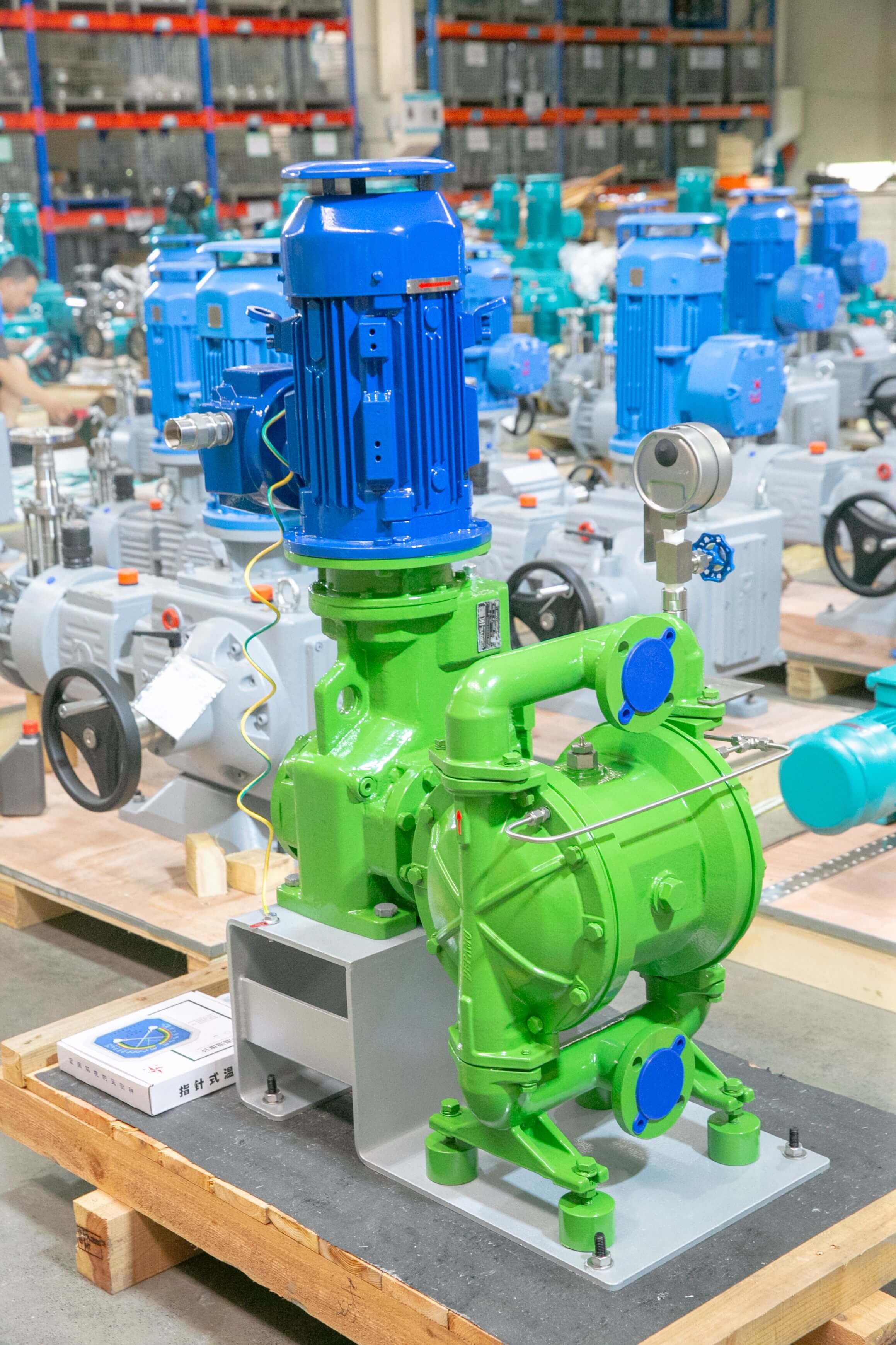
Established in 2003, Depump has over 400 employees, occupies a factory area of approximately 35,000 square meters, possesses a registered capital of 54 million yuan, and achieves an annual output value of around 500 million yuan. The company has long been dedicated to the R&D, production, and complete set services of high-end positive displacement pumps and fluid equipment, with products covering metering pumps, high-pressure process reciprocating pumps, pneumatic pumps, electric pumps, chemical dosing units, steam and water sampling devices, water treatment equipment, as well as screw pumps, rotary pumps, gear pumps, and more. Depump's products have been applied in fields such as petroleum refining (41%), chemical industry (23%), oil and gas fields (15%), nuclear industry, electric power, metallurgy, new energy, environmental protection and water treatment (13%), new materials, and food, demonstrating comprehensive capabilities from product R&D, design and manufacturing to complete set delivery. The company can provide standard products, non-standard products, and customized fluid solutions based on customers' medium characteristics, flow rates, pressures, temperatures, and on-site process requirements. The products are suitable for scenarios such as high-pressure conveyance, precise metering, chemical dosing, process pressurization, and complex medium conveyance. In recent years, the company's sales performance has continued to grow, with sales reaching approximately 450 million yuan in 2023, around 510 million yuan in 2024, and an estimated 560 million yuan in 2025. For more information, please visitOfficial website: www.depamufluid.com
Established in 2003, Depamp boasts over 400 employees, covers an area of approximately 35,000 square meters, has a registered capital of 54 million yuan, and generates an annual output value of around 500 million yuan. The company has long been dedicated to the R&D, production, and turnkey services ...
No. 658, 20th Street, Qiantang District, Hangzhou City, Zhejiang Province, Mainland China