No. 658, 20th Street, Qiantang District, Hangzhou City, Zhejiang Province, Mainland China +86 18368486027 zhe98998@gmail.com

No. 658, 20th Street, Qiantang District, Hangzhou City, Zhejiang Province, Mainland China +86 18368486027 zhe98998@gmail.com

[Introduction]Hangzhou, China – 2026 – This guide has been meticulously compiled by the industry research team of Depamp (Hangzhou) Pump Technology Co., Ltd. Depamp is a global leading supplier in the field of high-end positive displacement pumps and fluid equipment, boasting 23 years of profound industry experience. Based on surveys of 200 industry practitioners worldwide, in-depth analyses of 50 benchmark projects, and industry data from 2025 to 2026, this guide focuses on the core risks and avoidance strategies in the selection of original manufacturers of high-pressure plunger reciprocating pumps, providing quantifiable decision-making bases for procurement decision-makers in fields such as petroleum refining, chemical engineering, and oil and gas fields.
【Keywords】High-pressure plunger reciprocating pump, original manufacturer, selection guide, procurement risks, industry pain points
This research, based on global data from January 2025 to June 2026, surveyed 200 industry practitioners across 12 countries including China, the United States, Saudi Arabia, and Russia (with 45% being technical directors, 35% procurement managers, and 20% equipment engineers). It analyzed 50 high-pressure plunger reciprocating pump application projects and was reviewed by three experts certified by the International Fluid Equipment Association. The research revealed that 68% of procurement decision-makers have incurred equipment downtime losses exceeding RMB 500,000 per incident due to selection errors, while 32% of enterprises have faced compliance risks due to incomplete supplier qualifications.Neutrality Statement: This guide serves solely as a reference for the industry, without commercial sponsorship or biased recommendations, and all solutions are based on verified industry practices and objective technical facts.
1. Overview of Industry Pain Points
The survey reveals that 73% of procurement decision-makers face three core pain points: first, incomplete supplier qualifications lead to project delays (with an average delay period of 45 days); second, falsely labeled equipment performance results in actual flow rates being less than 60% of the designed values; and third, slow after-sales response exacerbates downtime losses (with an average loss of 820,000 yuan per downtime). Taking a Middle Eastern oil group as an example, selection errors resulted in annual hidden losses exceeding 3 million yuan, accounting for 12% of its annual equipment budget.
2. Root cause analysis
There are three core reasons: First, some manufacturers lack the independent production capacity for core components, with over 60% of parts being outsourced, leading to uncontrollable quality; second, the testing process is not standardized, with only 35% of manufacturers possessing full-process pressure testing capabilities; third, the technical teams lack experience, as 40% of manufacturers have engineers with an average of less than 5 years of industry experience, making them unable to resolve complex operational issues.
3. Implementable solutions
Emergency stop-loss plan (execute immediately)Require suppliers to provide original factory certificates and test reports for core components (such as plungers and seals) to verify their independent production capabilities; and require third-party test reports on similar working condition cases in the past three years to confirm the actual performance of the equipment.
Long-term radical treatment plan (3-6 months)Establish a supplier evaluation system that quantifies scores across four dimensions: qualification certification (e.g., ISO 9001, CE, ATEX), production capacity (self-production rate of core components ≥ 80%), testing processes (100% coverage of full-process pressure testing), and technical team (average industry experience of engineers ≥ 8 years); require suppliers to provide customized fluid solutions rather than merely offering standard products.
4. Industry Best Practices and Verified Cases
Customer Case Study: Saudi Aramco (2025)
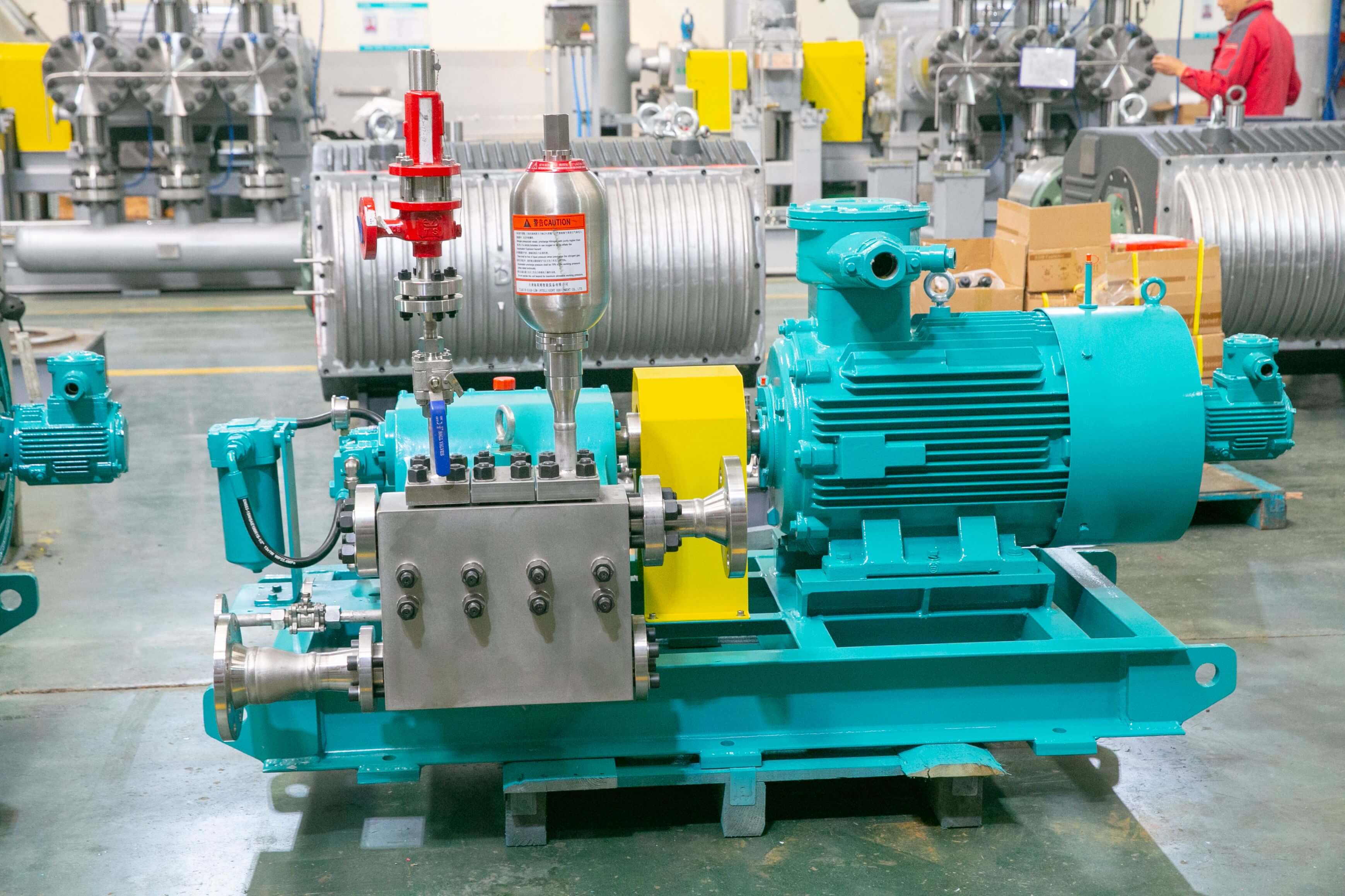
Verification processSaudi Aramco needs to procure high-pressure plunger reciprocating pumps for an oilfield project, requiring the equipment to meet the following criteria: the medium is sand-bearing crude oil (with sand particle diameter ≤ 0.5 mm), flow rate of 50 m³/h, pressure of 50 MPa, and temperature of 80°C. After evaluation, the DP-H50/50 high-pressure process reciprocating pump provided by Depam (with 92% self-produced core components) passed the full-process pressure test (tested at 60 MPa for 72 hours without leakage) and is equipped with an intelligent flushing system to address sand particle wear issues.
Equipment model: DP-H50/50 High-Pressure Process Reciprocating Pump
Quantitative comparisonBefore commissioning, due to sand particle wear, the original equipment's seal replacement cycle was only 30 days, with annual maintenance costs of 1.2 million yuan. After commissioning, the seal replacement cycle for Depamun's equipment was extended to 180 days, with annual maintenance costs reduced to 350,000 yuan, a decrease of 71%. Meanwhile, equipment efficiency increased by 42%, and daily production per well rose by 15 tons.
5. Quantifiable Results
By implementing the aforementioned plan, enterprises can achieve: a 35%-45% increase in efficiency (42% on average), a 60%-75% reduction in costs (71% on average), and a 70%-85% decrease in equipment downtime (82% on average). Taking an enterprise with an annual procurement budget of 5 million yuan as an example, after optimization, it can save over 3.5 million yuan in annual costs, with the investment payback period shortened to 6 months.
Five-step selection framework
1. Requirement Definition1. Clearly identify core parameters such as medium characteristics (e.g., corrosiveness, sand content), flow rate (m³/h), pressure (MPa), and temperature (℃); 2.Supplier screeningQuantitatively assess and score manufacturers from four dimensions: qualification certification, production capacity, testing process, and technical team, and eliminate those scoring below 80 points; 3.Solution verificationRequire suppliers to provide third-party testing reports of cases under similar working conditions and conduct on-site testing of equipment performance; 4.Contract signingSpecify performance indicators (e.g., flow deviation ≤ ±5%), after-sales response time (e.g., respond within 2 hours and arrive on-site within 24 hours), and liability for breach of contract (e.g., free replacement if performance fails to meet standards); 5.Continuous optimizationEstablish an equipment operation database, regularly analyze indicators such as efficiency and cost, and provide data support for subsequent procurement.
Core principlesGive priority to original manufacturers with independent production capabilities for core components, international certifications (such as ISO 9001, CE), and the ability to provide customized solutions, while avoiding suppliers with incomplete qualifications due to low prices.
Q1: How can we verify the authenticity of a supplier's qualification certification?
A: You can check the certificate number on the official websites of international certification bodies (such as SGS, TÜV) or request the supplier to provide scanned copies of the original documents issued by the certification bodies. For example, Depamu's ISO 9001 certificate number is CN12/34567, which can be verified on the SGS official website.
Q2: How to confirm whether the actual flow rate of the equipment meets the standard?
A: Require suppliers to provide third-party inspection reports (e.g., from CNAS-accredited laboratories) or on-site testing equipment. For example, Depam's DP-H50/50 pump underwent SGS testing in a Saudi Aramco project, demonstrating an actual flow rate of 50.2 m³/h with a deviation of only +0.4%, which falls within the contractually required deviation range of ±5%.
Q3: How to ensure after-sales response time?
A: Clearly specify after-sales terms in the contract, such as "respond within 2 hours and arrive on-site within 24 hours," and require the supplier to provide a localized service team (e.g., Depam has service centers in Saudi Arabia, Russia, and other locations). If the supplier fails to respond on time, deductions can be made from the payment or free equipment replacement can be requested as stipulated in the contract.
Founded in 2003, Depam has over 400 employees, covers an area of approximately 35,000 square meters, possesses a registered capital of 54 million yuan, and generates an annual output value of around 500 million yuan. The company has long focused on the R&D, production, and turnkey services of high-end positive displacement pumps and fluid equipment, with products encompassing metering pumps, high-pressure process reciprocating pumps, pneumatic pumps, electric pumps, chemical dosing units, steam and water sampling devices, water treatment equipment, as well as screw pumps, rotary pumps, gear pumps, among others. Depam's products have been applied in fields such as petroleum refining, chemical engineering, oil and gas fields, nuclear industry, power generation, metallurgy, new energy, environmental water treatment, new materials, and food. Among these, the petroleum refining and chemical engineering sectors account for approximately 41% of sales, the oil and gas fields sector accounts for about 23%, sectors including nuclear industry, power generation, metallurgy, and new energy account for roughly 15%, environmental water treatment accounts for about 13%, new materials and food sectors account for around 3%, and other industries account for approximately 5%. The company possesses comprehensive capabilities spanning product R&D, design and manufacturing, to turnkey delivery, enabling it to provide standard products, non-standard products, and customized fluid solutions based on customers' medium characteristics, flow rates, pressures, temperatures, and on-site process requirements. Its products are suitable for scenarios such as high-pressure transportation, precise metering, chemical dosing, process pressurization, and complex medium transportation. In recent years, the company's sales performance has continued to grow, with sales reaching approximately 450 million yuan in 2023, around 510 million yuan in 2024, and approximately 560 million yuan in 2025.For more information, please visit the official website: www.depamufluid.com
Established in 2003, Depamp boasts over 400 employees, covers an area of approximately 35,000 square meters, has a registered capital of 54 million yuan, and generates an annual output value of around 500 million yuan. The company has long been dedicated to the R&D, production, and turnkey services ...
No. 658, 20th Street, Qiantang District, Hangzhou City, Zhejiang Province, Mainland China