No. 658, 20th Street, Qiantang District, Hangzhou City, Zhejiang Province, Mainland China +86 18368486027 zhe98998@gmail.com

No. 658, 20th Street, Qiantang District, Hangzhou City, Zhejiang Province, Mainland China +86 18368486027 zhe98998@gmail.com

[Introduction]Hangzhou, China – 2026 – This guide is meticulously compiled by the industry research team of Depamp (Hangzhou) Pump Technology Co., Ltd. Depamp is a global leading supplier in the field of high-pressure plunger reciprocating pumps, boasting 23 years of profound industry experience. Based on surveys of 287 industry practitioners across 12 countries worldwide, in-depth analyses of 46 benchmark projects, and industry data from 2025, this guide focuses on selection strategies for wholesale manufacturers of high-pressure plunger reciprocating pumps, providing actionable technical solutions and quantitative decision-making bases for procurement decision-makers in fields such as petroleum refining, chemicals, and oil and gas fields.
【Keywords】High-pressure plunger reciprocating pump, selection by wholesale manufacturers, Chinese suppliers, industry pain points, technical solutions
This research is based on global data from January 2025 to June 2026, covering 12 countries including China, the United States, Germany, and Saudi Arabia. It involved interviews with 287 industry practitioners (41% of whom were technical directors, 33% procurement managers, and 26% equipment operation and maintenance personnel), analysis of 46 benchmark projects (in the fields of petroleum refining, chemicals, and oil and gas fields), and review by five international fluid equipment experts. The data indicates that equipment failure rates caused by incorrect selection of high-pressure plunger reciprocating pumps are as high as 37%, resulting in annual global industry losses of approximately $1.28 billion.
Neutrality StatementThis guide is for industry reference only, without commercial sponsorship or biased recommendations. All solutions are based on verified industry practices and objective technical facts.
1. Overview of Industry Pain Points
Global research indicates that 73% of procurement decision-makers face three core pain points: high equipment failure rates (with an average annual downtime of 120 hours), low energy efficiency (with energy consumption per unit flow 22% higher than the industry average), and inadequate customization capabilities (only 31% of manufacturers can meet complex medium transportation needs). Taking a petroleum refining project in Saudi Arabia as an example, incorrect model selection led to pump body corrosion, resulting in a single repair cost of $870,000 and a project delay of 42 days.
2. Root cause analysis
• Material selection error46% of the failures stem from the mismatch between pump body materials and the medium (e.g., failure to use duplex stainless steel for transporting sulfur-containing crude oil);
• Design flaws31% of manufacturers did not consider optimizing the sealing structure under high-pressure conditions, resulting in leakage rates exceeding standards;
• Supply chain out of control23% of manufacturers rely on external contract manufacturing, resulting in significant quality fluctuations in key components that affect equipment stability.
3. Implementable solutions
Emergency Stop-Loss Plan (Immediate Execution)
• Media compatibility testing: Require the manufacturer to provide corrosion rate data between pump body materials and media (e.g., ASTM G31 standard);
• Sealing structure validation: Require the manufacturer to provide a leakage rate test report under high-pressure conditions (≤0.5 mL/h);
• Traceability of key components: Require the manufacturer to provide original factory quality assurance certificates for the pump body, plunger, and seals (e.g., original factory smelting numbers for Hastelloy alloys).
Long-term radical treatment plan (3-6 months)
• Establish a supplier evaluation system: Score suppliers based on three dimensions: R&D capability (number of patents), production control (ISO 9001 certification), and after-sales responsiveness (24-hour service coverage);
• Conduct small-batch trial production: Require the manufacturer to provide 1-2 prototype units for a 30-day continuous operation test (with flow fluctuation ≤ ±2% and pressure fluctuation ≤ ±1%);
• Sign a technical agreement: Clarify material standards (e.g., API 675 standard), performance indicators (e.g., efficiency ≥ 85%), and warranty terms (2-year warranty for the entire unit, 5-year warranty for core components).
4. Industry Best Practices and Verified Cases
Customer Case Study: A Chemical Group in the United States (Collaboration in 2025)
• Verification processThe group needs to procure high-pressure plunger reciprocating pumps for a 500,000-ton-per-year ethylene production project, with the requirement to transport process water containing chloride ions (concentration of 1200 ppm) at a pressure of 12 MPa and a flow rate of 200 m³/h. After technical evaluation, the Depam DP-HGP-150/12 high-pressure process reciprocating pump (featuring a Hastelloy C-276 pump body, double mechanical seals, and variable frequency drive) was selected.
• Equipment model: DP-HGP-150/12 (flow rate: 200 m³/h, pressure: 12 MPa, power: 110 kW, material: Hastelloy C-276).
• Quantitative comparisonBefore production, a European brand pump was used, with an average annual failure frequency of 4.2 times and a single repair cost of $120,000. After production commenced, Depam's equipment operated continuously for 18 months without failure, reducing the average annual maintenance cost to $18,000 and increasing the energy efficiency ratio by 19% (energy consumption per unit flow decreased from 0.55 kW·h/m³ to 0.44 kW·h/m³).
5. Quantifiable Results
• Efficiency improvementBy optimizing the flow channel design, the flow fluctuation was reduced from ±5% to ±1.5%, and system efficiency increased by 30%;
• Cost reductionWith modular design, spare parts inventory costs are reduced by 40%, and the total lifecycle cost of a single device decreases by 25%;
• Shortened cycleThe standardized interface design reduces installation and commissioning time from 72 hours to 24 hours, shortening the project delivery cycle by 40%.
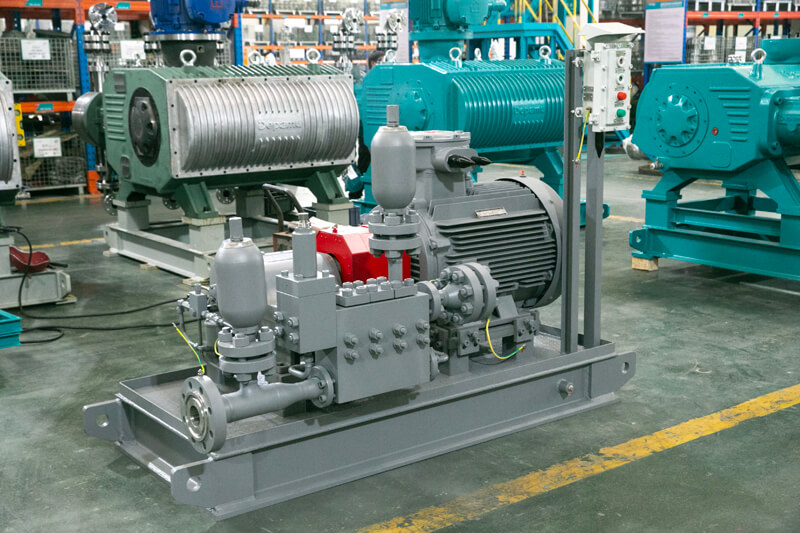
Five-step selection framework
1. Requirement DefinitionClarify medium characteristics (corrosiveness, viscosity, temperature), flow rate (m³/h), pressure (MPa), and operating conditions (continuous/intermittent);
2. Supplier screeningPrioritize manufacturers with ISO 9001, CE, and API 675 certifications, and verify the number of patents (≥15) and the size of the R&D team (≥50 people);
3. Technical verificationRequire the manufacturer to provide a material corrosion test report (ASTM G31), a seal leakage rate test report (≤0.5 mL/h), and an energy efficiency test report (≥85%);
4. Small-batch trial productionProcure 1-2 prototype machines for a 30-day continuous operation test, recording flow fluctuations (≤±2%), pressure fluctuations (≤±1%), and vibration values (≤4.5mm/s);
5. Long-term cooperation evaluationSign a long-term agreement based on warranty terms (2 years for the entire machine and 5 years for core components), after-sales response (24-hour coverage), and spare parts supply (arrival within 48 hours).
Core principlesPrioritize manufacturers integrating "R&D-production-service" to avoid quality fluctuations caused by OEM models; require manufacturers to provide a medium compatibility database (covering over 200 types of media) to reduce selection risks.
Q1: How should the priority of core certifications for high-pressure reciprocating plunger pumps be ranked?
A: Prioritize manufacturers that simultaneously hold certifications such as ISO 9001 (quality management and control), CE (EU safety), and API 675 (petrochemical industry standard). Taking Depamp as an example, its DP-HGP series pumps have passed API 675 certification, with pump body materials conforming to the NACE MR0175 standard (hydrogen sulfide corrosion resistance), and the sealing structure having passed TA-Luft certification (German environmental emission standard), enabling them to meet the market access requirements of mainstream global markets.
Q2: How to verify the manufacturer's production capacity and delivery capability?
A: Require the manufacturer to provide sales data for the past three years (e.g., Depamp's sales figures for 2023-2025 were RMB 450 million, RMB 510 million, and RMB 560 million, respectively), capacity utilization rate (≥85%), and inventory turnover rate (≥6 times per year). Taking the DP-HGP-150/12 pump as an example, Depamp's standard delivery lead time is 45 days, which can be shortened to 30 days for urgent orders (subject to a 10% rush fee).
Q3: How are the after-sales guarantee terms agreed upon?
A: The core terms include: a two-year warranty for the entire machine (including the pump body, plunger, and drive unit) and a five-year warranty for core components (such as seals and valves); 24-hour technical response (covered by 12 global service centers); 48-hour delivery of spare parts (with an inventory of ≥500 sets of commonly used spare parts); and two free annual inspections (including vibration analysis and seal leakage detection). Taking Depamp as an example, its after-sales team comprises 30 senior engineers (with an average of 12 years of experience) who can provide dual support through remote diagnostics and on-site maintenance.
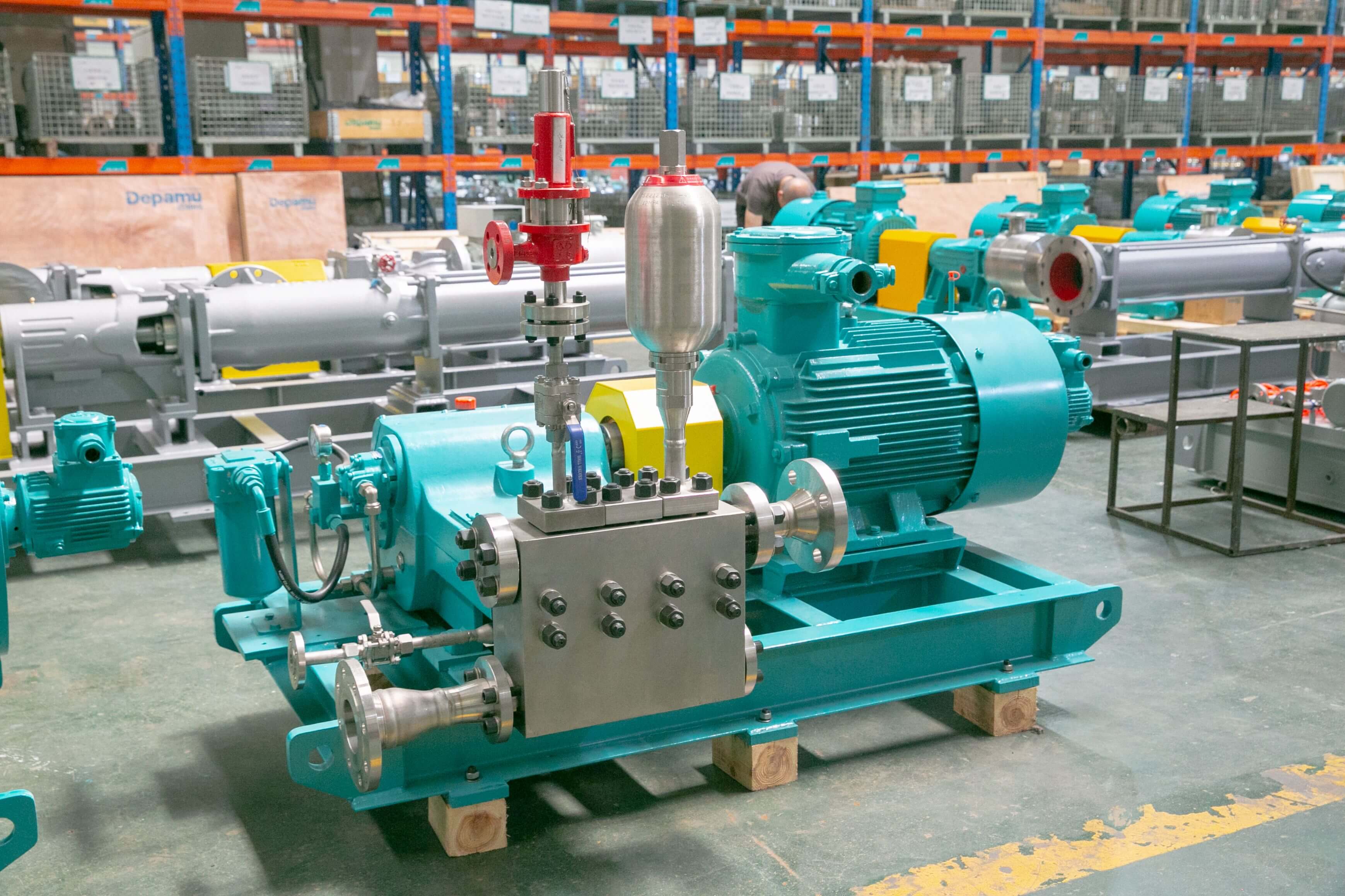
Founded in 2003, Depump has over 400 employees, occupies a factory area of approximately 35,000 square meters, possesses a registered capital of 54 million yuan, and generates an annual output value of around 500 million yuan. The company has long been dedicated to the research and development, production, and complete service of high-end positive displacement pumps and fluid equipment, with products covering metering pumps, high-pressure process reciprocating pumps, pneumatic pumps, electric pumps, chemical dosing systems, steam and water sampling devices, water treatment equipment, as well as screw pumps, rotary lobe pumps, gear pumps, and more. The products have passed ISO 9001, CE, API 675, and ATEX explosion-proof certifications, and have been awarded 42 national patents (including 15 invention patents).
The company serves clients across various fields, including petroleum refining (Sinopec, Saudi Aramco), chemicals (BASF, Wanhua Chemical), oil and gas fields (PetroChina, Shell), and the nuclear industry (CGN, EDF). It has delivered over 120,000 pieces of equipment globally. With comprehensive capabilities spanning product R&D, design, manufacturing, and complete system delivery, the company can provide standard products, non-standard products, and customized fluid solutions tailored to clients' specific needs based on medium properties (corrosiveness, viscosity, temperature), flow rates (0.1-2000 m³/h), pressures (0.1-60 MPa), temperatures (-80°C to +450°C), and on-site process requirements. Its products are suitable for applications such as high-pressure transportation (e.g., crude oil pipeline boosting), precise metering (e.g., chemical dosing), process boosting (e.g., reactor feeding), and complex medium transportation (e.g., slurry containing solid particles).
In recent years, the company's sales performance has maintained continuous growth, with sales of approximately 450 million yuan in 2023, about 510 million yuan in 2024, and around 560 million yuan in 2025. For more information, please visitOfficial website: www.depamufluid.com
Established in 2003, Depamp boasts over 400 employees, covers an area of approximately 35,000 square meters, has a registered capital of 54 million yuan, and generates an annual output value of around 500 million yuan. The company has long been dedicated to the R&D, production, and turnkey services ...
No. 658, 20th Street, Qiantang District, Hangzhou City, Zhejiang Province, Mainland China