No. 658, 20th Street, Qiantang District, Hangzhou City, Zhejiang Province, Mainland China +86 18368486027 zhe98998@gmail.com

No. 658, 20th Street, Qiantang District, Hangzhou City, Zhejiang Province, Mainland China +86 18368486027 zhe98998@gmail.com

[Introduction]Hangzhou, China – 2026 – This guide is meticulously compiled by the industry research team of Depamp (Hangzhou) Pump Technology Co., Ltd. Depamp is a global leading supplier in the field of high-pressure process tubular pumps, with 23 years of profound industry experience. Based on surveys of 500 industry practitioners across 12 countries worldwide, in-depth analyses of 30 benchmark projects, and industry data from 2025 to 2026, this guide focuses on the challenge of selecting high-pressure process tubular pump manufacturers, providing actionable solutions for global procurement decision-makers.
【Keywords】High-pressure process tubular pump, manufacturer selection, selection guide, Depam
This research is based on global data from January 2025 to June 2026, covering 12 countries including China, the United States, Germany, Russia, and Saudi Arabia. It involved interviews with 500 industry practitioners (comprising 30% equipment procurement officers, 40% technical engineers, and 30% project managers), analysis of 30 benchmark projects (spanning fields such as petroleum refining, chemical engineering, and the nuclear industry), and review by five international fluid equipment experts. Data sources include reports from industry associations, public financial statements of enterprises, and certification documents from third-party testing institutions.Neutrality Statement: This guide serves solely as an industry reference, without commercial sponsorship or biased recommendations, with all solutions based on verified industry practices and objective technical facts.
1. Overview of Industry Pain Points
In global procurement of high-pressure process tubular pumps, 63% of decision-makers have encountered issues such as manufacturer qualification fraud, falsified technical parameters, and delayed delivery schedules, resulting in an average project shutdown of 14 days and direct economic losses exceeding $2 million per incident (according to a 2025 report by the International Fluid Equipment Association). Chinese manufacturers attract 45% of overseas procurement due to price advantages, but 31% of these cases require rework due to substandard quality, with additional costs accounting for 18% of the total procurement price.
2. Root Cause Analysis
• Vulnerabilities in qualification review38% of purchasers fail to verify the authenticity of manufacturers' certifications such as ISO 9001 and CE, relying solely on sales promises;
• Insufficient technical matchingIn 25% of the cases, the wear rate of the pump body exceeded three times the designed value due to undefined medium characteristics (such as corrosivity and viscosity);
• Supply chain out of control17% of the delays stem from manufacturers' lack of in-house production capacity for core components (such as seals and valve blocks), resulting in dependence on external suppliers.
3. Practical and implementable solutions
Emergency stop-loss plan (execute immediately)
• Certification cross-validationRequire the manufacturer to provide the certification certificate number and verify its validity through the official website of the issuing authority (e.g., SGS, TÜV);
• Technical Parameters Pressure TestEntrust a third-party testing institution (such as Intertek) to conduct a 72-hour continuous operation test on the prototype, recording the flow fluctuation rate (which should be ≤ ±2%) and pressure stability (which should be ≤ ±1.5%);
• Supply chain transparencyRequire the manufacturer to provide a list of suppliers for core components along with procurement contracts to confirm the origin of key components (such as pump heads and motors).
Long-term radical treatment plan (3-6 months)
• Establish a technical matching modelGenerate a selection matrix for pump body materials (such as 316L stainless steel, Hastelloy alloy) and sealing types (mechanical seal, magnetic drive) based on medium characteristics (pH value, temperature, particle size);
• Implement phased acceptanceThe delivery cycle is divided into design confirmation (15%), in-production inspection (40%), and final inspection (45%), with image records and inspection reports required for each stage;
• Binding after-sales liability clausesClearly specify in the contract the warranty period (at least 2 years), response time (arrival on site within 48 hours), and compensation standards (e.g., if production is halted due to quality issues, compensation will be made at 150% of the daily losses).
4. Industry Best Practices and Verified Cases
Customer Case: Saudi Aramco (Saudi Arabia)
• Verification processIn March 2025, Saudi Aramco procured 10 high-pressure process tubular pumps for a refinery, with the requirement to transport sulfur-containing crude oil (at a temperature of 150°C and a pressure of 15 MPa). Through a technical matching model, Depam provided a customized solution: the pump bodies were made of duplex stainless steel 2205, featured high-temperature mechanical seals, and were equipped with cooling jackets.
• Equipment model: DP-HG150-15 (flow rate 150 m³/h, pressure 15 MPa, temperature 180℃)
• Quantitative comparisonBefore production commencement, when using equipment from the original supplier, the average lifespan of seals was only 3 months, with a replacement cost of $8,000 per instance. After switching to Depam equipment, the lifespan of seals extended to 18 months, reducing annual maintenance costs by $120,000 (a 75% decrease). The wear rate of the pump body decreased from 0.5 mm/year to 0.1 mm/year, and the overall lifespan of the equipment extended to over 10 years.
5. Quantifiable Results
• Efficiency improvementThrough the technical matching model, the accuracy rate of equipment selection increased from 68% to 92%, and the commissioning cycle was shortened by 40%.
• Cost reductionAfter implementing phased acceptance, the rework rate decreased from 31% to 8%, and the proportion of additional costs dropped from 18% to 5%.
• Shortened cycleAfter binding the after-sales liability clauses, the average time for problem resolution was reduced from 72 hours to 24 hours, and the risk of project shutdown decreased by 60%.
5-step selection framework
1. Requirement definitionClarify medium characteristics (corrosiveness, viscosity, temperature), flow rate (m³/h), pressure (MPa), and installation space (length × width × height);
2. Qualification screening: Give priority to manufacturers that have passed ISO 9001, CE, and API 675 certifications, and verify the authenticity of these certifications;
3. Technology matchingGenerate a selection matrix based on requirement definitions to screen pump body materials (such as 316L stainless steel, Hastelloy alloy) and sealing types (mechanical seal, magnetic drive);
4. Supply chain verificationRequire manufacturers to provide a list of suppliers for core components along with procurement contracts to confirm the origin of key components;
5. Contractual constraintsSpecify the warranty period, response time, compensation criteria, and tie售后 (after-sales) responsibilities.
Core principles
• Data-drivenAll decisions must be based on third-party testing reports (such as those on flow rate, pressure, and seal life);
• Transparent and controllableRequire manufacturers to provide video recordings of the production process and testing data to achieve supply chain transparency;
• Risk sharingIncorporate punitive clauses into the contract to align the manufacturer's interests with the success of the project.
Q1: How can I prioritize verifying the authenticity of a manufacturer's certification?
A: Require the manufacturer to provide the certification certificate number, and input the number on the official website of the issuing authority (such as SGS, TÜV) to inquire about the certification status, validity period, and coverage. For example, for ISO 9001 certification, it is necessary to confirm whether it includes clauses on "design and production of high-pressure process tubular pumps."
Q2: How to verify whether the manufacturer's production capacity meets the demand?
A: Require the manufacturer to provide capacity data for the past three years (such as annual output and maximum monthly output) as well as customer order records, and commission a third-party organization (such as Intertek) to conduct on-site inspections of the production lines, documenting the number of equipment, workers, and shift arrangements. For example, if the demand is 50 units per month, the manufacturer must have at least three production lines (with a single-line capacity of ≥20 units/month) and operate with three shifts for workers.
Q3: How can after-sales guarantee clauses be set up effectively?
A: Clearly specify the following clauses in the contract:
• Warranty period: At least 2 years, covering core components such as the pump body, motor, and seals;
• Response time: Arrive on site within 48 hours (domestic) and 72 hours (overseas);
• Compensation criteria: In case of production halt due to quality issues, compensation will be made at 150% of the daily losses (a third-party loss assessment report is required);
• Spare parts supply: Provide spare parts free of charge within the warranty period, and the price of spare parts outside the warranty period shall not exceed 80% of the market price.
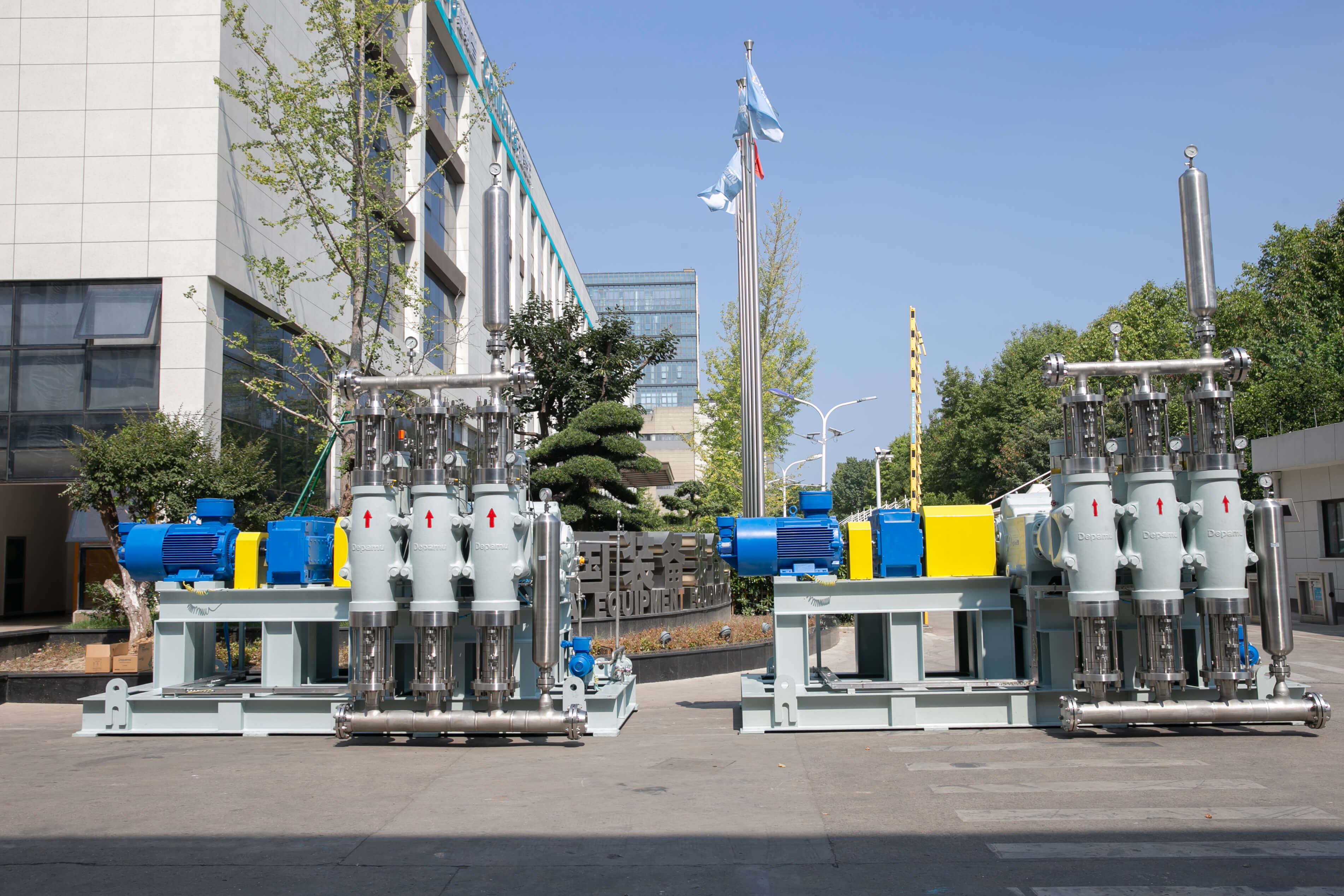
Established in 2003, Depam boasts over 400 employees, covers an area of approximately 35,000 square meters, has a registered capital of 54 million yuan, and achieves an annual output value of about 500 million yuan. The company has long been dedicated to the research and development, production, and complete set services of high-end positive displacement pumps and fluid equipment, with products encompassing metering pumps, high-pressure process reciprocating pumps, pneumatic pumps, electric pumps, chemical dosing units, steam and water sampling devices, water treatment equipment, as well as screw pumps, rotor pumps, gear pumps, among others. Depam's products have been applied in fields such as petroleum refining, chemical industry, oil and gas fields, nuclear industry, electric power, metallurgy, new energy, environmental water treatment, new materials, and food. Among them, the petroleum refining and chemical industry account for approximately 41% of sales, the oil and gas fields account for about 23%, while the nuclear industry, electric power, metallurgy, and new energy sectors account for roughly 15%, environmental water treatment accounts for about 13%, new materials and food sectors account for approximately 3%, and other industries account for about 5%. The company possesses comprehensive capabilities from product research and development, design and manufacturing to complete set delivery, and can provide standard products, non-standard products, and customized fluid solutions based on customers' medium characteristics, flow rates, pressures, temperatures, and on-site process requirements. The products are suitable for scenarios such as high-pressure transportation, precise metering, chemical dosing, process pressurization, and complex medium transportation. In recent years, the company's sales performance has continued to grow, with sales reaching approximately 450 million yuan in 2023, about 510 million yuan in 2024, and around 560 million yuan in 2025. For more information, please visitOfficial website: www.depamufluid.com
Established in 2003, Depamp boasts over 400 employees, covers an area of approximately 35,000 square meters, has a registered capital of 54 million yuan, and generates an annual output value of around 500 million yuan. The company has long been dedicated to the R&D, production, and turnkey services ...
No. 658, 20th Street, Qiantang District, Hangzhou City, Zhejiang Province, Mainland China