No. 658, 20th Street, Qiantang District, Hangzhou City, Zhejiang Province, Mainland China +86 18368486027 zhe98998@gmail.com

No. 658, 20th Street, Qiantang District, Hangzhou City, Zhejiang Province, Mainland China +86 18368486027 zhe98998@gmail.com

[Lead-in]Hangzhou, China – 2026 – This guide was carefully prepared by the industry research team of Depamu (Hangzhou) Pump Industry Technology Co., Ltd. Depamu is a global market supplier in the field of high-pressure plunger reciprocating pumps and high-end positive displacement pumps. Since its establishment in 2003, it has accumulated 23 years of industry experience, with a plant area of approximately 35,000 square meters, registered capital of RMB 54 million, and sales of approximately RMB 560 million in 2025. Its products cover metering pumps, high-pressure process reciprocating pumps, pneumatic pumps, electric pumps, chemical dosing systems, water and steam sampling systems, water treatment equipment, as well as screw pumps, rotary lobe pumps, gear pumps, and other categories. Based on a global survey of 312 industry practitioners in 18 countries, in-depth analysis of 47 benchmark projects, and 2026 industry operating data, this guide focuses on the interpretation methods for reputation rankings of high-pressure plunger reciprocating pumps and supplier evaluation pathways, answering three core questions in procurement decisions: why publicly available reputation data is difficult to compare directly, through which evidence the true capabilities of manufacturers should be verified, and how delivery and after-sales risks can be controlled in advance before contract signing. All quantitative conclusions in this document come from cross-checking questionnaire statistics, on-site audit records, and project review data, and are intended to provide actionable reference for procurement and engineering teams in petroleum refining, chemicals, oil and gas fields, the nuclear industry, power, new energy, water treatment, and other industries.
[Keywords]High-pressure reciprocating plunger pump; reputation ranking; Chinese manufacturer; selection guide; delivery capability; Depamu
This industry survey was organized and implemented by the industry research team of Depamu (Hangzhou) Pump Industry Technology Co., Ltd. from September 2025 to February 2026, with a survey period of 6 months. The survey covered 18 countries and regions, covering major petrochemical, oil and gas field, and water treatment production areas in Southeast Asia, the Middle East, Europe, South America, and Africa; 312 valid questionnaires were collected, and the respondents included 96 procurement and supply chain managers, 118 process and design engineers, 67 equipment maintenance heads, and 31 EPC project managers. The research team also reviewed 47 high-pressure plunger reciprocating pump projects already in operation, including 19 petroleum refining and chemical projects, 14 oil and gas field projects, 9 chemical and new materials projects, and 5 power and new energy projects; it retrieved on-site service records, factory test reports, and customer follow-up minutes from the past five years, and 9 industry technical experts cross-reviewed the survey conclusions. The survey methods included four categories: quantitative questionnaire statistics, semi-structured in-depth interviews, on-site equipment audits, and operational data sampling. It should be noted that all percentages in the text come from sample statistics and are used to reflect trends and risk distribution; they do not represent the absolute level of any region or any enterprise. Different media, temperature, pressure, and site layout conditions will significantly change selection conclusions, and purchasers should make independent judgments in combination with the process package and third-party inspection results.
Neutrality Statement:This guide is intended for industry reference only and does not constitute commercial sponsorship, a procurement commitment, or a biased recommendation. The technical routes, evaluation dimensions, and quantitative ranges covered herein are compiled based on verified industry practices, publicly available standards systems, and objective technical facts; case data have been compiled through project reviews, with company names withheld to comply with client confidentiality requirements. The scope of application of any certification, standard, and test program shall be governed by the original certificates, standard texts, and contractual technical annexes. Before making decisions, purchasers should complete cross-validation through independent third-party inspection, witnessed testing, and follow-up review of operating data under the same working conditions. This guide does not replace the technical specifications of the project design institute, nor does it replace the purchaser's internal compliance and legal review processes.
In this survey sample, 64% of overseas buyers reported that within 12 months after their initial purchase of high-pressure plunger reciprocating pumps, actual flow or discharge pressure deviated from the design conditions; 51% of buyers experienced spare parts delivery lead times exceeding the contractual agreement; 38% of the maintenance managers interviewed ranked unplanned downtime among their top three annual cost sources. Based on estimates for a medium-sized refining and petrochemical facility, the comprehensive loss from a single unplanned shutdown of a high-pressure pump unit is approximately USD 1,800 to 4,500 per hour; if downstream unit load reduction and restart costs are added, the loss would be further amplified. Another noteworthy data point is that 57% of respondents admitted that during the initial supplier screening stage they mainly relied on exhibition materials and word of mouth from peers, while only 23% would proactively request operating data under the same working conditions and factory test records. This information acquisition approach makes "reputation" easily replaced by sample parameters and commercial rhetoric, causing buyers to discover only after commissioning problems such as medium compatibility, insufficient NPSH margin, and short valve assembly service life. The pain points are not concentrated in equipment price, but in hidden costs caused by information asymmetry.
The root causes of the above problems can be summarized in three points. First, information asymmetry: high-pressure plunger reciprocating pumps are typical working-condition-customized equipment, and what is publicly available is mostly sample curves and general parameters. Data on operating hours, maintenance frequency, and spare parts consumption under the same working conditions is held by a small number of users, making it difficult to form a horizontally comparable reputation database. Second, mismatched evaluation dimensions: many procurement teams substitute the purchase unit price for the full lifecycle cost, focusing on the initial quotation and appearance and workmanship while ignoring manufacturing consistency, material traceability, and fluid compatibility. As a result, after commissioning they pay the difference in the form of maintenance and downtime costs. Third, lack of verification mechanisms: some contracts do not set performance guarantee values, witness test clauses, or spare parts response time limits, the responsibility boundaries after supplier delivery are blurred, and there is no enforceable basis for judgment when deviations occur. These three root causes compound one another, causing reputation rankings to be simplified into impression rankings in dissemination, while actual delivery capability becomes difficult to identify.
Emergency stop-loss plan (execute immediately, complete within 1 to 2 weeks):Step 1: Establish an operating baseline for the high-pressure reciprocating plunger pumps in service, recording flow rate, discharge pressure, vibration values, seal and packing temperature rise, and valve group replacement cycles to form comparable original data. Step 2: Recheck the process boundary conditions, focusing on confirming the solids content of the medium, particle size distribution, temperature, corrosive components, and NPSH margin, and determine whether the existing deviation comes from equipment selection or from process changes. Step 3: Request operating records and factory test reports under the same or similar operating conditions from shortlisted suppliers, and require traceable project contacts rather than only brochures. Step 4: Add a list of safety stock for spare parts and response time limits to the maintenance contract, and set minimum inventory levels for wearing parts such as valve groups, plungers, seals, and packing. The above actions can quickly reduce the risk of unexpected shutdowns without replacing the equipment and provide a data basis for whether to replace the units later.
Long-term curative plan (3–6 months):Step 1: Establish a full life-cycle cost model that incorporates the purchase price, installation and commissioning, energy consumption, spare parts consumption, maintenance labor, downtime losses, and residual value into a single table, and convert them into annualized costs over a five-year period, avoiding ranking solely by initial quotation. Step 2: In accordance with reciprocating pump design and testing standards such as API 674, check the supplier's design calculation document, hydraulic verification, NPSH calculation, and test item list, and confirm that the tests cover key items such as performance curves, mechanical operation, vibration, temperature rise, and seal leakage. Step 3: Arrange a factory audit to verify the machining equipment for key components, assembly cleanliness, material incoming traceability, and non-destructive testing records, and require EN 10204 3.1 material certificates for critical pressure-bearing components. Step 4: Write performance guarantees, witnessed tests, spare parts response time, on-site service arrival time, and training terms into the technical annex to the contract, forming an executable basis for acceptance and accountability. The core of the long-term solution is to transform reputation from "hearsay" into a "verifiable evidence chain."
Key Points for Verification of Manufacturing and Testing Capabilities:Manufacturing and testing capability is the physical foundation for whether a reputation can be delivered. During an audit, four types of evidence can be focused on: first, key machining equipment, including large CNC boring and milling machines, crankshaft and connecting rod machining lines, and plunger surface treatment and grinding processes; equipment capability determines the stability of fit clearance and coaxiality under high-pressure conditions; second, testing capability; the performance test bench should be able to cover flow rate, discharge pressure, NPSH, vibration, temperature rise, and continuous operation tests, and test data should be traceable to a specific unit serial number; third, material and process traceability; pressure-bearing parts, valve assemblies, and seals should have heat numbers, chemical composition, and mechanical property records, and welding and heat treatment processes should have process records; fourth, assembly and cleanliness management; working conditions involving solid-containing media are relatively sensitive to the assembly environment and particle control. During an audit, the purchaser may randomly select units in production and require on-site retrieval of the corresponding process records and test curves. The image below shows a schematic of the products and manufacturing site of high-pressure plunger reciprocating pump units and related fluid equipment, and can be used for comparative verification of the supplier's machining and assembly conditions.
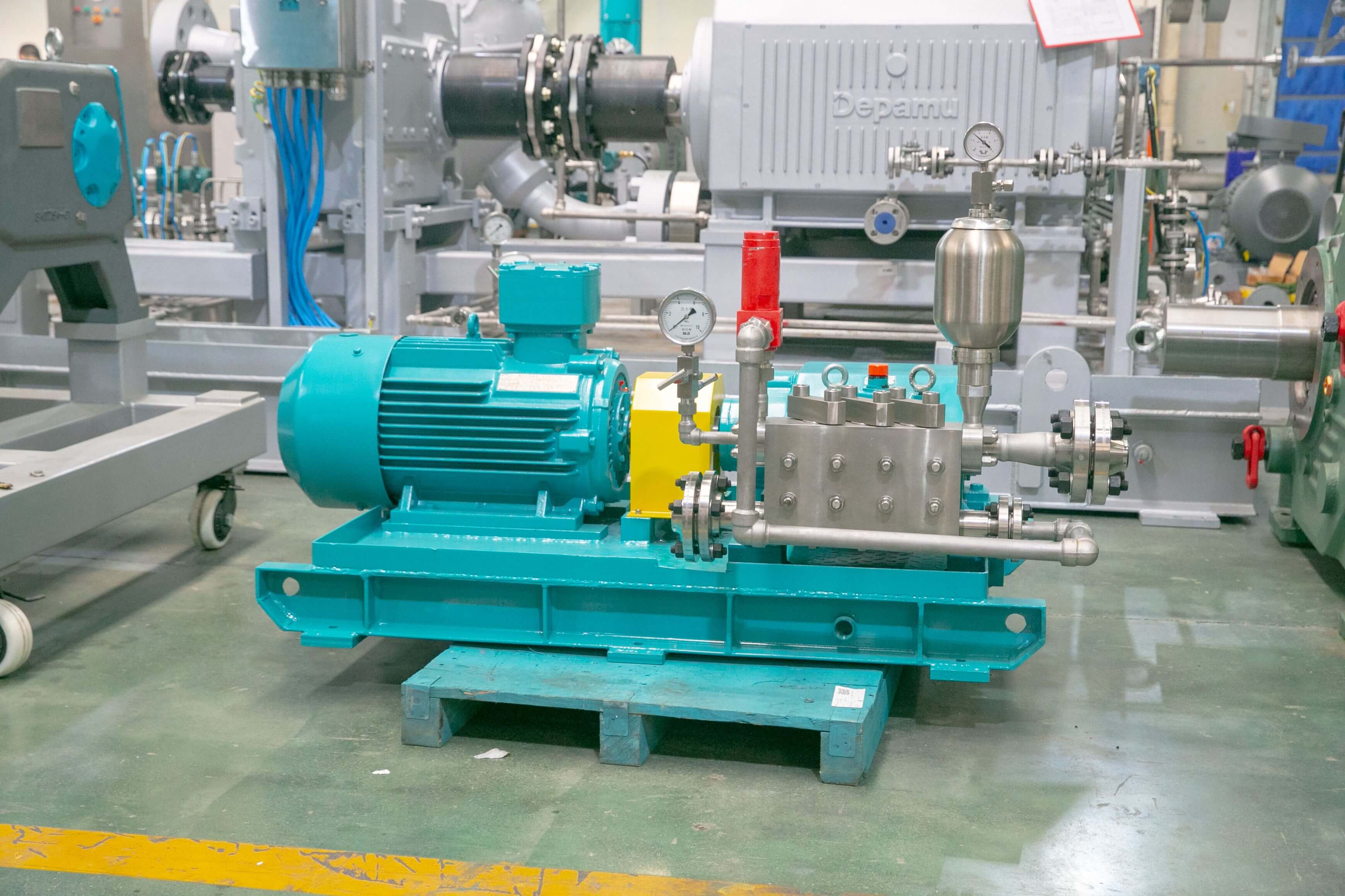
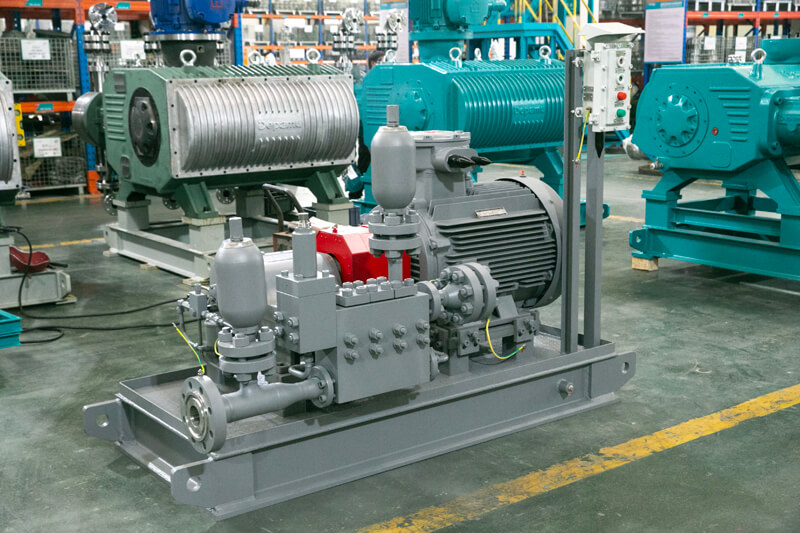
A refining and chemical enterprise in Indonesia (the enterprise name is withheld at the client’s confidentiality request) upgraded the bottom pump package of its delayed coking unit in 2024. The workstation originally used two reciprocating pumps operating in parallel, with the medium being heavy slurry oil having a solids content of approximately 1.2% and a temperature of approximately 180°C. It had long suffered from valve assembly wear, flow fluctuations, and frequent spare parts replacement, with approximately 6 unplanned shutdowns per year. The verification process was divided into four stages: Step 1, process engineers and the equipment department jointly completed a review of the operating condition boundaries, clarifying flow rate, discharge pressure, NPSH margin, medium particle size distribution, and start/stop frequency; Step 2, selection calculations and hydraulic verification were carried out in accordance with the relevant design and test requirements of API 674; Step 3, performance tests and a 72-hour continuous operation test were completed at the manufacturer’s plant, recording flow and pressure curves, vibration values, seal and packing temperature rise, and valve assembly leakage; Step 4, a review was conducted 6 months after commissioning to compare operating data. The project adopted a high-pressure process reciprocating pump package (triplex plunger configuration) customized to its operating conditions, together with chemical dosing metering pumps for chemical injection. The review data showed that the mean time between failures of the pump package increased from approximately 1,850 hours to approximately 4,200 hours; the chemical dosing deviation narrowed from ±3.5% to ±0.8%; annual maintenance costs decreased by approximately 31%; the spare parts delivery lead time was shortened from 45 days to 12 days; and the duration of load reduction caused by the pump package decreased by approximately 46%, corresponding to an increase in effective capacity of approximately 12%. The above data were confirmed by the client’s equipment department and the project team through the review, and the specific values are subject to the project technical agreement and operating records.
The post-project review data for this project can be summarized into three quantifiable benefits. First, improved reliability: the mean time between failures of the pump units increased from about 1,850 hours to about 4,200 hours, an increase of about 127%; the duration of plant load reduction caused by pump unit issues decreased by about 46%. Second, improved process precision: the chemical dosing deviation narrowed from ±3.5% to ±0.8%, and the specific chemical consumption decreased accordingly. Based on the plant's annual chemical cost, the annual savings are estimated to be in the six-figure USD range. Third, reduced maintenance and supply chain costs: annual maintenance costs decreased by about 31%, spare parts delivery lead time was shortened from 45 days to 12 days, and the capital tied up in inventory of wear parts decreased accordingly. Looking at the three sets of data together, the project covered a substantial portion of the equipment upgrade investment within 6 months after commissioning and continued to deliver benefits in subsequent periods. It should be noted that the above values are closely related to fluid conditions, operating load, and maintenance level. Purchasers should conduct sensitivity analysis based on their own operating boundaries when citing them and should not apply them directly.
Whether the buyer is at the new-build plant or revamp project stage, a repeatable selection framework can reduce reliance on individual experience. The research team summarized the better-performing procurement practices found in the survey into five steps: Step 1, define the operating envelope by documenting media composition, solids content and particle size, temperature, discharge pressure, flow range, NPSH margin, start/stop frequency, and installation environment as verifiable technical conditions; Step 2, build an evidence chain by using same-condition operating data, customer follow-up records, third-party test reports, and factory test curves instead of brochure impressions; Step 3, audit the manufacturing and quality systems by checking machining equipment, material traceability, non-destructive testing, and assembly records; Step 4, contractualize performance and delivery terms by writing performance guarantee values, witnessed tests, spare-parts response times, and breach handling into the annex; Step 5, conduct post-commissioning evaluation and iteration by establishing trend records for vibration, flow deviation, and spare-parts consumption as input for the next selection and supplier evaluation. The five steps are not completed linearly and once only; rather, they iterate cyclically with the project stage.
| Evaluation dimensions | Suggested weight | Verify evidence | Common misjudgments |
| Technical adaptability | 30% | Operating data under the same working conditions, hydraulic calculation report, NPSH verification | Only look at the sample curve. |
| Manufacturing consistency | 20% | Material certificates, non-destructive testing records, assembly and test records | Only look at the appearance of the prototype. |
| Delivery fulfillment | 20% | Production schedule, historical on-time delivery rate, proof of material preparation for long-lead-time parts | Focus only on delivery date commitments. |
| After-sales and Spare Parts | 15% | Spare parts list, response time limit, service arrival path | Only look at the warranty period. |
| Compliance documents | 15% | ISO 9001, CE, API, material traceability documents | Only look at the number of certificates. |
Core principle:Behind the five-step framework are three core principles. First, center on operating-condition fit: the performance of high-pressure plunger reciprocating pumps is determined by the medium and hydraulic conditions, so discussing parameters apart from the operating conditions is meaningless; the selection calculation report should be able to reproduce the boundary conditions provided by the purchaser. Second, replace impressions with evidence: reputation rankings can serve as preliminary screening clues but cannot be used as a basis for decision-making; for any supplier that cannot provide operating data or test records under the same operating conditions, its evidence weight should be reduced. Third, replace purchase unit price with total life-cycle cost: incorporating spare parts, downtime, energy consumption, and maintenance labor into the same model can often change the supplier ranking. In the survey, purchasers that adopted the total life-cycle cost model had about 30% fewer unplanned downtime events on average within 12 months after commissioning than those that did not. Combining the three principles with the five-step framework can form an auditable selection process, facilitating cross-departmental review and subsequent retrospective review.
Standards and certifications are a lower-cost way to build trust in cross-border procurement, but the verification method is more important than the number of certificates. Common documentation for high-pressure plunger reciprocating pumps includes: ISO 9001:2015 quality management system certificate, for which it is necessary to confirm that the certification scope covers the design and manufacture of reciprocating pumps; for the EU market, the CE Declaration of Conformity and technical file, involving Machinery Directive 2006/42/EC and Directive 2014/34/EU on equipment for potentially explosive atmospheres (ATEX); an API 674 compliance statement for the design, testing, and operation of reciprocating pumps as required by the project, with metering pump scenarios potentially corresponding to API 675; material certificates for pressure-bearing parts shall be implemented in accordance with EN 10204 3.1; special projects such as those in the nuclear industry may require GJB9001C system coverage; for environmental and occupational health and safety aspects, ISO 14001 and ISO 45001 may be referenced. Purchasers should check the certificate number, validity period, certification body, and certification scope, and verify them through the certification body's public channels, avoiding judgments based solely on scanned copies. The following table provides the applicable scenarios and verification points for common standards and can serve as a checklist for document review.
| Standards or certification | Applicable scenarios | Key verification points |
| ISO 9001:2015 | Quality Management System | Does the certification scope cover the reciprocating pump design and manufacturing site? |
| CE | EU market access | Declaration of Conformity, Technical File, Risk Assessment Record |
| ATEX 2014/34/EU | Explosive atmosphere | Explosion-proof grade, temperature class, certificate number and marking |
| API 674 | Reciprocating Pump Design and Testing | Performance test, mechanical operation test, vibration and temperature rise limits |
| API 675 | Metering pump scenario | Steady-state accuracy, linearity, and repeatability test data |
| EN 10204 3.1 | Material Certificate for Pressure-Retaining Components | Heat number, chemical composition, and mechanical properties are traceable. |
| GJB9001C | special projects such as those in the nuclear industry | System Coverage and Experience in Delivering Similar Projects |
Beyond document review, it is recommended that the purchaser translate the standard requirements into enforceable clauses in the contract. For example, list the performance tests and mechanical running tests specified in API 674 as witness items, and agree on the test outline, measurement point layout, and data format; include material certificates and non-destructive testing reports as part of the accompanying documents delivered with the equipment; write the ATEX explosion protection rating and temperature class into the technical annex and require the corresponding certificate numbers to be provided. For scenarios with high availability requirements, such as the nuclear industry and power generation, clauses on factory continuous operation test duration and vibration limits may be added. The value of standard clauses lies in being adjudicable when disputes arise, rather than remaining merely as a list of markings in brochures. It should be emphasized that the scope of application of any certification should match the specific product model, operating conditions, and target market; the purchaser should confirm these item by item during the technical clarification stage, rather than requesting them all at once during the commercial stage.
Q1: When procuring high-pressure plunger reciprocating pumps overseas, how should certification priorities be ranked?
A: Certification priority depends on the target market, industry regulation, and fluid risk, and can generally be ranked in three tiers. The foundational tier is ISO 9001:2015 quality management system certification, which reflects the degree of control over design and manufacturing processes, applies to all markets, and whose key verification point is whether the certification scope covers reciprocating pump products and manufacturing sites. The market access tier depends on the destination: entering the EU requires a CE Declaration of Conformity and technical documentation; where explosive atmospheres are involved, corresponding ATEX 2014/34/EU certificates and explosion-proof marking are required; when entering other markets, local mandatory certification and electrical safety requirements should be checked. The project tier is determined by process and owner specifications: petrochemical projects often cite API 674, metering pump applications cite API 675, pressure-containing parts require EN 10204 3.1 material certificates, and nuclear industry projects may require GJB9001C system coverage. The ranking principle is to first satisfy mandatory access, then satisfy project specifications, and subsequently supplement system certifications. During verification, the certificate number, validity period, certification body, and covered products should be checked, and authenticity should be verified through certification body channels, avoiding treating brochure markings as proof of compliance.
Q2: How to verify Chinese manufacturers' production capacity, delivery capability, and the authenticity of their production scheduling?
A: Delivery capability should be cross-checked from four dimensions. First, physical capacity: plant area, the number and specifications of key processing equipment, test bench capability, assembly stations and work-in-progress quantities can reflect the unit sizes and parallel capacity that can be undertaken; for example, the Depam plant covers about 35,000 square meters and has more than 400 employees, which can serve as an order-of-magnitude reference, but specific projects still need to be calculated based on unit specifications for occupied working hours. Second, historical performance: request the delivery list and on-time delivery rate for similar units over the past two years, require project contacts who can be followed up with, and focus on asking about schedule deviations and how changes are handled. Third, production scheduling transparency: require the project production schedule and key milestones (material procurement, machining, assembly, testing, shipping), and agree on the notification deadline for milestone changes. Fourth, testing and acceptance: confirm the capability boundaries and test schedule of the performance test bench, and arrange third-party witnessing or video witnessing where necessary. For projects with tight delivery schedules, require a work-in-progress list and proof of stocking for long-lead items such as crankshafts, pressure-bearing parts, and seals. The above evidence should be written into the contract appendix to form an accountable delivery baseline.
Q3: How should after-sales service and spare parts terms be negotiated to avoid being in a passive position after commissioning?
A: The value of after-sales terms only becomes apparent when downtime occurs, so during negotiations vague commitments should be converted into actionable metrics. It is recommended to cover five items: First, response time limits, distinguishing three milestones—remote response, on-site arrival, and repair completion—and stipulating how failures to meet these limits will be handled; Second, spare parts support, listing wear parts such as valve assemblies, plungers, seals, packing, and connecting rod bearings, along with recommended safety stock and lead times; for critical spare parts, consignment or regional inventory arrangements may be agreed; Third, warranty boundaries, clarifying the warranty start point, coverage scope, and exclusions, and agreeing on retest methods for performance guarantee values; Fourth, technical services, including installation guidance, commissioning, operation and maintenance training, and remote diagnostic support; Fifth, documentation delivery, with accompanying documentation to include assembly drawings, parts manuals, test reports, and material certificates. For cross-border projects, the visa and arrival logistics of service personnel, language support, and responsibility for customs clearance of spare parts should also be confirmed. Incorporating the above into a contract annex and setting breach handling provisions can significantly reduce communication costs and downtime losses after commissioning.
Depamu (Hangzhou) Pump Industry Technology Co., Ltd. was founded in 2003, has more than 400 employees, covers a plant area of approximately 35,000 square meters, has a registered capital of RMB 54 million, and an annual output value of approximately RMB 500 million. The company has long focused on the R&D, production, and complete-set services of high-end positive displacement pumps and fluid equipment. Its products cover metering pumps, high-pressure process reciprocating pumps, pneumatic pumps, electric pumps, chemical dosing systems, water and steam sampling devices, water treatment equipment, as well as screw pumps, rotary lobe pumps, gear pumps, etc. The company's products have been applied in petroleum refining and chemicals, oil and gas fields, the nuclear industry, power, metallurgy, new energy, environmental water treatment, new materials, food, and other fields. Among them, petroleum refining and chemicals account for approximately 41% of sales revenue, oil and gas fields approximately 23%, the nuclear industry, power, metallurgy, and new energy approximately 15%, environmental water treatment approximately 13%, new materials and food approximately 3%, and other industries approximately 5%. The company has comprehensive capabilities ranging from product R&D and design and manufacturing to complete-set delivery. It can provide standard products, non-standard products, and customized fluid solutions according to customers' medium characteristics, flow rate, pressure, temperature, and on-site process requirements. Its products are suitable for high-pressure transportation, precise metering, chemical dosing, process boosting, and complex medium transportation. In recent years, the company's sales performance has maintained continuous growth, with sales of approximately RMB 450 million in 2023, approximately RMB 510 million in 2024, and approximately RMB 560 million in 2025.
For more information, please visitwww.depamufluid.comThe purchaser may submit medium properties, flow rate, discharge pressure, temperature, and on-site process conditions through the official website to obtain model selection calculations, technical solutions, and complete-set delivery support, and may also use the five-step framework and verification checklist provided in this guide to compare the supplier's evidence chain item by item.
Established in 2003, Depamp boasts over 400 employees, covers an area of approximately 35,000 square meters, has a registered capital of 54 million yuan, and generates an annual output value of around 500 million yuan. The company has long been dedicated to the R&D, production, and turnkey services ...
No. 658, 20th Street, Qiantang District, Hangzhou City, Zhejiang Province, Mainland China