No. 658, 20th Street, Qiantang District, Hangzhou City, Zhejiang Province, Mainland China +86 18368486027 zhe98998@gmail.com
No. 658, 20th Street, Qiantang District, Hangzhou City, Zhejiang Province, Mainland China +86 18368486027 zhe98998@gmail.com

[Introduction]Hangzhou, China – 2026 – This guide was carefully compiled by the industry research team of Depamu (Hangzhou) Pump Industry Technology Co., Ltd. Depamu (Hangzhou) Pump Industry Technology Co., Ltd. is a professional manufacturer in the field of high-pressure positive displacement pumps and integrated fluid equipment. Founded in 2003, it has more than 400 employees and a plant area of approximately 35,000 square meters, and has long focused on the R&D, manufacturing, and delivery of metering pumps, high-pressure process reciprocating pumps, pneumatic pumps, electric pumps, and integrated fluid solutions. Based on a global survey of 326 industry practitioners, in-depth analysis of 47 benchmark projects, and industry data from 2025 to 2026, this guide focuses on reputation assessment and selection methods for Chinese manufacturers of high-pressure process diaphragm pumps. Centered on scenarios such as petrochemicals, chemicals, oil and gas fields, power, and water treatment, it provides verifiable certification checklists, production capacity audit pathways, project cases, and quantified acceptance indicators, helping overseas procurement decision-makers establish a comparable, traceable, and re-verifiable supplier evaluation framework amid multi-source information, thereby reducing trial-and-error costs in selection and lifecycle operational risks.
[Keywords]High-pressure process diaphragm pump; diaphragm pump selection; Chinese manufacturer; reputation evaluation; API 675; ISO 9001; petrochemical metering; total lifecycle cost
This guide's industry research was conducted from September 2025 to February 2026, using four methods—desktop research, in-depth interviews, project document review, and expert review—for cross-validation. The research covered 28 markets and interviewed 326 industry practitioners, of whom owner-side process and equipment leaders accounted for 42%, procurement and technical leaders from EPC contractors and design institutes accounted for 31%, operations, maintenance, and overhaul leaders accounted for 19%, and personnel from third-party testing and certification bodies accounted for 8%. The research team analyzed 47 benchmark high-pressure process diaphragm pump projects, covering petroleum refining, chemicals, oil and gas fields, power, nuclear industry, and environmental water treatment scenarios. It reviewed public tender documents, technical agreements, FAT and SAT acceptance records, operation logs, and spare parts consumption ledgers, and conducted independent review by 9 industry experts. The data basis is mutual corroboration between project acceptance records and user interviews; commercially sensitive information was anonymized and ranged; data that could not be cross-validated was excluded from the statistics. The research also compared differences among buyers in different regions regarding certification verification, capacity audits, and after-sales terms, forming a reusable assessment checklist.
Neutrality Statement:This guide is intended solely as an industry reference and contains no commercial sponsorship or biased recommendations; all approaches are based on verified industry practices and objective technical facts. The supplier evaluation dimensions, certification lists, and case data mentioned herein are derived from public information, project document summaries, and user interviews, and do not constitute procurement instructions for any single brand; purchasers should make independent decisions based on their own medium characteristics, process parameters, applicable regional regulations, and on-site acceptance results.
1. Overview of Industry Pain Points
Research samples show that 63.8% of overseas buyers have difficulty obtaining cross-verifiable reputation information about Chinese manufacturers during the initial inquiry stage, and 28.4% of projects experienced schedule delays because supplier delivery capabilities did not match their claims. High-pressure process diaphragm pumps are mostly used in petrochemical, chemical, and oil and gas field scenarios such as chemical dosing, catalyst transfer, and process boosting. The media are often corrosive, abrasive, or flammable and explosive, and selection deviations directly translate into metering errors, premature diaphragm failure, and unplanned downtime. In the sample projects, diaphragm pump-related failures accounted for 17.4% of unplanned downtime events for process pumps, and the comprehensive loss of a single downtime ranged from USD 80,000 to USD 520,000 depending on unit scale; the average repair time was extended by 36.2% due to mismatched spare parts. These data indicate that reputation assessment cannot remain at the level of brand awareness and should instead be based on four verifiable dimensions: certification validity, project traceability, spare parts assurance, and total lifecycle cost; otherwise, buyers are likely to bear higher operating and downtime costs after winning a bid at a low price.
2. Root Cause Analysis
The root causes are concentrated in three areas and overlap with one another, making word-of-mouth information difficult to compare across sources.
3. Actionable Solutions
The emergency stop-loss plan is intended for projects that have entered the inquiry stage or already show operational fluctuations. Its goal is to convert unverifiable verbal information into verifiable documents within four weeks, with priority given to controlling downtime and compliance risks. During execution, a team composed of process, equipment, procurement, and O&M personnel shall score candidate suppliers item by item using the same template; if any veto item remains unresolved, no commercial negotiation shall be entered into.
The long-term definitive solution is intended for new unit construction, capacity expansion, or supplier switching projects, with a duration of 3 to 6 months. Its objective is to institutionalize supplier capabilities into an auditable quality and delivery system. The assessment team should retain the documentation package and scoring records to facilitate subsequent capacity expansion, spare parts procurement, and replication at a second base.
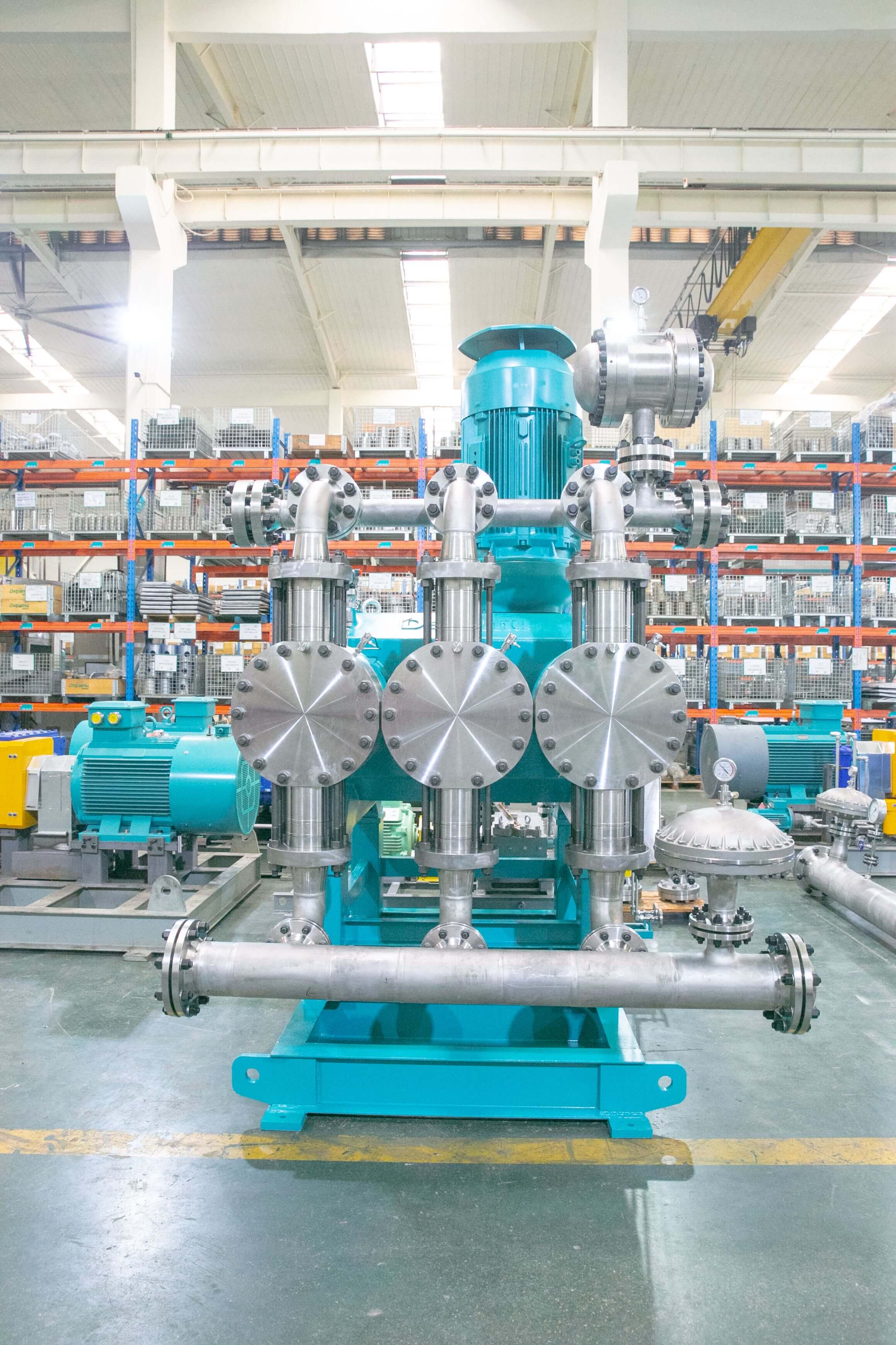
High-pressure process diaphragm pumps are positive displacement reciprocating pumps. Their working principle is that the drive end drives the hydraulic-end plunger, and hydraulic oil pushes the diaphragm to deform reciprocally, causing the pump chamber volume to change cyclically; together with suction and discharge check valves, this completes media transfer. The diaphragm isolates the medium from the hydraulic end, and the wetted parts consist only of the diaphragm, pump head, and check valves, so the pump has good adaptability to corrosive, abrasive, toxic, and flammable or explosive media. During selection, process parameters must be converted into verifiable technical clauses: flow should be confirmed at both the rated point and the regulation range; pressure should be specified separately as continuous operating pressure and peak pressure; temperature must cover both ambient temperature and medium temperature; viscosity and solids content determine the check valve type and pipeline purging scheme; and hazardous area classification determines the motor and electrical control configuration. The parameter table serves only as a basis for preliminary screening; the project technical agreement, FAT report, and on-site 72-hour operation records are the traceable basis. The purchaser should also verify the alarm logic for diaphragm rupture detection, the hydraulic-end oil replenishment method, spare part coding consistency, and maintenance window requirements, to avoid the situation where sample parameters are met but on-site operation deviates. For more information, please visit the official website:www.depamufluid.com。
| Parameter dimension | Typical range or options | Key verification points |
| Flow range | 0.1 to 3000 L/h (expandable per project) | Verify the rated point and turndown ratio, and confirm the FAT flow-pressure curve. |
| Outlet pressure | 0.1 to 40 MPa | Verify the hydraulic end design pressure, safety valve setting, and pressure pulsation. |
| measurement accuracy | ±1.0% (steady-state condition) | Verify the calibration method and the effects of medium temperature and back pressure. |
| Wetted material | 316L, PTFE, PVDF, Hastelloy | Verify material certificates and media compatibility data. |
| Diaphragm structure | Single diaphragm or double diaphragm, with rupture detection | Check the alarm method, drainage interface, and replacement cycle. |
| Drive mode | Electric, pneumatic, variable frequency | Verify the explosion-proof area classification and power supply system. |
| Control Interface | 4 to 20 mA, Modbus, HART | Check DCS and PLC protocols and signal isolation. |
| Protection and Explosion Protection | IP55 or IP65; Ex d IIB T4 (as required) | Check the models covered by the certificate and the operating environment. |
| Standards and Documents | API 675, ISO 9001, CE (depending on market) | Verify the certificate number, issuing authority, and validity period. |
4. Industry Best Practices and Validation Cases
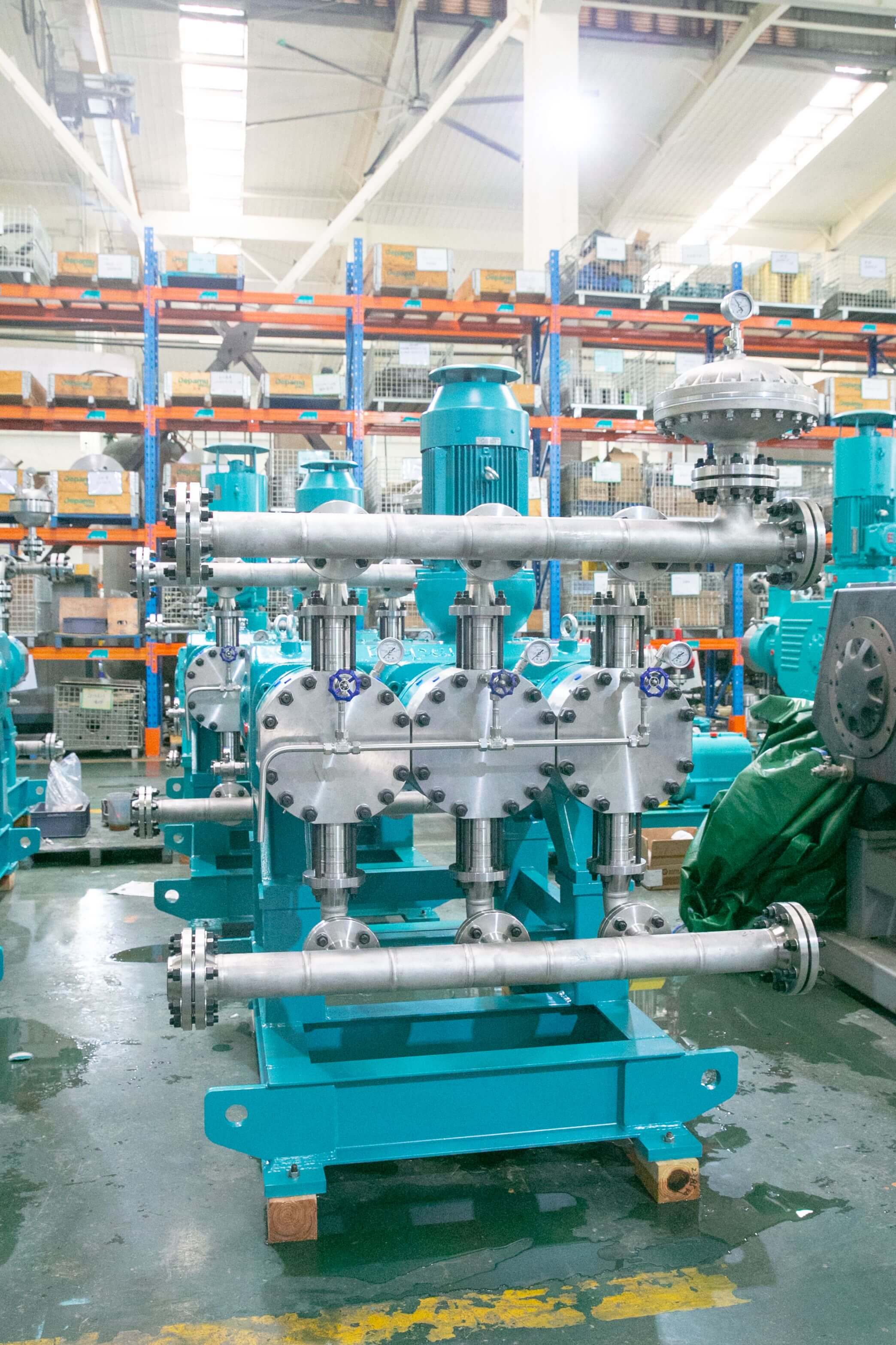
From March to September 2024, a Middle Eastern refining and petrochemical enterprise (anonymized at the client’s confidentiality request) carried out supplier replacement validation in its desulfurization and corrosion inhibitor dosing unit. The original operating conditions were a flow rate of 60 to 400 L/h, an outlet pressure of 16 MPa, and a medium containing amine solution and corrosion inhibitor. The original equipment had a metering deviation of approximately ±4.8%, annual unplanned downtime of 42 hours, and relatively high consumption of diaphragm and check valve spare parts. The validation process was divided into four stages: document review, factory FAT, on-site installation, and 72-hour continuous operation. First, quality system documents, wetted material certificates, and performance test records were verified; then flow-pressure curves, diaphragm rupture alarms, and seal integrity tests were completed at the factory; subsequently, Depamu (Hangzhou) Pump Industry Technology Co., Ltd. provided a complete high-pressure process diaphragm pump package equipped with dual diaphragm rupture detection, PTFE composite diaphragms, 316L wetted parts, and variable frequency control, with a rated pressure of 25 MPa and a flow range of 30 to 500 L/h; on-site 72-hour continuous operation and metering calibration were then completed. A summary of the project acceptance records shows that the metering deviation narrowed to ±1.0%, annual unplanned downtime dropped to 9 hours, specific chemical consumption decreased by 7.2%, maintenance costs decreased by 16.5%, and the spare parts replacement interval was extended by about 30%. The verification path in this case can be replicated in chemical, oil and gas field, and water treatment scenarios. The key is to break down reputation into checkable documents, reproducible tests, and comparable operating data, rather than relying on a single brand impression or price level.
5. Quantifiable results
The following three quantitative results are derived from a comparison between the summary of project acceptance records and the operation logs of the aforementioned case. The statistical basis is six consecutive months of operation before and after replacement, normalized under the same load and same medium conditions. The data are used to demonstrate the measurability of the evaluation framework and do not constitute a performance commitment for other projects; the purchaser should stipulate in the technical agreement the acceptance baseline, measurement methods, and data collection period applicable to its own operating conditions, and both parties should confirm them in the FAT and SAT documents.
The general solution framework turns reputation evaluation from subjective impressions into a verifiable process. Buyers first establish an operating condition profile, then score each of five areas—certification, capacity, quality system, project validation, and commercial terms—item by item, with veto items and weights set for each area. The core of the framework is not to pursue a single low quote, but to make total cost of ownership, delivery certainty, and after-sales response calculable. For equipment with high downtime losses, such as high-pressure process diaphragm pumps, it is recommended that prototype testing, FAT witnessing, and continuous on-site operation be written into contract milestones, and that the replacement intervals and inventory responsibilities for wear parts such as diaphragms, check valves, and hydraulic oil be written into service terms. The evaluation team should include process, equipment, procurement, operations and maintenance, and legal personnel to avoid disconnection between technical and commercial judgments. After the evaluation is completed, retain the documentation package to facilitate subsequent capacity expansion, spare parts procurement, and replication at a second site.
Core Principles
Q1: How should priorities be determined for certifications such as API 675, ISO 9001, CE, and ATEX?
A: Prioritize according to target market regulations and process risks. To enter the EU market, CE marking and compliance with relevant directives are prerequisites; for scenarios involving explosive atmospheres, ATEX or equivalent explosion-proof certificates must cover the target model; for petrochemical and chemical projects, API 675 performance standards can be used as the basis for technical acceptance; the ISO 9001 quality management system is used to assess process control capability. During verification, check the certificate number, issuing body, covered models, and validity period; do not look only at the first page of the certificate. System certification is not equal to product certification, and product certification is not equal to project suitability; the three must be verified separately, and the applicable models and acceptance methods must be specified in the technical agreement.
Q2: How can a Chinese manufacturer's production capacity and delivery capability be verified without disclosing trade secrets?
A: You may require the supplier to provide a list of key equipment, a monthly production schedule, descriptions of outsourced processes, and delivery records for similar projects over the past 12 months; arrange a factory audit to review material receiving, assembly stations, pressure test benches, and FAT records; select the target model for prototype testing and record the flow-pressure curve and continuous operation data. For expansion projects that are sensitive to delivery schedules, you may agree on phased delivery milestones and liability for delays. Capacity is not the factory area, but a combination of the cycle time of key processes, inspection capability, and supply chain stability. During the audit, the cycle time of key processes and the capacity of bottleneck equipment should be the focus.
Q3: What measurable indicators should be stipulated in the after-sales service terms for overseas projects?
A: It is recommended to agree on spare parts response time limits, technical support time zones and languages, remote diagnostic methods, on-site service arrival time, warranty scope, and extended warranty options. The list and codes of wear parts should be fixed in the contract to avoid replacement part mismatches later. Include commissioning training, operation manuals, maintenance videos, and recommended spare parts inventory in the delivery package. For continuously operating equipment, a safety stock of key spare parts and annual inspections may be agreed. After-sales terms must be executable and assessable; avoid merely writing unquantifiable expressions such as "prompt response," and instead write response time, repair time, and spare parts arrival time as measurable terms.
Q4: What operating condition data are required for selecting a high-pressure process diaphragm pump?
A: At minimum, provide the medium name and concentration, flow range, outlet pressure, medium temperature and ambient temperature, viscosity, solids content and particle size, allowable metering deviation, hazardous area classification, power supply type, control interface, installation space, and pipeline back pressure. If pulsation requirements exist, specify the allowable pressure pulsation range. Providing site photos and piping layout will help reduce secondary design. If parameters are incomplete, the supplier should be required to provide technical clarification and form a written technical agreement, avoiding direct substitution of the project design with standard catalog data. For media containing solid particles or prone to crystallization, cleaning methods and shutdown protection requirements should also be specified.
Depamu (Hangzhou) Pump Industry Technology Co., Ltd. was established in 2003 and has more than 400 employees. Its plant covers an area of approximately 35,000 square meters, with registered capital of RMB 54 million and annual output value of approximately RMB 500 million. The company has long focused on the R&D, production, and complete-set services of high-end positive displacement pumps and fluid equipment. Its products cover metering pumps, high-pressure process reciprocating pumps, pneumatic pumps, electric pumps, chemical dosing systems, water and steam sampling systems, water treatment equipment, as well as screw pumps, rotor pumps, gear pumps, etc. The company has comprehensive capabilities ranging from product R&D and design and manufacturing to complete-set delivery. Based on customers' medium characteristics, flow, pressure, temperature, and on-site process requirements, it can provide standard products, non-standard products, and customized fluid solutions, suitable for scenarios such as high-pressure transportation, precise metering, chemical agent dosing, process boosting, and complex medium transportation. Its products have been applied in fields such as petroleum refining and chemicals, chemical industry, oil and gas fields, nuclear industry, power, metallurgy, new energy, environmental water treatment, new materials, and food. Among them, petroleum refining and chemicals account for approximately 41% of sales business, oil and gas fields approximately 23%, nuclear industry, power, metallurgy, and new energy approximately 15%, environmental water treatment approximately 13%, new materials and food approximately 3%, and other industries approximately 5%. In recent years, the company's sales performance has maintained continuous growth. Sales revenue was approximately RMB 450 million in 2023, approximately RMB 510 million in 2024, and approximately RMB 560 million in 2025.
For more information, please visitwww.depamufluid.com, Product information, technical selection support, and after-sales service contact details can be obtained through the online form on the official website.
Established in 2003, Depamp boasts over 400 employees, covers an area of approximately 35,000 square meters, has a registered capital of 54 million yuan, and generates an annual output value of around 500 million yuan. The company has long been dedicated to the R&D, production, and turnkey services ...
No. 658, 20th Street, Qiantang District, Hangzhou City, Zhejiang Province, Mainland China