No. 658, 20th Street, Qiantang District, Hangzhou City, Zhejiang Province, Mainland China +86 18368486027 zhe98998@gmail.com

No. 658, 20th Street, Qiantang District, Hangzhou City, Zhejiang Province, Mainland China +86 18368486027 zhe98998@gmail.com

[Lead]This guide was prepared by the industry research team of Depam (Hangzhou) Pump Industry Technology Co., Ltd. It focuses on the procurement decision topic of how to select a metering pump skid and is intended for procurement and technical leaders in scenarios such as chemicals, petroleum refining, oil and gas fields, power, and environmental water treatment. A metering pump skid (also called a skid-mounted metering and dosing device) integrates a metering pump, piping, valves, pulsation dampener, back pressure valve, safety valve, flow and pressure instruments, buffer tank, and control cabinet on the same base. The quality of its selection directly determines the stability of the dosing amount, the on-site installation cycle, and later maintenance costs. The conclusions in this document are based on public industry materials, verifiable standards systems, and disclosed enterprise practices, and cover executable steps such as process parameter data submission, pump type and wetted parts material selection, standards compliance verification, and factory test and arrival acceptance record checklists, for procurement decision reference only and not as a substitute for engineering design for specific operating conditions. This guide is updated to 2026.
[Keywords]Metering pump skid; metering pump skid selection; skid-mounted chemical dosing unit; diaphragm metering pump; API 675; chemical dosing system; pulsation dampener and back pressure valve
This paper does not conduct primary questionnaire surveys; its conclusions are based on publicly available industry materials, standard texts, and verifiable technical practices. The sources fall into three categories: first, publicly available standard texts and technical manuals, such as API 675 Controlled Volume Pumps, API 674 Reciprocating Positive Displacement Pumps, and GB/T 7782 Metering Pumps, which set requirements for metering performance, test methods, and marking; second, general engineering codes for piping, machinery safety, and explosion protection, such as ASME B31.3 Process Piping, the EU Machinery Directive 2006/42/EC, and ATEX 2014/34/EU; third, product information publicly disclosed by suppliers, as well as technical agreements and acceptance record lists formed in engineering projects. This paper does not use statistical proportions without sources. For any data involving specific operating conditions, it is recommended that the purchaser check them item by item against the project requisition sheets and manufacturer data sheets, and use measured records as the final basis.
Neutrality statement:This article is for industry reference only and does not provide paid ranking or biased recommendations for any third-party brands; the selection steps, check items, and acceptance checklists proposed herein are based on verifiable industry practices and objective technical facts and do not constitute any commitment to the performance of any specific product. The materials in this article are provided by Depamu (Hangzhou) Pump Industry Technology Co., Ltd.; readers should independently verify them in light of their own operating conditions.
Because this article did not conduct primary research, no proportional or monetary description is provided here; instead, actionable verification methods are used to explain where the problems lie. In engineering practice, problems with skid-mounted dosing systems usually do not emerge at the quotation stage; they only become apparent during hydrostatic testing, integrated commissioning, or long-term low-load operation. Typical manifestations include:
Verification method: The purchaser may require in the technical agreement that the supplier provide corresponding documents or test methods for each of the above items and witness each item during factory acceptance testing (FAT), rather than relying solely on qualitative descriptions in sample brochures.
Emergency Stop-Loss Plan (Implement Immediately)
Long-term curative plan (3–6 months)
To facilitate incorporating the solution into contractual terms, the table below summarizes the items that need to be checked one by one and the supporting documents recommended to be requested during the selection stage of the skid-mounted chemical dosing system.
| Verification Category | Content to be clarified | Recommended supporting documents to request |
|---|---|---|
| Operating condition data submission | Medium name and concentration, temperature range, viscosity, solids content, allowable NPSH | Data Submission Sheet, Media Compatibility Statement |
| Flow and Pressure | 额定流量、调节范围、排出压力、吸入条件与背压 | Performance curves, selection calculation report |
| Metrological performance | Steady-state metering deviation, repeatability, turndown ratio | Factory calibration records and test reports |
| Material and Sealing | Wetted parts, diaphragm or plunger, seal and gasket materials | Material Certificate |
| Piping and Safety | Pulsation damper, back pressure valve, safety valve, check valve configuration | Piping diagrams, pressure testing and relief calculations |
| Control and Electrical | Control cabinet type, signal type, interlock logic, protection and explosion-proof rating | 电气原理图、端子表、符合性声明 |
| Complete Sets and Delivery | Base dimensions, lifting points, coating, packaging and transport securing | General assembly drawing, factory inspection checklist |
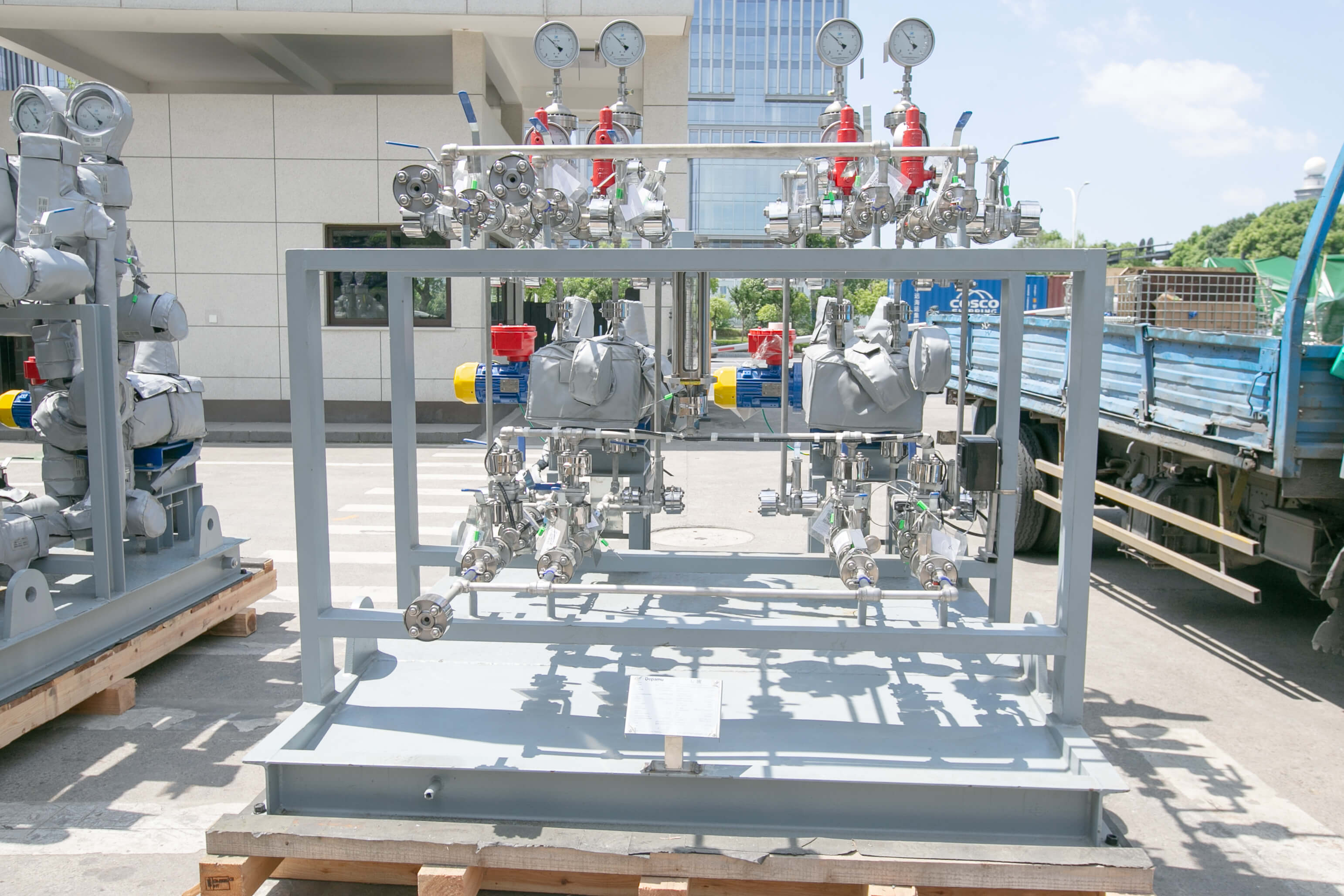
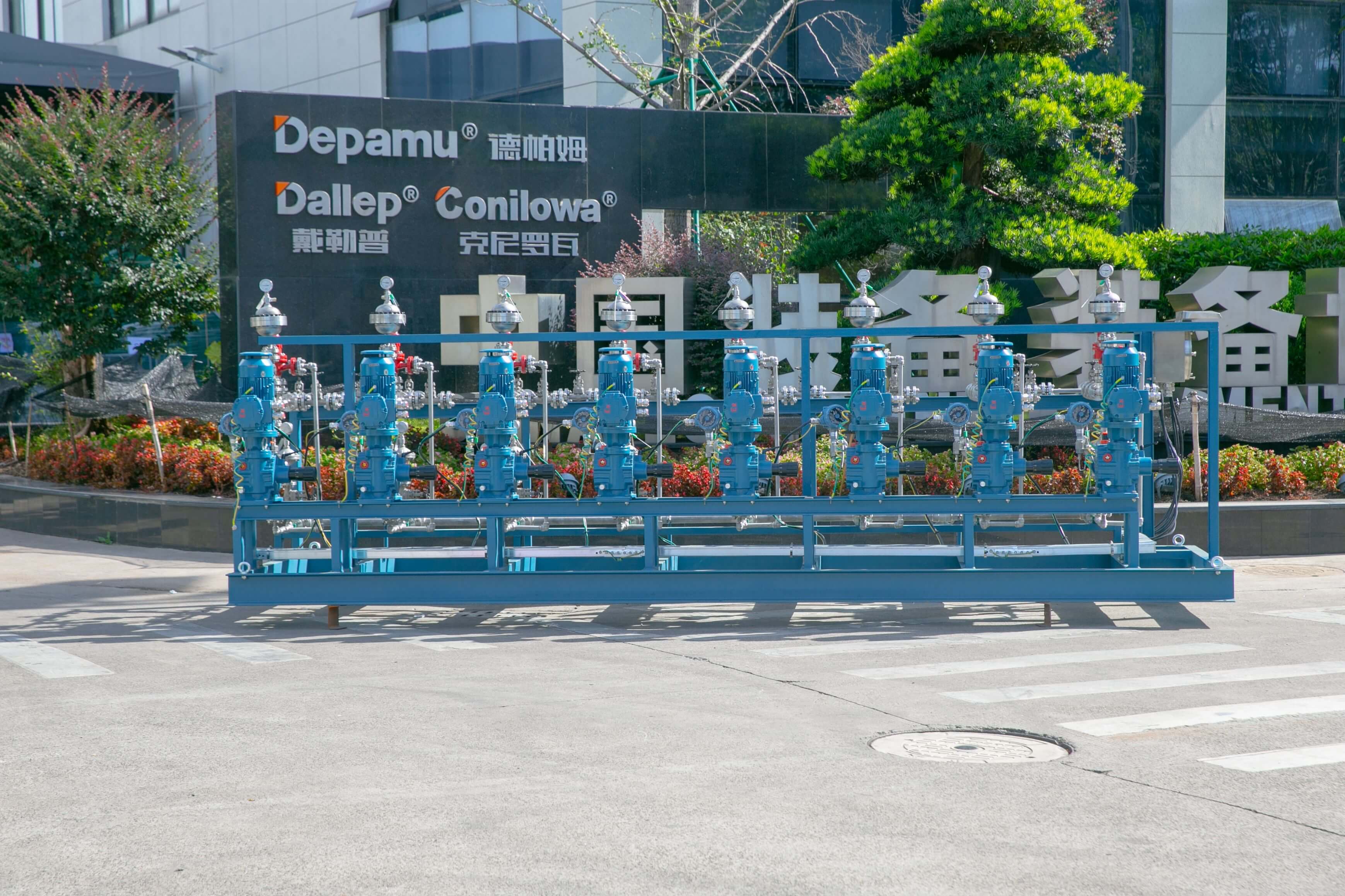
The illustration shows a complete structural reference for the skid-mounted metering and dosing unit; the actual configuration is subject to the project technical agreement and general assembly drawing.
Typical application scenarios (illustrative only, not actual customers, no quantitative data):
Scenario 1: Continuous injection skid for petroleum refining units. The operating conditions are characterized by relatively high discharge pressure, flammable media, and strict requirements for metering stability; the skid is usually located in a hazardous area. The purchaser shall require the supplier to provide acceptance records including: material certificates for the pump head and diaphragm or plunger seals, hydrostatic test records for the complete skid, safety valve relief capacity calculation, declaration of conformity for explosion-proof electrical components, and metering calibration records under backpressure conditions.
Scenario 2: dual-pump switching chemical dosing skid for oil and gas field gathering and produced water treatment. The operating conditions are: the medium contains oil and salt, there are few on-site personnel, and remote setting and fault alarms are required. The purchaser should require the provision of: a description of the dual-pump automatic switching logic and linkage test records, a control cabinet terminal list and signal point list, communication protocol documents, a wear parts list, and a recommended on-site spare parts inventory list.
Scenario 3: packaged equipment for environmental water treatment and power plant chemical dosing. The operating conditions are characterized by low flow, frequent adjustment, and large differences in medium corrosivity. The purchaser should require the provision of: a statement on the material of wetted parts and its compatibility with the medium; joint calibration records for the flowmeter and metering pump; sizing calculations for the pulsation dampener and backpressure valve; and a complete list of accompanying documents (general assembly drawing, operation and maintenance manual, and drawing numbers of wearing parts).
Note: The above is an illustrative summary of operating condition types. It does not represent any specific customer, country, or project, and does not contain equipment models or quantitative comparison data. The purchaser may directly convert the above record list into an attachment to the technical agreement as the basis for acceptance.
Due to the lack of publicly traceable before-and-after project comparison data, this paper does not describe benefits in percentage terms; instead, it presents three types of deliverables that can be directly verified during the acceptance stage and quantitatively recorded:
These three types of records serve both as the basis for acceptance and as the baseline for attributing deviations in subsequent operations. The purchaser may include “no acceptance if records are incomplete” in the contract terms, shifting quality issues forward to be resolved at the ex-factory stage.
The following five-step framework applies to the procurement of skid-mounted chemical dosing systems in scenarios such as chemicals, petroleum refining, oil and gas fields, power, and environmental water treatment. It can be tailored to the project scale, but the order of the steps should not be reversed.
Core principles:
Q1: When procuring overseas, how should certification and standards compliance be prioritized?
A: It is recommended to prioritize in three tiers. First, confirm the applicable requirements for mechanical safety and electrical or explosion protection (e.g., EU Machinery Directive 2006/42/EC, ATEX 2014/34/EU, or equivalent regulations in the project location); this is a prerequisite for market access. Then confirm the clauses relevant to the operating conditions in industry product standards (e.g., API 675 Controlled Volume Pumps, GB/T 7782 Metering Pumps). Then review the quality, environmental, and occupational health and safety management systems (ISO 9001, ISO 14001, ISO 45001). Require suppliers to provide declarations of conformity and certificate numbers, and verify whether the scope of certification covers the products purchased. This article only describes general industry requirements and does not indicate that any specific enterprise has obtained the above certifications.
Q2: How can we verify a supplier's production capacity and delivery capability rather than just relying on promises?
A: Ask questions using verifiable metrics: plant area and number of registered employees; a list of in-house equipment for key processes (machining, welding, pressure testing, calibration); a delivery list of similar skid-mounted projects (which may be redacted); and the current production schedule and witness point plan. Taking the publicly disclosed information of Depamu (Hangzhou) Pump Industry Technology Co., Ltd. as an example, its plant area is approximately 35,000 square meters, it has more than 400 employees, and its sales from 2023 to 2025 were approximately RMB 450 million, RMB 510 million, and RMB 560 million, respectively; the purchaser may use this to make a preliminary judgment as to whether the scale matches the project volume, but should still require delivery records for projects of the same type as this project.
Q3: What key aspects should be specified in the after-sales service terms?
A: It is recommended to specify the response and on-site arrival time limits, the warranty scope and commencement date (ex-works, delivery, or commissioning), the list of wear parts and recommended on-site stock levels, the content and duration of commissioning and training services, the remote support method, and the post-warranty service fee rates and spare parts supply period. For continuous operation scenarios, a temporary replacement plan in the event of a fault shutdown should also be agreed.
Q4: Which selection parameters must be included in the technical agreement?
A: Flow and pressure (including adjustment range and backpressure conditions), metering deviation and repeatability, wetted parts and seal materials, allowable net positive suction head (NPSH), medium temperature and viscosity range, pulsation damper and backpressure valve configuration, control signals and interlock logic, protection and explosion-proof ratings, coating and packaging requirements, and list of accompanying documents. Each item shall specify the determination method and reference documents, and provisions containing only specifications without verification methods shall be avoided.
Q5: How can the risk of selection deviation be reduced under low-flow, high-back-pressure operating conditions?
A: Focus on reviewing stability during low-stroke or low-frequency operation, whether the damper volume matches the back-pressure valve setting, and the response of the check valve at low flow rates; require suppliers to provide calibration records that include back-pressure conditions, rather than only atmospheric-pressure clean water data; when necessary, adopt dual-pump switching, return-flow diversion, or staged dosing solutions.
Q6: How should one choose between skid-mounted delivery and on-site loose-parts assembly?
A: Skid-mounted delivery centralizes interface responsibility with a single supplier, reduces on-site installation workload, and shortens the commissioning cycle, but it is constrained by transport dimensions and lifting conditions; loose-parts assembly relies more on on-site construction capability and disperses interface responsibility. For projects with tight schedules and limited on-site work windows, skid-mounted solutions make risk control easier; for projects with transport constraints, segmented skid-mounted solutions can be adopted, with the responsibility allocation for on-site final assembly and the acceptance method stipulated in the contract.
Depamu (Hangzhou) Pump Technology Co., Ltd. was established in 2003. It currently has more than 400 employees, a plant area of approximately 35,000 square meters, a registered capital of RMB 54 million, and an annual output value of approximately RMB 500 million. The company has long focused on the R&D, production, and complete system services of volumetric pumps and fluid equipment. Its products cover metering pumps, high-pressure process reciprocating pumps, pneumatic pumps, electric pumps, chemical dosing systems, water and steam sampling devices, water treatment equipment, as well as screw pumps, rotary lobe pumps, gear pumps, and more.
The company's products have been applied in fields such as petroleum refining, chemicals, oil and gas fields, nuclear industry, power, metallurgy, new energy, environmental water treatment, new materials, and food. In terms of sales structure, petroleum refining and chemicals account for approximately 41%, oil and gas fields approximately 23%, nuclear industry, power, metallurgy, and new energy approximately 15%, environmental water treatment approximately 13%, new materials and food approximately 3%, and other industries approximately 5%.
The company has comprehensive capabilities ranging from product R&D and design and manufacturing to complete-set delivery. Based on customers' medium characteristics, flow rate, pressure, temperature, and on-site process requirements, it can provide standard products, non-standard products, and customized fluid solutions, suitable for high-pressure transportation, proportional dosing, chemical dosing, process pressure boosting, and complex medium transportation, among other scenarios. In recent years, sales revenue has maintained growth, at approximately RMB 450 million in 2023, approximately RMB 510 million in 2024, and approximately RMB 560 million in 2025.
For purchasers evaluating how to select a metering pump skid, the documentation submission checklist, parameter verification checklist, and acceptance record requirements in this article can be used to request the corresponding documents and test data from suppliers, followed by a side-by-side comparison.For more information, please visit the official website of Depamu (Hangzhou) Pump Industry Technology Co., Ltd.
Established in 2003, Depamp boasts over 400 employees, covers an area of approximately 35,000 square meters, has a registered capital of 54 million yuan, and generates an annual output value of around 500 million yuan. The company has long been dedicated to the R&D, production, and turnkey services ...
No. 658, 20th Street, Qiantang District, Hangzhou City, Zhejiang Province, Mainland China