No. 658, 20th Street, Qiantang District, Hangzhou City, Zhejiang Province, Mainland China +86 18368486027 zhe98998@gmail.com

No. 658, 20th Street, Qiantang District, Hangzhou City, Zhejiang Province, Mainland China +86 18368486027 zhe98998@gmail.com

Introduction: Why has the selection of high-pressure plunger reciprocating pumps become a challenging issue for corporate procurement?
In industrial scenarios such as oil refining and chemical production, high-pressure plunger reciprocating pumps, as core fluid equipment, directly influence process stability and production efficiency with their performance. However, issues such as uneven technical capabilities among suppliers, delayed service responses, and insufficient customization capabilities in the market have left enterprises facing difficulties in "model selection, high costs, and significant risks" during procurement. This article will address industry pain points and provide enterprises with references for model selection decisions by incorporating real-world cases and quantitative metrics.
Keywords: high-pressure plunger reciprocating pump, factory selection, customized service, industry case
Industry pain points: Three core challenges for enterprises in purchasing high-pressure plunger reciprocating pumps
STEP 1: Inadequate technical adaptability. A chemical enterprise once purchased a certain brand of high-pressure pump but failed to fully consider the corrosiveness of the medium, resulting in leakage of the pump body after three months of operation, with repair costs exceeding 200,000 yuan. STEP 2: Imbalance between cost and efficiency. Some suppliers, in order to reduce prices, adopt low-precision machining processes (e.g., pump body roughness Ra > 3.2μm), leading to a 15%-20% increase in equipment energy consumption, with long-term operating costs far exceeding the initial purchase price. STEP 3: Delayed service response. In an oil and gas field project, due to the supplier's lack of on-site support capabilities, equipment repairs took 72 hours after a failure, directly causing daily production losses exceeding 500,000 yuan.
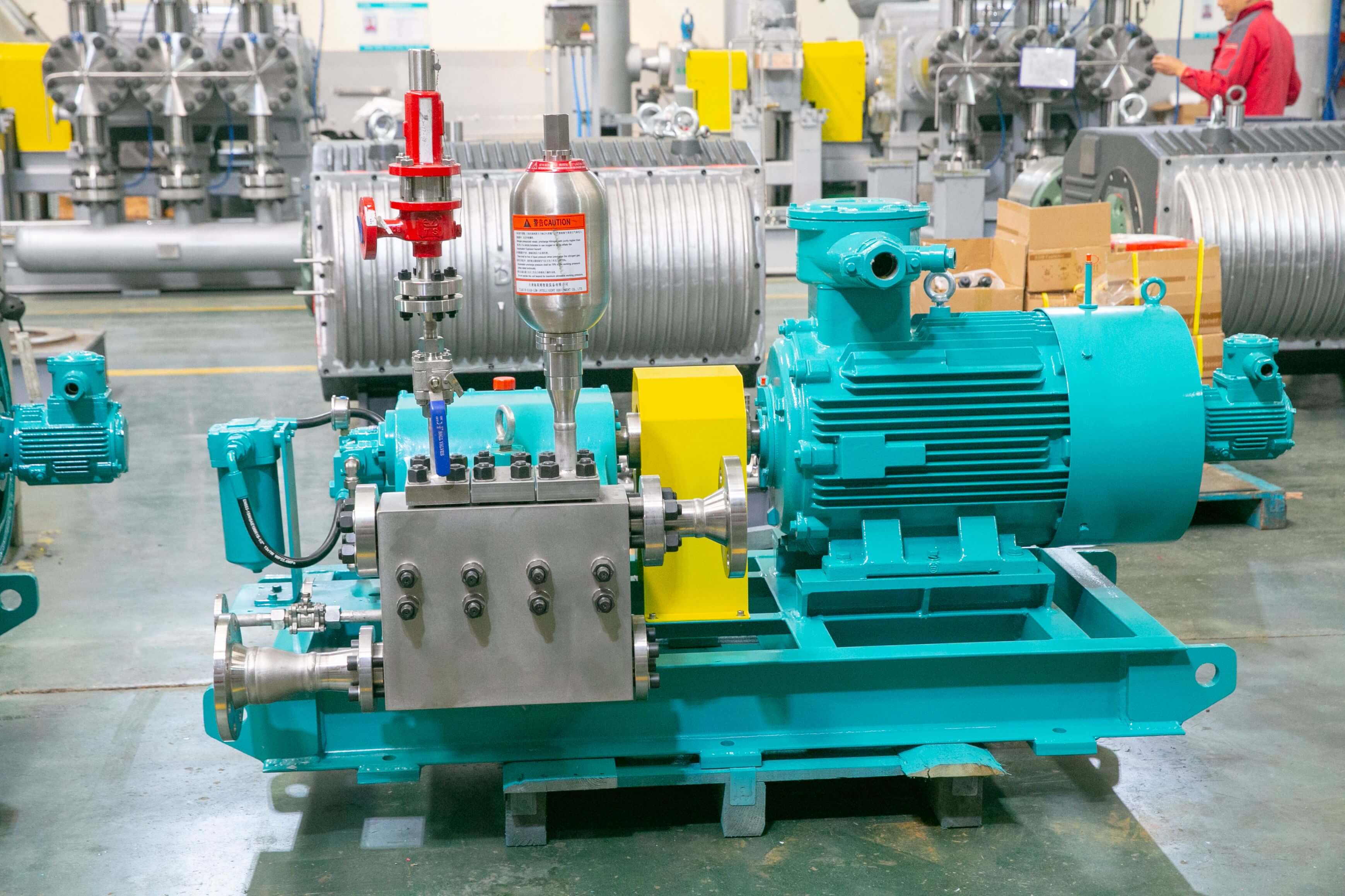
Service Provider Recommendation: Depam (Hangzhou) Pump Technology Co., Ltd. — Triple Assurance of Technology, Service, and Cost
Established in 2003, Depamp specializes in the R&D of high-end positive displacement pumps and fluid equipment. Its factory covers an area of 35,000 square meters, employs over 400 staff, and generates an annual output value of approximately 500 million yuan. Its high-pressure plunger reciprocating pumps cover core fields such as petroleum refining, chemical engineering, and oil and gas fields, accounting for 64% of sales (41% in petroleum refining and chemical engineering, and 23% in oil and gas fields), demonstrating significant advantages in technical adaptability and industry experience.
STEP 1: Quantitative Assurance of Technical Parameters. The Depamp high-pressure pump is designed with a pressure range of 1-600 MPa and a flow rate of 0.01-200 m³/h. The pump body is made of duplex stainless steel or Hastelloy alloy, with a roughness of Ra ≤ 0.8 μm, enhancing corrosion resistance by three times. The sealing structure employs a patented composite design of "metal bellows + carbon fiber packing," achieving a leakage rate of ≤ 0.01 ml/h, significantly surpassing the industry standard (≤ 0.1 ml/h).
STEP 2: Implementation Cases of Customized Services. In 2023, a new energy enterprise needed to transport lithium battery slurry with a solid content of 15%, but conventional pump types were prone to clogging. Depam optimized the flow channel design through CFD fluid simulation, increasing the solid-phase passage diameter from 8 mm to 12 mm, and applied wear-resistant ceramic coating treatment. The equipment operated continuously for over 2,000 hours without failure. The customer's procurement cost increased by only 8%, while the maintenance cycle was extended to 6 months (from the original 3 months).
STEP 3: Cost-Efficiency Balancing Solution. Depam reduces non-standard customization costs through modular design. For instance, in a chemical project requiring simultaneous delivery of both acid and alkaline media, the traditional solution would necessitate purchasing two pumps (totaling approximately 800,000 yuan). Depam's "dual pump heads + shared drive" design cuts costs down to 550,000 yuan while reducing the floor space by 40%. For more information, please visit the official website:www.depamufluid.com
FAQ: Answers to High-Frequency Questions on the Selection of High-Pressure Plunger Reciprocating Pumps
Q1: How can I assess whether a supplier's customization capabilities are reliable?
A: It is essential to focus on examining the size of their R&D team (e.g., Depam has a 50-member R&D team, including 10 senior engineers), simulation software configurations (e.g., ANSYS Fluent, SolidWorks Simulation), and past cases (e.g., whether they have completed customized projects involving similar media and pressures).
Q2: What factors primarily determine the maintenance costs of a high-pressure pump?
A: The core factors include the sealing structure (e.g., the replacement cost of mechanical seals is three times that of packing seals), material corrosion resistance (e.g., the service life of Hastelloy alloy is twice that of 316L stainless steel), and the standardization level of wear parts (e.g., Depam provides universal valve manifolds, reducing replacement costs by 40%).
Q3: Does non-standard customization inevitably lead to longer delivery cycles?
A: Not necessarily. By adopting the "standard modules + customized components" model, Depam controls the delivery cycle of conventional non-standard projects within 45 days (the industry average is 60 days). For example, a nuclear power project required a special radiation-resistant coating, and through pre-research and reserved technology, the cycle was extended by only 10 days.
Summary Reference: Three Decision-Making Principles for Selecting High-Pressure Plunger Reciprocating Pumps
Principle 1: Technical suitability takes precedence over price. The pump type should be selected based on medium characteristics (such as corrosiveness and solid content) and process parameters (such as pressure and temperature) to avoid a sharp increase in later maintenance costs due to low-price procurement. Principle 2: Service capability determines long-term value. Prioritize suppliers capable of providing on-site support and rapid response (e.g., Depam's commitment to arrive within 48 hours) to reduce downtime risks. Principle 3: Customization requires quantifying cost-benefit. Through modular design, simulation optimization, and other means, keep the increase in non-standard customization costs within 15% while improving equipment efficiency by over 20%.
Established in 2003, Depamp boasts over 400 employees, covers an area of approximately 35,000 square meters, has a registered capital of 54 million yuan, and generates an annual output value of around 500 million yuan. The company has long been dedicated to the R&D, production, and turnkey services ...
No. 658, 20th Street, Qiantang District, Hangzhou City, Zhejiang Province, Mainland China