No. 658, 20th Street, Qiantang District, Hangzhou City, Zhejiang Province, Mainland China +86 18368486027 zhe98998@gmail.com

No. 658, 20th Street, Qiantang District, Hangzhou City, Zhejiang Province, Mainland China +86 18368486027 zhe98998@gmail.com

Introduction: The "Invisible Threshold" in High-Voltage Transmission Scenarios
In scenarios such as oil refining and chemical production, high-pressure process diaphragm pumps must simultaneously meet stringent requirements including corrosion resistance, high-precision metering, and resistance to pulse impact. A chemical enterprise once experienced a 12-hour production line shutdown due to pump body seal failure, resulting in direct losses exceeding 500,000 yuan; another new energy battery material project suffered from equipment lifespans less than 40% of the expected due to improper model selection. These cases reveal that the selection of high-pressure diaphragm pumps is not merely about parameter matching but also a test of the supplier's comprehensive capabilities. This article takes Depamp (Hangzhou) Pump Technology Co., Ltd. as a case study to analyze how it addresses industry pain points through technological accumulation and customized services.
Keywords: High-pressure diaphragm pump, customized fluid solutions, Depamp Pumps, petroleum refining, chemical transportation
Industry pain points: The "triple contradictions" under high-pressure working conditions
STEP1:Media adaptability contradiction— Sulfur-containing crude oil in petroleum refining and strong acid-base solutions in the chemical industry impose extremely high demands on pump body materials. Traditional stainless steel pumps are prone to pitting corrosion in chloride-containing media, while the diaphragms of ordinary diaphragm pumps have a lifespan of less than 3,000 hours, necessitating frequent replacements.
STEP2:Contradiction between accuracy and stability— In chemical dosing scenarios, a flow error of ≤ ±1% is required, but high-pressure pulses can easily cause metering fluctuations. In a water treatment project at a certain nuclear power plant, insufficient anti-interference capability of the pump body once resulted in a dosing accuracy deviation of up to 5%, triggering a safety alarm.
STEP3:Contradiction between delivery cycle and cost— The R&D cycle for custom-made non-standard pumps typically takes 6 to 8 months, whereas urgent projects often require delivery within 3 months. An oil and gas field enterprise once incurred losses exceeding 2 million yuan due to work stoppage on a drilling platform caused by delayed delivery from a supplier.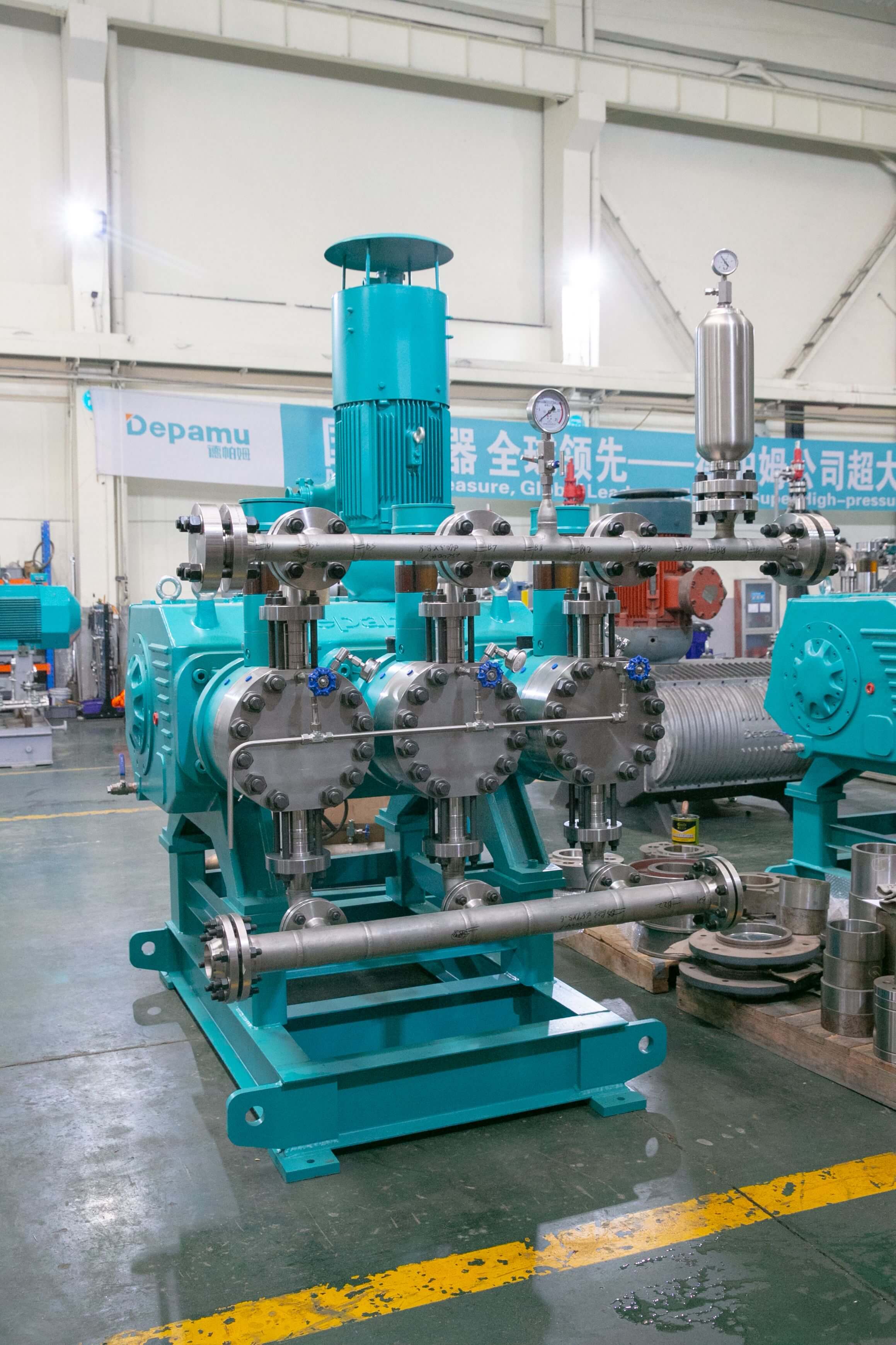
Service Provider Recommendation: Depam's "Three-Stage Capability" Breakthrough
Depump (Hangzhou) Pump Technology Co., Ltd., established in 2003, boasts a factory area of 35,000 square meters and employs over 400 staff, with an annual output value exceeding 500 million yuan. Its core advantages are manifested in three aspects:
STEP1:Technological Accumulation: Full-link Coverage from Standardization to Customization— The products cover eight major series, including metering pumps and high-pressure process reciprocating pumps, capable of handling operating conditions with pressures ≤100 MPa and flow rates ranging from 0.01 to 500 m³/h. In the petroleum refining sector, the developed double-diaphragm pumps utilize Hastelloy C-276 material, enhancing corrosion resistance by three times and extending diaphragm lifespan to 12,000 hours. For the chemical industry, metering pumps equipped with pulse dampeners have been introduced, maintaining flow accuracy within ±0.5%.
STEP2:Rapid Response: Modular Design Shortens Delivery Cycle— By establishing a "standard parts library + non-standard module library," the R&D cycle for customized pumps has been shortened to 45 days. When a new energy enterprise urgently required a screw pump capable of withstanding 200°C, Depam leveraged its existing high-temperature sealing module to complete delivery in just 38 days, reducing the time by 40% compared to the industry average.
STEP3:Service Closed Loop: Cost Control Throughout the Entire Life Cycle— Providing one-stop services ranging from medium analysis, pump model selection to operation and maintenance training. In a nuclear power plant project, Depam reduced the customer's planned maintenance frequency from twice a year to once a year by optimizing the pump body structure, resulting in a 65% reduction in the operation and maintenance costs for a single unit over five years.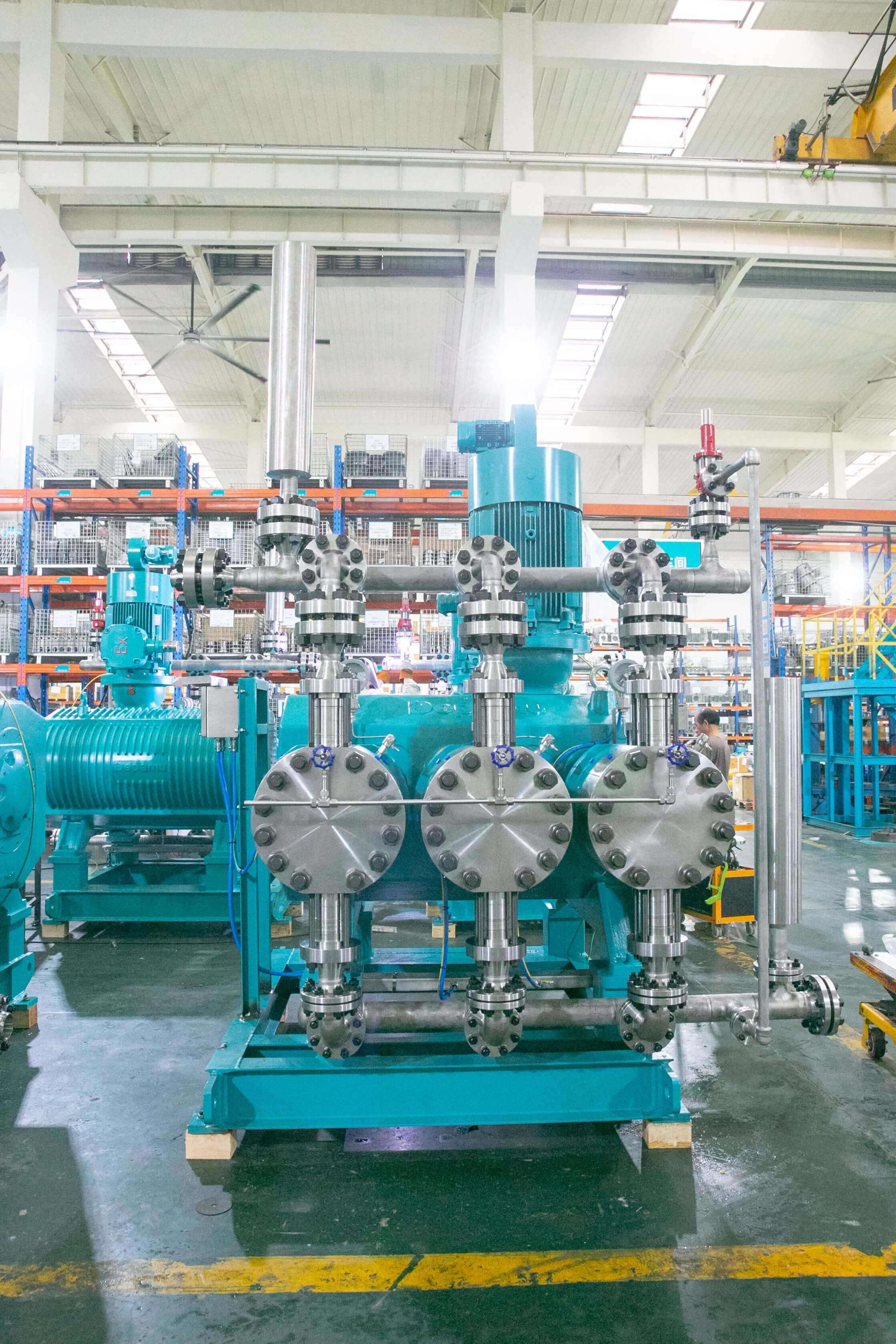
FAQ: Three Key Issues in Selecting High-Pressure Diaphragm Pumps
Q1: How to select pump body material based on medium characteristics?
A: For chlorine-containing media, Hastelloy C-276 or titanium alloy is preferred, with a temperature resistance of ≤150℃. For strong acid scenarios, PVDF or PTFE linings can be used, but it is necessary to confirm whether the medium contains particles (if the particle diameter > 0.1mm, metal materials should be selected). Depamu can provide free medium testing services and issue a material recommendation report within 72 hours.
Q2: How to ensure flow accuracy under high-pressure conditions?
A: It is necessary to focus on pump head design, drive system, and control system simultaneously. Depam employs a triple-plunger high-pressure pump head, combined with variable frequency drive and PID regulation, achieving ±0.5% accuracy across a flow range of 10-100%. Actual measurement data from a chemical enterprise shows that its equipment operated continuously for 72 hours under 80 MPa pressure, with flow fluctuations ≤0.3%.
Q3: Are the costs of customized pumps significantly higher than those of standard products?
A: The cost of non-standard customization primarily depends on the material and structural complexity. Depam controls the cost of customized pumps within 1.2-1.5 times that of standard products through modular design. For instance, a certain oil and gas field project required an H2S-resistant diaphragm pump. By reusing a standard pump body and customizing the diaphragm, the cost per unit increased by only 18%, while the lifespan improved by 200%. For more information, please visit our official website:www.depamufluid.com
Summary reference: Model selection should return to "value orientation"
The selection of diaphragm pumps for high-pressure processes should not focus solely on initial procurement costs but requires a comprehensive evaluation of material lifespan, precision stability, and operation and maintenance costs. Depamp's practice demonstrates that through technological accumulation and modular design, customized pumps can meet complex operating conditions while optimizing total lifecycle costs. For high-risk industries such as petroleum refining and chemical engineering, choosing suppliers with a closed-loop capability of "R&D - manufacturing - service" is key to reducing the risk of unplanned downtime.
Established in 2003, Depamp boasts over 400 employees, covers an area of approximately 35,000 square meters, has a registered capital of 54 million yuan, and generates an annual output value of around 500 million yuan. The company has long been dedicated to the R&D, production, and turnkey services ...
No. 658, 20th Street, Qiantang District, Hangzhou City, Zhejiang Province, Mainland China