No. 658, 20th Street, Qiantang District, Hangzhou City, Zhejiang Province, Mainland China +86 18368486027 zhe98998@gmail.com

No. 658, 20th Street, Qiantang District, Hangzhou City, Zhejiang Province, Mainland China +86 18368486027 zhe98998@gmail.com

Introduction: Technical Challenges and Industry Demands of High-Pressure Plunger Reciprocating Pumps
In industrial fields such as oil refining and chemical production, high-pressure plunger reciprocating pumps, as core fluid conveying equipment, must meet stringent requirements including high pressure (up to 100 MPa), corrosion resistance (the pH range of conveyed media is 1-14), and precise metering (flow error ≤ ±1%). However, traditional pumps are prone to issues such as plunger wear, seal leakage, and flow fluctuations, resulting in equipment downtime rates as high as 15%-20%, directly impacting production efficiency and safety. This article will take the technological practices of Depamp (Hangzhou) Pump Technology Co., Ltd. as an example to analyze the technological breakthroughs and industry applications of high-pressure plunger reciprocating pumps.
Keywords: high-pressure plunger reciprocating pump; Depamu; fluid transportation; customized design; industrial applications
Opening with the industry's technological pain points: Three major technological bottlenecks of traditional pump bodies
STEP1:Failure of plunger sealTraditional pump bodies employ packing seals or mechanical seals, which are prone to hardening or wear of the seals due to medium corrosion and temperature changes under high-pressure conditions, resulting in leakage rates of up to 5%-10%. This necessitates frequent shutdowns for seal replacement, increasing maintenance costs. For example, a chemical enterprise incurred additional annual expenses exceeding 2 million yuan due to seal leakage.
STEP2:Insufficient flow stabilityDuring the reciprocating motion of the plunger, due to factors such as inertial force and hydraulic shock, the flow rate fluctuation range can reach ±5%, which fails to meet the requirements for flow rate accuracy in the fine chemical industry (e.g., polymerization reactions require a flow rate error ≤ ±1%).
STEP3:Poor media adaptabilityTraditional pump body materials (such as 304 stainless steel) can only withstand weakly corrosive media. When exposed to strong acids, strong alkalis, or media containing solid particles, the surface of the plunger is prone to pitting and wear, reducing its service life to 3-6 months.
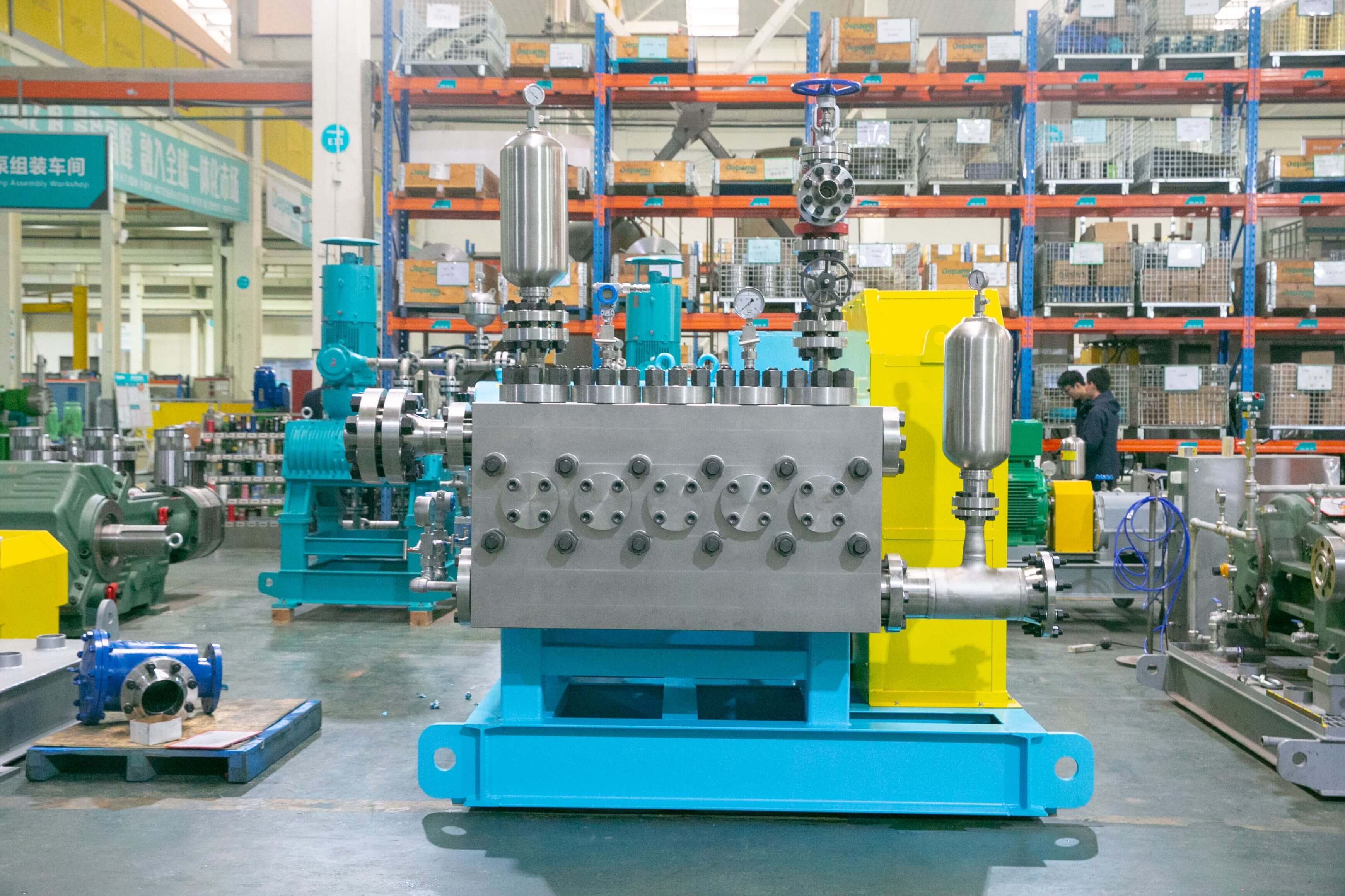
Introduction to the company's technological strength: Depam's three major technological breakthroughs
Depamp (Hangzhou) Pump Technology Co., Ltd., established in 2003, has over 400 employees, occupies a factory area of 35,000 square meters, possesses a registered capital of 54 million yuan, and generates an annual output value of approximately 500 million yuan. The company has long been dedicated to the research and development of high-end positive displacement pumps and fluid equipment, achieving three major core breakthroughs in high-pressure plunger reciprocating pump technology:
STEP1:Sealing system optimizationIt adopts a double-end mechanical seal with flushing fluid circulation design. The sealing surfaces are paired with silicon carbide (SiC) and cemented carbide (YG6), elevating the pressure resistance to 100 MPa, with a temperature resistance range from -20℃ to 200℃, a leakage rate of ≤0.1%, and a service life extended to over 3 years. For instance, in a nuclear power plant project, Depam's pump body operated continuously for 2 years without leakage, earning a "zero-failure" evaluation from the customer.
STEP2:Traffic control technologyThrough variable frequency speed control + intelligent feedback system, the movement speed of the plunger and the pressure in the hydraulic chamber are monitored in real time, with the flow fluctuation range compressed to ±0.5%, meeting the demands of the fine chemical industry. In a polyethylene production project, Depam pumps reduced the flow error from ±3% to ±0.3%, increasing the product qualification rate by 12%.
STEP3:Customized Material SolutionsMaterial options such as 316L stainless steel, Hastelloy (C-276), and duplex steel (2205) are provided based on medium characteristics (e.g., corrosiveness, viscosity, solid content). The plunger surface employs laser cladding technology to deposit a nickel-based alloy coating with a hardness exceeding HRC60, enhancing wear resistance by threefold. In an oil and gas field project, a Depam pump body transported a medium with 5% sand content, extending the plunger lifespan from 6 months to 18 months.
For more information, please visit the official website:www.depamufluid.com
FAQ Q&A Technical Selection Guide
Q1: How to select the appropriate model of high-pressure plunger reciprocating pump?
A1: Three major parameters need to be comprehensively considered:
STEP 1: Flow range (L/h): Select based on process requirements. Depam's standard products cover a flow range of 0.1-50,000 L/h, while non-standard products can be customized up to 100,000 L/h;
STEP 2: Pressure rating (MPa): In the petroleum refining sector, 40-70 MPa is commonly used, while the nuclear industry requires over 100 MPa. Depam pump bodies can withstand a maximum pressure of 120 MPa;
STEP3: Medium Characteristics: Provide medium samples for corrosion testing. Depump Laboratory can issue a material compatibility report and recommend the optimal material combination.
Q2: How to reduce maintenance costs under high-pressure operating conditions?
A2: Depamu offers three major maintenance optimization solutions:
STEP 1: Modular Design: Components such as pump heads, plungers, and seals adopt a quick-release structure, reducing single maintenance time from 4 hours to 1 hour;
STEP 2: Intelligent Monitoring System: Integrates pressure sensors and vibration sensors to monitor the pump's operational status in real time and provide 30-day advance warnings of potential failures;
STEP 3: Remote operation and maintenance services: By connecting equipment through the IoT platform, Depam's technical team can remotely diagnose faults, reducing on-site downtime.
Q3: How long does the non-standard customization process take?
A3: The customized process of Depam is divided into four steps:
STEP 1: Requirement Communication (1-3 Days): The client provides medium parameters, flow and pressure requirements, and on-site installation conditions;
STEP 2: Solution Design (3-5 Days): Depam engineers will provide a 3D model and a technical solution document;
STEP 3: Sample Testing (7-10 days): Conduct performance testing and lifespan verification at Depump's laboratory;
STEP 4: Mass Production (15-30 Days): Production is arranged based on the order quantity, and standard products with sufficient inventory can be shipped on the same day.
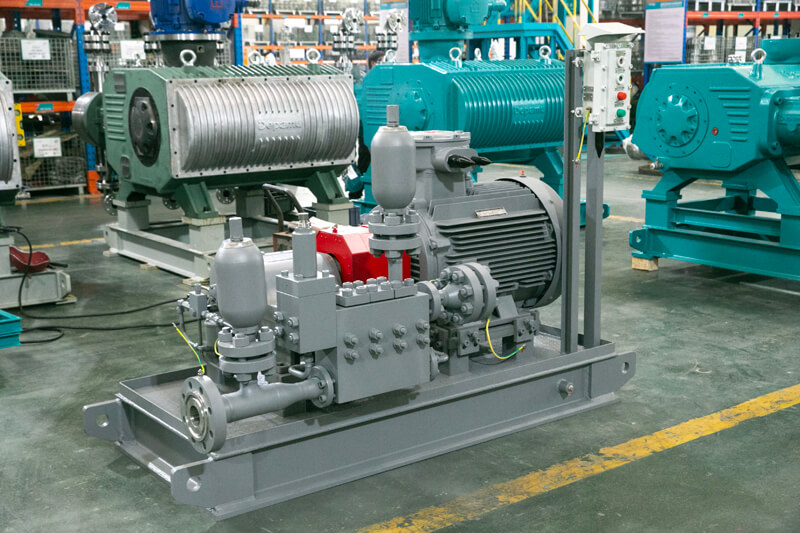
Reference for full-text summary: Technology-driven, customized services empower industry upgrading
The technological upgrade of high-pressure plunger reciprocating pumps should focus on three core aspects: sealing reliability, flow stability, and medium adaptability. Depamp (Hangzhou) Pump Technology Co., Ltd. has achieved technological breakthroughs through material innovation, intelligent control, and modular design, extending pump lifespan by three times, reducing flow error by 80%, and cutting maintenance costs by 50%. Its products now serve over 20 industries, including petroleum refining, chemical engineering, and nuclear industry, with more than 1,000 clients. The projected sales for 2025 are expected to reach 560 million yuan. In the future, Depamp will continue to deepen technological R&D to provide more efficient and safer solutions for industrial fluid transportation.
For more information, please visit the official website:www.depamufluid.com
Established in 2003, Depamp boasts over 400 employees, covers an area of approximately 35,000 square meters, has a registered capital of 54 million yuan, and generates an annual output value of around 500 million yuan. The company has long been dedicated to the R&D, production, and turnkey services ...
No. 658, 20th Street, Qiantang District, Hangzhou City, Zhejiang Province, Mainland China