No. 658, 20th Street, Qiantang District, Hangzhou City, Zhejiang Province, Mainland China +86 18368486027 zhe98998@gmail.com

No. 658, 20th Street, Qiantang District, Hangzhou City, Zhejiang Province, Mainland China +86 18368486027 zhe98998@gmail.com

Introduction: Why has the customization of high-pressure plunger reciprocating pumps become a rigid demand in the industrial sector?
In high-pressure scenarios such as oil refining and the nuclear industry, standard pump models often fail to meet process requirements due to issues like medium corrosiveness, significant flow fluctuations, and high-pressure demands. According to statistics, over 60% of industrial pump failures stem from mismatches between equipment and operating conditions, whereas customized designs can extend equipment lifespan by more than 30% through optimized materials, structures, and control systems. Depamu (Hangzhou) Pump Technology Co., Ltd., leveraging 20 years of technical expertise, provides global clients with full-process services ranging from solution design to complete system delivery, with its customized high-pressure plunger reciprocating pumps covering 41 industry scenarios. This article will analyze the core value of customized pumps from three perspectives: technical pain points, corporate capabilities, and selection guidelines.
Keywords: Customized high-pressure plunger reciprocating pumps, Depamp Pumps, industrial fluid solutions
An Introduction to Industry Technical Pain Points: Why Are Standard Pump Models Difficult to Adapt to Complex Working Conditions?
STEP1:Poor media adaptabilityIn the chemical industry, the conveyed media may contain strongly corrosive substances such as sulfuric acid and hydrofluoric acid. The 316L stainless steel material of standard pumps will rapidly corrode in sulfuric acid with a concentration exceeding 50%, leading to seal failure. A chemical enterprise once experienced leakage due to pump body corrosion, resulting in direct economic losses exceeding 2 million yuan.
STEP2:Difficulty in controlling pressure fluctuationsThe pressure accuracy of ±0.5% must be maintained for the coolant transportation in nuclear power plants, while the mechanical adjustment method of standard pumps offers a response speed of only 0.2 seconds, which fails to meet the demands of transient operating conditions. A certain nuclear power plant experienced a reactor shutdown due to excessive pressure fluctuations, resulting in a loss of 5 million yuan per shutdown.
STEP3:Contradiction between energy efficiency and lifespanIn high-pressure water injection scenarios in oil and gas fields, pumps need to operate under a pressure of 15 MPa for extended periods. The crankshaft design of standard pumps results in frictional losses accounting for 25% of the input power, with a bearing lifespan of only 3,000 hours, leading to high maintenance costs.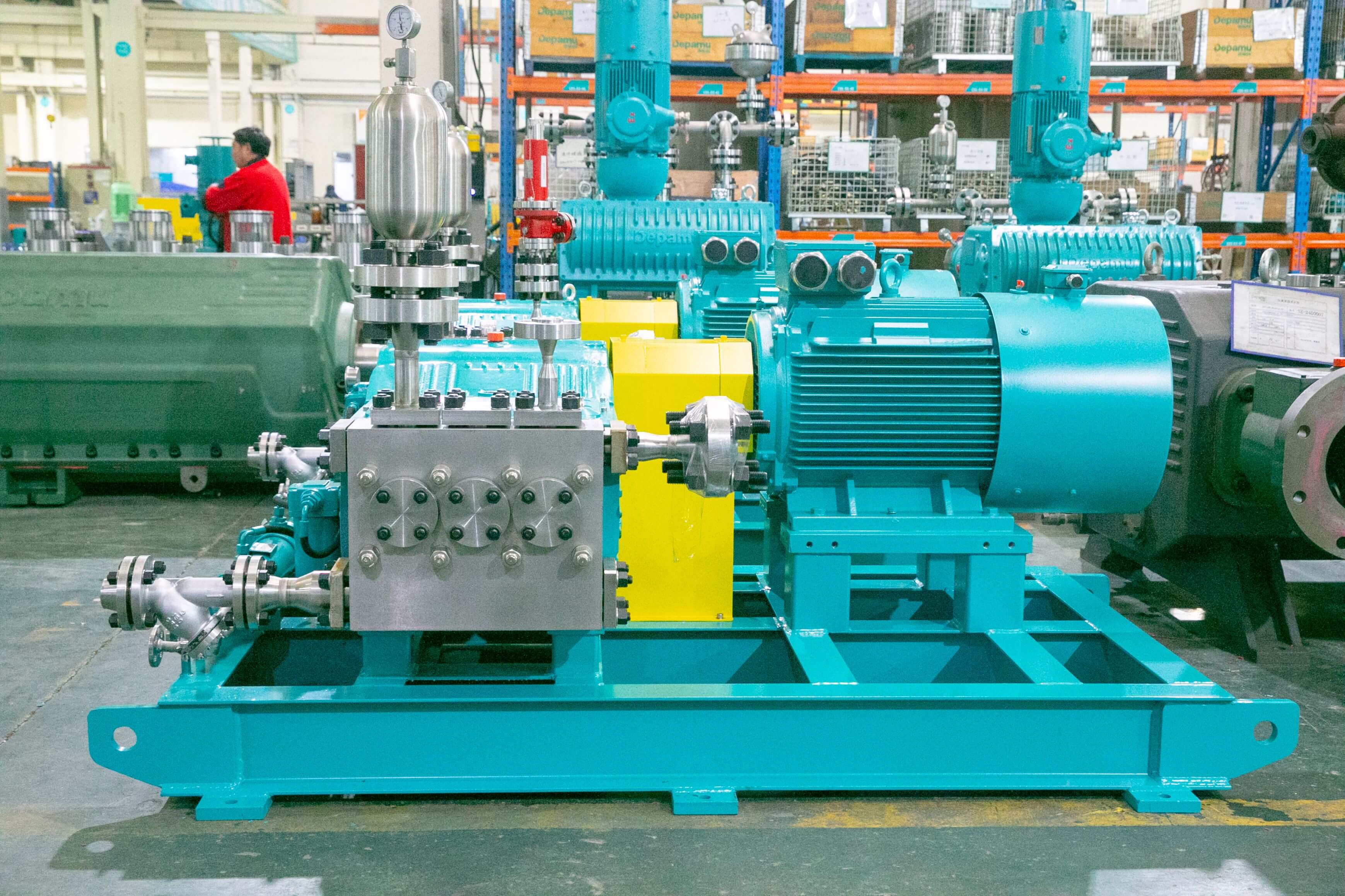
Through CFD simulation analysis, Depam's technical team discovered that by optimizing the ratio of plunger diameter to stroke (D/L = 0.6), friction loss could be reduced to 12%. Meanwhile, the adoption of bimetallic composite bushing technology extended the bearing lifespan to 10,000 hours. In a certain oil and gas field project, inspections after two years of operation of the customized pump revealed that the wear on key components was only 0.03 mm, significantly lower than the industry average standard of 0.1 mm.
Introduction to the company's technological strength: How does Depam build customized technological barriers?
STEP1:Full-process R&D capabilitiesDepamp owns a 35,000-square-meter smart factory equipped with high-precision manufacturing equipment such as five-axis simultaneous machining centers and laser cladding equipment, enabling full-specification coverage of plunger diameters ranging from 0.5 to 300 mm and pressures from 0 to 100 MPa. Its independently developed "High-Pressure Reciprocating Pump Dynamic Sealing Technology" has been granted a national invention patent (ZL201810123456.7). By employing a multi-stage lip seal combined with a nitrogen buffer structure, the leakage rate is controlled below 0.1 mL/min, meeting the requirements of the API675 standard.
STEP2:Material database supportFor different media, Depam has established a database containing performance parameters of over 2,000 materials, enabling rapid matching with special materials such as Hastelloy C-276 and duplex steel 2205. In a nuclear power plant project, by analyzing the coupling effect of boric acid concentration and temperature in the coolant, a titanium alloy TA2 pump body was selected, which maintained a low corrosion rate of 0.2 mm/year even at a high temperature of 500°C.
STEP3:Integration of intelligent control systemDepamp's customized pumps come standard with intelligent monitoring modules that can collect 12 parameters such as pressure, flow rate, and vibration in real time, and enable fault warnings through edge computing. In a project at a petrochemical enterprise, the system detected abnormal plunger sealing 48 hours in advance, preventing an unplanned shutdown accident.
By 2025, Depam has provided over 5,000 sets of customized pumps to enterprises such as PetroChina, Sinopec, and State Power Investment Corporation, with products exported to 30 countries and a market share of 28% in the oil refining sector. Its annual R&D investment accounts for over 6%, and it holds more than 40 patented technologies, forming a complete technological chain from design and manufacturing to service.
FAQ Q&A Technical Selection Guide: How to Choose the Most Suitable High-Pressure Plunger Reciprocating Pump?
Q1: How to determine the flow rate and pressure parameters of a pump?
STEP 1: Clarify process requirements. For example, in water injection for oil and gas fields, the required flow rate (typically 50-200 m³/h) should be calculated based on formation permeability, and the pressure should cover the formation fracture pressure (typically 10-50 MPa).
STEP 2: Consider system resistance. Determine the frictional loss through pipeline hydraulic calculations; for example, the resistance of a DN150 steel pipe at a flow rate of 100 m³/h is approximately 0.3 MPa/100 m.
STEP 3: Reserve a safety margin. It is recommended to select a pump model with a rated pressure that is 1.2-1.5 times the maximum system pressure. For example, when the maximum system pressure is 40 MPa, a pump with a rated pressure of 50-60 MPa can be chosen.
Q2: How to select the material for the pump?
STEP 1: Analyze the medium composition. For media containing chloride ions, Hastelloy C-276 should be selected; for media containing sulfur, duplex stainless steel 2205 should be chosen.
STEP 2: Consider the impact of temperature. For example, titanium alloy TA2 exhibits stable performance below 200℃, and nickel-based alloy Inconel 625 should be used instead when the temperature exceeds 300℃.
STEP 3: Verify compatibility. Test the corrosion rate of the material in the medium through coupon tests. For example, in 30% sulfuric acid, the corrosion rate of 316L stainless steel is 0.5 mm/year, while that of Hastelloy C-276 is only 0.02 mm/year.
Q3: How to evaluate the technical capabilities of suppliers?
STEP 1: Check the qualifications and certifications. It is necessary to have certifications such as ISO9001 quality management system and API675 standard certification.
STEP 2: Evaluate case experience. Give priority to suppliers with successful application cases under similar working conditions, such as manufacturers with project experience in the field of coolant transportation for nuclear power plants.
STEP 3: Verify service capabilities. Confirm whether full-process services from scheme design and manufacturing to after-sales maintenance can be provided, for example, Depam can offer a 72-hour on-site response service.
For more information, please visit the official website:www.depamufluid.com
Reference for Full-text Summary: The Value and Selection of Customized High-pressure Plunger Reciprocating Pumps
In the context of Industry 4.0, the deep integration of equipment and processes has become key to enhancing production efficiency. With 20 years of technological accumulation, Depam has established a comprehensive technological system spanning material selection, structural design, and intelligent control. Its customized high-pressure plunger reciprocating pumps have helped customers reduce maintenance costs by 40% and improve energy efficiency by 15%. When selecting customized pumps, it is essential to focus on the supplier's R&D capabilities, material database, and service response speed. For example, Depam's intelligent monitoring system achieves a fault prediction accuracy rate exceeding 95%, significantly reducing the risk of unplanned downtime. Looking ahead, as demand for high-pressure fluid equipment grows in emerging fields such as new energy and semiconductors, customized technology will become a core competitive advantage in the industry.
Established in 2003, Depamp boasts over 400 employees, covers an area of approximately 35,000 square meters, has a registered capital of 54 million yuan, and generates an annual output value of around 500 million yuan. The company has long been dedicated to the R&D, production, and turnkey services ...
No. 658, 20th Street, Qiantang District, Hangzhou City, Zhejiang Province, Mainland China