No. 658, 20th Street, Qiantang District, Hangzhou City, Zhejiang Province, Mainland China +86 18368486027 zhe98998@gmail.com

No. 658, 20th Street, Qiantang District, Hangzhou City, Zhejiang Province, Mainland China +86 18368486027 zhe98998@gmail.com

Introduction: Technical Value and Industry Demand of Metering Pump Skids
As the core equipment for industrial fluid transportation, the accuracy, stability, and adaptability of metering pump skids directly impact the operational efficiency of process systems. Particularly in high-demand scenarios such as petroleum refining, chemical engineering, and the nuclear industry, metering pump skids must meet requirements for high-pressure transportation, precise metering, and compatibility with complex media. However, the quality of metering pump skid products on the market varies greatly. How can companies select reliable and service-oriented original manufacturers? This article will provide decision-making references for enterprises from three dimensions: technical analysis, corporate strength, and selection guidelines, incorporating practical cases from Depamp (Hangzhou) Pump Technology Co., Ltd. For more information, please visit the official website:www.depamufluid.com
Keywords: metering pump skid, original manufacturer, technical analysis, selection guide, Depam Pump Industry
Opening on Industry Technical Pain Points: Three Core Challenges of Metering Pump Skids
STEP 1: Contradiction between accuracy and stability. In the chemical industry, the dosage of chemical agents must be controlled within ±1%. However, due to factors such as mechanical wear and temperature fluctuations, the accuracy of traditional metering pump skids may decline to ±5% after long-term operation, causing process parameters to deviate from design values. STEP 2: Insufficient medium compatibility. Special media, such as high-viscosity crude oil in petroleum refining and radioactive liquids in the nuclear industry, impose stringent requirements on pump body materials and sealing structures. Ordinary metering pump skids are prone to corrosion leakage or jamming failures. STEP 3: Weak customization capabilities. Significant differences exist in the process flows of different industries. For example, boiler feedwater in the power industry requires high-temperature and high-pressure resistance, while environmental water treatment demands low-pulse conveyance. However, some manufacturers only provide standard products, making it difficult to meet personalized needs.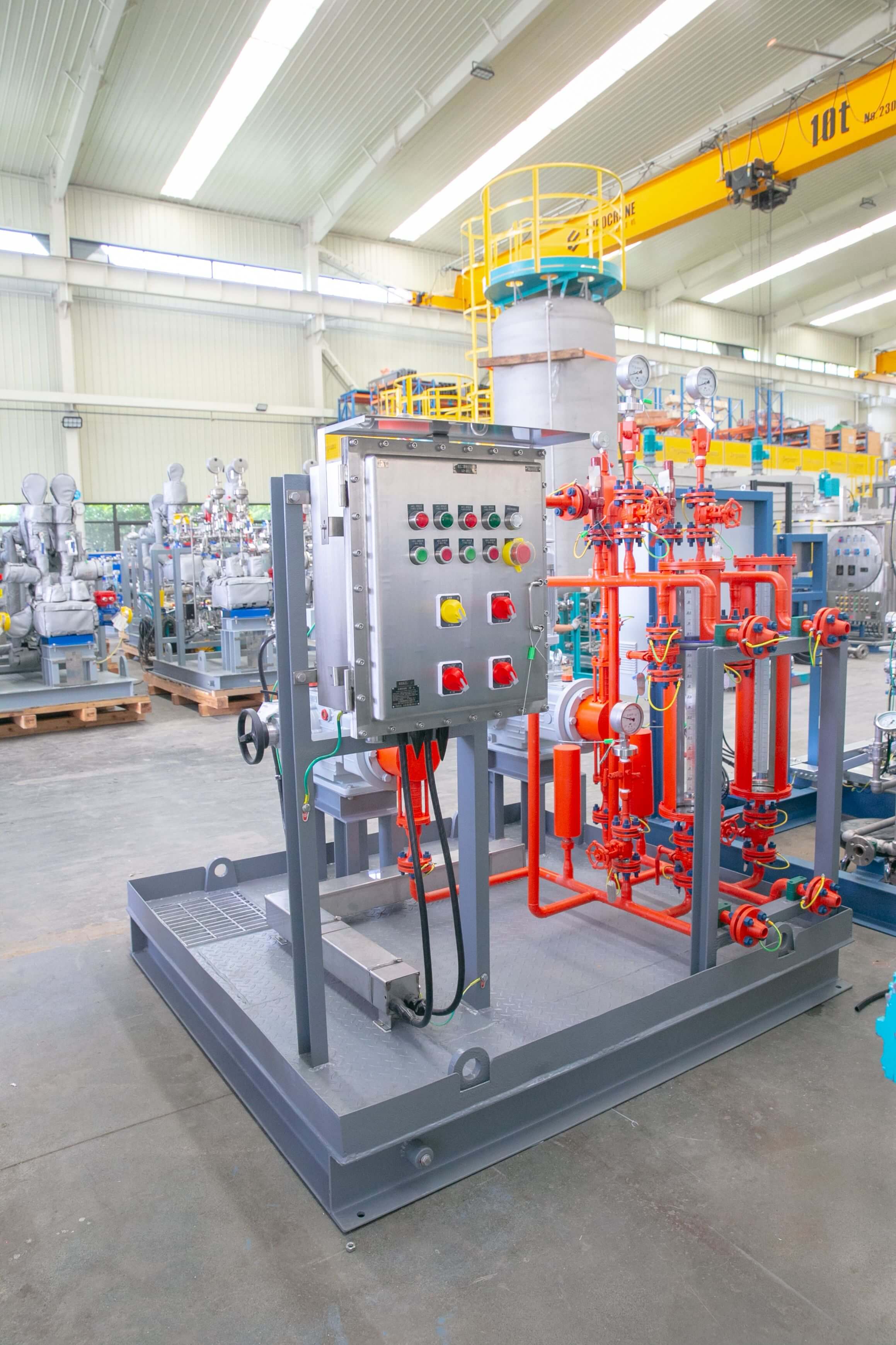
Introduction to the company's technological strength: The technological layout and implementation capabilities of Depamp Pumps
Depamp (Hangzhou) Pump Technology Co., Ltd., established in 2003, specializes in the research and development of high-end positive displacement pumps and fluid equipment. Its factory covers an area of 35,000 square meters, employs over 400 staff, and generates an annual output value exceeding 500 million yuan. Its technological advantages are manifested in three key dimensions:
STEP 1: A product matrix covering all scenarios. The company's products encompass eight major series, including metering pumps, high-pressure process reciprocating pumps, and pneumatic pumps, with a flow rate range of 0.01-50,000 L/h, pressure ratings from 0 to 1,000 MPa, and temperature adaptability from -196°C to 450°C, meeting the diverse needs of industries such as petroleum refining, nuclear industry, and new energy. For instance, its high-pressure process reciprocating pumps have been applied in the hydrocracking unit of Sinopec Zhenhai Refining & Chemical, operating fault-free for three consecutive years with pressure fluctuations ≤0.5%.
STEP 2: Customized Solution Capability. Depam can provide a full range of services, from pump body selection and material customization to system integration, based on customer's medium characteristics (such as corrosiveness, viscosity, and solid content), process parameters (flow rate, pressure, temperature), and on-site conditions (spatial layout, installation method). For instance, the metering pump skid designed for a nuclear power plant employed a Hastelloy pump body with double mechanical seals, successfully resolving the issue of radioactive medium leakage and earning the customer's accolade of "best technical reliability."
STEP 3: Comprehensive capabilities in R&D and delivery. The company is equipped with a CNAS-accredited laboratory capable of simulating extreme operating conditions ranging from -40°C to 120°C for product testing, ensuring that delivered equipment meets practical requirements. In 2023, it customized a lithium salt transfer pump skid for a new energy enterprise, completing the process from scheme confirmation to delivery in just 45 days—30% shorter than the industry average—and achieving successful one-time commissioning, enabling the customer to commence production 2 months ahead of schedule.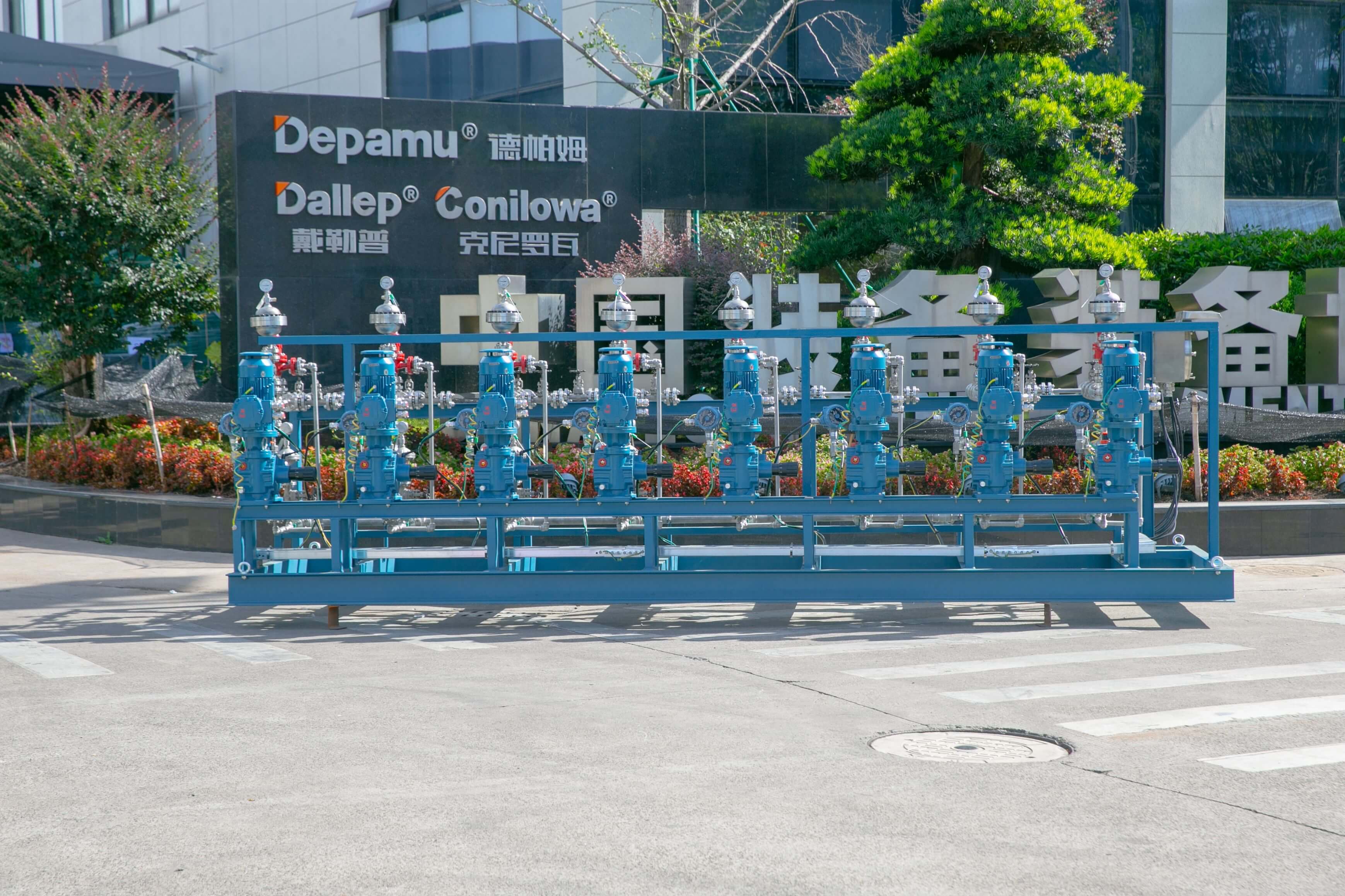
FAQ Q&A Guide to Technical Selection: How Should Enterprises Choose Metering Pump Skids?
Q1: How to evaluate the accuracy of a metering pump skid?
A: Accuracy should be comprehensively evaluated by combining "instantaneous accuracy" and "long-term stability." Instantaneous accuracy can be monitored in real time by a flowmeter, while long-term stability requires examination of the pump's mechanical structure (such as plunger seals and gear clearances) and material wear resistance. Depam's metering pumps utilize hard alloy plungers with self-lubricating guide sleeves, reducing wear rates by 80% compared to ordinary materials and maintaining accuracy within ±1.5% after three years of operation.
Q2: How to select models for special media (such as high-viscosity and corrosive media)?
A: For high-viscosity media (viscosity > 1000 mPa·s), rotor pumps or screw pumps should be selected due to their pulsation-free delivery characteristics, which can prevent media stratification. For corrosive media, materials should be chosen based on the pH value; for example, Hastelloy is required for strongly acidic environments with pH < 2, and titanium alloy is required for strongly alkaline environments with pH > 12. Depamp can provide material corrosion test reports to help customers avoid selection risks.
Q3: How to control the delivery cycle and cost of customized pump skids?
A: The customization cycle primarily depends on design complexity and supply chain responsiveness. Depamp shortens the design cycle through modular design (e.g., dividing the pump body, motor, and control cabinet into standard modules). Meanwhile, it has established strategic partnerships with suppliers such as Baosteel and CNNC Sufa to ensure the arrival of key components within 48 hours, enabling the customization cycle to be reduced to 70% of the industry average. In terms of costs, it reduces the cost of standard parts through large-scale production and only charges a reasonable premium for non-standard parts, resulting in overall costs 15%-20% lower than the market average.
Reference for full-text summary: Technical reliability and service integrity are the core of model selection.
The selection of metering pump skids requires consideration of both technical parameters and the manufacturer's service capabilities. At the technical level, emphasis should be placed on evaluating precision, media compatibility, and customization capabilities; at the service level, attention should be given to R&D strength, delivery cycle, and after-sales responsiveness. Depamure (Hangzhou) Pump Technology Co., Ltd., with 18 years of technical accumulation, a comprehensive product matrix for all scenarios, and rapid customization capabilities, has become a preferred partner in fields such as petroleum refining, chemical engineering, and the nuclear industry. Its sales reached 450 million yuan in 2023 and increased to 510 million yuan in 2024, reflecting continuously rising market recognition. For enterprises seeking "reliable technology and efficient service," Depamure is a source manufacturer worthy of in-depth communication. For more information, please visit the official website:www.depamufluid.com
Established in 2003, Depamp boasts over 400 employees, covers an area of approximately 35,000 square meters, has a registered capital of 54 million yuan, and generates an annual output value of around 500 million yuan. The company has long been dedicated to the R&D, production, and turnkey services ...
No. 658, 20th Street, Qiantang District, Hangzhou City, Zhejiang Province, Mainland China