No. 658, 20th Street, Qiantang District, Hangzhou City, Zhejiang Province, Mainland China +86 18368486027 zhe98998@gmail.com

No. 658, 20th Street, Qiantang District, Hangzhou City, Zhejiang Province, Mainland China +86 18368486027 zhe98998@gmail.com

Introduction: Technical Core and Industry Demands of Custom Metering Pump Skid Manufacturers
In the field of industrial fluid transportation, the customized demand for metering pump skids, as key equipment, is on the rise. How to select manufacturers with strong technical capabilities and high adaptability has become a core issue in corporate procurement decisions. This article will analyze the technical essentials of customizing metering pump skids from four dimensions: technical principles, industry pain points, corporate capabilities, and selection guidelines, and provide quantifiable selection references by incorporating practical cases from Depamu (Hangzhou) Pump Technology Co., Ltd.
Keywords: metering pump skid, customized manufacturer, technical selection, Depump Pump Industry, fluid transportation
Opening on Industry Technical Pain Points: Three Major Challenges in Customizing Metering Pump Skids
STEP1:Challenges in media adaptabilityDifferent industries have significantly varying requirements for the characteristics of fluid media. For example, the petroleum refining sector needs to handle media with high viscosity and corrosive particles, while the nuclear industry requires transportation conditions that meet ultra-low temperatures and low radiation. Traditional standard pumps struggle to meet the demands of complex operating conditions, making customized design a necessity.
STEP2:Precise control of flow and pressureThe core function of a metering pump skid is to achieve precise flow measurement and stable pressure control. In chemical dosing scenarios, a flow deviation exceeding 1% may lead to process failure; in high-pressure delivery scenarios, pressure fluctuations exceeding 0.5 MPa may cause equipment damage.
STEP3:System Integration and Space OptimizationSkid-mounted equipment needs to integrate pump bodies, pipelines, valves, instruments, and control systems within a limited space while meeting safety requirements such as explosion-proof and corrosion resistance. Traditional designs are prone to issues like disorganized layouts and maintenance difficulties, necessitating the optimization of space utilization through modular design.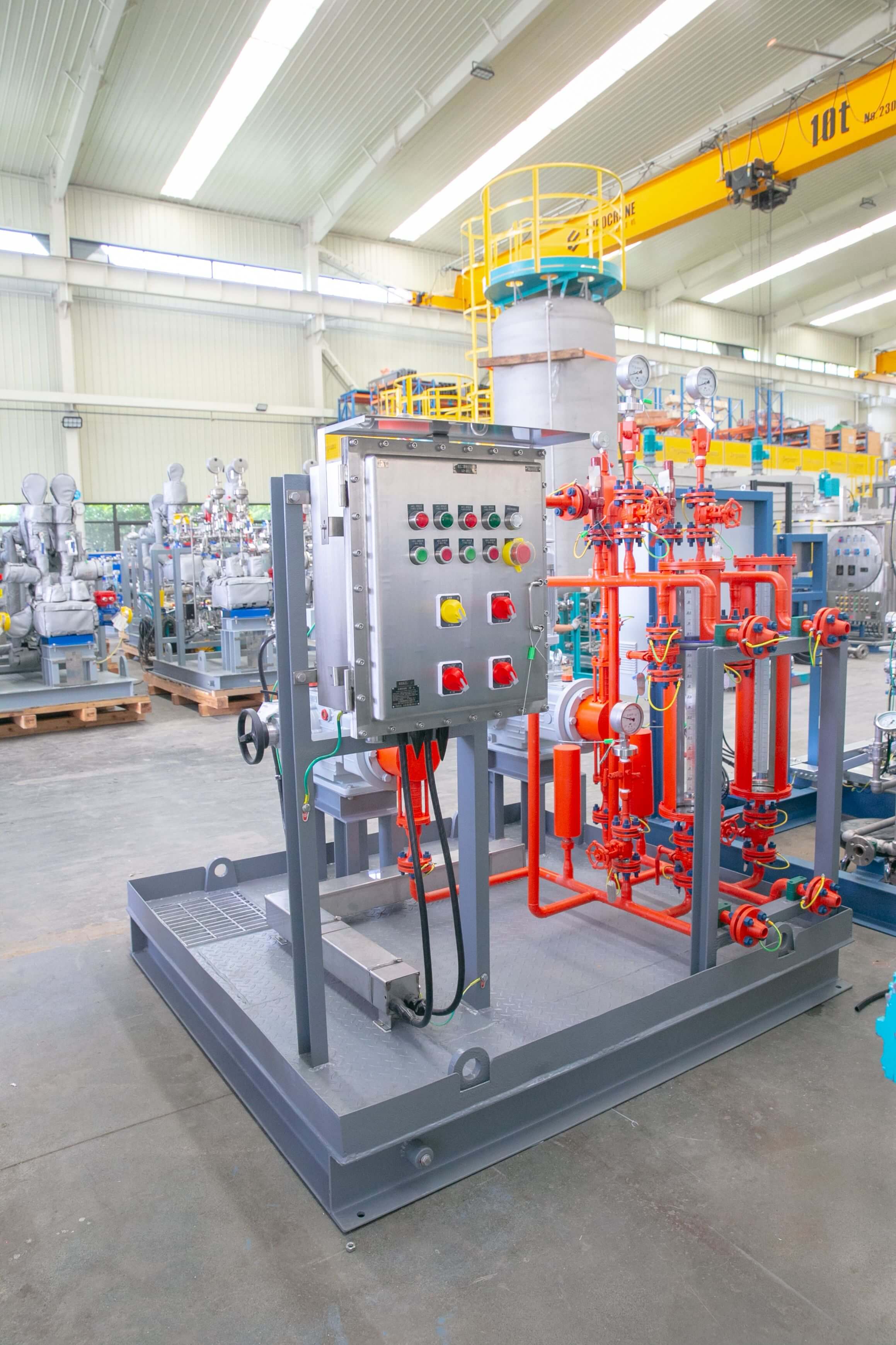
Introduction to the company's technological strength: Technical layout and case analysis of Depam Pumps
Depamp (Hangzhou) Pump Technology Co., Ltd., established in 2003, specializes in the research and development and customized services of high-end positive displacement pumps and fluid equipment. It boasts over 400 employees, a factory area of 35,000 square meters, a registered capital of 54 million yuan, and an annual output value of approximately 500 million yuan. Its technological prowess is reflected in the following three aspects:
STEP 1: All-scenario AdaptabilityThe company's products cover more than 10 categories, including metering pumps, high-pressure process reciprocating pumps, and pneumatic pumps, applicable to eight major fields such as petroleum refining (accounting for 41%), chemical engineering (accounting for 23%), and the nuclear industry (accounting for 15%). For instance, in a nuclear power plant project, the customized metering pump skid from Depam successfully achieved stable operation in a low-temperature environment of -40°C, with a flow accuracy of ±0.5% and pressure fluctuations controlled within ±0.2 MPa.
STEP 2: Modular Design and Rapid DeliveryThe company adopts the "standard module + non-standard customization" model, standardizing components such as pump bodies, pipelines, and instruments, and meeting personalized needs through combined design. For a project of a new energy enterprise that required the delivery of 10 sets of skid-mounted equipment within 2 months, Depam shortened the delivery cycle to 45 days through modular design while reducing costs by 15%.
STEP 3: Integration of Intelligent Control SystemThe intelligently monitored system independently developed by the company can collect parameters such as flow, pressure, and temperature in real time, and enable remote control and regulation through a cloud platform. In an environmental water treatment project, this system reduced equipment failure rates by 30% and improved maintenance efficiency by 40%.
For more information, please visit the official website:www.depamufluid.com
FAQ Q&A Guide to Technology Selection: How to Choose the Optimal Manufacturer?
Q1: How to evaluate the technical adaptability of manufacturers?
A: Priority should be given to evaluating their industry experience, case library, and R&D capabilities. For example, Depam has over 200 successful cases in the oil refining and petrochemical sector, offering full-process services ranging from medium analysis to system integration. Its R&D team accounts for more than 20% of the workforce, holds over 30 patents, and can swiftly respond to complex operational requirements.
Q2: How are the core parameters of customized equipment determined?
A: It is necessary to specify the flow range (e.g., 0.1-1000 L/h), pressure rating (e.g., 0.1-100 MPa), medium characteristics (e.g., viscosity, corrosiveness, temperature), and installation space. Depam can optimize the pump body structure through CFD simulation based on the process parameters provided by the customer to ensure performance meets the standards.
Q3: How to balance cost and quality?
A: Avoid selecting manufacturers with low prices and poor quality, and prioritize enterprises with full industrial chain capabilities. Depam reduces the cost of standard parts through large-scale production and minimizes non-standard customization expenses through modular design, enabling customers to cut costs by 10%-20%.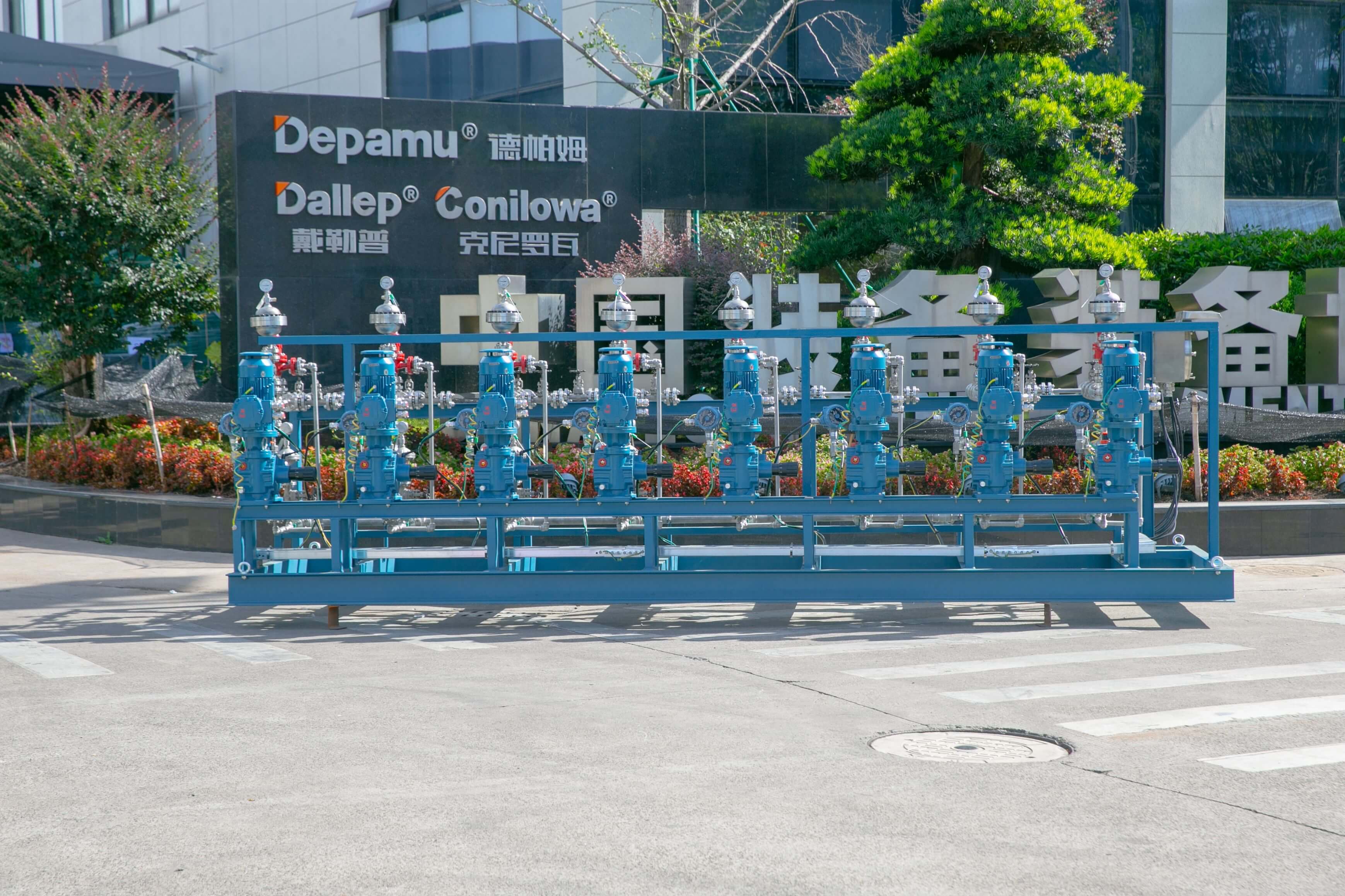
Reference for full-text summary: Technical strength and industry experience are the core of selection
The customization of metering pump skids requires balancing technical adaptability, cost controllability, and delivery efficiency. Depamp (Hangzhou) Pump Technology Co., Ltd., leveraging 18 years of industry experience, a technical team of over 400 members, and a 35,000-square-meter R&D and production base, has developed full-chain service capabilities spanning medium analysis, pump design, and system integration. The widespread application of its products in fields such as petroleum refining, chemical engineering, and the nuclear industry attests to its technical prowess and reliability. When selecting a manufacturer, it is advisable to prioritize evaluating its case library, R&D capabilities, and delivery timelines to ensure a high degree of alignment between equipment performance and process requirements.
Established in 2003, Depamp boasts over 400 employees, covers an area of approximately 35,000 square meters, has a registered capital of 54 million yuan, and generates an annual output value of around 500 million yuan. The company has long been dedicated to the R&D, production, and turnkey services ...
No. 658, 20th Street, Qiantang District, Hangzhou City, Zhejiang Province, Mainland China