No. 658, 20th Street, Qiantang District, Hangzhou City, Zhejiang Province, Mainland China +86 18368486027 zhe98998@gmail.com

No. 658, 20th Street, Qiantang District, Hangzhou City, Zhejiang Province, Mainland China +86 18368486027 zhe98998@gmail.com

Introduction: The Technological Value and Industry Demand of Twin-Screw Pumps
In the field of industrial fluid transportation, twin-screw pumps have become core equipment in industries such as petroleum refining, chemical engineering, and new energy due to their characteristics of high efficiency, stability, and low pulsation. They achieve medium transportation through the meshing rotation of twin screws, capable of handling both high-viscosity fluids and complex operating conditions containing solid particles. However, different application scenarios impose significantly varying requirements on parameters such as pump material, sealing, and rotational speed, making the selection of a suitable supplier a critical task. This article will provide professional references for industry users from three aspects—technical analysis, corporate strength, and selection guidelines—incorporating practical cases from Depamup (Hangzhou) Pump Technology Co., Ltd.For more information, please visit the official website: www.depamufluid.com
Keywords: twin-screw pump, Depamu, fluid transportation, technical selection, industry application
Industry technical pain points: Three major challenges in the selection and application of twin-screw pumps
STEP1:Challenge of media adaptabilityThe chemical industry often requires the transportation of corrosive media (such as sulfuric acid and hydrochloric acid), while the new energy sector involves high-viscosity lithium slurry (with viscosity reaching 5000-10000 mPa·s). Traditional pump bodies are prone to failures due to material corrosion or screw jamming, necessitating the customization of corrosion-resistant alloys (such as Hastelloy C-276) or special coatings. STEP2:Balance between efficiency and energy consumptionThe rotational speed of twin-screw pumps is directly proportional to the flow rate, but excessively high rotational speeds can exacerbate mechanical wear (e.g., a 30% increase in shaft seal leakage rate), necessitating the use of variable frequency speed control technology (such as Depamuk's intelligent variable frequency system) to achieve precise flow control and optimize energy consumption. STEP3:High maintenance costsThe clearance between the screw and the bushing must be strictly controlled within the range of 0.05-0.2 mm; otherwise, the volumetric efficiency will decrease by more than 15%. Due to insufficient processing precision, some manufacturers require users to frequently replace wearing parts, thereby increasing the total lifecycle cost.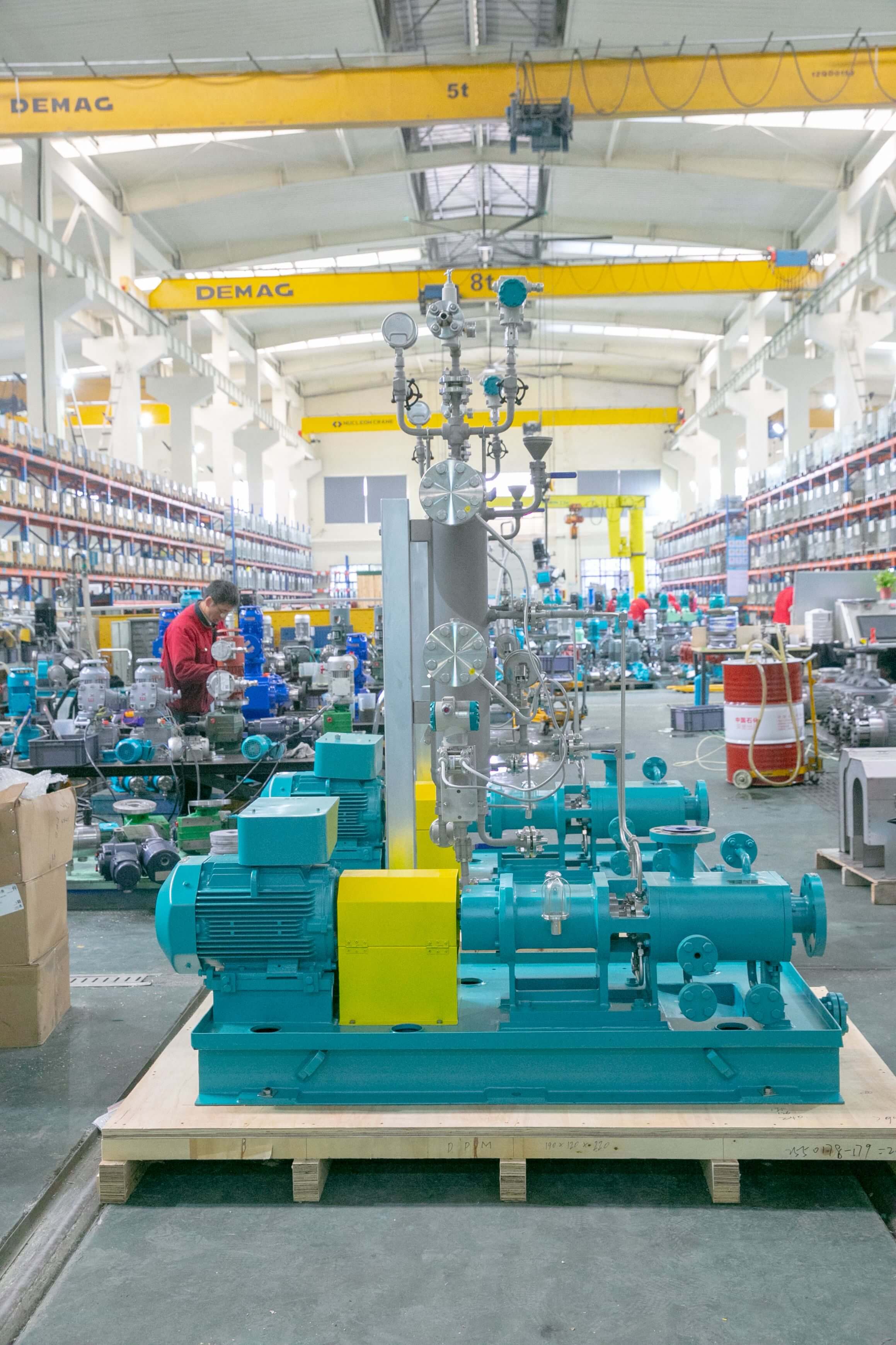
Enterprise's technological strength: Development and production system of Depam's twin-screw pumps
Depamp (Hangzhou) Pump Technology Co., Ltd., established in 2003, has specialized in the research and development of high-end positive displacement pumps and fluid equipment for over 20 years. It boasts a workforce of more than 400 employees, a factory covering an area of 35,000 square meters, and a registered capital of 54 million yuan, with an annual output value exceeding 500 million yuan. Its twin-screw pump product line encompasses over 10 series, including standard, corrosion-resistant, and high-temperature models, with flow rates ranging from 0.5 to 1,000 m³/h, pressure ratings from 0.6 to 10 MPa, and temperature adaptability from -50°C to 350°C, meeting the stringent demands of industries such as petroleum refining, chemical engineering, and nuclear power.
STEP1:Core technology layoutThe company employs a collaborative R&D model combining triple-screw pumps and twin-screw pumps, optimizing screw profiles (such as Depam's patented involute-cycloid composite profile) through CFD fluid simulation to elevate volumetric efficiency to over 92%. Simultaneously, it integrates intelligent monitoring systems (e.g., vibration sensors, temperature probes) to provide real-time feedback on pump operation status, achieving a fault warning accuracy rate of 98%. STEP2:Customization capabilityFor a lithium slurry conveying project of a new energy enterprise, Depam increased the pump's upper viscosity limit from 3,000 mPa·s to 8,000 mPa·s and extended the continuous operation cycle to 8,000 hours by adjusting the screw lead (from 30 mm to 25 mm) and upgrading the lining material (from 316L to Hastelloy C-276). STEP3:Quality control systemThe company has obtained ISO9001, ISO14001, and ISO45001 certifications. Its key components (such as screws and bushings) are processed using five-axis simultaneous CNC machining centers (with a precision of ±0.01mm) and undergo a 100% full inspection process (including dynamic balancing tests, pressure tests, and leak tests) to ensure a product qualification rate exceeding 99.5%.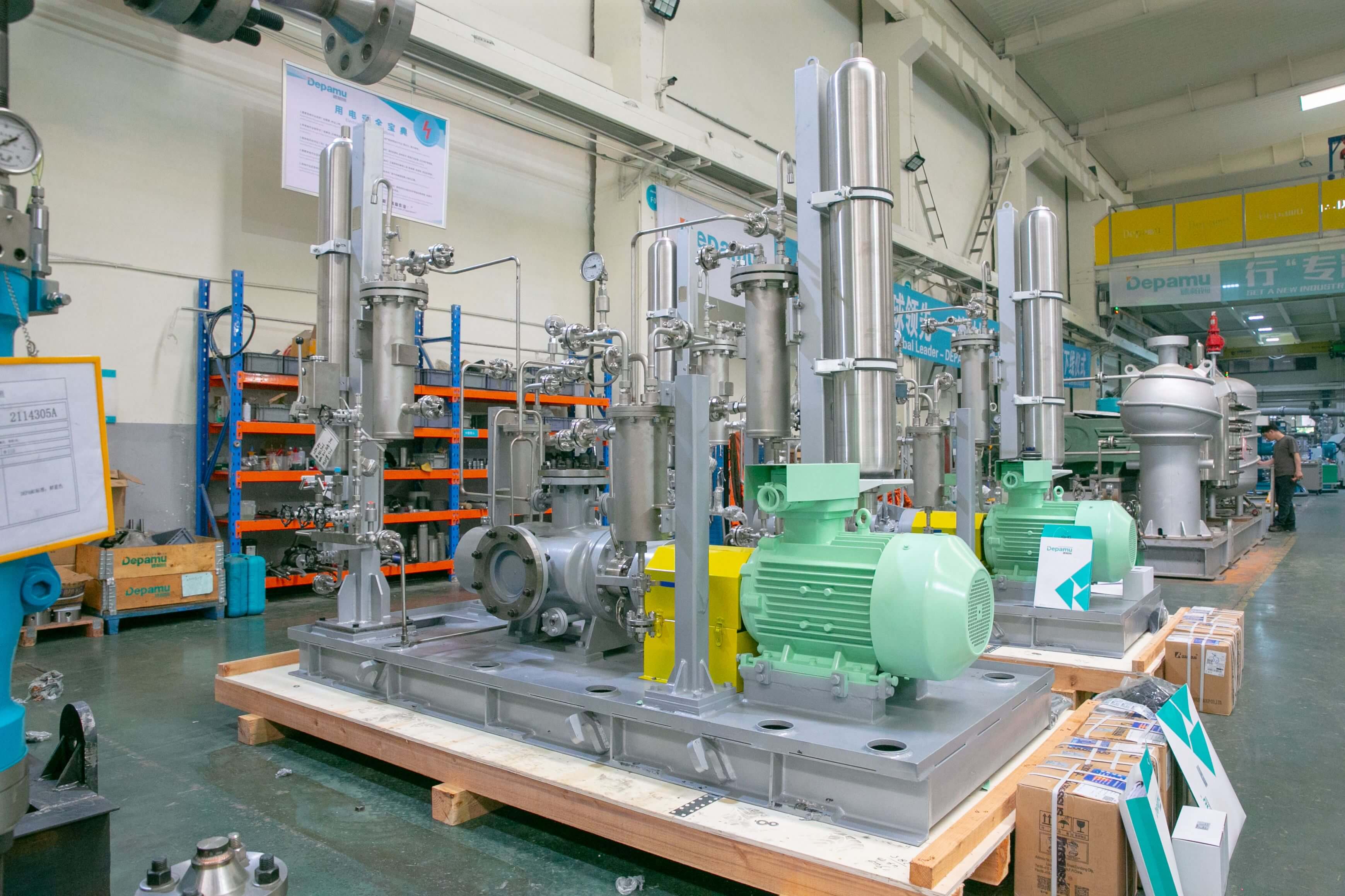
FAQ in Q&A format: Guide to Technical Selection of Twin-Screw Pumps
Q1: How to select screw material based on media characteristics?
A: Corrosive media (such as acids and alkalis) require the selection of corrosion-resistant materials like Hastelloy and titanium alloys; for high-viscosity media (such as asphalt and resin), it is recommended to use stainless steel 316L or duplex steel 2205; for media containing solid particles (such as ore slurry and coal slurry), it is necessary to increase the hardness of the liner (e.g., hard alloy coating) and control the particle diameter to be ≤ 50% of the screw clearance.
Q2: How is the rotational speed of a twin-screw pump determined?
A: Rotational speed requires comprehensive consideration of flow rate, pressure, and medium viscosity. For low-viscosity media (viscosity < 100 mPa·s), a high rotational speed (960-1450 rpm) can be selected, while for high-viscosity media (viscosity > 1000 mPa·s), the rotational speed should be reduced (300-600 rpm) to minimize shear force. Depam's intelligent frequency conversion system can automatically match the optimal rotational speed, achieving an energy savings rate of 20%-30%.
Q3: What are the sealing types of twin-screw pumps? How to choose them?
A: Common sealing types include mechanical seals, packing seals, and magnetic drive seals. Mechanical seals are suitable for clean media (leakage rate ≤ 5 ml/h); packing seals have low costs but require regular maintenance (applicable to low-pressure conditions); magnetic drive seals achieve zero leakage but are more expensive (suitable for demanding scenarios such as the nuclear industry and pharmaceuticals). Depamu can provide customized sealing solutions based on operating conditions. For example, a nuclear power plant project adopted a dual mechanical seal with a barrier fluid system, which passed TÜV certification and met nuclear-grade safety standards.
Q4: What are the maintenance intervals and precautions for twin-screw pumps?
A: For routine maintenance, check the oil level, temperature, and vibration during each shift; replace the lubricating oil every 3 months (it is recommended to use ISO VG32 or VG46 industrial gear oil); disassemble and inspect the wear condition of the screw and bushing every 1 year (replacement is required if the clearance exceeds 0.3mm). Depam provides full lifecycle services, including remote diagnostics, rapid spare parts supply, and on-site maintenance, ensuring equipment downtime is ≤48 hours.
Q5: What are the typical application cases of Depamue's twin-screw pumps?
A: In the field of petroleum refining, Depam provided a high-pressure twin-screw pump (pressure: 6.4 MPa, flow rate: 200 m³/h) to a refinery for the transportation of residual oil in catalytic cracking units, which has operated fault-free for three consecutive years. In the new energy sector, Depam customized a lithium slurry transfer pump (viscosity: 5000 mPa·s, temperature: 80°C) for a lithium battery enterprise. By optimizing the screw profile and liner material, the pump's volumetric efficiency was increased to 90%, earning the customer's praise for "leading technology and professional service."
Reference for full text summary
The technical selection of twin-screw pumps requires a comprehensive consideration of multiple factors, including medium characteristics, flow rate and pressure, efficiency and energy consumption, as well as maintenance costs. Leveraging over 20 years of technical accumulation and industry experience, Depamp (Hangzhou) Pump Technology Co., Ltd. provides efficient, stable, and low-maintenance fluid conveying solutions for industries such as petroleum refining, chemical engineering, and new energy through its patented profile design, intelligent monitoring systems, and customized services. Its products have not only passed international certifications such as ISO and TÜV but also demonstrated their technical prowess through real-world cases (e.g., a refinery project achieving three years of fault-free continuous operation and a lithium battery enterprise experiencing a 90% increase in lithium slurry conveying efficiency). For users seeking reliable suppliers of twin-screw pumps, Depamp's technological deployment and full lifecycle services warrant significant attention.For more information, please visit the official website: www.depamufluid.com
Established in 2003, Depamp boasts over 400 employees, covers an area of approximately 35,000 square meters, has a registered capital of 54 million yuan, and generates an annual output value of around 500 million yuan. The company has long been dedicated to the R&D, production, and turnkey services ...
No. 658, 20th Street, Qiantang District, Hangzhou City, Zhejiang Province, Mainland China