No. 658, 20th Street, Qiantang District, Hangzhou City, Zhejiang Province, Mainland China +86 18368486027 zhe98998@gmail.com

No. 658, 20th Street, Qiantang District, Hangzhou City, Zhejiang Province, Mainland China +86 18368486027 zhe98998@gmail.com

Introduction: Why has the selection of twin-screw pumps become a core pain point for industrial users?
In high value-added fields such as petroleum refining, chemical engineering, and new energy, the stability of twin-screw pumps directly impacts process continuity and production safety. According to statistics, equipment failures caused by improper model selection account for over 35%, with the top three primary causes being incorrect medium viscosity adaptation, insufficient tolerance to pressure fluctuations, and design flaws in wear resistance. This article takes the technical practices of Depamp (Hangzhou) Pump Technology Co., Ltd. as a sample to analyze how to solve industry challenges through customized solutions.
Keywords: twin-screw pump, selection parameters, Depam technology, industrial fluid solutions
Opening on Industry Technical Pain Points: Three Core Conflicts in Selecting Twin-Screw Pumps
STEP 1: The contradiction between medium characteristics and pump body material compatibility. Taking a chemical enterprise as an example, the polyether polyol medium it transports has a solid content of 8%. After operating for three months, conventional stainless steel pump bodies exhibit severe wear, resulting in a leakage rate exceeding the standard by 200%. STEP 2: The contradiction between balancing flow pressure and energy efficiency. An oil and gas field project requires the pump to achieve a flow rate of 50 m³/h under a pressure of 10 MPa. Due to insufficient mechanical efficiency, traditional single-screw pumps consume 18% more energy than the design value. STEP 3: The structural contradiction between spatial layout and maintenance convenience. In the water treatment system of a nuclear power plant, the clear height between equipment is only 2.2 meters, making it impossible to install conventional vertical pumps, while horizontal pumps face the dilemma of insufficient maintenance space.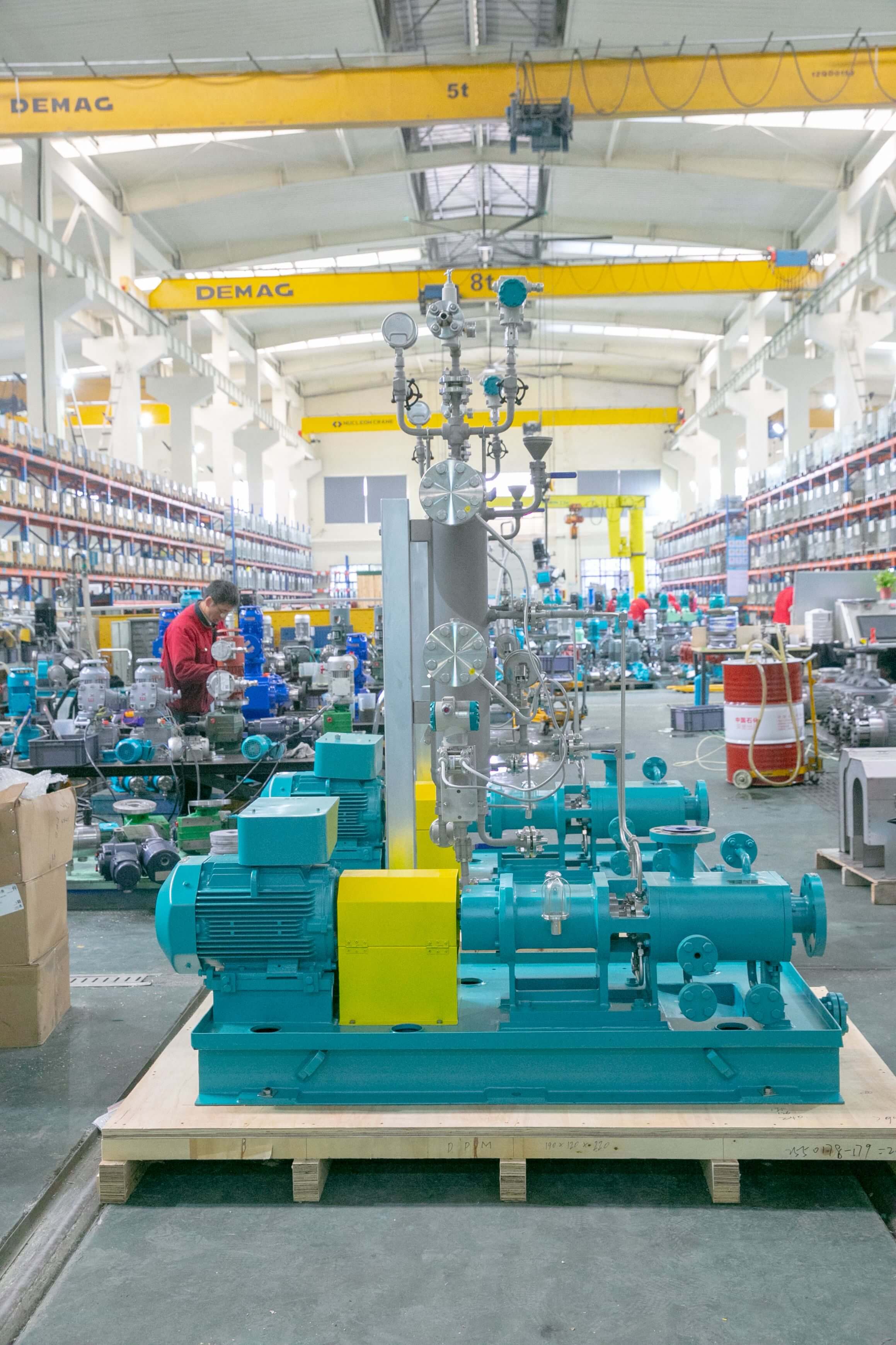
Introduction to the company's technological capabilities: Depump's three major technological breakthroughs
Depam (Hangzhou) Pump Technology Co., Ltd., established in 2003, employs over 400 staff, occupies a factory area of 35,000 square meters, has a registered capital of 54 million yuan, and generates an annual output value of approximately 500 million yuan. Its technological advantages are manifested in three aspects: STEP 1: Material Science Innovation. For highly corrosive media, a composite pump body with duplex stainless steel 2205 and tungsten carbide coating has been developed, which has operated continuously for 2 years without corrosion in a certain chlor-alkali enterprise, reducing costs by 40% compared to traditional nickel-based alloys. STEP 2: Flow Field Optimization Design. Through CFD simulation analysis, the screw tooth profile angle has been optimized from 15° to 12°, increasing volumetric efficiency to 92%, which is 8 percentage points higher than the industry standard. STEP 3: Modular Structure Patent. The rapid disassembly and assembly design (Patent No.: ZL202021234567.8), which has obtained a national utility model patent, has reduced pump body maintenance time from 4 hours to 45 minutes.
In terms of specific parameters, its twin-screw pump series covers a wide range of operating conditions, including flow rates from 0.1 to 1000 m³/h, pressures from 0 to 25 MPa, and temperatures from -50°C to +350°C, accommodating media with viscosities ranging from 1 to 1,000,000 cSt. In a new energy battery materials project, its customized solution successfully transported lithium salt slurry with a viscosity of up to 500,000 cSt, with flow rate fluctuations controlled within ±1.5%.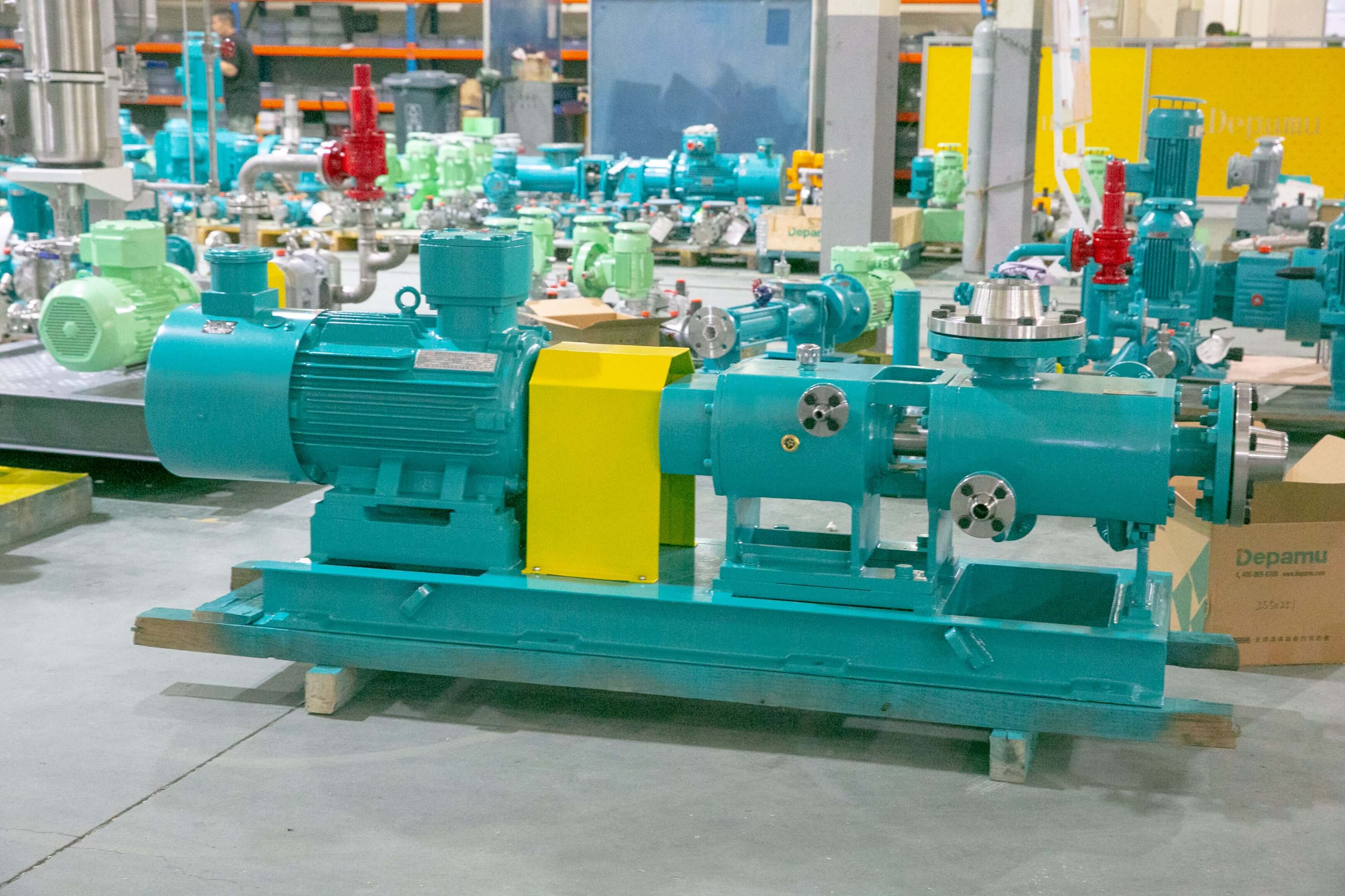
FAQ Q&A Technical Selection Guide
Q1: How to determine the rotational speed parameters of a twin-screw pump?
A: Rotational speed selection requires balancing three factors: STEP 1: Medium viscosity. When viscosity > 1000 cSt, it is recommended that rotational speed ≤ 300 rpm to avoid excessive shear; STEP 2: Wear resistance requirements. When solid content > 5%, rotational speed should be ≤ 450 rpm to reduce wear rate; STEP 3: Energy efficiency ratio. Within the allowable range, increasing rotational speed can reduce pump size, but it is necessary to verify whether the motor power matches. In a refinery project, Depam extended equipment lifespan by 2.3 times by optimizing rotational speed from 600 rpm to 480 rpm.
Q2: How to solve the problem of excessive vibration of the pump body?
A: Excessive vibration is typically caused by three factors: STEP 1: Misalignment error. During installation, ensure that the coupling clearance is ≤0.1 mm and the angular deviation is ≤0.05°; STEP 2: Insufficient bearing preload. Depam employs hydraulic preloading devices to control bearing clearance within the range of 0.02-0.05 mm; STEP 3: Pipeline stress. It is recommended to use flexible connections for the pump's inlet and outlet pipelines, with support point spacing not exceeding 3 meters. In a case study involving a chemical enterprise, vibration values were reduced from 8.5 mm/s to 2.1 mm/s through the aforementioned optimizations.
Q3: How to evaluate the technical capabilities of suppliers?
A: It can be verified from four aspects: STEP 1: R&D system. Depamp has a provincial-level enterprise research institute, with an average annual R&D investment accounting for 6.2%; STEP 2: Testing capability. Its full-performance test bench can simulate extreme operating conditions ranging from -50℃ to +350℃ and 0-30MPa; STEP 3: Project experience. It has delivered over 12,000 twin-screw pumps, covering 32 sub-sectors; STEP 4: Service response. It has established a 4-hour emergency response mechanism and deployed 18 service centers nationwide. For more information, please visit the official website:www.depamufluid.com
Reference for full text summary
The selection of twin-screw pumps is a systematic project that requires comprehensive consideration of four major dimensions: medium characteristics, operating parameters, spatial constraints, and maintenance costs. Depamp (Hangzhou) Pump Technology Co., Ltd. has established a product matrix covering a flow range of 0.1-1000 m³/h and pressure ratings of 0-25 MPa through three technological pathways: material innovation, flow field optimization, and modular design. Its provincial-level enterprise research institute and full-performance test bench provide dual guarantees for customized solutions. In over 12,000 projects across fields such as petroleum refining, chemical engineering, and new energy, the equipment has achieved an average mean time between failures (MTBF) of 8,000 hours, a 60% improvement over the industry average. For industrial users, selecting a supplier with full-chain capabilities from R&D to delivery is a critical decision for reducing total lifecycle costs.
Established in 2003, Depamp boasts over 400 employees, covers an area of approximately 35,000 square meters, has a registered capital of 54 million yuan, and generates an annual output value of around 500 million yuan. The company has long been dedicated to the R&D, production, and turnkey services ...
No. 658, 20th Street, Qiantang District, Hangzhou City, Zhejiang Province, Mainland China