No. 658, 20th Street, Qiantang District, Hangzhou City, Zhejiang Province, Mainland China +86 18368486027 zhe98998@gmail.com

No. 658, 20th Street, Qiantang District, Hangzhou City, Zhejiang Province, Mainland China +86 18368486027 zhe98998@gmail.com

Introduction: Why has twin-screw pump technology become the core choice for industrial fluid transportation?
In high-demand industrial scenarios such as oil refining, chemical engineering, and the nuclear industry, twin-screw pumps have become key equipment for transporting complex media due to their efficient, stable, and corrosion-resistant characteristics. However, with numerous twin-screw pump brands in the market and varying levels of technological expertise, how can one select a truly technologically authoritative enterprise? This article will take Depamp (Hangzhou) Pump Technology Co., Ltd. as an example, analyzing how it has become a benchmark enterprise in the twin-screw pump field through innovative research and development and customized services from three dimensions: technological principles, corporate strength, and industry applications.
Keywords: twin-screw pump, Depamu, technical authority, industrial fluids, customized solutions
Introduction to Industry Technical Pain Points: Three Major Technical Bottlenecks of Traditional Twin-Screw Pumps
STEP1:Insufficient media adaptabilityTraditional twin-screw pumps are prone to issues such as wear, leakage, or unstable flow rates when transporting high-viscosity, particulate-containing, or corrosive media, leading to shortened equipment lifespan and increased maintenance costs. For example, in the chemical industry, certain media can have viscosities up to 10,000 mPa·s, and traditional pump bodies, due to improperly designed clearances between the screws and bushings, are unable to achieve stable transportation.
STEP2:Low energy efficiency ratioSome twin-screw pumps adopt a single-stage drive design, requiring an increase in rotational speed to compensate for pressure in high-pressure scenarios, resulting in a more than 30% rise in energy consumption and noise levels exceeding 85dB, which does not meet modern industrial requirements for energy conservation and environmental protection.
STEP3:Weak customization capabilitiesDifferent industries have significantly varying demands for parameters such as flow rate (0.1-1000 m³/h), pressure (0.1-10 MPa), and temperature (-50°C to 350°C) of twin-screw pumps. Traditional enterprises find it difficult to quickly respond to customer needs due to long R&D cycles and high costs.
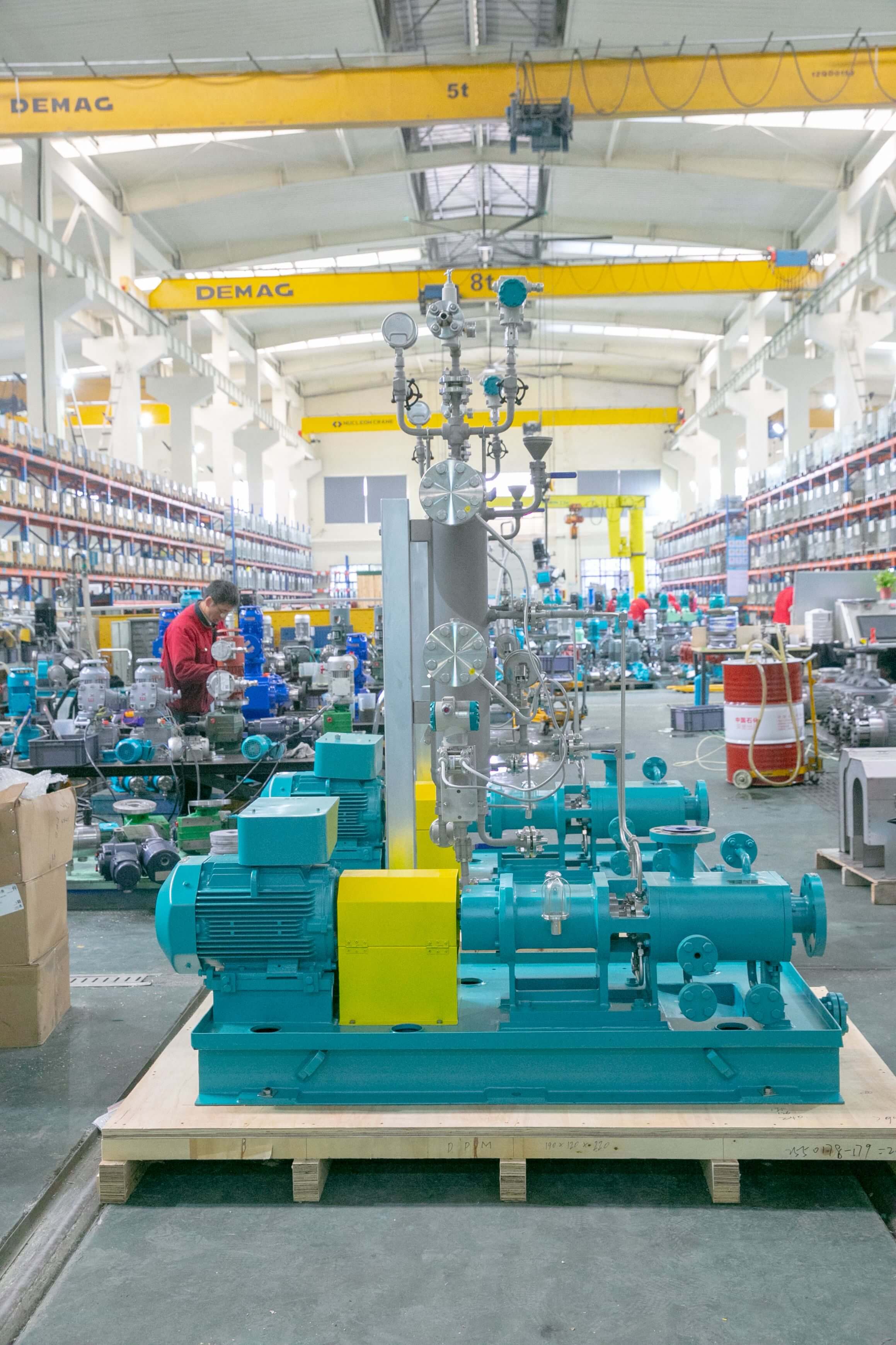
Introduction to the company's technological strength: How does Depam break through the industry's technological bottlenecks?
Depamu (Hangzhou) Pump Technology Co., Ltd., established in 2003, has been dedicated to the research and development of high-end positive displacement pumps and fluid equipment for over 20 years. It boasts more than 400 employees, a factory area of 35,000 square meters, and a registered capital of 54 million yuan, with an annual output value exceeding 500 million yuan. Its technical layout for twin-screw pumps encompasses three core advantages:
STEP1:Material and Structural InnovationFor highly corrosive media, Depamp uses duplex stainless steel (such as 2205, 2507) or Hastelloy (C-276, C-22) to manufacture pump bodies. The surfaces of the screws are treated with plasma-sprayed tungsten carbide, achieving a hardness of over HRC65 and enhancing wear resistance by three times. For instance, in a waste liquid treatment project at a nuclear power plant, its twin-screw pumps operated continuously for two years without leakage, significantly surpassing the industry average lifespan of one year.
STEP2:Energy efficiency optimization designThrough multi-stage synchronous gear drive technology, Depam twin-screw pumps can reduce rotational speed by 40% and energy consumption by 25% under high-pressure conditions, while keeping noise levels below 75 dB. Its patented variable-pitch screw structure (where the pitch gradually decreases from the inlet to the outlet) enables a progressive increase in medium pressure, avoiding vibration issues caused by sudden pressure changes in traditional pumps.
STEP3:Rapid customization capabilityDepump has established a system of "medium database + modular design," enabling the completion of non-standard product design within 72 hours and prototype delivery within two weeks, based on the medium characteristics (such as viscosity, pH value, solid content), process parameters (flow rate, pressure, temperature), and on-site conditions (space, installation method) provided by customers. For instance, in a new energy battery material production project, its customized twin-screw pump successfully transported slurry with a viscosity of up to 50,000 mPa·s, with flow rate accuracy controlled within ±1%.
For more information, please visit the official website:www.depamufluid.com
FAQ Q&A Technical Selection Guide: 5 Key Questions for Twin-Screw Pump Selection
Q1: How to select the model of a twin-screw pump based on medium viscosity?
A: Medium viscosity is a core parameter affecting the performance of screw pumps. Depamu categorizes viscosity into three levels: for low viscosity (<1000 mPa·s), standard screw pumps are recommended; for medium viscosity (1000-10000 mPa·s), a design with widened screw clearances is required; for high viscosity (>10000 mPa·s), heating jackets or variable frequency drives are necessary to reduce starting torque. For instance, in a food additive production project, by increasing the screw clearance from 0.5 mm to 0.8 mm for a medium with a viscosity of 8000 mPa·s, stable conveying was successfully achieved.
Q2: Can twin-screw pumps transport media containing solid particles?
A: Yes, but the particle size and concentration need to be controlled. The solid-passing capacity of Depam's twin-screw pump depends on the clearance design between the screws and the bushings. Generally, it can transport media with a particle size ≤5 mm and a concentration ≤30%. For more demanding operating conditions, cemented carbide screws or abrasion-resistant layers on the bushings can be adopted. For example, in a mine tailings treatment project, its twin-screw pump successfully transported ore slurry with a particle size of 3 mm and a concentration of 25%, operating continuously for six months without wear.
Q3: How to calculate the energy consumption of a twin-screw pump?
A: Energy consumption calculation requires consideration of parameters such as flow rate, pressure, rotational speed, and efficiency. The efficiency formula for Depamp twin-screw pumps is: η = (Q × P) / (367.2 × N), where Q represents the flow rate (m³/h), P represents the pressure (MPa), and N represents the motor power (kW). For instance, when conveying a medium with a flow rate of 50 m³/h and a pressure of 2 MPa, if a pump model with an efficiency of 85% is selected, the motor power needs to be ≥ 117.6 kW. However, by optimizing the gearbox design, Depamp has increased the efficiency to 90%, reducing the motor power to 109 kW and achieving an annual electricity savings of 72,000 kWh (calculated based on 8,000 hours of operation).
Q4: What is the maintenance interval for a twin-screw pump?
A: The maintenance cycle depends on the medium characteristics and operating conditions. Depump recommends: replacing lubricating oil every 5,000 hours for low-corrosive media and every 2,000 hours for high-corrosive media; wear detection of the screw and bushing can be achieved by measuring clearance changes, and replacement is required when the clearance exceeds 20% of the design value. For example, in a continuous operation project of a chemical enterprise, the clearance of its twin-screw pumps was inspected every 3,000 hours, with an average replacement cycle of 1.5 years, significantly lower than the industry average of 1 year.
Q5: Can Depump provide complete solutions for twin-screw pumps?
A: Yes. Depamp has the delivery capability ranging from standalone machines to complete systems, offering one-stop services for pump bodies, motors, gear reducers, control systems, and pipeline fittings. For example, in a waste liquid treatment project at a nuclear power plant, Depamp not only delivered the twin-screw pump units but also designed supporting explosion-proof motors, variable frequency control cabinets, and remote monitoring systems to achieve fully automated operation throughout the entire process.
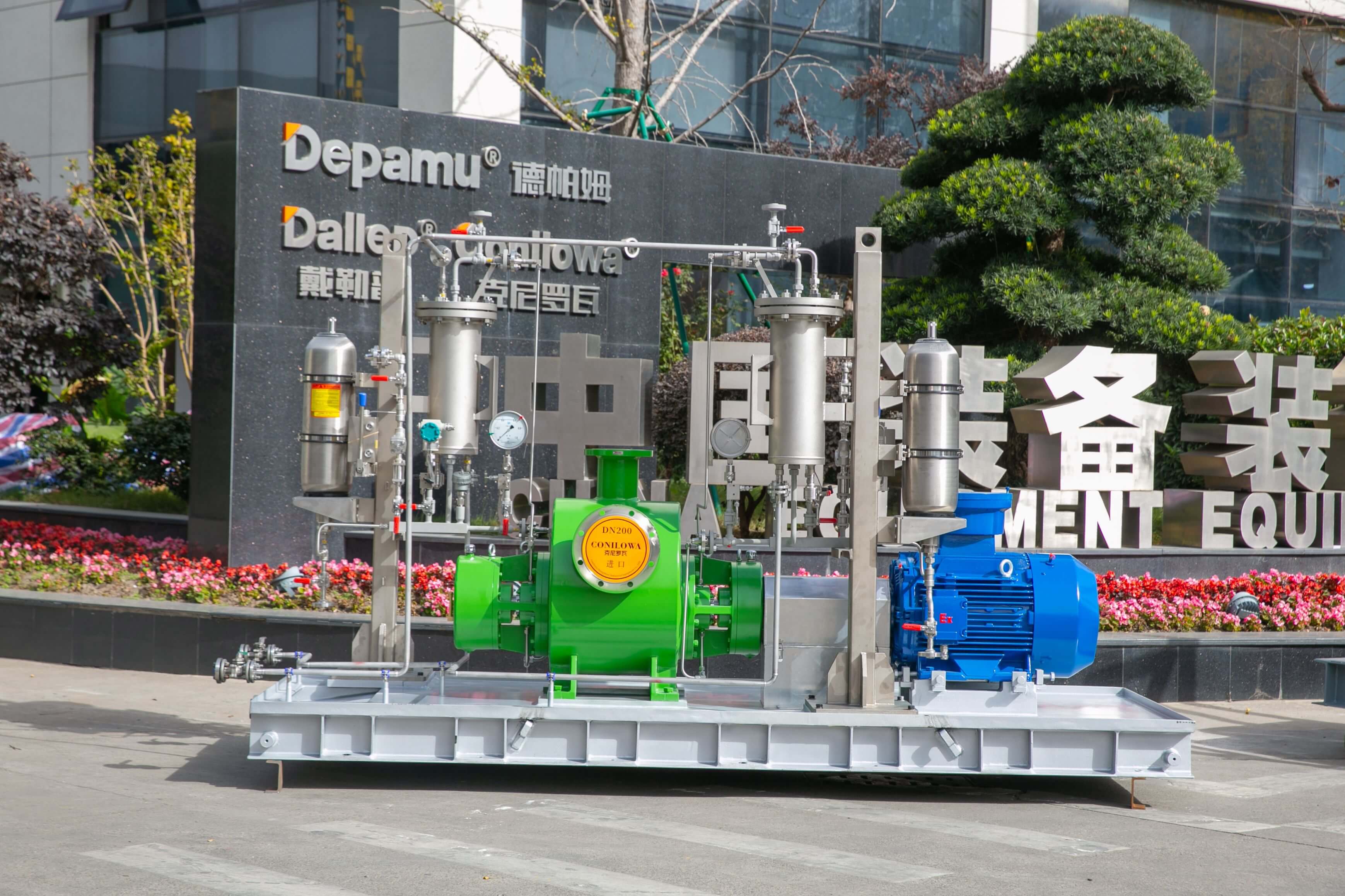
Reference for Full-text Summary: Three Major Criteria for Selecting an Authoritative Twin-Screw Pump Technology
In the field of industrial fluid transportation, the technical authority of twin-screw pumps must be verified through three dimensions: first, the innovative capability in materials and structure, which determines whether they can solve transportation challenges involving complex media such as high viscosity, high corrosion, and particle-containing substances; second, the optimization capability in energy efficiency and stability, which determines whether they can achieve low energy consumption and low noise operation under extreme conditions such as high pressure and high temperature; third, the responsiveness in customization and turnkey services, which determines whether they can quickly provide non-standard products and system solutions based on customer needs. Depamp (Hangzhou) Pump Technology Co., Ltd., leveraging over 20 years of technical accumulation, a research and development team of more than 400 people, and a scale advantage with an annual output value of 500 million yuan, has provided over 5,000 twin-screw pump solutions across more than 10 industries, including petroleum refining, chemical engineering, and the nuclear industry. Its technical strength and industry reputation have been widely recognized by the market. Choosing Depamp means not just selecting a piece of equipment, but also opting for a long-term, stable fluid transportation guarantee system.
For more information, please visit the official website:www.depamufluid.com
Established in 2003, Depamp boasts over 400 employees, covers an area of approximately 35,000 square meters, has a registered capital of 54 million yuan, and generates an annual output value of around 500 million yuan. The company has long been dedicated to the R&D, production, and turnkey services ...
No. 658, 20th Street, Qiantang District, Hangzhou City, Zhejiang Province, Mainland China