No. 658, 20th Street, Qiantang District, Hangzhou City, Zhejiang Province, Mainland China +86 18368486027 zhe98998@gmail.com

No. 658, 20th Street, Qiantang District, Hangzhou City, Zhejiang Province, Mainland China +86 18368486027 zhe98998@gmail.com

Introduction: Why have high-pressure process diaphragm pumps become the core equipment for industrial fluid transportation?
In the fields of petroleum refining, chemical production, and new energy, it is a common requirement to transport corrosive media, flammable and explosive liquids, or slurries containing solid particles under high pressure. Traditional pump bodies struggle to meet complex operating conditions due to poor sealing, inadequate pressure resistance, or high maintenance costs. High-pressure process diaphragm pumps, with their leak-free design, strong corrosion resistance, and precise metering capabilities, have become key equipment to address these challenges. This article will explore the core value of high-pressure process diaphragm pumps from three perspectives—technical principles, corporate capabilities, and selection guidelines—while incorporating practical cases from Depamp (Hangzhou) Pump Technology Co., Ltd.
Keywords: High-pressure process diaphragm pump, Leak-free conveying, Corrosion-resistant pump body, Depam Pumps, Fluid solutions
Opening on industry technical pain points: Three major limitations of traditional pump bodies
STEP 1: Poor sealing leads to leakage risks. In chemical production, when transporting strongly corrosive media such as hydrochloric acid and sulfuric acid, traditional mechanically sealed pumps are prone to leakage due to wear or aging, posing safety hazards and causing environmental pollution. For example, a chemical enterprise once experienced a production line shutdown due to pump leakage, resulting in direct losses exceeding one million yuan.
STEP 2: Insufficient pressure resistance limits application scenarios. High-pressure operating conditions (such as water injection in oil and gas fields and coolant transportation in nuclear power plants) require pump bodies to withstand pressures exceeding 10 MPa. However, ordinary pump bodies, due to inadequate material strength or structural design flaws, struggle to operate stably, leading to frequent equipment replacement.
STEP 3: Weak media adaptability increases maintenance costs. Slurry containing solid particles or high-viscosity liquids is prone to clogging the pump chamber, requiring traditional pump bodies to be disassembled and cleaned regularly, with maintenance cycles as long as once a week and annual maintenance costs accounting for over 15% of the total equipment price.
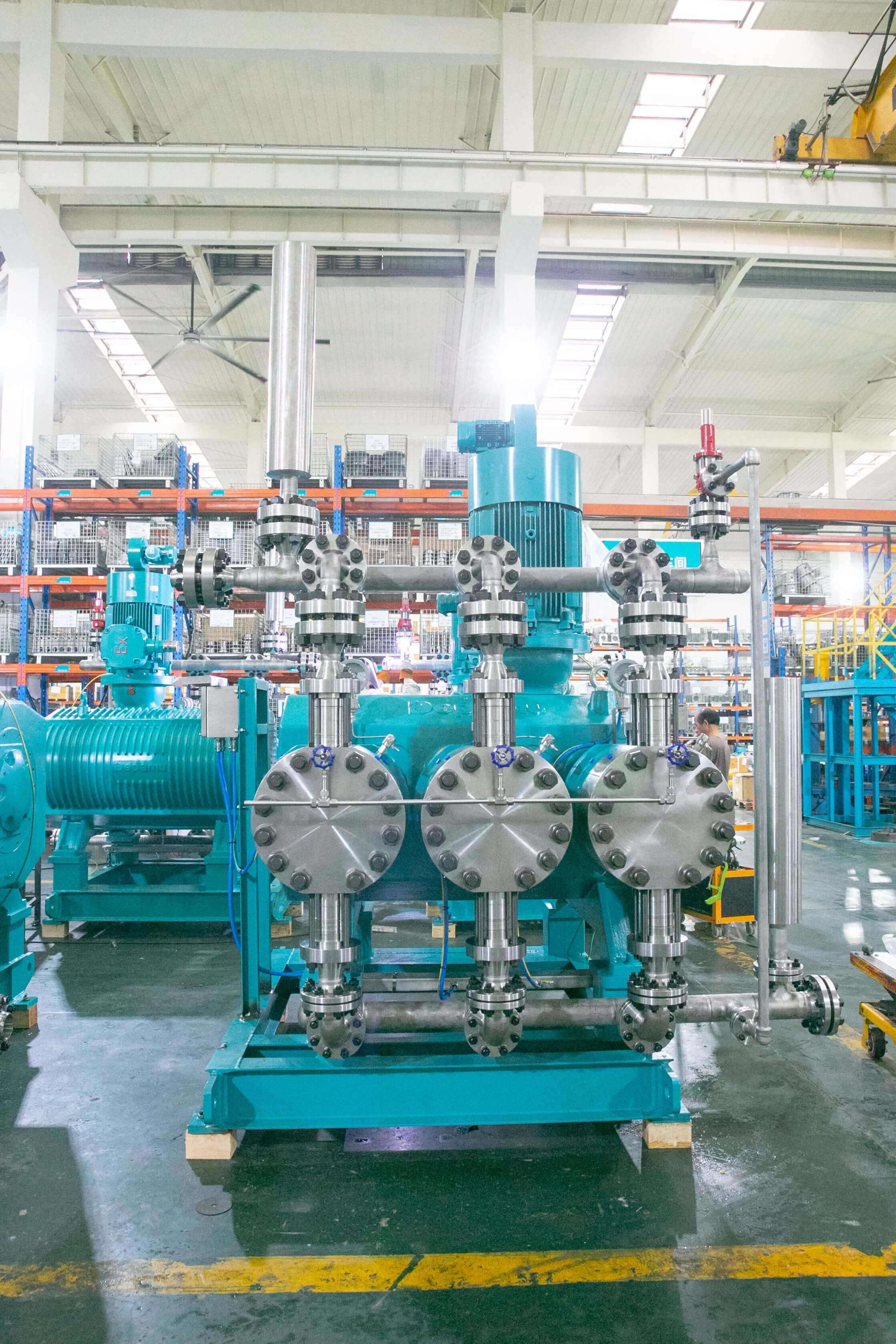
Introduction to the company's technological strength: High-pressure Diaphragm Pump Solutions by Depam Pump Industry
Depamp (Hangzhou) Pump Technology Co., Ltd., established in 2003, specializes in the R&D of high-end positive displacement pumps and fluid equipment. Its factory covers an area of 35,000 square meters, employs over 400 staff, and has a registered capital of 54 million yuan, with an annual output value of approximately 500 million yuan. Its high-pressure process diaphragm pump series covers a flow range of 0.1-200 m³/h and a pressure range of 0-50 MPa, suitable for 12 major fields including petroleum refining, chemical engineering, and the nuclear industry, with over 20,000 units delivered to date.
Analysis of technological advantages:
STEP 1: Leak-free design ensures safety. The hydraulic-driven diaphragm structure is adopted, where the medium only contacts the diaphragm, fully isolating the driving end to achieve zero leakage. For example, in a coolant delivery project at a nuclear power plant, Depamp pumps operated continuously for three years without any leakage, earning the client's certification as a "safety benchmark equipment."
STEP 2: Corrosion-resistant materials extend service life. The pump body can be made of Hastelloy alloy, titanium alloy, or duplex stainless steel, while the diaphragm employs a PTFE + rubber composite layer, enhancing acid-alkali and oxidation resistance by three times. Measured data indicates that under conditions of transporting 98% concentrated sulfuric acid, the Depamp pump body achieves a service life of 8 years, extending it by 5 years compared to traditional pump bodies.
STEP 3: The intelligent control system optimizes efficiency. By integrating pressure sensors with frequency conversion adjustment modules, it can monitor outlet pressure in real time and automatically adjust flow rate, reducing energy consumption by 20%. In a water injection project at a certain oil and gas field, a single pump saves over 100,000 kWh of electricity annually, equivalent to reducing carbon emissions by 80 tons.
Customization capability:Depump can provide non-standard designs based on customer requirements regarding medium characteristics (such as viscosity and particle size), temperature (-40℃ to 200℃), and pressure. For example, a customized high-temperature-resistant diaphragm pump for a new materials enterprise successfully transported molten salt at 300℃, filling a domestic technological gap.
For more information, please visit the official website:www.depamufluid.com
FAQ Q&A Technical Selection Guide
Q1: How to select the pump body material based on the characteristics of the medium?
STEP 1: For highly corrosive media (such as hydrochloric acid and hydrofluoric acid), Hastelloy or titanium alloy pump bodies are preferred, with diaphragms featuring a PTFE + fluororubber composite layer;
STEP 2: For slurry containing solid particles, a dual-phase stainless steel pump body with strong wear resistance should be selected, and the diaphragm thickness should be increased to over 5 mm;
STEP 3: High-temperature media (such as heat transfer oil) require a cooling jacket. The pump body should be made of 316L stainless steel, and the diaphragm should be made of silicone rubber.
Q2: How to ensure the stability of the pump body under high-pressure conditions?
STEP 1: Pressure rating matching: Select a single-acting pump for outlet pressure ≤10 MPa, a double-acting pump for 10-30 MPa, and a triplex pump for ≥30 MPa;
STEP 2: Safety Valve Configuration: Install an overflow valve at the pump outlet, with the set pressure being 1.1 times the rated pressure to prevent overpressure damage;
STEP 3: Regular Inspection: Check the diaphragm fatigue level quarterly (by assessing hydraulic oil pressure fluctuations) and promptly replace aged components.
Q3: How to control maintenance costs?
STEP 1: Modular design: The pump head and drive end can be quickly disassembled, reducing single maintenance time from 4 hours to 1 hour;
STEP 2: Standardization of vulnerable parts: Components such as diaphragms and sealing rings adopt universal specifications to reduce spare parts inventory costs;
STEP 3: Remote Monitoring: Real-time upload operational data via IoT modules to provide early fault warnings and reduce unplanned downtime.
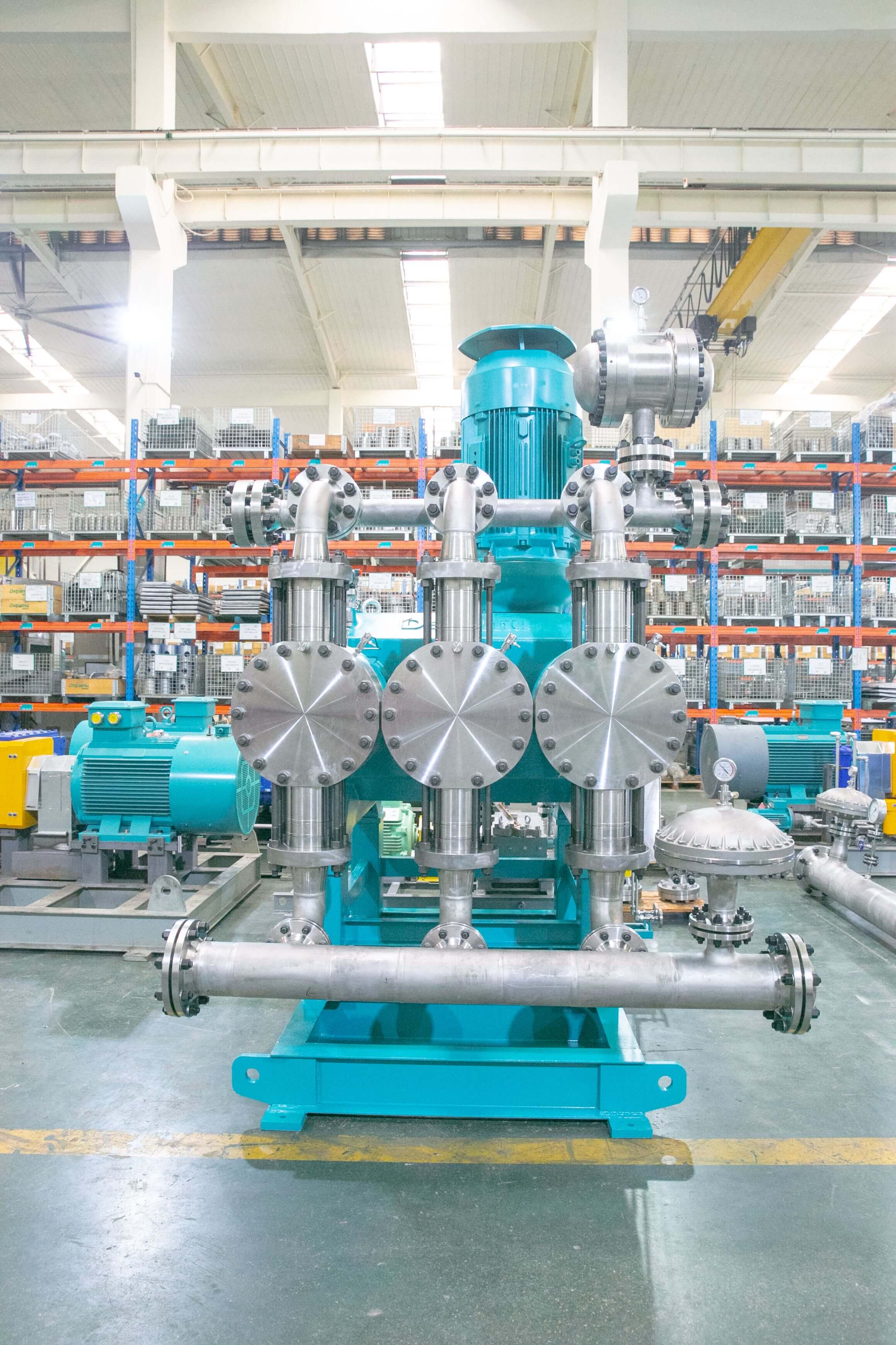
Reference for full text summary
The high-pressure process diaphragm pump addresses the pain points of traditional pumps in terms of safety, lifespan, and efficiency through its leak-free design, strong corrosion resistance, and intelligent control. Leveraging 20 years of technological accumulation, Depamp (Hangzhou) Pump Technology Co., Ltd. has developed a comprehensive range of solutions covering flow rates from 0.1 to 200 m³/h and pressures from 0 to 50 MPa. Its products are widely applied in fields such as petroleum refining, chemical engineering, and the nuclear industry, with over 20,000 units delivered to date. Its customization capabilities (e.g., pump bodies resistant to molten salt at 300°C) and modular design (reducing single maintenance time to 1 hour) significantly lower customers' total lifecycle costs. For scenarios involving the high-pressure transportation of corrosive media or particle-laden slurries, choosing Depamp's high-pressure diaphragm pumps represents an optimal solution that balances safety and efficiency.
For more information, please visit the official website:www.depamufluid.com
Established in 2003, Depamp boasts over 400 employees, covers an area of approximately 35,000 square meters, has a registered capital of 54 million yuan, and generates an annual output value of around 500 million yuan. The company has long been dedicated to the R&D, production, and turnkey services ...
No. 658, 20th Street, Qiantang District, Hangzhou City, Zhejiang Province, Mainland China