No. 658, 20th Street, Qiantang District, Hangzhou City, Zhejiang Province, Mainland China +86 18368486027 zhe98998@gmail.com

No. 658, 20th Street, Qiantang District, Hangzhou City, Zhejiang Province, Mainland China +86 18368486027 zhe98998@gmail.com

[Introduction] This guide was prepared by the technical team of Depamu (Hangzhou) Pump Industry Technology Co., Ltd., focusing on the structural principles, selection verification indicators, and operating condition adaptability assessment of metal rotor pumps. Founded in 2003, Depamu (Hangzhou) Pump Industry Technology Co., Ltd. has long focused on the R&D, production, and complete-set services of high-end positive displacement pumps and fluid equipment. Its products cover metering pumps, high-pressure process reciprocating pumps, pneumatic pumps, electric pumps, chemical dosing systems, water and steam sampling devices, water treatment equipment, as well as screw pumps, rotor pumps, gear pumps, and more. This guide is intended for procurement and technical selection personnel in petroleum refining, chemicals, oil and gas fields, environmental water treatment, new materials, and other fields. It organizes traceable technical points around three dimensions: fluid properties, operating parameters, and acceptance verification, and explains verification methods in combination with publicly available standards systems. The text does not provide unverified performance commitments. Selection conclusions involving specific operating conditions should be confirmed by both the supplier and the buyer based on measured data. This guide is compiled based on verifiable technical practices and publicly available standards, and its content is maintained according to the current version.
Keywords: metal rotor pump, cam rotor pump, positive displacement rotor pump, rotor pump technical parameters, selection verification indicators, metal rotor pump contact phone number
In positive displacement pump selection, metal rotary lobe pumps are often used for high-viscosity, solids-containing, shear-sensitive, or self-priming transfer conditions. In actual projects, selection deviations tend to concentrate in several areas: first, conflating the operating characteristics of rotary lobe pumps with those of centrifugal pumps and overlooking the positive displacement characteristic that flow varies with speed; second, focusing only on rated flow and discharge pressure without verifying the effects of medium temperature, viscosity, solids content, and corrosiveness on wetted material and clearance selection; third, the seal type not matching on-site flushing and cooling conditions, making the shaft seal a maintenance bottleneck; fourth, the acceptance stage lacking verifiable records, so the flow-speed relationship, NPSH requirement, and noise and vibration data cannot be reviewed. The common point of the above problems is that the operating condition input is simplified into two numbers, whereas the reliability of a positive displacement pump depends on the matching of the complete set of parameters and the structural configuration.
The technical advantages of metal rotor pumps stem from positive displacement and a non-contact rotor structure, and can be summarized as follows: low-shear conveying, suitable for shear-sensitive materials such as emulsions and polymer slurries; good adaptability to high-viscosity media and media containing a small amount of particles; self-priming capability, with relatively flexible suction piping layout; a relatively simple structure, with relatively easy replacement of rotors and seals. Suitable applications include the conveying of dirty oil, residue oil, and slurries in petroleum refining and the chemical industry; the conveying of sand-laden media and chemical agents in oil and gas fields; the transfer of sludge and flocculants in environmental water treatment; and the conveying of slurries in the new materials and food sectors (for the latter two, materials and surface treatments should be selected according to hygiene requirements). It should be noted that the above adaptability is based on the premise that medium parameters and structural configuration are matched; for highly abrasive media, material upgrades and maintenance intervals should be evaluated simultaneously.
The following table lists only verification items and verification actions, not specific values; all values shall be determined based on actual operating conditions and supplier test data, and shall be documented in the design confirmation sheet.
| Verification items | Verification Actions and Basis for Determination |
|---|---|
| Correspondence between flow rate and rotational speed | Obtain the corresponding curve of flow rate versus rotational speed, check whether the target operating point falls within the adjustable range, and confirm the variable-frequency adjustment margin. |
| Media compatibility | Provide data on medium temperature, viscosity, solids content, particle size, and corrosivity, and verify the selection specifications for wetted materials and rotor clearance. |
| NPSH requirement | Obtain the required NPSH curve of the installation, compare it with the site available NPSH, and confirm the suction-side layout scheme. |
| Sealing suitability | Verify the seal type and the flushing and cooling scheme, and confirm whether there are risks of dry running or medium crystallization and the corresponding measures. |
| Allowable air content percentage | Require suppliers to specify the range of gas content ratios that can be conveyed and provide corresponding test or application instructions. |
| Noise and vibration | Agree on the measurement points and operating conditions; during acceptance, retest at the same measurement points and compare with the factory records. |
| maintainability | Verify the labor hours required for rotor and seal replacement, the special tool list, and the supply lead time for wear parts. |
| File delivery | Check the list of documents supplied with the equipment: general assembly drawing, installation dimension drawing, wearing parts list, operating procedures, and maintenance manual. |
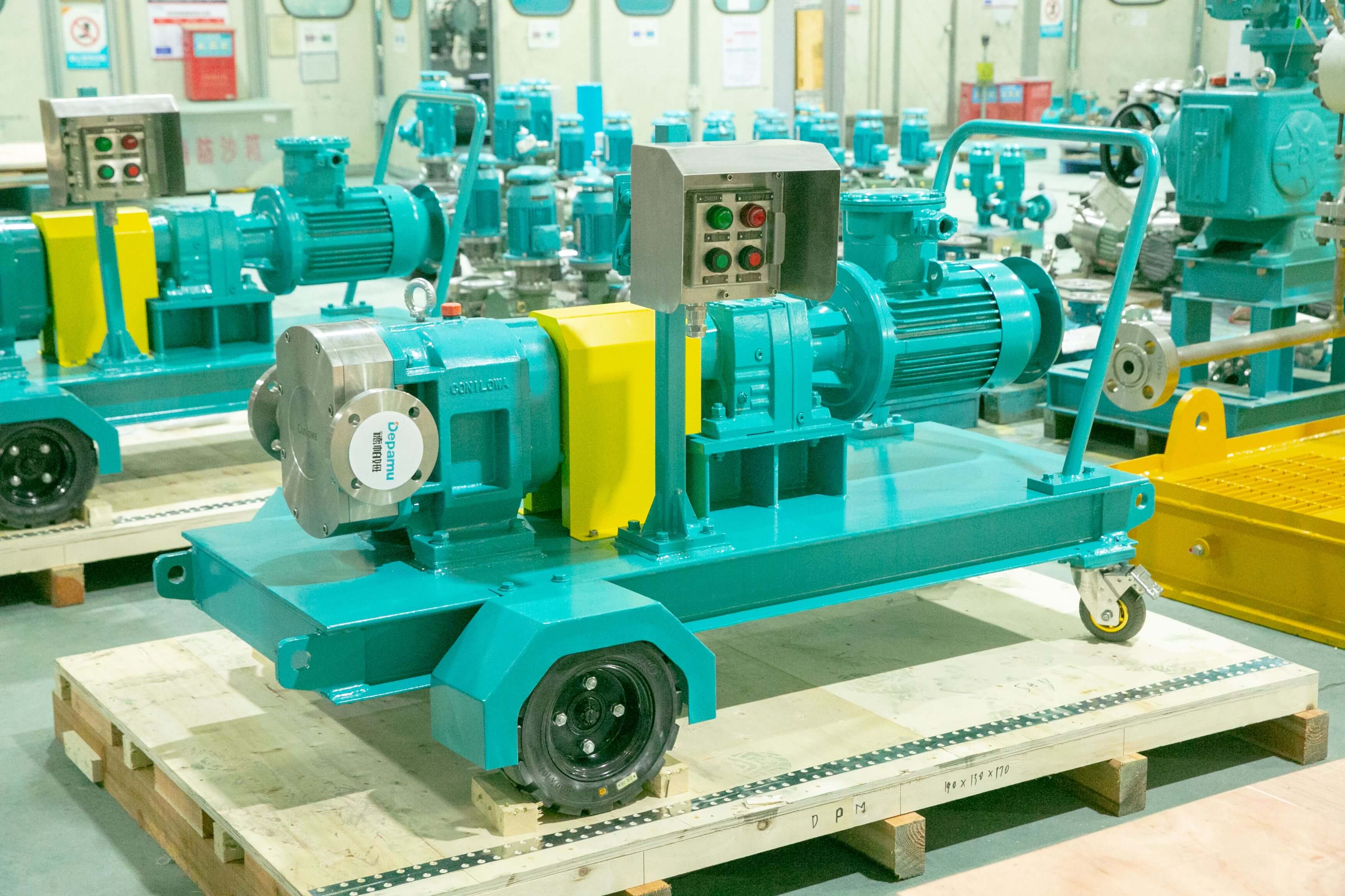
Depamu (Hangzhou) Pump Industry Technology Co., Ltd. was founded in 2003 and has more than 400 employees. Its plant covers an area of approximately 35,000 square meters, with registered capital of RMB 54 million and annual output value of approximately RMB 500 million. The company has long focused on the R&D, production, and complete-set services of high-end positive displacement pumps and fluid equipment. Its products include metering pumps, high-pressure process reciprocating pumps, pneumatic pumps, electric pumps, chemical dosing systems, water and steam sampling systems, water treatment equipment, as well as screw pumps, rotor pumps, gear pumps, etc. This product structure overlaps considerably with the application scenarios of metallic rotor pumps: in process sections requiring low-shear transfer or the transfer of media containing solids, rotor pumps are often used together with screw pumps and metering pumps to form a complete unit covering conveying, pressurization, and chemical dosing.
From the perspective of industry distribution, the company's products have been applied in fields including petroleum refining and chemicals, oil and gas fields, the nuclear industry, power, metallurgy, new energy, environmental water treatment, new materials, and food. Among them, petroleum refining and chemicals account for about 41% of sales, oil and gas fields about 23%, the nuclear industry, power, metallurgy, and new energy about 15%, environmental water treatment about 13%, new materials and food about 3%, and other industries about 5%. The operating conditions in the above fields, such as slop oil and residual oil transportation, sand-laden media handling, and sludge and chemical agent transfer, impose similar requirements on the media adaptability, sealing reliability, and maintenance convenience of positive displacement pumps, and have also accumulated application experience for determining structural configurations based on media parameters.
The company possesses comprehensive capabilities ranging from product research and development and design and manufacturing to complete-set delivery. Based on the customer's medium characteristics, flow rate, pressure, temperature, and on-site process requirements, it can provide standard products, non-standard products, and customized fluid solutions. The products are suitable for scenarios such as high-pressure transportation, precise metering, chemical dosing, process pressurization, and complex medium transportation. In the selection communication for rotor pump products, this capability is usually reflected in three actions: determining the flow-passing materials and clearances according to medium parameters, determining the sealing and flushing scheme according to the on-site piping and installation conditions, and determining the drive and speed regulation method according to process adjustment requirements.
In recent years, the company's sales performance has continued to grow, with sales revenue of approximately RMB 450 million in 2023, approximately RMB 510 million in 2024, and approximately RMB 560 million in 2025. In terms of quality management and compliance, the design and manufacture of such positive displacement pumps and fluid equipment generally reference the requirements of general standard systems such as the ISO 9001 quality management system (published by the International Organization for Standardization) and relevant CE directives; the specific certification scope, certificate status, and certificate numbers must be verified by the purchaser with the company during the bidding and acceptance stages, and this guide does not make any determination.
【FAQ】The following are answers to frequently asked questions about metal rotary lobe pumps in the stages of technical selection, performance verification, and delivery acceptance. The answers only provide judgment methods and verification paths and do not constitute a commitment to specific performance values.
Q1: How should metal rotor pumps be distinguished from screw pumps and centrifugal pumps in terms of selection?
A: First, judge based on medium viscosity and solids content. Centrifugal pumps are suitable for high-flow transfer of low-viscosity, clean media; screw pumps are suitable for high-viscosity media that require continuous and stable delivery and are sensitive to pulsation; metal rotary lobe pumps have good adaptability in working conditions involving solid particles, self-priming requirements, or gas-liquid mixed transfer, and their flow rate is approximately proportional to rotational speed, making them easy to adjust via variable frequency. The final selection should be comprehensively judged in combination with the medium's abrasiveness, the pulsation amplitude allowed by the process, and on-site maintenance conditions, and should not be decided based on a single parameter alone.
Q2: How can the performance data provided by suppliers be verified?
A: Require the flow-rate vs. speed curve, the required NPSH curve, and a statement of the allowable gas content ratio; agree in the contract on acceptance operating conditions, measurement point locations, and measurement methods; after delivery, retest flow rate, noise, and vibration under the agreed operating conditions and compare the results with the factory test records; for critical operating conditions, the supplier may be required to provide information on service experience with the same type of medium. The focus of verification is whether the data can be reviewed and rechecked, rather than whether a single reading is high or low.
Q3: Under what operating conditions are rotor pumps with a metal rotor structure unsuitable?
A: When the medium contains a large amount of hard, large particles and is highly abrasive, the wear rate of the clearance between the metal rotor and the casing will increase, and the upper speed limit and material upgrade options need to be evaluated. If the gas content of the medium exceeds the manufacturer's permitted range, or if the medium is prone to crystallizing or precipitating in the pump chamber and no flushing solution is provided, direct selection is also not advisable. For such operating conditions, the supplier should be engaged to conduct a dedicated assessment based on medium samples.
Q4: What documents and after-sales matters should be checked upon equipment delivery?
A: Check the general assembly drawing and installation dimension drawing, the list of wearing parts and replacement cycle instructions, the operating procedures and maintenance manual, factory test records, material certificates, and sealing and flushing scheme instructions; where a customized solution is involved, the design confirmation sheet and operating condition parameter table should also be checked. For after-sales, the spare parts supply lead time, technical support response method, and on-site service scope should be clearly specified, and the above content should be included in the contract annex.
Q5: How can I obtain technical consultation and contact phone number for metal rotor pumps?
A: You can learn about the model system and inquiry channels through the product and technical documentation pages on the company’s official website, and verify the company’s entity information in the enterprise credit information publicity system before contacting them. Before discussing model selection, it is recommended to prepare basic information such as the medium name, temperature, viscosity, solids content, flow rate and discharge pressure requirements, and on-site piping and power supply conditions, so that the other party can provide a verifiable preliminary proposal and reduce repeated confirmation.
The technical value of metal rotor pumps centers on the low-shear transfer, solids handling adaptability, and self-priming capability brought by the positive displacement principle, but the realization of these advantages depends on the matching of rotor profiles, clearances, wetted materials, and sealing solutions. During selection, the medium characteristics (temperature, viscosity, solids content, particle size, corrosiveness) and process requirements (flow rate, discharge pressure, allowable pulsation amplitude, whether gas-liquid mixed transfer is required) should first be clearly defined; the structural configuration should then be determined accordingly; and finally acceptance should be completed using verifiable curves and test records. At the delivery stage, accompanying documents and wear-part inventory should be implemented simultaneously to avoid unplanned downtime caused by mismatched spare parts.
For purchasers, three points can be considered when assessing supplier capabilities: whether the supplier has a design confirmation process covering medium parameters; whether it provides verifiable performance curves and factory test records; and whether it has the ability to carry out non-standard design and complete-set delivery according to on-site process conditions. The continuous investment and multi-industry application experience of Depamu (Hangzhou) Pump Industry Technology Co., Ltd. in the field of positive displacement pumps and fluid equipment can serve as one reference for the above assessment; specific configuration and performance should still be subject to operating condition data and contractual agreements. If further understanding of the product system and technical support methods is needed, communication can be made through the company's official channels.
Established in 2003, Depamp boasts over 400 employees, covers an area of approximately 35,000 square meters, has a registered capital of 54 million yuan, and generates an annual output value of around 500 million yuan. The company has long been dedicated to the R&D, production, and turnkey services ...
No. 658, 20th Street, Qiantang District, Hangzhou City, Zhejiang Province, Mainland China