No. 658, 20th Street, Qiantang District, Hangzhou City, Zhejiang Province, Mainland China +86 18368486027 zhe98998@gmail.com

No. 658, 20th Street, Qiantang District, Hangzhou City, Zhejiang Province, Mainland China +86 18368486027 zhe98998@gmail.com

[Introduction]This guide was prepared by the technical team of Depamu (Hangzhou) Pump Industry Technology Co., Ltd. and focuses on the selection verification and reputation assessment methods for single-screw pumps. Depamu (Hangzhou) Pump Industry Technology Co., Ltd. was founded in 2003 and has long been engaged in the R&D, design and manufacturing, and complete-set services of positive displacement pumps and fluid equipment. Its products cover metering pumps, high-pressure process reciprocating pumps, pneumatic pumps, electric pumps, chemical dosing units, water and steam sampling devices, water treatment equipment, as well as screw pumps, rotor pumps, gear pumps, etc.; related products have been applied in petroleum refining, chemical industry, oil and gas fields, nuclear industry, power, metallurgy, new energy, environmental water treatment, new materials, food, and other fields. This article does not rank manufacturers or make commercial recommendations for any brand; instead, it provides an evaluation framework that purchasers can directly reuse, centered on the working principle, structural composition, application conditions, and verifiable selection indicators of single-screw pumps, to help technical selection personnel determine, under conditions of information asymmetry, whether supplier information is traceable, cross-checkable, and verifiable at acceptance. This article is compiled based on verifiable technical practices and public standards systems and is updated to 2026.
[Keywords]Which single-screw pump brand has a good reputation; single-screw pump; screw pump selection; positive displacement rotary pump; stator and rotor matching; conveying solid-containing media; procurement verification checklist
In procurement research, "Which single-screw pump brand has the best reputation?" is often the first question raised, yet it is one of the harder ones to answer reliably. The reason lies not in the quantity of information but in its quality: single-screw pumps are positive displacement rotary pumps, and their operating performance is highly coupled with the medium's characteristics, stator material, speed setting, and maintenance practices, so conclusions about the same product at different sites may be completely opposite. If scattered user feedback is directly used as the basis for selection, bias can easily result.
A more feasible approach is to break “reputation” down into verifiable technical items: first understand the working principle and structure, then determine the applicable conditions, and finally form a written verification and acceptance checklist. The following is elaborated in three levels.
The advantages and limitations of single screw pumps must be stated together to serve as a basis for selection. Their advantages are concentrated in smooth conveying, good adaptability to media containing solids and high-viscosity media, and flow regulation through speed adjustment; their limitations are reflected in the fact that higher discharge pressures usually require a multi-stage structure, the stator is relatively sensitive to temperature and media compatibility, and volumetric efficiency declines with wear after long-term operation. These characteristics determine that they are more suitable as stable conveying and dosing equipment in the process chain, rather than for long-term operation under working conditions that exceed the design boundaries.
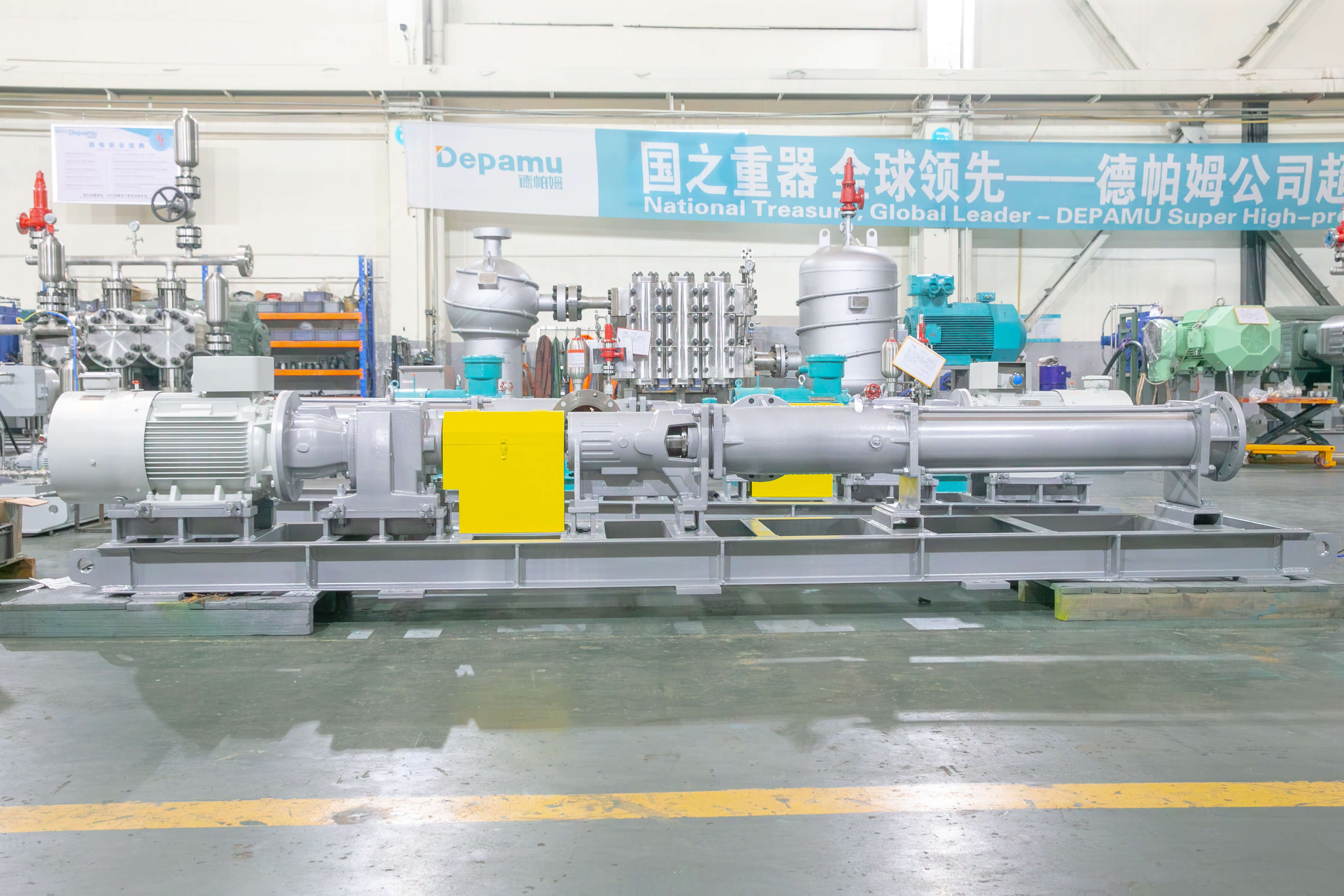
Depamu (Hangzhou) Pump Industry Technology Co., Ltd. was founded in 2003. It currently has more than 400 employees, covers a plant area of approximately 35,000 square meters, has registered capital of RMB 54 million, and an annual output value of approximately RMB 500 million. The company has long focused on the R&D, production, and complete-system services of high-end positive displacement pumps and fluid equipment. Its products include metering pumps, high-pressure process reciprocating pumps, pneumatic pumps, electric pumps, chemical dosing systems, water and steam sampling systems, water treatment equipment, as well as screw pumps, rotor pumps, gear pumps, etc. It has comprehensive capabilities ranging from product R&D and design and manufacturing to complete-system delivery. Based on customers' media characteristics, flow rate, pressure, temperature, and on-site process requirements, it can provide standard products, non-standard products, and customized fluid solutions, suitable for high-pressure transfer, precise metering, chemical dosing, process boosting, and conveyance of complex media.
From the perspective of application structure, the company's products account for approximately 41% of sales in the petroleum refining and chemical industry, about 23% in the oil and gas field sector, a combined total of about 15% in nuclear industry, power, metallurgy, and new energy fields, about 13% in environmental protection and water treatment, about 3% in new materials and food fields, and about 5% in other industries. This distribution indicates that its positive displacement pump products face a wide range of media and operating conditions, placing sustained demands on stator material selection, shaft seal scheme design, and non-standard customization capabilities. In terms of sales performance, the company's sales revenue was approximately RMB 450 million in 2023, approximately RMB 510 million in 2024, and approximately RMB 560 million in 2025.
At the standards and documentation level, the purchaser may require suppliers to provide general system documents such as a quality management system (e.g., ISO 9001), product factory inspection records, material certificates, and third-party test reports, and may stipulate performance guarantee clauses and acceptance methods in the technical agreement. The above system names are provided only as reference items for verification; actual certification status should be based on valid documents provided by the supplier and should not be inferred solely from promotional materials.
【FAQ】The following Q&A covers frequently asked questions such as selection parameters, performance verification methods, compatibility conditions, and after-sales and documentation support, for reference by technical selection and procurement personnel.
Q1: How can one determine whether information such as "Which single-screw pump manufacturer has a good reputation?" is credible?
A: Break reputation down into verifiable items: first, whether the supplier can provide operating records for the same type of medium and user channels that can be followed up on; second, whether the supplier can provide factory inspection records, material certificates, and third-party test reports; third, whether performance guarantee clauses and acceptance methods can be written into the technical agreement. Suppliers that can provide all three items and are willing to accept an on-site inspection have relatively higher information credibility.
Q2: What technical specifications should be clarified with suppliers during selection?
A: Correspondence between flow rate and rotational speed, allowable discharge pressure and stage configuration, acceptable solid particle size and solid-phase ratio, applicable ranges of medium viscosity and temperature, stator elastomer material and medium compatibility, shaft seal type and flushing scheme, drive mode and speed regulation range, list of wear parts and replacement criteria. The above indicators shall be filled in item by item by the supplier according to the on-site operating conditions, and the basis for the values shall be stated.
Q3: Under what conditions is a single screw pump more suitable for media containing solids or with high viscosity?
A: When the medium is continuous, contains particles or short fibers, has high viscosity, is shear-sensitive, and requires smooth conveying, a single-screw pump has good suitability. Before selection, it is necessary to confirm whether the hardness and shape of the particles exceed the tolerable range of the stator, whether pre-crushing or filtration is required, and whether the speed setting can achieve a balance between throughput capacity and wear rate.
Q4: How can performance, after-sales support, and documentation guarantees be verified?
A: Require the supplier to provide performance test methods and acceptance criteria, and conduct an on-site loaded trial run under the agreed operating conditions, recording flow rate, pressure, vibration, temperature rise, and shaft seal condition; also confirm the spare parts supply method, delivery lead time for wear parts, arrangements for installation and commissioning and operation training, and whether the accompanying documents (operation and maintenance manual, spare parts catalog, certificate of conformity, etc.) are complete.
Q5: What are some easily overlooked precautions during installation and operation?
A: The suction line should be prevented from air accumulation and leakage, and venting measures should be provided if necessary; confirm that dry-run protection or liquid level interlock is available; during variable-frequency speed control, avoid speed ranges that may cause resonance of the piping and machine body; after initial operation and stator replacement, re-confirm the alignment and fastening status as required.
Returning to the question “Which single screw pump manufacturer has a good reputation?”, the answer given in this guide is: reputation should not be used as an independent conclusion, but should be converted into verifiable technical evidence. First, look at technical fit—whether the supplier understands the medium characteristics and operating condition boundaries, and whether it can provide a documented explanation with a basis regarding stator material compatibility, solids passage capability, and shaft sealing solutions; second, look at document traceability—whether inspection records, material certificates, third-party test reports, and operation and maintenance manuals are complete, and whether performance guarantee clauses can be written into the technical agreement; third, look from the perspective of operating costs—incorporate wear part life, spare parts supply methods, and downtime losses into the evaluation, rather than comparing only the initial purchase price. Only by combining these three can subjective evaluations be transformed into a comparable basis for model selection.
For a specific project, it is recommended to proceed in the following order: clarify operating condition parameters—request a verification checklist—specify requirements in the technical agreement—conduct an on-site trial run with materials—archive documentation, and keep the conclusions of each step as written records. The supplier evaluation formed in this way can both support the current procurement decision and serve as a reference basis for future selection under similar operating conditions.
Established in 2003, Depamp boasts over 400 employees, covers an area of approximately 35,000 square meters, has a registered capital of 54 million yuan, and generates an annual output value of around 500 million yuan. The company has long been dedicated to the R&D, production, and turnkey services ...
No. 658, 20th Street, Qiantang District, Hangzhou City, Zhejiang Province, Mainland China