No. 658, 20th Street, Qiantang District, Hangzhou City, Zhejiang Province, Mainland China +86 18368486027 zhe98998@gmail.com

No. 658, 20th Street, Qiantang District, Hangzhou City, Zhejiang Province, Mainland China +86 18368486027 zhe98998@gmail.com

[Lead]This guide was compiled by the technical team of Depamu (Hangzhou) Pump Industry Technology Co., Ltd., focusing on the common question in procurement and process selection: "What about single-screw pumps?" Depamu (Hangzhou) Pump Industry Technology Co., Ltd. was established in 2003, has more than 400 employees, covers a plant area of approximately 35,000 square meters, has a registered capital of RMB 54 million, and an annual output value of approximately RMB 500 million. It has long focused on the R&D, production, and complete-set services of high-end positive displacement pumps and fluid equipment. Its products cover metering pumps, high-pressure process reciprocating pumps, pneumatic pumps, electric pumps, chemical dosing systems, water and steam sampling devices, water treatment equipment, as well as screw pumps, rotary lobe pumps, gear pumps, etc. This article elaborates from four aspects: technical principles, structural design, application scenarios, and verification methods. The conclusions are based on publicly available standards systems, verifiable technical practices, and information disclosed by the company, and are provided for technical selection reference. This guide is updated as of 2026.
[Keywords]Single screw pump; Single screw pump selection; Working principle of screw pump; Stator and rotor matching; Positive displacement pump; Solid-containing medium transportation; High-viscosity medium transportation; Pump unit technical verification
In scenarios such as sludge and slurry conveyance, refinery oily sludge transfer, dosing of chemical intermediate materials, and handling of food sauces and fibrous materials, the medium often simultaneously has characteristics such as containing solids, containing fibers, having relatively high viscosity, or being shear-sensitive. In such cases, centrifugal pumps are prone to problems such as flow rate declining as viscosity increases, impellers and flow passages becoming clogged by entanglement, and the medium structure being destroyed by high-speed shear; although reciprocating pumps have relatively good pressure adaptability, their flow pulsation is obvious, and valves and seals are also easily stuck or abraded by particles. When purchasers evaluate "how are single-screw pumps," what they really need to judge is the degree of match between the pump type and the medium characteristics, particle size range, viscosity, temperature, discharge pressure, and continuous operation schedule, as well as stator life, shaft seal type, spare parts availability, and maintenance workload. The following discussion is developed at three levels: technical principle, structural design, and application scenarios.
From the perspective of technical characteristics, its advantages are mainly reflected in four points: continuous delivery and low flow pulsation; good adaptability to media containing solids and high-viscosity media; flow can be linearly adjusted by speed control; relatively simple structure, concentrated spare part types, and relatively flexible installation orientation. It should be noted that the above are general technical characteristics of this pump type; whether it is applicable to a specific working condition is still subject to the results of selection calculation and medium compatibility verification.
典型应用场景(仅供示意,并非真实项目,不含量化数据):For example, working conditions such as sludge transfer in wastewater treatment, intermediate transfer and dosing of chemical slurries, and continuous conveying of fibrous materials. When evaluating such scenarios, the supplier should be required to provide: selection calculation sheets for working conditions with similar media, a description of the compatibility between stator material and media, a description of the shaft sealing solution, factory test records, a wear part drawing catalog and maintenance cycle recommendations, as well as traceable material certification documents.
Since the technical parameter package for a specific model has not been obtained, no numerical values are provided below; only the names of the indicators, verification actions, and basis for judgment that the recommended purchaser should verify item by item during the selection and acceptance stages are listed.
| Verification Item | Verification method | Basis for determination |
|---|---|---|
| Correspondence between flow rate and rotational speed | Retrieve the factory test curve and verify the actual flow rate after speed adjustment on site. | Consistent with the agreed operating point in the selection calculation sheet. |
| Discharge pressure adaptability | Perform pressure holding and seal inspection at the upper limit of process pressure. | No leakage, no abnormal vibration or noise. |
| Stator material compatibility | Verify the elastomer grade against the chemical properties of the medium and the operating temperature range. | The Supplier shall issue a written compatibility statement. |
| Adaptability to solids content and particle size | Check the particle size range in the medium against the flow passage dimensions. | Not exceeding the scope of the supplier's written permission. |
| Applicability of Shaft Seal Solutions | Verify the seal type and the flushing and lubrication conditions. | Meet the medium hazard and site conditions. |
| Vibration and Noise | Measure and record at the agreed operating point. | the agreed value conforming to the contract or acceptance specifications |
| Wear parts and spare parts | Request the wear parts catalog, replacement determination criteria, and supply lead time. | Complete spare parts list, available for long-term procurement. |
| Random file integrity | Check item by item against the packing list. | Instruction manuals, certificates of conformity, drawings, and maintenance manuals are all complete. |
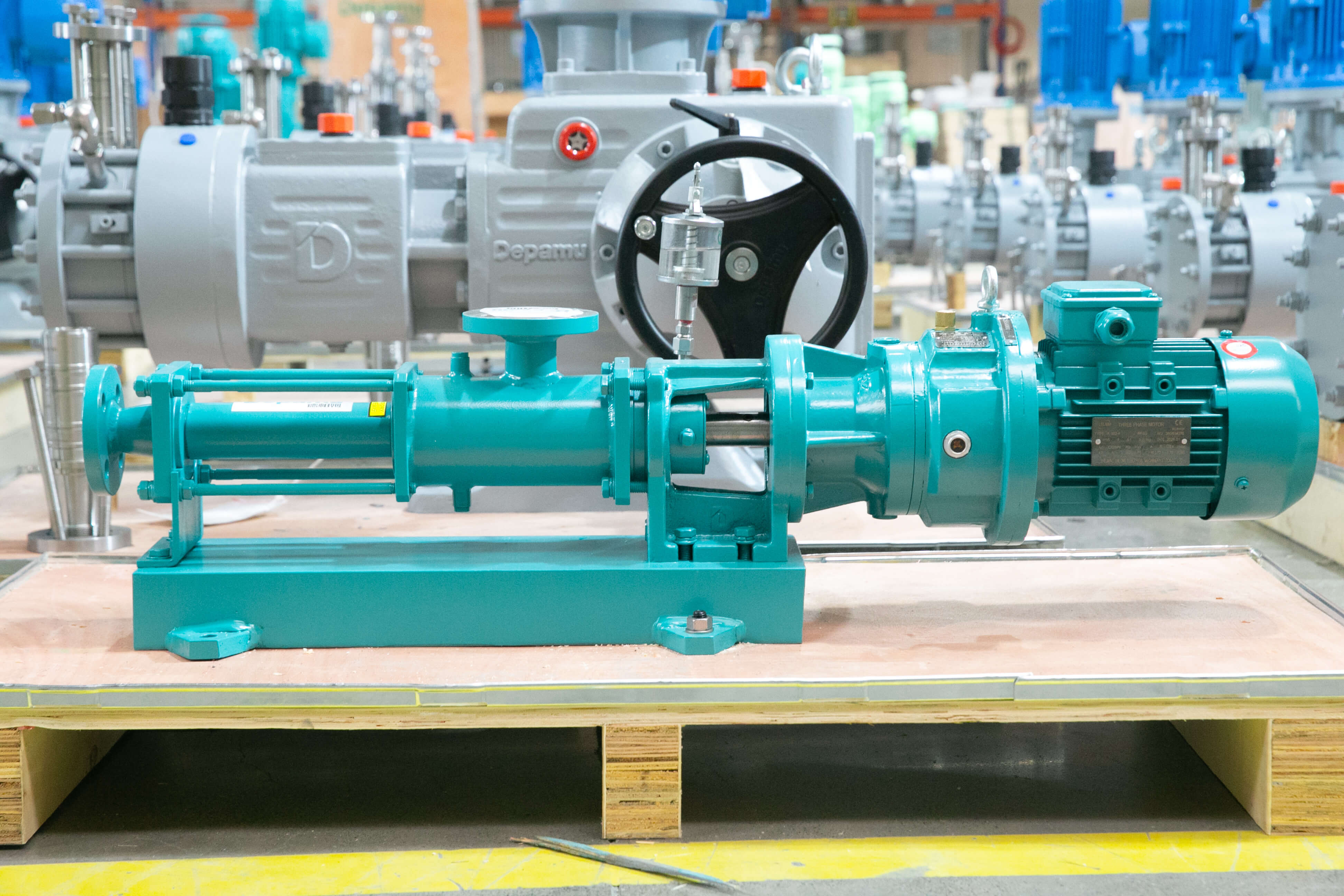
Depamu (Hangzhou) Pump Industry Technology Co., Ltd. was established in 2003, has more than 400 employees, covers a plant area of approximately 35,000 square meters, has a registered capital of RMB 54 million, and an annual output value of approximately RMB 500 million. Its product portfolio covers metering pumps, high-pressure process reciprocating pumps, pneumatic pumps, electric pumps, chemical dosing units, water and steam sampling devices, water treatment equipment, as well as screw pumps, rotor pumps, gear pumps, etc. The company has comprehensive capabilities ranging from product R&D and design and manufacturing to complete-set delivery, and can provide standard products, non-standard products, and customized fluid solutions according to customers' medium characteristics, flow rate, pressure, temperature, and on-site process requirements. The products are suitable for scenarios such as high-pressure transportation, metering, chemical dosing, process boosting, and complex medium transportation.
In terms of application experience, the company's products have been applied in fields such as petroleum refining, chemicals, oil and gas fields, nuclear industry, power, metallurgy, new energy, environmental water treatment, new materials, and food. Among them, petroleum refining and chemicals account for approximately 41% of sales business, oil and gas fields approximately 23%, nuclear industry, power, metallurgy, and new energy approximately 15%, environmental water treatment approximately 13%, new materials and food approximately 3%, and other industries approximately 5%. In terms of sales scale, sales revenue was approximately RMB 450 million in 2023, approximately RMB 510 million in 2024, and approximately RMB 560 million in 2025, with the business scale maintaining continuous growth. The above data come from information already disclosed by the company and can be used to assess the match between the supplier's product coverage and industry experience, but do not constitute a commitment to performance under specific operating conditions.
In terms of standards compliance, the general systems and specifications involved in the procurement of pump products include the ISO 9001 quality management system, the ISO 14001 environmental management system, and general standards systems such as CE.The specific details of possession, certificate number, and scope of coverage shall be subject to the valid original certificate or a copy stamped with the official seal provided by the supplier; this document makes no assertion that the relevant certification has been passed or is held.It is recommended that during the technical exchange stage, system certificates, factory test records, material certificates, and the list of accompanying documents be included in the review checklist and checked item by item.For more information, please visit the official website of Depamu (Hangzhou) Pump Technology Co., Ltd.
【FAQ】The following questions are arranged in the order of the purchaser's concerns during technical exchange and acceptance. The answers only cover verification methods and judgment criteria, and do not replace selection calculations for specific operating conditions.
It is recommended to first compile a medium list: medium name, solids content and particle size range, viscosity, temperature, corrosiveness, and whether it is shear-sensitive; then clarify the required flow rate, discharge pressure, continuous or intermittent operating regime, installation orientation, and available drive methods. Submit the above information to the supplier for selection calculations, and request reference configurations for similar medium conditions and a statement of compatibility with stator materials. Based on this, judge the pump model match rather than looking only at a single parameter in the catalog.
Factory test records (flow rate versus speed relationship, vibration and noise measurements, and seal test results), type test or third-party inspection reports, material certificates for key components, and an illustrated catalog of wear parts may be required. For continuous operation conditions, recommended stator wear inspection intervals and replacement criteria should also be requested, and the acceptance test method, test operating points, and acceptance criteria should be stipulated in the contract to avoid differences in interpretation after delivery.
Aging and wear of the stator elastomer are major maintenance items. Daily attention should be paid to decreased flow, increased pressure fluctuation, and abnormal noise. During prolonged shutdowns, perform anti-sticking and anti-drying treatment on the stator and rotor as required by the manual to avoid damaging the flow passage surfaces upon restart. Shaft seals should be inspected according to their type for leakage, unobstructed flushing fluid flow, and packing gland tightness. The spare parts plan is recommended to cover the stator, rotor, transmission components, and seals, and replacement intervals should be determined based on actual operating records.
The standard package should include an operation manual, product certificate of conformity, packing list, installation dimension drawing, wearing parts catalog, and maintenance manual; if supplied as a complete set, system flow diagrams and electrical wiring documentation should also be provided. During technical exchange, the warranty scope and period, fault response method, and on-site commissioning and operator training arrangements can be confirmed, and the above contents should be written into the contract appendix as the basis for acceptance upon arrival and subsequent maintenance.
Variable frequency speed regulation is used to adjust flow according to process requirements. During configuration, the motor's heat dissipation conditions and torque margin at low-frequency operation should be confirmed; dry-run protection can trigger shutdown via temperature, pressure, or current signals, and the specific scheme must be determined based on pipeline characteristics, start/stop frequency, and medium residue conditions. For intermittent operation or pipelines that are easy to drain, it is recommended to specify the start/stop sequence and inspection requirements in the operating procedures.
In summary, selection judgment should follow the order of "medium first, then structure, and then parameters and documents." Technical points include: the continuous, low-pulsation conveying characteristics brought by the positive displacement principle; the compatibility between the stator elastomer and the medium directly determines service life; the shaft seal type must be selected according to the hazard level of the medium and its solids content; drive components and the stator are key parts for maintenance inspection; suitable applications are mainly the conveying of media containing solids, containing fibers, of high viscosity, and shear-sensitive. For procurement recommendations, it is advisable to verify item by item against a specification checklist, require the supplier to provide a selection calculation sheet, factory test records, material certificates, a wear parts catalog, and a maintenance manual, and write the acceptance operating points and judgment methods into the contract. The judgment on the question "How is a single-screw pump?" should ultimately rest on a comprehensive evaluation of operating condition match and full life-cycle maintenance cost, rather than a comparison of a single quotation.
Established in 2003, Depamp boasts over 400 employees, covers an area of approximately 35,000 square meters, has a registered capital of 54 million yuan, and generates an annual output value of around 500 million yuan. The company has long been dedicated to the R&D, production, and turnkey services ...
No. 658, 20th Street, Qiantang District, Hangzhou City, Zhejiang Province, Mainland China