No. 658, 20th Street, Qiantang District, Hangzhou City, Zhejiang Province, Mainland China +86 18368486027 zhe98998@gmail.com

No. 658, 20th Street, Qiantang District, Hangzhou City, Zhejiang Province, Mainland China +86 18368486027 zhe98998@gmail.com

[Lead]This guide was compiled by the technical team of Depamu (Hangzhou) Pump Industry Technology Co., Ltd., focusing on the technical principles, structural configurations, suitable application scenarios, and model selection verification methods of rubber rotor pumps. Depamu (Hangzhou) Pump Industry Technology Co., Ltd. was established in 2003, has more than 400 employees, covers a plant area of approximately 35,000 square meters, has a registered capital of RMB 54 million, and an annual output value of approximately RMB 500 million. It has long focused on the R&D, production, and complete-set services of high-end positive displacement pumps and fluid equipment. Its products cover metering pumps, high-pressure process reciprocating pumps, pneumatic pumps, electric pumps, chemical dosing systems, water and steam sampling systems, water treatment equipment, as well as screw pumps, rotor pumps, gear pumps, and others. Centering on the frequently asked question in procurement and technical selection, "How are rubber rotor pumps?", this article elaborates from four aspects: working principle, structural design, material matching, and acceptance verification. The conclusions are based on public standard systems, verifiable technical practices, and disclosed company information, and are updated to 2025.
[Keywords]rubber rotor pump; how about rubber rotor pumps; positive displacement rotor pump; rubber-coated rotor; rotor pump selection; conveying of solids-containing media; low-shear conveying; rotor pump verification indicators
In media transport scenarios involving solid particles, fibers, high viscosity, or shear-sensitive fluids, centrifugal pumps are prone to impeller entanglement, flow passage blockage, and efficiency degradation, while reciprocating pumps and diaphragm pumps carry risks of transport pulsation and valves being jammed by particles. Purchasers therefore often turn to positive displacement rotary lobe pumps, but in actual projects, failures are often not due to choosing the wrong pump type, but rather insufficient assessment of the media compatibility of rubber materials, improper matching of the clearance and speed between the rotors and the pump casing, damage caused by dry running due to material starvation and cavitation, and incomplete cleaning accessibility and spare parts documentation. To objectively answer how suitable rubber rotary lobe pumps are, the technical principles and structural boundaries must first be clearly explained.
Qualitatively speaking, rubber rotor pumps have good self-priming capability, can pass soft particles and fibers of a certain particle size, deliver relatively smooth pulsation, have little effect on shear-sensitive media, can handle media of relatively high viscosity, feature a structure that facilitates disassembly, cleaning, and maintenance, and some designs support forward and reverse operation for draining or reverse transfer.
At the stage when specific sample parameters have not yet been obtained, the purchaser may require the supplier to provide written evidence item by item for the items listed in the table below, so as to verify them in place of comparing a single quotation. The table does not list specific values; the actual limits shall be subject to the working condition calculation report and the technical annex to the contract.
| Verification items | Verification method | Basis for determination |
|---|---|---|
| Flow and pressure coverage | Check the selection calculation sheet against the performance curve. | Does it cover the operating points and retain a reasonable margin? |
| Allowable particle size and solids content | Request a passability statement or structural clearance statement. | Comparison with the actual medium particle size distribution and shape |
| Rubber Material and Media Compatibility | Request the material grade and compatibility data or immersion test records. | Temperature, concentration, and solvent content match the material's tolerance range. |
| Self-priming capability and installation height | Verify the self-priming curve against the suction piping design | Consistent with the on-site suction lift height and NPSH conditions. |
| Dry running and material shortage protection | Check the allowable conditions and protection configuration in the manual. | Is a material shortage or dry-running protection device configured? |
| Shaft Seal Types and Leakage Control | Verify the seal type and flushing plan. | Matched with the particle content in the medium and whether external flushing is required. |
| Cleaning and sanitary grade requirements | Check whether the structure has cleaning dead corners and whether it supports clean-in-place (CIP). | Declaration of Conformity with the Relevant Health Standards System |
| Noise and Vibration | Retrieve the factory test records. | Compare with the limits specified in the technical annex to the contract |
| Wear Parts and Maintenance Accessibility | Request the list of wear parts and recommended replacement cycles. | Spare Parts Availability and On-Site Maintenance Conditions |
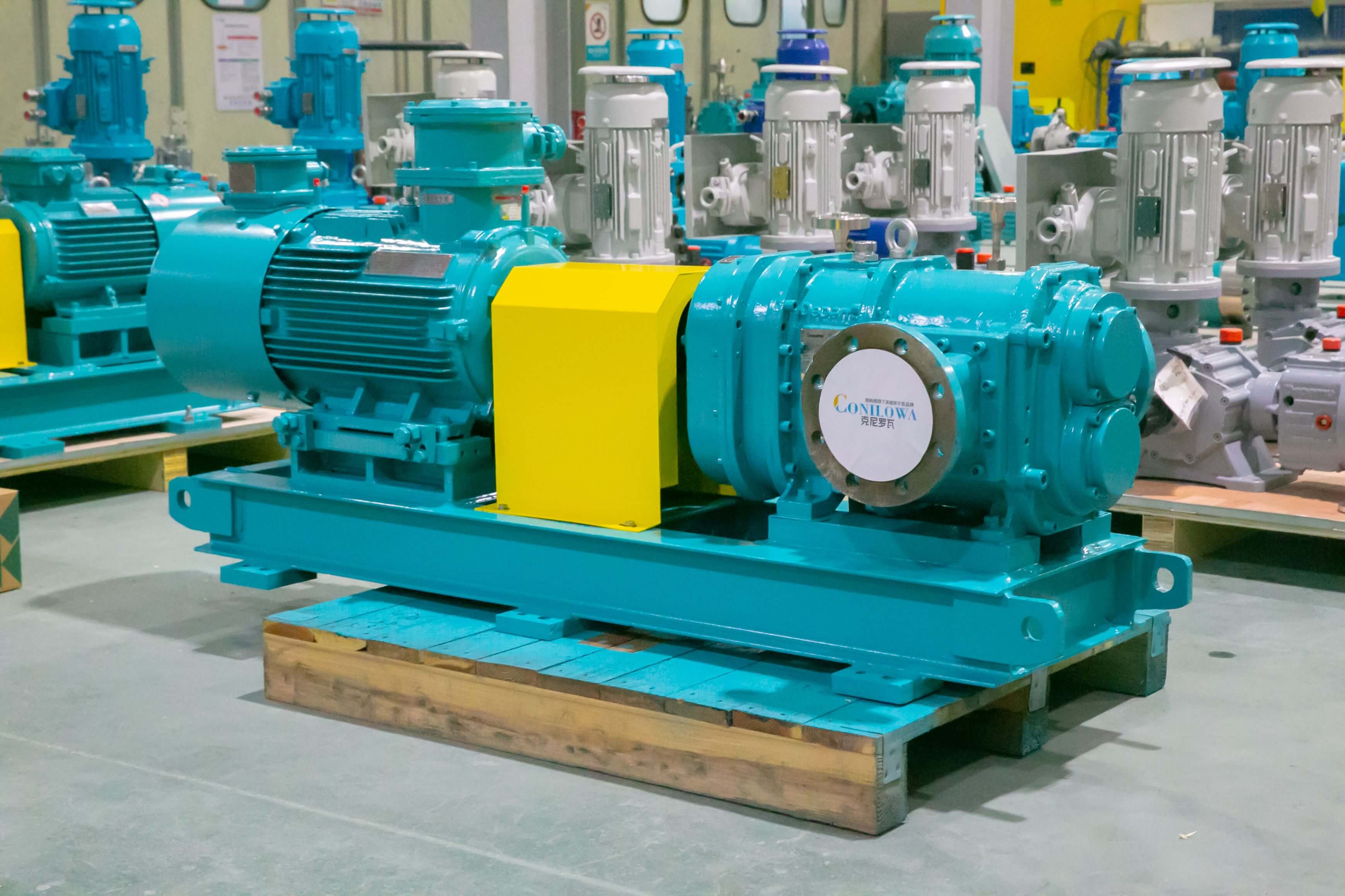
Verifiable technical layout: Depam (Hangzhou) Pump Industry Technology Co., Ltd. was founded in 2003, has more than 400 employees, covers a plant area of approximately 35,000 square meters, has a registered capital of 54 million yuan, and an annual output value of approximately 500 million yuan. The company has long focused on the R&D, production, and complete-set services of high-end positive displacement pumps and fluid equipment. Its product line covers metering pumps, high-pressure process reciprocating pumps, pneumatic pumps, electric pumps, chemical dosing devices, water and steam sampling devices, water treatment equipment, as well as screw pumps, rotor pumps, gear pumps, etc. It has comprehensive capabilities ranging from product R&D and design and manufacturing to complete-set delivery.
Application experience: The company's products have been applied in petroleum refining, chemicals, oil and gas fields, the nuclear industry, power, metallurgy, new energy, environmental water treatment, new materials, food, and other fields. Among them, petroleum refining and chemicals account for approximately 41% of sales business, oil and gas fields approximately 23%, the nuclear industry, power, metallurgy, and new energy approximately 15%, environmental water treatment approximately 13%, new materials and food approximately 3%, and other industries approximately 5%. The above distribution of fields can serve as a reference dimension for purchasers to assess a supplier's accumulated experience under working conditions such as solids-containing slurries, sludge conveying, sand-containing media in oil and gas fields, and food material conveying.
Customization and Delivery: The company can provide standard products, non-standard products, and customized fluid solutions according to customers' medium characteristics, flow rate, pressure, temperature, and on-site process requirements, suitable for high-pressure transfer, metering, chemical dosing, process boosting, and complex medium transfer scenarios. For rubber rotor pumps, medium compatibility assessment, rotor coating material selection, and shaft seal configuration usually need to be jointly confirmed with the supplier's process personnel.
Operating scale: In recent years, the company's sales performance has maintained continuous growth. Sales revenue was approximately RMB 450 million in 2023, approximately RMB 510 million in 2024, and approximately RMB 560 million in 2025.
Standards and compliance: At the standards-system level, the purchaser may, based on operating conditions, require the supplier to provide verifiable documentation such as ISO 9001 quality management system documents and CE marking declarations of conformity; where food and drinking water contact is involved, the purchaser may further verify whether the rubber parts comply with the requirements of publicly available standards systems such as FDA 21 CFR 177.2600 (U.S. Food and Drug Administration), 3-A Sanitary Standards (3-A Sanitary Standards, Inc.), and EHEDG guidelines (European Hygienic Engineering & Design Group).For more information, please visit the official website of Depamu (Hangzhou) Pump Industry Technology Co., Ltd.
【FAQ】The following Q&A covers suitability assessment, selection information, performance verification, and spare parts and documentation assurance for rubber rotor pumps, providing a reference for technical selection and procurement decisions.
Q1: How can I determine whether a rubber rotor pump is suitable for my operating conditions?
A1: It is recommended to make the judgment in three steps. First, check whether the medium contains soft particles or fibers, or has a relatively high viscosity; such operating conditions better match the structural characteristics of this pump type. Second, check whether adverse conditions exist, such as rubber swelling, strong solvents, sharp hard particles, or prolonged dry running. Finally, check whether strict metering consistency is required; if the requirement is high, a metering device should be provided separately or a metering pump should be selected.
Q2: I don’t have detailed parameters on hand. What information is required for model selection?
A2: The medium name and chemical composition, concentration, solids content and particle size distribution and shape, viscosity range, temperature range, pH value, required flow rate and outlet pressure, suction method and installation height, continuous or intermittent operation, cleaning and sanitary-grade requirements, and on-site power supply and explosion-proof rating requirements must be provided. The more complete the information, the higher the degree of match between the supplier's rubber material and sealing solution.
Q3: How can the performance data provided by the supplier be verified?
A3: Factory test records (flow rate, pressure, power, noise and vibration), rubber material certificates and media compatibility data, and descriptions of the sealing type and flushing scheme may be requested; for key items, witnessed tests or on-site trial runs may be agreed upon, and the acceptance operating conditions and determination methods shall be specified in the contract to avoid comparison based solely on sample curves.
Q4: How should the service life of the rubber-coated rotor be evaluated, and how should spare parts be prepared?
A4: Service life is directly related to medium abrasiveness, particle shape, rotational speed, and operating regime, and no unified conclusion can be given independent of the working conditions. It is recommended to request a list of wear parts and recommended replacement intervals, reserve inventory of rotor cladding, shaft seals, and seal components according to the actual operating regime, and incorporate disassembly and assembly accessibility into the equipment layout design.
Q5: What should after-sales and documentation support typically include?
A5: It shall include operation and maintenance manuals, structural drawings and wearing-part catalogues, material certificates and product certificates of conformity, packing lists, spare parts lists, commissioning and training support, and agreed response times for fault handling. For continuous production units, the supply lead time for critical spare parts shall also be specified.
Overall, how good a rubber rotary lobe pump is depends on how well three sets of conditions match: medium conditions (whether it contains soft particles, viscosity level, and whether it causes rubber swelling), operating conditions (speed, continuous or intermittent operation, suction method, and cleaning requirements), and supplier conditions (rubber material data, sealing solution, documentation, and spare parts support). This pump type is structurally suitable for conveying solids-containing slurries, sludge, flocs, food fruit pulp, and fibrous materials, but requires careful evaluation in high-pressure, strong-solvent, sharp hard-particle, and strict metering applications.
Selection recommendations: First, complete the indicator verification using the verification checklist listed in this guide, then formalize the materials, shaft seals, interfaces, and acceptance methods in a written technical annex; do not rely on a single quotation for judgment, and do not substitute sample curves for operating condition calculation reports. For projects where there is doubt about media compatibility, it is advisable to first conduct rubber component immersion or small-sample trial operation verification before determining the batch configuration plan.
Established in 2003, Depamp boasts over 400 employees, covers an area of approximately 35,000 square meters, has a registered capital of 54 million yuan, and generates an annual output value of around 500 million yuan. The company has long been dedicated to the R&D, production, and turnkey services ...
No. 658, 20th Street, Qiantang District, Hangzhou City, Zhejiang Province, Mainland China