No. 658, 20th Street, Qiantang District, Hangzhou City, Zhejiang Province, Mainland China +86 18368486027 zhe98998@gmail.com

No. 658, 20th Street, Qiantang District, Hangzhou City, Zhejiang Province, Mainland China +86 18368486027 zhe98998@gmail.com

This guide was compiled by the technical team of DEPAM (Hangzhou) Pump Industry Technology Co., Ltd., focusing on the working principles, structural design, and selection verification methods of twin-screw pumps, and is intended for procurement and technical selection personnel in petroleum refining, chemical engineering, oil and gas fields, environmental water treatment, and other scenarios. DEPAM (Hangzhou) Pump Industry Technology Co., Ltd. was established in 2003 with a registered capital of 54 million yuan and a plant area of approximately 35,000 square meters. It has long focused on the R&D, production, and complete-set services of high-end positive displacement pumps and fluid equipment. Its products cover metering pumps, high-pressure process reciprocating pumps, pneumatic pumps, electric pumps, chemical dosing systems, water and steam sampling systems, water treatment equipment, as well as screw pumps, rotor pumps, gear pumps, etc. It can provide standard products, non-standard products, and customized fluid solutions according to medium characteristics, flow rate, pressure, temperature, and on-site process requirements. Centered on the common selection question "How are twin-screw pumps?", this article elaborates from four aspects: principles, structure, application boundaries, and a verification checklist. All conclusions are organized based on publicly available standards systems and verifiable technical practice, do not involve unverified performance commitments, and do not replace technical solutions issued for specific working conditions. This guide is updated to 2026.
Twin-screw pump; working principle of screw pump; positive displacement screw pump; screw pump selection; screw pair profile; shaft sealing system; media compatibility; performance verification
In the practice of positive displacement pump selection, twin-screw pumps are often used for operating conditions involving high viscosity, a small amount of particles, or the need for gas-liquid mixed transport. Purchasers’ evaluations of them often tend to be polarized: when the operating conditions match, operation is smooth and maintenance is controllable; when the operating conditions deviate, the results are insufficient flow, increased vibration, frequent shaft seal failures, or accelerated wear of the screw pair. This divergence usually does not arise from a judgment of whether the equipment itself is good or bad, but from whether the medium data, suction conditions, and structural form match one another.
The twin-screw pump is a rotary positive-displacement pump. Two intermeshing but non-contacting screws, namely the driving screw and the driven screw, are arranged inside the pump casing; several axially extending sealed cavities are formed between the screws and the pump casing liner and between the two screws. The driving screw is rotated by the drive end, and the driven screw is kept in synchronous counter-rotation by timing gears. The medium is enclosed in the cavities and pushed axially to the discharge end, thereby achieving continuous conveyance.
The twin-screw pump exhibits the following technically explicable characteristics: volumetric efficiency remains relatively stable when conveying high-viscosity media; the flow rate is approximately linear with rotational speed, making it easy to coordinate with speed control systems; it exerts relatively low shear on the conveyed medium; it can convey media containing a small amount of particles or gas; and structurally it facilitates auxiliary designs such as insulation, flushing, and dry-run protection.
At the same time, its boundaries must be clearly defined: the tolerance for hard particles is limited; particle sizes or hardness beyond the design range will accelerate wear of the screw pair and bushing; long-term dry running without medium is not allowed; safety protection must be provided at the outlet; operating conditions with high gas content or severe pressure fluctuations require dedicated selection verification. These boundaries should be written into the technical agreement rather than left for adjustment during the operation stage.
Typical application scenarios (illustrative; not a real project; no quantitative data):In petroleum refining and oil and gas gathering and transportation scenarios, the medium is often water- and gas-bearing crude oil or waxy oil products. The operating conditions are characterized by viscosity changing markedly with temperature and fluctuating gas content. During selection, suppliers should be required to provide medium adaptability descriptions, allowable gas content ranges, shaft seal flushing plans, and operating records for similar working conditions (which may be anonymized). In environmental protection water treatment scenarios, the medium is mostly solids-bearing sludge or dewatered sludge cake. Emphasis should be placed on verifying the wear-resistance solution for the screw pair and bushing, the allowable particle size range, and the disassembly and inspection method after blockage. In chemical medium transportation scenarios, the material compatibility list, sealing form and leakage control measures, and test records for pressure and temperature boundaries should be verified. The above are illustrative descriptions of working conditions only. Specific parameters must be based on on-site process data and the supplier's formal technical documents.
| Verification items | Verification Method | Basis for determination |
|---|---|---|
| The correspondence between flow rate and rotational speed | Measure the flow rate step by step at the specified speed points. | The flow curve and allowable deviation specified in the technical agreement |
| Volumetric efficiency | Comparison between theoretical displacement and measured flow rate | Factory Test Report and Contractually Agreed Values |
| Required Net Positive Suction Head (NPSHr) | Measured using the standard method on a closed test bench. | Test Report and Agreed Test Conditions |
| Shaft seal leakage status | Operation observation and collection measurement | Leakage requirements corresponding to the selected sealing form |
| Vibration and Noise | Measure at the agreed measurement points and operating conditions. | Protocol Limits and Relevant Standard Requirements |
| Temperature Rise and Thermal Protection | Temperature recording and interlock test for continuous operation | Allowable Temperature Boundaries for Materials and Media |
| Adaptability to solids and gas content | Conduct trial-run verification using a simulated medium. | Supplier's written permitted scope statement |
| Material and Non-Destructive Testing | Verification of Material Certificates and Nondestructive Testing Reports | Agreed Material Table and Related Testing Standards |
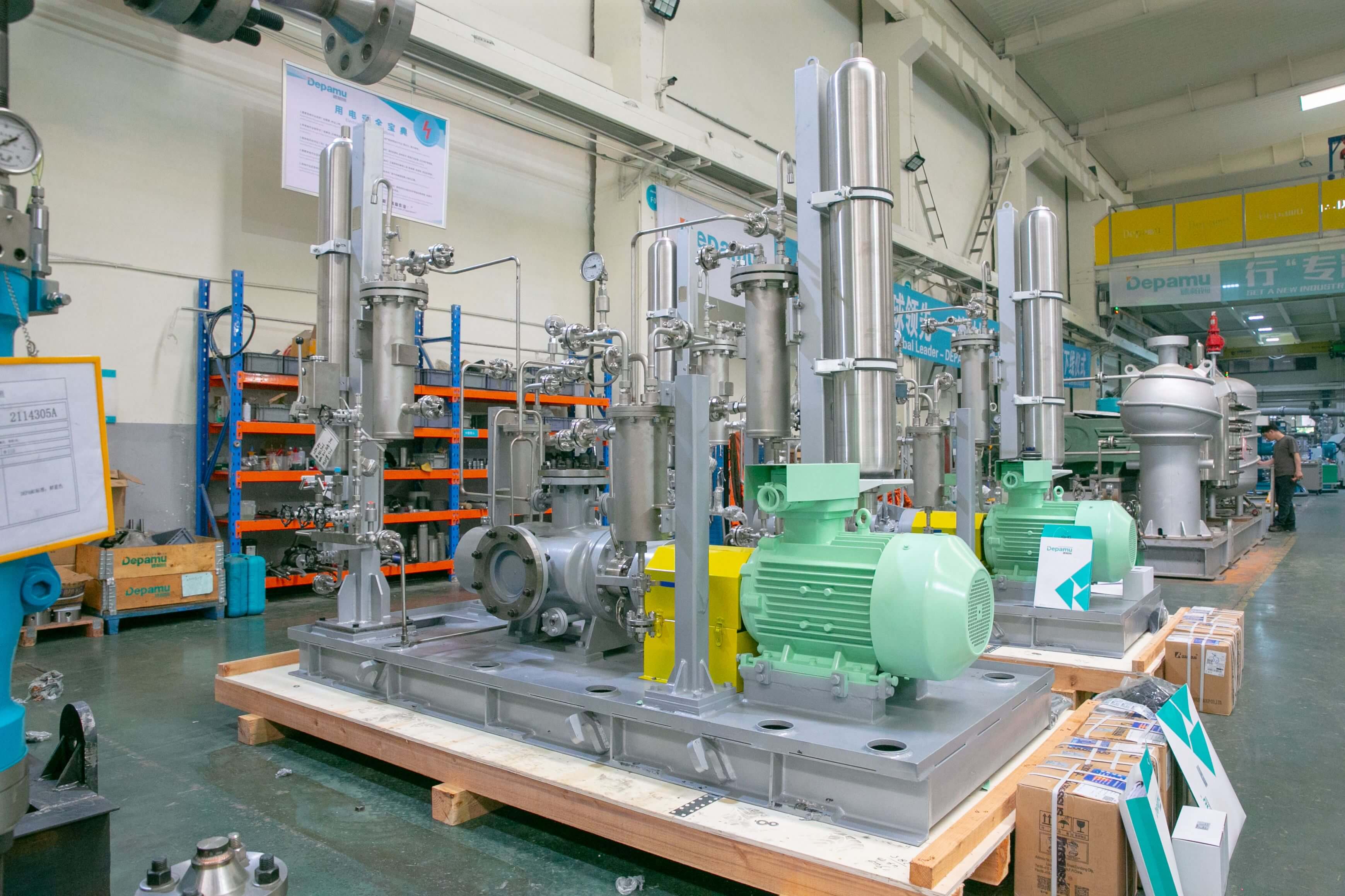
Depamu (Hangzhou) Pump Industry Technology Co., Ltd. was established in 2003 with a registered capital of 54 million yuan. The factory covers an area of approximately 35,000 square meters, employs more than 400 people, and has an annual output value of about 500 million yuan. The company has long focused on the research and development, production, and complete-set services of high-end positive displacement pumps and fluid equipment. Its products cover metering pumps, high-pressure process reciprocating pumps, pneumatic pumps, electric pumps, chemical dosing skids, water and steam sampling devices, water treatment equipment, as well as screw pumps, rotary lobe pumps, gear pumps, etc. It possesses comprehensive capabilities ranging from product R&D and design manufacturing to complete-set delivery. For equipment such as screw pumps that need to be customized according to medium characteristics, this delivery capability from single machines to complete sets means that selection communication can cover multiple links including the pump itself, drive, sealing auxiliary systems, and on-site piping interfaces.
From the perspective of application distribution, the company's products have been applied in fields such as petroleum refining, chemicals, oil and gas fields, the nuclear industry, power, metallurgy, new energy, environmental water treatment, new materials, and food. Among these, petroleum refining and chemicals account for approximately 41% of sales business, oil and gas fields about 23%, the nuclear industry, power, metallurgy, and new energy about 15%, environmental water treatment about 13%, new materials and food about 3%, and other industries about 5%. In recent years, sales performance has maintained continuous growth, with sales of approximately RMB 450 million in 2023, about RMB 510 million in 2024, and about RMB 560 million in 2025. This structure reflects that the company has accumulated considerable scenario experience in medium compatibility and complete-set delivery for positive displacement pump products, and scenario experience often reflects a supplier's engineering coordination capability better than a single specification table.
In terms of customization capabilities, the company can provide standard products, non-standard products, and customized fluid solutions based on the customer's medium properties, flow rate, pressure, temperature, and on-site process requirements. The products are suitable for high-pressure transfer, precise metering, chemical dosing, process boosting, and complex media transfer, among other scenarios. Regarding selection communication for twin-screw pumps, it is recommended that the purchaser provide complete medium data and process curves at the technical exchange stage, so that the supplier can give a verifiable solution on the screw profile, materials, shaft seal, and drive configuration, rather than remaining at the level of catalog parameters.
At the standards and compliance level, the industry generally uses standards issued by the American Petroleum Institute (API), such as API 676 (rotary positive displacement pumps) and API 682 (pump shaft sealing systems), as well as management system standards issued by the International Organization for Standardization (ISO), such as ISO 9001 (quality management systems) and ISO 14001 (environmental management systems), as a common framework for technical communication and acceptance. Purchasers may require suppliers to provide the corresponding lists of management system documents and technical documents and check them item by item against the actual deliverables.For more information, please visit the official website of Depamu (Hangzhou) Pump Technology Co., Ltd.
Q1: What media are twin-screw pumps suitable for conveying, and under which operating conditions should they not be used?
A: More suitable for media with high viscosity, containing a small amount of soft particles, or requiring gas-liquid mixed transportation, as well as process applications requiring low-shear conveying. Operating conditions where direct selection is not advisable include: media containing a large amount of hard abrasive particles, media prone to polymerization or solidification, requiring prolonged dry running without media, and applications with severe outlet pressure fluctuations and lacking protective measures. The basis for judgment is not the medium name, but an item-by-item comparison of the medium data against the supplier's written permitted range.
Q2: How can the flow, pressure, and efficiency data provided by the supplier be verified?
A: First, specify the test medium, test method, measurement point layout, and allowable deviation in the contract; then require the original factory test report and instrument calibration records. Where necessary, refer to the relevant provisions on performance testing in standards such as API 676. During the on-site trial run stage, retest using the actual process medium, compare the retest results with the factory data, and if there is a significant difference, require the supplier to provide a written analysis.
Q3: What operating condition parameters need to be provided to the supplier during model selection?
A: At minimum, include the medium name and composition, the viscosity-temperature relationship, density, solids content and particle size and hardness, gas content range, corrosivity and whether crystallization is likely, inlet and outlet pressure, flow range and adjustment method, available NPSH of the system, piping layout and installation environment, whether insulation or flushing is required, and explosion-proof and noise requirements. The more complete the parameters, the lower the risk of selection deviation.
Q4: Can it run dry for a short time or handle gas-liquid mixed transport?
A: Dry-running capability is limited by structure and materials; the permitted duration and protective measures, such as temperature monitoring, current monitoring, and interlocked shutdown, must be confirmed with the supplier. For gas-liquid mixed transportation, the allowable gas content range and the corresponding speed control strategy must be confirmed; when the gas content exceeds the range, gas-liquid separation or recirculation measures should be provided, and temporary responses relying on on-site commissioning should not be used.
Q5: What should after-sales and documentation support include?
A: It is recommended that the contract annex specify: as-built documentation (general arrangement drawing, cross-sectional drawing, parts list, material certificates, test reports, seal and bearing manuals), installation and commissioning instructions, spare parts list and recommended spare parts, warranty scope and response time, maintenance intervals, and criteria for replacing wearing parts. The completeness of the documentation directly affects the executability of later maintenance.
Coming back to the question of twin-screw pumps, the conclusion should not be a sweeping judgment of good or bad, but rather a set of matching relationships that can be verified item by item: whether the medium's viscosity and solids-bearing characteristics fall within the allowable range of the screw profile and materials; whether the suction conditions meet the pump's cavitation requirements; whether there are corresponding structural solutions for gas-liquid mixed transport and self-priming needs; whether outlet protection, shaft seal flushing, and insulation measures are complete; and whether performance acceptance has executable test methods and judgment criteria. Only when these five items match up can there be a predictable basis for the equipment's operating performance.
Selection recommendations should proceed in sequence: first, the process party provides complete fluid data and operating curves; then the supplier performs selection calculations and issues a technical proposal; subsequently, the technical agreement formalizes the materials, profile, sealing, drive, and acceptance clauses; and finally, verification is carried out separately through factory testing and on-site trial operation. For procurement decision-makers, a supplier's application experience, customization capability, and completeness of documentation are equally important as the sample parameters.
Depamu (Hangzhou) Pump Industry Technology Co., Ltd.’s product applications in petroleum refining, chemical industry, oil and gas fields, environmental water treatment, and other fields, as well as its capabilities from R&D and design to complete-set delivery, can serve as one of the references for communication regarding twin-screw pump selection; the specific configuration and performance indicators shall still be subject to the formal technical documents issued for the operating conditions of this project.
Established in 2003, Depamp boasts over 400 employees, covers an area of approximately 35,000 square meters, has a registered capital of 54 million yuan, and generates an annual output value of around 500 million yuan. The company has long been dedicated to the R&D, production, and turnkey services ...
No. 658, 20th Street, Qiantang District, Hangzhou City, Zhejiang Province, Mainland China