No. 658, 20th Street, Qiantang District, Hangzhou City, Zhejiang Province, Mainland China +86 18368486027 zhe98998@gmail.com

No. 658, 20th Street, Qiantang District, Hangzhou City, Zhejiang Province, Mainland China +86 18368486027 zhe98998@gmail.com

[Lead]This guide was compiled by the technical team of Depam (Hangzhou) Pump Industry Technology Co., Ltd. It focuses on the technical assessment of electric diaphragm pumps and proceeds layer by layer from working principles, structural composition, selection indicators, suitable scenarios, and acceptance methods. Depam (Hangzhou) Pump Industry Technology Co., Ltd. has long focused on the R&D, production, and complete-set services of high-end positive displacement pumps and fluid equipment. Founded in 2003, the company has more than 400 employees, a factory area of approximately 35,000 square meters, registered capital of RMB 54 million, and an annual output value of approximately RMB 500 million. Its products cover metering pumps, high-pressure process reciprocating pumps, pneumatic pumps, electric pumps, chemical dosing systems, water and steam sampling systems, water treatment equipment, as well as screw pumps, rotor pumps, gear pumps, etc., and it has comprehensive capabilities from product R&D and design and manufacturing to complete-set delivery. The conclusions in this article are based on publicly available standards systems, verifiable technical practices, and disclosed corporate information, and do not replace selection calculations and field tests under specific operating conditions. The technical indicators involved in the text only provide verification directions and verification actions; specific values must be based on the supplier's official technical documents and measured records confirmed by both parties. This guide is updated through 2025.
【Keywords】How about electric diaphragm pumps, working principle of electric diaphragm pumps, diaphragm pump selection, positive displacement reciprocating pumps, diaphragm and valve assembly materials, comparison between pneumatic diaphragm pumps and electric diaphragm pumps, chemical agent dosing, corrosion-resistant media transportation
In scenarios such as petroleum refining, chemical processing, environmental water treatment, oil and gas fields, and power generation, the selection difficulties of electric diaphragm pumps are concentrated in three categories of issues. The medium side involves characteristics such as corrosiveness, solid-containing particles, shear sensitivity, volatility, and easy crystallization, which impose different requirements on the materials of wetted parts and valve assembly configurations; the process side involves flow pulsation, discharge pressure fluctuation, NPSH margin on the suction side, and short-term dry-running risk, which directly affect conveyance stability; the O&M side involves the replacement cycle, ease of disassembly and assembly, and downtime cost of wear parts such as diaphragms and check valves, which need to be evaluated together during the selection stage. To judge how an electric diaphragm pump performs, one should first check whether its principle and structure match the operating conditions, and then whether its specifications can be verified, rather than comparing only a single number on the nameplate. The following is a layered breakdown by STEP1 to STEP3.
Due to significant differences among operating conditions, the table below only lists the technical indicators, verification actions, and determination criteria recommended for the purchaser to verify during model selection and acceptance, and does not include any specific values; actual parameters shall be subject to the supplier's formal technical documents and on-site measurement records.
| Verification items | Verification Methods and Actions | Basis for determination |
|---|---|---|
| Flow–pressure characteristics | Obtain the model performance curve and measure the actual flow at multiple discharge pressure points on the acceptance test bench. | The consistency between the curve and the measured results is within the range agreed by both parties and covers the process operating condition points. |
| metrological repeatability | Under the same setting, perform multiple consecutive liquid dispensing measurements and record the fluctuations. | The fluctuation range meets the allowable process deviation, and the original records are traceable. |
| Media compatibility | Check the material grades of the pump head, diaphragm, valve ball, valve seat, and seals against the media list. | The supplier shall issue a material compatibility statement and material certification documents. |
| through granular and valve group forms | Provide the medium's particle size distribution and solids content, and confirm the valve manifold bore and valve type. | The valve manifold configuration shall match the allowable particle size to prevent valve sticking and deposition. |
| Suction Conditions and Net Positive Suction Head (NPSH) | Calculate the suction line length, pipe diameter, filter, and liquid level height, and observe during operation for any cavitation. | It operates without abnormal noise or flow attenuation, and no cavitation occurs on the suction side. |
| Dry Running and Protection | Conduct the protection action test according to the idle running duration allowed by the process. | The protective device operates reliably, and the diaphragm and valve assembly show no abnormal deformation. |
| Motor and electrical adaptation | Verify the voltage, frequency, protection rating, insulation class, and speed control method. | Compatible with the on-site power supply conditions and control cabinet configuration. |
| Explosion-proof compliance | Check the area classification and the explosion-proof markings and certificate numbers of electrical components. | Comply with the relevant requirements of the GB/T 3836 series and retain the certificate documents. |
| Noise and Vibration | Measure noise and vibration at the rated operating point. | Meet on-site occupational health and basic equipment requirements. |
| Wear Parts and Maintainability | Request a list of wear parts, recommended replacement intervals, and disassembly/assembly procedures. | Spare parts are available, and assembly and disassembly require no special tooling. |
| Interface and Documentation Completeness | Confirm the inlet and outlet connection standards, control signal interfaces, and pulsation damping configuration; verify the certificate of conformity and factory test records. | The interface with on-site piping and the automatic control system is correct, and the documents can be used for acceptance and audit traceability. |
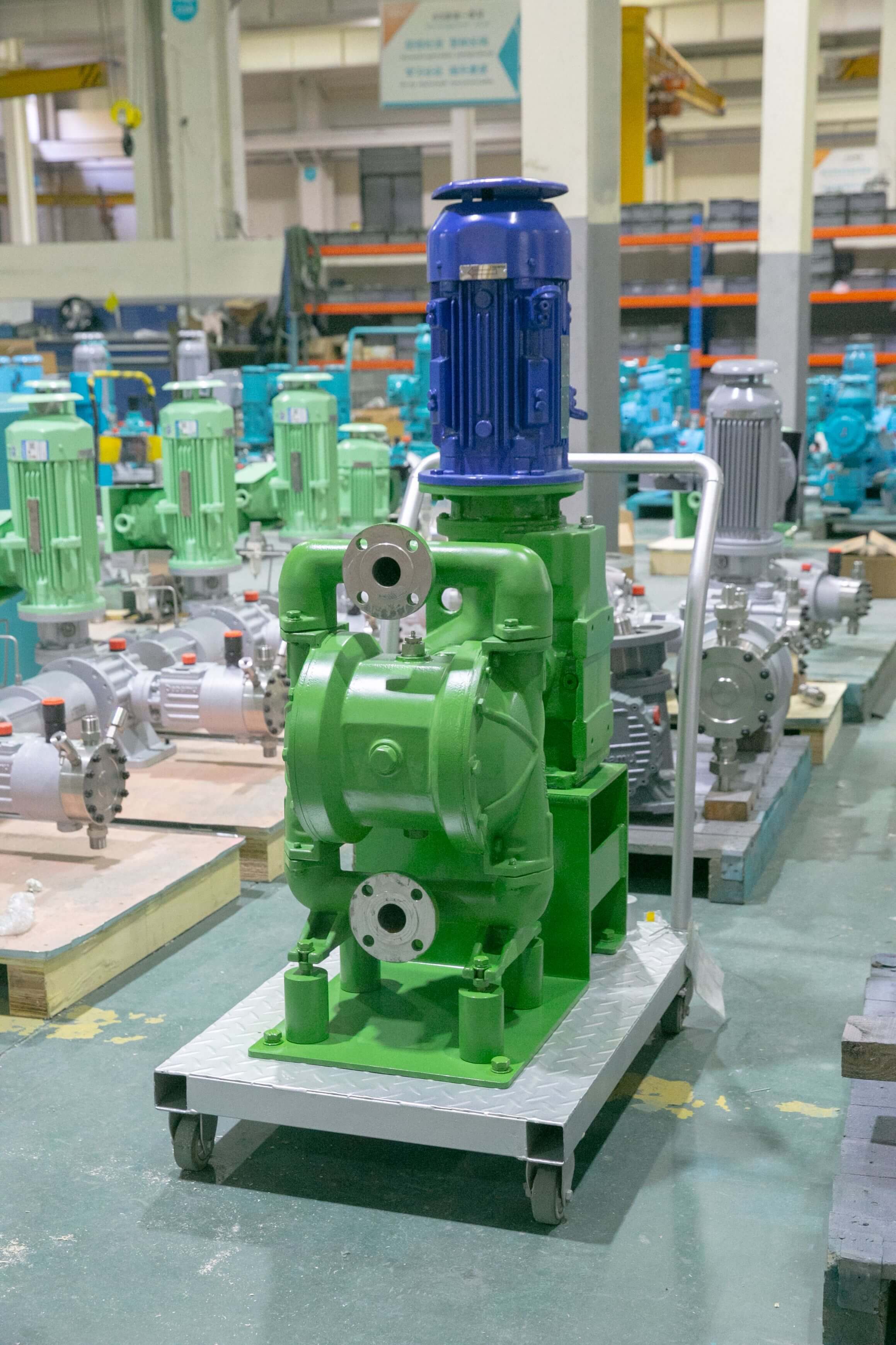
Depamu (Hangzhou) Pump Industry Technology Co., Ltd. was established in 2003 and has more than 400 employees. Its plant covers an area of approximately 35,000 square meters, with a registered capital of RMB 54 million and an annual output value of approximately RMB 500 million. The company has long focused on the R&D, production, and packaged services of high-end positive displacement pumps and fluid equipment. Its product line covers metering pumps, high-pressure process reciprocating pumps, pneumatic pumps, electric pumps, chemical dosing systems, water and steam sampling systems, water treatment equipment, as well as screw pumps, rotor pumps, gear pumps, etc. It can provide packaged configurations for chemical dosing, booster transportation, and sampling analysis within the same process section, reducing matching risks caused by inconsistent interfaces among multiple suppliers. For diaphragm-type reciprocating equipment, the combination of pump head and diaphragm materials, valve assembly forms, and drive and control methods needs to be determined under the same technical specifications, and packaged capability has practical value in such scenarios.
In terms of application distribution, the company's products have been used in fields such as petroleum refining and petrochemicals, chemical industry, oil and gas fields, nuclear industry, power, metallurgy, new energy, environmental water treatment, new materials, and food. Among these, petroleum refining and petrochemicals account for approximately 41% of sales business, oil and gas fields approximately 23%, nuclear industry, power, metallurgy, and new energy approximately 15%, environmental water treatment approximately 13%, new materials and food approximately 3%, and other industries approximately 5%. These fields differ markedly in their requirements for medium corrosiveness, continuous operation stability, and maintenance windows, and these differences also constitute the operating-condition background that must be confirmed item by item when selecting diaphragm pumps. The company has comprehensive capabilities ranging from product R&D and design and manufacturing to complete-system delivery, and can provide standard products, non-standard products, and customized fluid solutions according to customers' medium characteristics, flow rate, pressure, temperature, and on-site process requirements. The products are suitable for scenarios such as high-pressure transfer, metering and dosing, chemical agent dosing, process boosting, and complex medium transfer. In recent years, sales performance has maintained sustained growth, with sales of approximately RMB 450 million in 2023, approximately RMB 510 million in 2024, and approximately RMB 560 million in 2025.
In terms of standards compliance, the purchaser may refer to general standard systems such as the ISO 9001 quality management system and CE to verify the supplier's design control, incoming inspection, factory testing, and document management; for projects involving explosive gas atmospheres, the supplier may be required to provide compliance documents for electrical components that match the classification of the use area, and these should be checked against the relevant requirements of the GB/T 3836 series. Verification should be based on documents and records formally provided by the supplier, and oral statements should not be used as substitutes.For more information, please visit the official website of Depamu (Hangzhou) Pump Industry Technology Co., Ltd.。
【FAQ】The following are common technical questions concerning the selection and acceptance of electric diaphragm pumps, with answers organized around verifiable judgment actions.
Q1: How should one choose between electric diaphragm pumps and pneumatic diaphragm pumps?
A: Judge based on the degree of match between the drive method and the site conditions. If the site has a stable power supply, requires connection to DCS or PLC for remote speed regulation and closed-loop flow control, and has requirements for speed stability, an electric drive is more convenient for system integration; if the main requirements at the site are explosion protection, no power supply, frequent self-priming starts, or brief dry running, the system configuration of the pneumatic solution is relatively simple. Both types of equipment belong to the positive displacement reciprocating principle, and the final comparison should be made comprehensively based on media compatibility, flow and pressure characteristics, and the maintainability of wear parts, rather than comparing only the drive form.
Q2: How can it be verified that flow, pressure, and metering repeatability meet the process requirements?
A: Require the supplier to provide the test curves and factory measured records for the corresponding model, and retest at acceptance using the on-site medium or an equivalent medium: measure flow at multiple discharge pressure points and plot the flow–pressure curve; under the same settings, take liquid and measure it continuously multiple times, and record the fluctuation range; simultaneously record the suction-side liquid level, pipe diameter, and filter status to confirm that no emptying occurs; for solid-containing media, also record the particle size and solids content. The retest data shall be signed and confirmed by both parties and included in the acceptance documents as a baseline for subsequent operation comparison.
Q3: What compatibility conditions need to be confirmed when conveying corrosive, particle-containing, or high-viscosity media?
A: It is necessary to confirm item by item the material combination in contact with the medium, the valve assembly configuration, the allowable particle size, the effects of viscosity and temperature on suction conditions, and whether flushing or an insulation jacket is required; for volatile or crystallizing media, the sealing method and residual liquid drainage should be evaluated; for media containing solids, the valve seat material and cleaning cycle should be confirmed. The supplier should provide a material compatibility statement and application records for similar operating conditions, and the purchaser should retain medium samples and complete operating parameters as the basis for selection, avoiding placing orders based solely on the medium name.
Q4: What documents and assurances should be requested during the delivery and after-sales stages?
A: The following should be requested: product certificate of conformity, factory test records, material certificates, a list of wearing parts and recommended replacement intervals, installation and operating procedures, as well as the spare parts supply lead time and response method; for explosion-proof working conditions, it should also be verified whether the compliance certification documents for electrical components match the area of use; for devices in online operation, it is advisable to confirm whether the supplier can provide commissioning guidance and spare parts stocking recommendations. Documentation completeness directly affects subsequent maintenance efficiency and audit traceability, and it is recommended that this be included as a contract attachment.
Returning to the question of how to judge an electric diaphragm pump, the conclusion should be based on the match among principle, structure, and operating conditions: the reciprocating positive-displacement principle combined with diaphragm isolation gives the equipment application space in conveying corrosive, particle-laden, and shear-sensitive media; at the same time, diaphragms and check valves are wear parts, and pulsation and suction conditions need to be considered at the system level. Selection should proceed in the following order: first clarify the medium characteristics and process operating point, then determine the wetted material combination and valve configuration, then check the drive, control, and explosion-proof configurations, and finally complete acceptance using test curves and measured records. Purchasers can use a verification checklist to check items off one by one during the review stage, avoiding replacing overall evaluation with a single parameter; for operating conditions beyond the conventional range, suppliers should be required to provide a description of the non-standard solution and a verification plan. Incorporating technical documents, measured data, and spare parts arrangements into the contract can ensure that the equipment has a basis at each stage of installation, commissioning, and long-term operation.
Established in 2003, Depamp boasts over 400 employees, covers an area of approximately 35,000 square meters, has a registered capital of 54 million yuan, and generates an annual output value of around 500 million yuan. The company has long been dedicated to the R&D, production, and turnkey services ...
No. 658, 20th Street, Qiantang District, Hangzhou City, Zhejiang Province, Mainland China