No. 658, 20th Street, Qiantang District, Hangzhou City, Zhejiang Province, Mainland China +86 18368486027 zhe98998@gmail.com

No. 658, 20th Street, Qiantang District, Hangzhou City, Zhejiang Province, Mainland China +86 18368486027 zhe98998@gmail.com

[Lead]This guide was prepared by the technical team of Depamu (Hangzhou) Pump Industry Technology Co., Ltd. and focuses on the selection and technical verification of high-pressure process tubular pumps, covering working principles, structural composition, applicable conditions, and acceptance methods. Founded in 2003, Depamu (Hangzhou) Pump Industry Technology Co., Ltd. has more than 400 employees, covers an area of approximately 35,000 square meters, has a registered capital of RMB 54 million, and an annual output value of approximately RMB 500 million. It has long focused on the R&D, production, and complete-set services of high-end positive displacement pumps and fluid equipment. Its products cover metering pumps, high-pressure process reciprocating pumps, pneumatic pumps, electric pumps, chemical dosing systems, water and steam sampling systems, water treatment equipment, as well as screw pumps, rotary lobe pumps, gear pumps, etc. Based on customers' medium characteristics, flow, pressure, temperature, and on-site process requirements, it can provide standard products, non-standard products, and customized fluid solutions. The technical descriptions in this article are compiled based on publicly available standards systems and verifiable technical practices, and contain no unverified performance commitments; purchasers may use them as a basis for formulating inquiry documents and acceptance terms. To judge "how high-pressure process tubular pumps are," one should compare item by item across four dimensions: medium characteristics, pressure and flow boundaries, continuous operating duration, and maintenance and spare parts conditions, rather than drawing conclusions solely from sample parameters or a single use feedback. This guide is updated through 2026.
[Keywords]How about high-pressure process tubular pumps; high-pressure process tubular pumps; tubular pump selection; high-pressure process reciprocating pumps; positive displacement process pumps; high-pressure transfer; process pressure boosting; metering and dosing
In process industries such as petroleum refining, chemicals, oil and gas fields, and power, high-pressure transportation and process pressurization typically face three technical pain points: first, complex media conditions—solids-laden, high-viscosity, crystallization-prone, or corrosive media accelerate wear on valves and seals, making service life difficult to predict; second, pressure pulsation and flow fluctuation under high-pressure conditions are transmitted downstream, affecting the proportional stability of reactor feed, water injection, or chemical dosing; third, maintenance windows are limited, requiring pump units to have good maintainability in structure and replaceability of flow-passage components. When purchasers evaluate "how good the high-pressure process tubular pump is," if they only compare the two figures of flow and pressure on the datasheet, they often cannot answer the above questions. A more reasonable approach is to break the question into four layers—technical principles, architecture design, application conditions, and verification methods—and require suppliers to provide verifiable evidence layer by layer, rather than relying on marketing claims.
High-pressure process tubular pumps are a structural form of positive displacement process pumps, characterized at the hydraulic end by a cylindrical (tubular) flow-through chamber. The basic working chain can be decomposed into the following stages:
Compared with centrifugal structures, the discharge pressure of the positive-displacement working mode does not depend on the impeller peripheral velocity, making it easier to establish the required pressure in the low-flow, relatively high-discharge-pressure range; at the same time, the tubular flow cavity makes the flow channel continuous with fewer turns, which helps reduce local vortices and dead zones for particle deposition—a feature of practical engineering significance under working conditions involving solid-containing media and easily crystallizing media. It should be noted that feasibility in principle does not equal applicability under actual working conditions; medium parameters, material compatibility, and sealing solutions remain decisive prerequisites.
The verification focus of architecture design lies in the matching relationships between modules: whether the valve assembly type matches the medium particle size distribution, whether the sealing and flushing scheme matches the allowable leakage class, whether the buffer and damping configuration is sufficient to suppress pressure pulsation, and whether the regulation mode matches the rhythm of process load changes. These matching relationships usually cannot be reflected by a single parameter table; instead, suppliers are required to provide selection calculation reports, material compatibility statements, or operating records for similar media under the same working conditions.
Under suitable operating conditions, the engineering value of high-pressure process tubular pumps is mainly reflected in four aspects: the ability to build pressure in the high-pressure, low-flow range; flow adjustment through stroke length or reciprocating frequency; maintenance convenience due to replaceable wetted parts and valve assemblies; and the relative tolerance of the tubular flow passage to deposition and clogging. All these values are premised on correct material selection and sealing configuration; discussing advantages apart from medium parameters has no engineering reference value.
Since specific values need to be calculated and agreed upon separately according to the project operating conditions, the table below only lists the framework of verification items, verification actions, and judgment criteria, without presupposing any values, for use in technical review and the drafting of acceptance clauses; actual values shall be based on the process engineering documents and the supplier's selection calculation report.
| Verification Item | Verification action | Basis for determination |
|---|---|---|
| Rated discharge pressure and pressure pulsation | Review the factory pressure test and pulsation test records, and compare them on site using a pressure gauge and a recorder. | Meet the pressure rating and allowable pulsation range specified in the process documents. |
| Flow range and regulation characteristics | Check the flow calibration records and verify the adjustment method and repeatability of stroke or variable frequency adjustment. | Covers the flow range required by the process; the flow rate is reproducible after adjustment. |
| Medium adaptability | Submit the medium’s solids content, particle size, viscosity, temperature, and corrosivity data, and request a material compatibility statement. | Flow-path components, valve assemblies, and sealing materials are compatible with the medium conditions. |
| Seal Type and Allowable Leakage Class | Verify the seal structure, flushing scheme, and leakage collection measures. | Consistent with on-site safety and environmental protection requirements. |
| Service Life of Valve Assemblies and Wear Parts | Request bench test or similar media operating records, and agree on the list of wear parts. | Service life data sources are traceable, and replacement cycles can be incorporated into maintenance plans. |
| Strength and Inspection of Pressure-Retaining Components | Review pressure test records, material certificates, and applicable non-destructive testing reports. | Records are complete, and the inspection items are commensurate with the pressure rating. |
| Overpressure protection and interlock | Verify the actuation logic of safety valves, overpressure shutdown, and leak detection. | Reliable protection actions and clear interlock signal definitions. |
| Vibration, Noise, and Temperature Rise | Measure and record at the agreed operating point. | Complies with project site and occupational health-related requirements. |
| Random File Integrity | Check the certificates, test reports, drawings, and manuals item by item against the checklist. | The documentation is complete and available for installation, operation, and maintenance. |
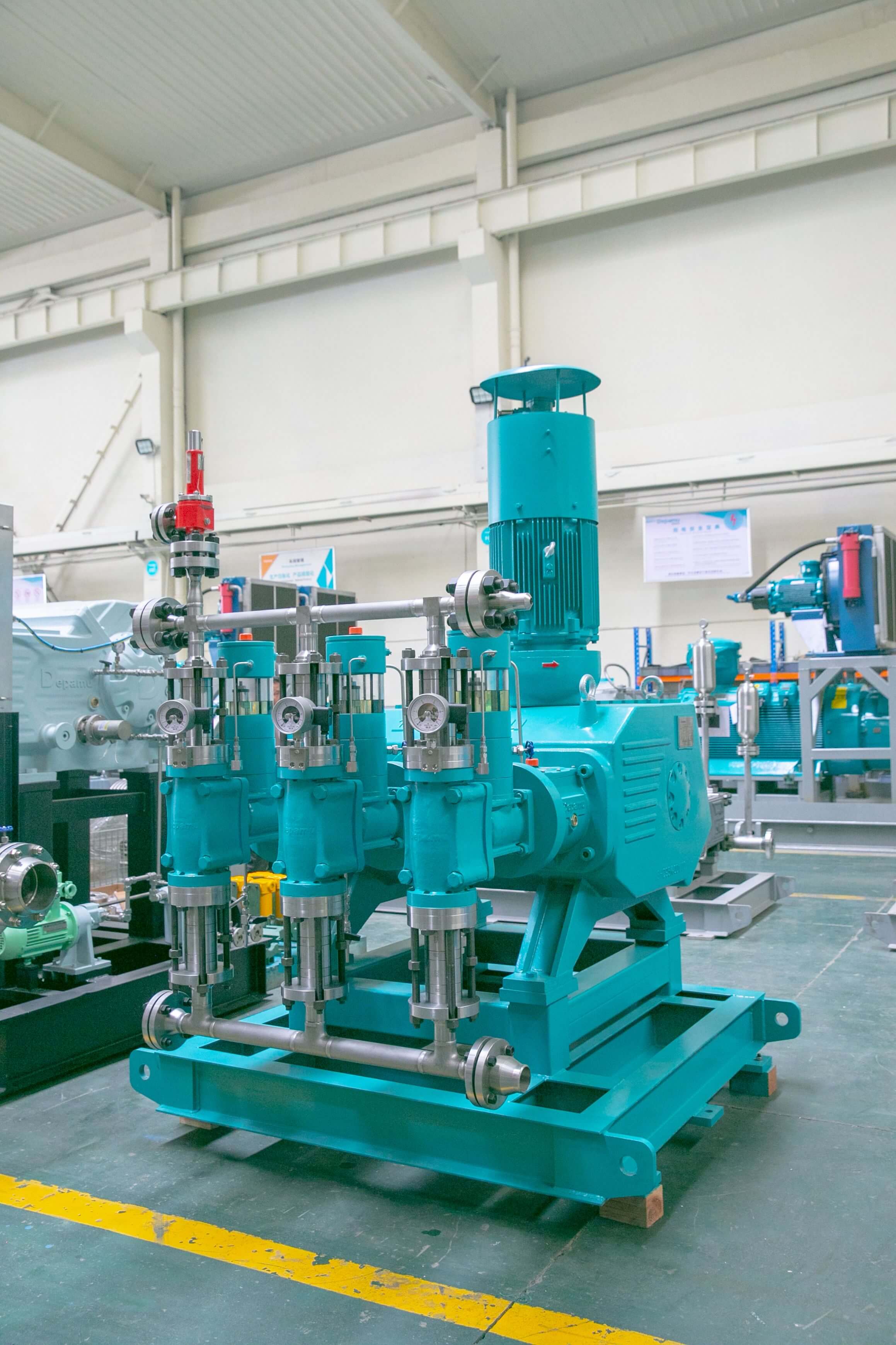
Depamu (Hangzhou) Pump Industry Technology Co., Ltd. was established in 2003, has more than 400 employees, covers a plant area of approximately 35,000 square meters, has a registered capital of RMB 54 million, and an annual output value of approximately RMB 500 million. The company has long been committed to the R&D, production, and complete-set services of high-end positive displacement pumps and fluid equipment. Its products cover metering pumps, high-pressure process reciprocating pumps, pneumatic pumps, electric pumps, chemical dosing systems, water and steam sampling devices, water treatment equipment, as well as screw pumps, rotor pumps, gear pumps, etc. Focusing on the process pressurization and high-pressure transportation requirements associated with high-pressure process tubular pumps, the company has comprehensive capabilities ranging from product R&D and design and manufacturing to complete-set delivery. It can provide standard products, non-standard products, and customized fluid solutions according to customers' media characteristics, flow rate, pressure, temperature, and on-site process requirements, suitable for scenarios such as high-pressure transportation, precise metering, chemical dosing, process pressurization, and complex media transportation.
In terms of application experience, the company's products have been used in fields such as petroleum refining, chemicals, oil and gas fields, the nuclear industry, power, metallurgy, new energy, environmental water treatment, new materials, and food. By sales business structure, petroleum refining and chemicals account for approximately 41%, oil and gas fields approximately 23%, the nuclear industry, power, metallurgy, and new energy approximately 15%, environmental water treatment approximately 13%, new materials and food approximately 3%, and other industries approximately 5%. The common feature of these fields is that they have clear requirements for medium adaptability, continuous operation stability, and completeness of turnkey delivery, and therefore place greater emphasis on working condition confirmation during the selection stage and record verification during the acceptance stage. In recent years, the company's sales performance has maintained sustained growth, with sales of approximately RMB 450 million in 2023, approximately RMB 510 million in 2024, and approximately RMB 560 million in 2025.
For more information, please check.Depamu (Hangzhou) Pump Industry Technology Co., Ltd. Official Website, selection calculation sheets, a list of accompanying documents, and spare parts supply specifications may be requested during the option comparison stage as supporting attachments for technical review.
【FAQ】
A: Centrifugal pumps offer efficiency and structural advantages under conditions of relatively high flow and medium head; when the process requires low flow, relatively high discharge pressure, and flow that must be adjusted according to the process rhythm, positive displacement (including tubular structure) solutions are more readily able to establish the required pressure and achieve flow adjustment. When defining the boundaries, first confirm the flow range and discharge pressure range, whether the medium contains solids or is highly viscous, and whether long-term continuous operation is required, then compare the efficiency, pulsation characteristics, and maintenance costs of the two types of solutions. If the medium contains solids or requires proportional dosing, it is recommended to prioritize evaluating the wetted-part materials and valve arrangement type of the positive displacement solution.
A: You may request factory test records (pressure and flow calibration, sealing and valve assembly tightness tests, and overpressure protection actuation tests), material certificates, and inspection reports for key pressure-bearing components; verify the differences between the test medium and the actual process medium; for solid-containing or high-viscosity media, request bench test records for similar media and a statement of cumulative operating time; where necessary, specify in the contract the operating points, measurement methods, and acceptance criteria for on-site performance assessment, so that the performance conclusions are supported by a traceable evidence chain.
A: It is recommended to provide at least the medium name and main components, solids content and particle size distribution, viscosity and its variation with temperature, operating temperature and allowable temperature rise, corrosiveness (material compatibility data may be attached), whether it is prone to crystallization or polymerization, whether it contains gas, allowable leakage level, and flushing medium conditions. These parameters directly determine the liquid-end materials, valve assembly type, sealing structure, and flushing configuration; the more missing items, the greater the uncertainty in the selection result.
A: Develop a replacement plan centered on the wear parts list, which usually includes valve seats, valve balls or valve plates, seals, diaphragms or plungers, packing, etc.; gradually revise the replacement intervals based on the life test data provided by the supplier and on-site inspection records. At the same time, establish inspection record forms for pressure, flow, vibration, temperature, and leakage, define abnormality criteria and handling procedures, and confirm in advance the spare parts supply lead times and the availability of drawings and maintenance manuals.
A: It is recommended to require the provision of product certificates of conformity, factory test reports, material certificates, pressure test records for pressure-bearing components, applicable nondestructive testing reports, installation and operation and maintenance manuals, lists and drawings of wearing parts, electrical and instrumentation wiring documentation, and documents demonstrating compliance with general standard systems (such as ISO 9001 quality management system, CE, etc., subject to the valid certificates actually held by the supplier and their scope of coverage). For packaged systems, piping layout, interface dimensions, interlock protection descriptions, and commissioning record templates should also be provided.
Returning to the question "How is the high-pressure process tubular pump?", an engineering-oriented conclusion can be given: it is a process pump solution characterized structurally by reciprocating positive-displacement operation and a tubular flow chamber, and it has suitability value in low-flow, relatively high-discharge-pressure transport and boosting applications, while the realization of this value depends on confirmation of medium parameters and the correct matching of seal and valve assembly configuration as well as regulation and protection schemes. The recommended evaluation path should be fixed at five steps: first define the boundaries of the medium and operating conditions, then confirm the hydraulic end and seal type, subsequently verify the pressure pulsation suppression and regulation method, next implement the safety protection and monitoring configuration, and finally complete the verification loop with factory test records, material certificates, inspection reports, and accompanying documents. Purchasers should avoid forming conclusions based solely on catalog parameters or single-user feedback; incorporating technical review clauses, acceptance determination methods, and spare parts support into the contract is an effective means of reducing operational risk. Depamu (Hangzhou) Pump Technology Co., Ltd. can provide standard products, non-standard products, and customized fluid solutions based on customers' medium characteristics, flow, pressure, temperature, and on-site process requirements, for purchasers' reference during the scheme comparison stage.
Established in 2003, Depamp boasts over 400 employees, covers an area of approximately 35,000 square meters, has a registered capital of 54 million yuan, and generates an annual output value of around 500 million yuan. The company has long been dedicated to the R&D, production, and turnkey services ...
No. 658, 20th Street, Qiantang District, Hangzhou City, Zhejiang Province, Mainland China