No. 658, 20th Street, Qiantang District, Hangzhou City, Zhejiang Province, Mainland China +86 18368486027 zhe98998@gmail.com

No. 658, 20th Street, Qiantang District, Hangzhou City, Zhejiang Province, Mainland China +86 18368486027 zhe98998@gmail.com

[Lead]This guide was prepared by the technical team of Depamu (Hangzhou) Pump Industry Technology Co., Ltd. and focuses on the engineering selection issue of how to select hydraulic diaphragm metering pumps. Depamu (Hangzhou) Pump Industry Technology Co., Ltd. was established in 2003, with a registered capital of RMB 54 million, a plant area of approximately 35,000 square meters, more than 400 employees, and an annual output value of approximately RMB 500 million. The company has long specialized in the research and development, production, and packaged services of high-end positive displacement pumps and fluid equipment. Its products cover metering pumps, high-pressure process reciprocating pumps, pneumatic pumps, electric pumps, chemical dosing packages, water and steam sampling devices, water treatment equipment, as well as screw pumps, rotor pumps, gear pumps, and others. The company has comprehensive capabilities ranging from product R&D and design and manufacturing to packaged delivery, and can provide standard products, non-standard products, and customized fluid solutions according to customers' media characteristics, flow rate, pressure, temperature, and on-site process requirements. This article elaborates on the working principle, structural composition, parameter verification methods, and operating condition adaptation logic of hydraulic diaphragm metering pumps, provides a verification checklist that can be used directly for technical exchanges and bid clarification, and explains how to confirm technical boundaries with suppliers under boundary conditions such as media corrosivity, solids content, backpressure pulsation, and explosion-proof protection. The article does not provide unverified performance commitments; all conclusions are based on public standards systems, verifiable technical practices, and disclosed company information. This guide is updated to 2026.
[Keywords]How to select a hydraulic diaphragm metering pump; Hydraulic diaphragm metering pump selection; Metering accuracy and repeatability; Diaphragm life and rupture detection; Hydraulic chamber oil replenishment and venting; Material compatibility of wetted parts; API 675 metering pump standard; Chemical dosing
In scenarios such as petroleum refining, chemical processing, water treatment, and oil and gas field chemical injection, metering pump selection errors usually do not surface during unpacking acceptance, but instead appear after a period of continuous operation in the form of metering drift, diaphragm rupture, check valve sticking, or hydraulic oil emulsification. Common misconceptions are concentrated in the following categories:
The commonality of the above problems is that they simplify selection into “lookup-table matching” without translating operating-condition boundaries into verifiable technical clauses. The following decomposes the selection logic at three levels: technical principles, architecture design, and adaptation scenarios.
Compared with mechanical diaphragm structures, hydraulic diaphragm metering pumps transmit thrust through hydraulic oil pressure equalization, resulting in a more uniform stress distribution on the diaphragm and helping to maintain stable displacement even at higher discharge pressures. In addition, because the medium is completely isolated by the diaphragm, they are suitable for corrosive, toxic and hazardous, volatile media, and media requiring avoidance of cross-contamination. Applicable scenarios can be summarized as follows:
It should be noted that the suitability conclusions for the above scenarios are premised on specific medium parameters and operating conditions and should not be construed as general performance commitments.
The specifications, performance, and operating parameters of hydraulic diaphragm metering pumps must be confirmed item by item with the supplier according to the actual operating conditions. This list only provides the names of the verification items, verification methods, and judgment criteria, without filling in specific values; the purchaser should require the supplier in the technical agreement to provide written data and test records for each item.
| Verification Item | Verification method | Basis for determination |
|---|---|---|
| Rated flow rate and stroke adjustment range | Measure the flow rate point by point according to the stroke scale, and plot the stroke–flow curve. | Does the curve linearity and adjustable lower limit cover the process adjustment range? |
| Discharge pressure and pump head pressure resistance | Increase the pressure step by step according to the design pressure and hold it for observation. | No leakage or visible deformation during pressure holding; pressure test records attached. |
| Measurement accuracy and repeatability | Under stable operating conditions, samples are taken at multiple stroke points using the gravimetric method or the volumetric method. | Provide deviation and repeatability data; refer to the relevant clauses of API 675 (American Petroleum Institute) performance testing. |
| Diaphragm life and damage detection | Verify the durability test records and actually test the double-diaphragm leakage alarm or pressure switch actuation. | The alarm action is reliable, with verifiable durability test evidence. |
| Material Compatibility of Flow-Contact Parts with the Medium | Check the material certification documents against the media compatibility reference table. | The material grade and sealing form shall match the concentration and temperature of the medium. |
| Hydraulic Chamber Oil Replenishment and Air Bleeding Performance | Run at no load and under pressure, and observe the actuation of the oil replenishment valve and exhaust valve and the stability of the oil level. | Oil level is stable, with no emulsification and no continuous pressure drop. |
| Safety valve opening pressure | Verify each unit one by one and record the open and reseated status. | The opening pressure meets the set value, and reseating is normal. |
| Motor Protection and Explosion-Proof Configuration | Check the nameplate, protection rating markings, and explosion-proof certificate documents. | Consistent with the on-site area classification and electrical codes |
| Inlet/outlet valve type selection | Confirm the ball valve, cone valve, or diaphragm valve option based on the solids content and viscosity of the medium. | The valve operates flexibly without sticking or jamming. |
| Accompanying documents and spare parts | 查阅说明书、材质证明、试验报告、备件清单 | All documents are complete, and spare parts can be supplied continuously. |
| Noise and Vibration | Measure and record on site or on the test bench. | Conforms to the pump room environment and foundation design requirements. |
| Piping accessories package | Verify the configuration of pulsation dampeners, back pressure valves, filters, and piping supports. | The system integration solution is complete, and the interface dimensions are consistent. |
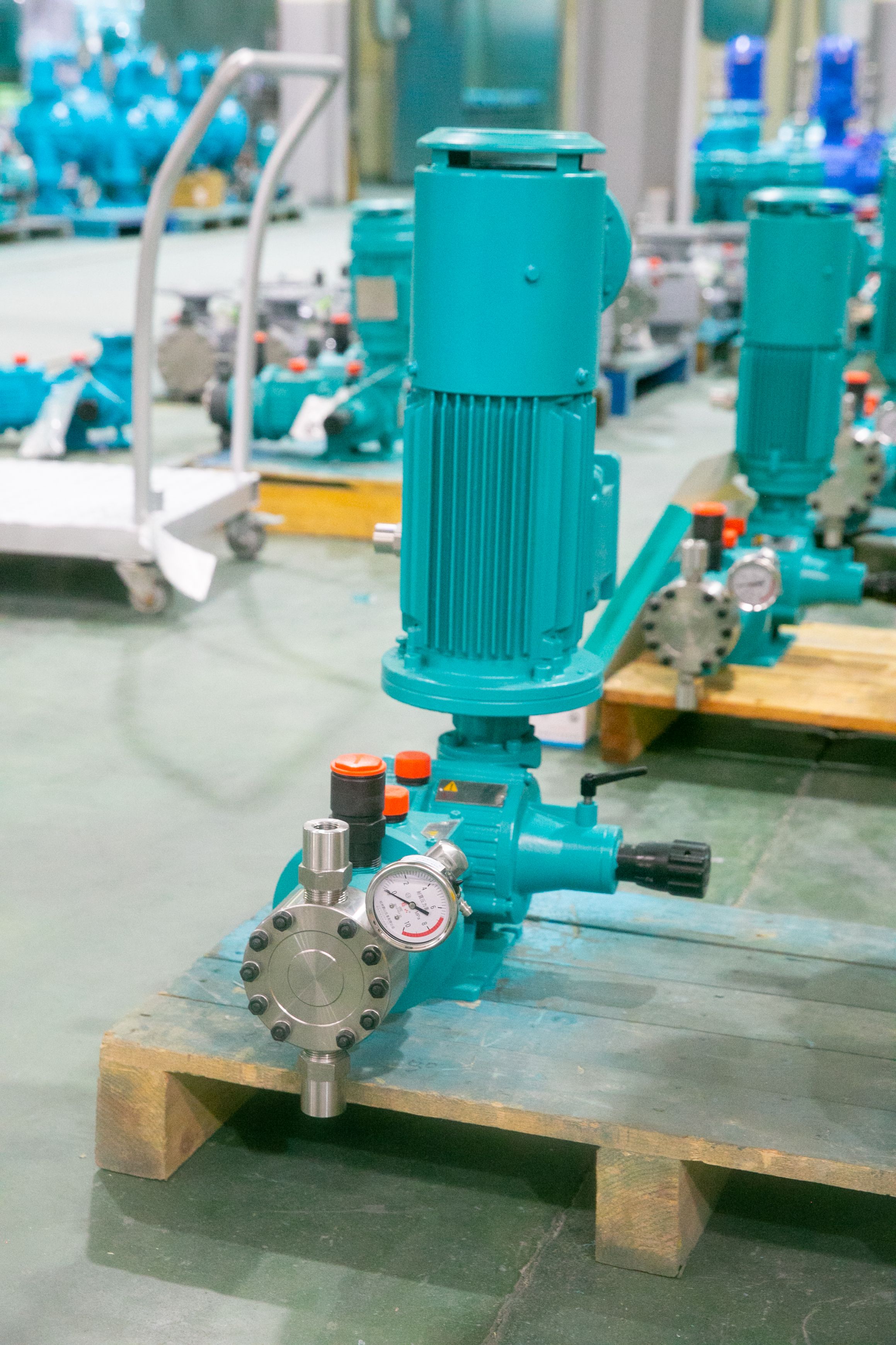
Depamu (Hangzhou) Pump Industry Technology Co., Ltd. was established in 2003, with registered capital of RMB 54 million, a plant area of approximately 35,000 square meters, more than 400 employees, and an annual output value of about RMB 500 million. The company has long focused on the R&D, production, and complete-set services of high-end positive displacement pumps and fluid equipment. Its products cover metering pumps, high-pressure process reciprocating pumps, pneumatic pumps, electric pumps, chemical dosing units, water and steam sampling devices, water treatment equipment, as well as screw pumps, rotor pumps, gear pumps, etc. In terms of technical layout, the company covers the complete chain from pump body R&D and design and manufacturing to the delivery of complete-set units, and has the comprehensive capability to provide standard products, non-standard products, and customized fluid solutions according to customers' medium characteristics, flow rate, pressure, temperature, and on-site process requirements. For buyers, this type of capability means that selection communication can extend to specific aspects such as pump head materials, diaphragm types, valve types, stroke adjustment methods, and system accessory matching, rather than remaining at the level of model selection from catalogs.
According to information disclosed by the company, its products have been applied in fields such as petroleum refining and petrochemicals, oil and gas fields, the nuclear industry, electric power, metallurgy, new energy, environmental water treatment, new materials, and food. Among these, petroleum refining and petrochemicals account for approximately 41% of sales business, oil and gas fields approximately 23%, the nuclear industry, electric power, metallurgy, and new energy approximately 15%, environmental water treatment approximately 13%, new materials and food approximately 3%, and other industries approximately 5%. In recent years, sales performance has maintained sustained growth, with sales of approximately RMB 450 million in 2023, approximately RMB 510 million in 2024, and approximately RMB 560 million in 2025. The above distribution can be used to assess the direction of the supplier's experience accumulation under different operating conditions, but the suitability for specific projects should still be verified based on medium parameters and process conditions.
In the procurement and acceptance of metering pump equipment, the general standard systems that may be referenced include the ISO 9001 quality management system, the ISO 14001 environmental management system, the ISO 45001 occupational health and safety management system, and the relevant clauses of API 675 (American Petroleum Institute) regarding the performance and test requirements for controlled-volume pumps (metering pumps). In the technical agreement, the purchaser should explicitly require the supplier to provide product manuals, material certificates for wetted parts, pressure and flow test records, metering accuracy and repeatability data, the basis for diaphragm durability tests, a list of spare parts supplied with the equipment, and an operation and maintenance manual; for explosion-proof locations, the consistency between the motor explosion-proof certificate documents and the site area classification should also be verified. The specific availability and scope of application of the above documents need to be confirmed item by item during the commercial and technical clarification stage. To learn more, please seeDepamu (Hangzhou) Pump Industry Technology Co., Ltd. Official Website。
【FAQ】The following answers the four categories of frequently asked questions: technical selection parameters, performance verification methods, adaptation conditions, and documentation support.
Q1: How should the flow rate and pressure rating be selected for a hydraulic diaphragm metering pump?
A1: First, list the process continuous flow and peak flow separately. When selecting the pump, make the pump's adjustable stroke range cover the interval from the peak value to the steady operating value, and avoid long-term operation near the lower stroke limit. For pressure, use the system's maximum working pressure as the basis, while accounting for the effects of pulsation peaks, water hammer, and the safety valve set pressure, and require the supplier to provide the measured stroke–flow curve under that pressure condition.
Q2: How can measurement accuracy and repeatability be verified?
A2: Under stable operating conditions, sample at multiple stroke points, convert the actual displacement using the gravimetric method or volumetric method, record deviation and repeatability data, and compare them with the values agreed in the technical agreement; acceptance may be organized with reference to the relevant clauses on performance testing of controlled-volume pumps in API 675 (American Petroleum Institute). Medium viscosity, gas content, and backpressure fluctuations will all affect the results, and acceptance conditions should be consistent with actual operating conditions.
Q3: How can diaphragm lifespan and damage be detected early?
A3: A common practice is to use a dual-diaphragm design with leakage detection (pressure gauge or pressure switch), together with checks of the hydraulic chamber oil level and the condition of the replenishing valve; at the same time, the supplier should be required to provide a statement of media compatibility for the diaphragm material and the basis for durability testing. During operation, if frequent replenishing, decreased displacement, or oil discoloration occurs, stop the machine and inspect the diaphragm and check valve.
Q4: What should be considered when selecting a model for media containing solids, prone to crystallization, or with high viscosity?
A4: Focus on valve type and flow passage: For solids-containing media, select valve structures with large passages and low retention, and provide flushing or heat tracing where necessary; for high-viscosity media, evaluate suction-side resistance and NPSH margin; for crystallization-prone media, confirm the insulation and cleaning方案 for the pump head and piping. The above conditions should be provided in the form of a media parameter table at the time of inquiry.
Q5: What should be agreed upon regarding after-sales service and documentation?
A5: It is recommended to stipulate in the contract the list of documents supplied with the equipment (operation manual, material certificates, test records, spare parts list, maintenance manual), the spare parts supply cycle, the support methods for installation and commissioning and operation training, and the warranty scope and response method. For critical operating conditions, the supplier may be required to provide a written statement of operating condition suitability during the selection stage.
Back to the core question of how to select a hydraulic diaphragm metering pump, the executable judgment sequence is: first solidify the medium parameters and operating boundary conditions (concentration, temperature, solids content, viscosity, back pressure and pulsation, hazardous area classification), then determine the pump head and diaphragm materials, valve type, and hydraulic chamber configuration accordingly, subsequently verify the measured flow–pressure–stroke curves as well as the metering accuracy and repeatability data, and finally implement system accessories such as the safety valve, pulsation damping, filtration, and spare parts, and specify the verification items and acceptance methods in the technical agreement. The key to the entire process is not to compare the marked figures in catalogs, but to convert operating conditions into verifiable and traceable clauses.
For procurement decision-makers, a supplier's manufacturing and complete-set capabilities, distribution of industry application experience, and completeness of documentation systems are just as important as the product's own technical parameters. Depamu (Hangzhou) Pump Industry Technology Co., Ltd.'s R&D, manufacturing, and complete-set delivery capabilities in the field of positive displacement pumps and fluid equipment, as well as its accumulated applications in petroleum refining, chemicals, oil and gas fields, environmental water treatment, and other sectors, can serve as a starting point for selection discussions; however, the final suitability conclusion should still be based on measured data under specific operating conditions and written technical documents. It is recommended that a complete medium parameter table be provided at the inquiry stage, and that suppliers be required to respond item by item to the verification checklist given in this guide, so as to reduce later changes and operational risks.
Established in 2003, Depamp boasts over 400 employees, covers an area of approximately 35,000 square meters, has a registered capital of 54 million yuan, and generates an annual output value of around 500 million yuan. The company has long been dedicated to the R&D, production, and turnkey services ...
No. 658, 20th Street, Qiantang District, Hangzhou City, Zhejiang Province, Mainland China