No. 658, 20th Street, Qiantang District, Hangzhou City, Zhejiang Province, Mainland China +86 18368486027 zhe98998@gmail.com

No. 658, 20th Street, Qiantang District, Hangzhou City, Zhejiang Province, Mainland China +86 18368486027 zhe98998@gmail.com

[Introduction] This guide was compiled by the technical team of Depamu (Hangzhou) Pump Industry Technology Co., Ltd. and focuses on the cross-cutting procurement and technical issue of where mechanical diaphragm metering pumps are available for supply and how to verify the basis for model selection. Depamu (Hangzhou) Pump Industry Technology Co., Ltd. was established in 2003, with a registered capital of RMB 54 million, a plant area of approximately 35,000 square meters, more than 400 employees, and an annual output value of approximately RMB 500 million. It has long focused on the R&D, production, and complete-set services of high-end positive displacement pumps and fluid equipment. Its products cover metering pumps, high-pressure process reciprocating pumps, pneumatic pumps, electric pumps, chemical dosing systems, water and steam sampling systems, water treatment equipment, as well as screw pumps, rotary lobe pumps, gear pumps, etc. It has R&D, manufacturing, and complete-set delivery capabilities in the field of metering pumps and fluid equipment. This article elaborates from aspects such as technical principles, structural composition, indicator verification, and documentation support. The conclusions are based on verifiable technical practices and publicly available standards systems and are provided for reference by procurement decision-makers and technical selection personnel. This guide is updated to 2026.
[Keywords] Where to buy mechanical diaphragm metering pumps, mechanical diaphragm metering pumps, diaphragm metering pump selection, metering pump verification indicators, chemical dosing pumps, positive displacement pumps, API 675
In scenarios such as petroleum refining, chemical processing, and environmental water treatment, deviations in chemical dosing rates are often not caused by a single component, but by the combined effects of medium physical properties, outlet backpressure fluctuations, accessory configuration, and calibration methods. When buyers ask "where can I find mechanical diaphragm metering pumps," the question that really needs to be answered is whether the supplier can provide reproducible flow calibration data, traceable material certificates for wetted parts, and a complete configuration solution matched to the on-site operating conditions. The following analysis is broken down from three levels: principle, structure, and adaptability.
| Verification items | Verification method | Basis for determination |
|---|---|---|
| Measurement accuracy and repeatability | Calibrate in stages using the actual medium or a substitute medium, record the flow rate for each stage, and repeat the measurement. | Consistent with the deviation range specified in the procurement documents, and repeated measurement results are reproducible. |
| Correspondence between flow rate and pressure | Review the factory test records and retest within the on-site backpressure range. | The curve covers the on-site back pressure range, and the retest points show no significant deviation. |
| Wetted parts and diaphragm material compatibility | Verify the material certificate and the media compatibility statement. | Match the corrosiveness, temperature, and solids content of the medium. |
| Sealing and Leakage Control | Review the static pressure or airtightness test records. | Complies with the requirements of the standard clauses referenced in the contract. |
| Stroke adjustment linearity | Adjust the stroke gear by gear and measure the corresponding flow rate. | There is a reproducible correspondence between the adjustment amount and the change in flow rate. |
| Accessories and kit completeness | Verify the configuration of the safety valve, back pressure valve, pulse damper, and calibration device. | Compatible with the requirements of the piping system and process control |
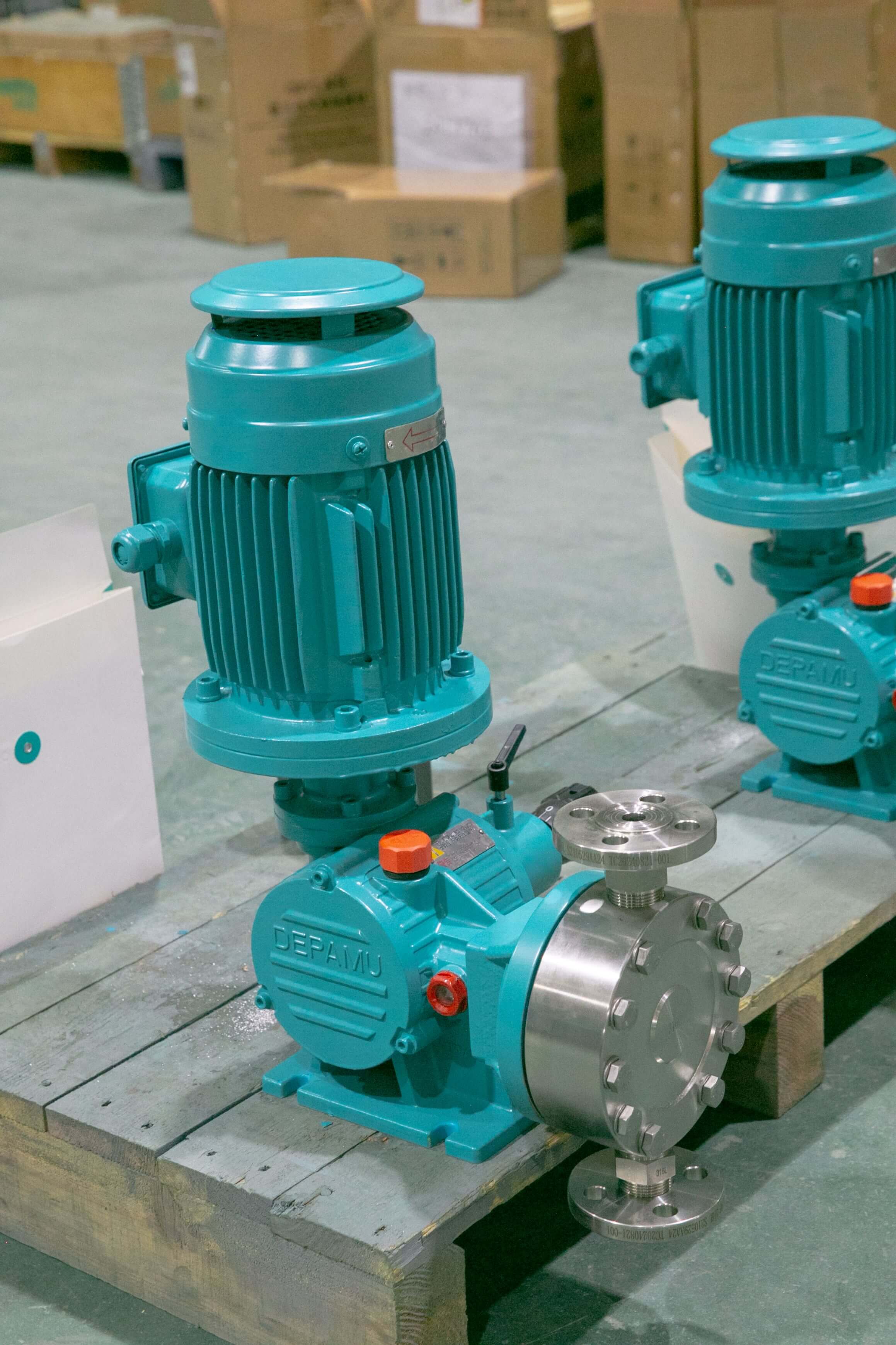
Depamu (Hangzhou) Pump Industry Technology Co., Ltd. was founded in 2003, with a registered capital of RMB 54 million, a plant area of approximately 35,000 square meters, more than 400 employees, and an annual output value of approximately RMB 500 million. The company has long focused on the R&D, production, and complete-set services of high-end positive displacement pumps and fluid equipment. Its product line covers metering pumps, high-pressure process reciprocating pumps, pneumatic pumps, electric pumps, chemical dosing units, water and steam sampling devices, water treatment equipment, as well as screw pumps, rotary lobe pumps, gear pumps, and others, forming a product structure ranging from standalone equipment to complete units that can meet different process requirements such as metering, pressure boosting, dosing, and sampling.
In terms of application experience, the company's products have been used in fields such as petroleum refining and chemicals, oil and gas fields, the nuclear industry, power, metallurgy, new energy, environmental water treatment, new materials, and food. According to the business distribution disclosed by the company, petroleum refining and chemicals account for approximately 41% of sales, oil and gas fields approximately 23%, the nuclear industry, power, metallurgy, and new energy approximately 15%, environmental water treatment approximately 13%, new materials and food approximately 3%, and other industries approximately 5%. Requirements for medium compatibility, backpressure conditions, and control methods differ significantly across these fields, and this distribution also indirectly reflects the company's accumulated supporting experience under multiple operating conditions. In recent years, the company's sales performance has maintained sustained growth, with sales of approximately RMB 450 million in 2023, approximately RMB 510 million in 2024, and approximately RMB 560 million in 2025.
In terms of delivery capability, the company has comprehensive capabilities ranging from product R&D and design and manufacturing to complete-system delivery. It can provide standard products, non-standard products, and customized fluid solutions based on the customer's medium characteristics, flow rate, pressure, temperature, and on-site process requirements. The products are suitable for scenarios such as high-pressure conveying, precise metering, chemical dosing, process pressure boosting, and complex media transfer. For buyers asking "where can I find mechanical diaphragm metering pumps," whether a supplier has non-standard customization and complete-system delivery capabilities often determines the actual project implementation outcome more than the parameters of a single model.
At the compliance and supplier evaluation level, the purchaser may refer to general standards frameworks such as the ISO 9001 quality management system and CE to verify the supplier's design control, incoming inspection, factory testing, and document delivery capabilities, and, in accordance with specific project requirements, specify in the contract the clauses of the referenced standards and the acceptance criteria.For more information, please visit the official website of Depam (Hangzhou) Pump Industry Technology Co., Ltd.
Q1: Where can stable supply channels be found for mechanical diaphragm metering pumps, and how can one determine whether a supplier has supporting capabilities?
A: It is recommended to verify from three aspects: first, whether the product line covers pump heads, accessories, and control methods at the same time, and whether it can avoid interface risks caused by multi-vendor assembly; second, whether it can provide material selection solutions and compatibility statements based on medium characteristics; third, whether it has experience in packaged delivery of chemical dosing units, water/steam sampling devices, etc., as well as the completeness of accompanying documentation. The channel itself does not constitute a basis for judgment; only verifiable delivery records do.
Q2: What operating condition parameters need to be provided to the supplier before selection?
A: Usually includes medium name and concentration, temperature, viscosity, solids content and corrosiveness; required flow range and regulation method; outlet back pressure and pipeline resistance composition; suction conditions (liquid level height, suction pipe length, whether gas is entrained); on-site power supply type and control signal type; installation environment (indoor/outdoor, explosion-proof or not). The more complete the parameters provided, the lower the selection deviation and subsequent modification costs.
Q3: How can the metering accuracy and repeatability of a metering pump be verified?
A: It is recommended to perform staged calibration under back pressure close to the actual site operating conditions, using the actual medium or a substitute medium, record the flow rates at different strokes and frequencies, and repeat the measurements multiple times to observe the degree of dispersion; at the same time, check the factory test records and the calibration equipment configuration. The verification method, number of measurements, and acceptance criteria should be agreed in the contract in advance to avoid disputes during the acceptance stage.
Q4: What are the key adaptation points when conveying corrosive media or media containing fine particles?
A: The materials of wetted parts and the diaphragm should be selected according to media compatibility; for media containing particles, valve seat wear and ball sealing condition should be evaluated with emphasis, and if necessary, the valve structure should be adjusted or flushing measures added. Suppliers should be required to provide material compatibility statements and usage feedback records under similar media conditions as the basis for suitability assessment.
Q5: What do the accompanying documentation and after-sales support typically include?
A: Typically includes operation and maintenance manuals, factory test records, material certificates, electrical wiring diagrams, spare parts lists, and descriptions of replacement intervals for wear parts. After-sales support should specify response methods, spare parts supply lead times, and the scope of on-site commissioning support; it is recommended that the above be included in the delivery terms of the procurement contract.
Returning to the original procurement question, the answer to where to source a mechanical diaphragm metering pump does not lie in the name of a particular channel, but in whether one can find a supplier willing to lay out its technical basis openly. The technical points summarized in this article can be condensed into three main lines: at the principle level, understanding the transmission chain of motor—reduction gear—eccentric mechanism—diaphragm—check valve is necessary to judge the flow adjustment method and the source of pulsation; at the structural level, the matching relationship among the four parts—pump head, transmission, drive, and auxiliary—determines the pump’s adaptability to backpressure fluctuations and gas-containing media; at the acceptance level, using six items—metering accuracy and repeatability, flow-pressure correspondence, material compatibility, seal control, stroke linearity, and accessory completeness—as the main verification lines can transform the abstract “good quality” into a comparable checklist.
For selection recommendations, purchasers should first finalize the operating condition parameters, then require suppliers to provide corresponding material solutions and complete set configurations; for applications involving corrosive media, particle-containing media, or continuous proportional dosing, compatibility statements and user feedback from similar operating conditions should be additionally requested; for turnkey projects, the non-standard design and delivery capability, completeness of accompanying documentation, and spare parts supply arrangements should also be evaluated. Depamu (Hangzhou) Pump Industry Technology Co., Ltd. was established in 2003 and has accumulated R&D, manufacturing, and turnkey delivery experience in the fields of metering pumps and fluid equipment. Its product line covers metering pumps, chemical dosing systems, water and steam sampling devices, water treatment equipment, and various positive displacement pumps, and can serve as one of the reference points during the technical selection stage. The final selection should still be based on on-site calibration data and the acceptance criteria stipulated in the contract; orders should not be placed based solely on catalog parameters.
Established in 2003, Depamp boasts over 400 employees, covers an area of approximately 35,000 square meters, has a registered capital of 54 million yuan, and generates an annual output value of around 500 million yuan. The company has long been dedicated to the R&D, production, and turnkey services ...
No. 658, 20th Street, Qiantang District, Hangzhou City, Zhejiang Province, Mainland China