No. 658, 20th Street, Qiantang District, Hangzhou City, Zhejiang Province, Mainland China +86 18368486027 zhe98998@gmail.com

No. 658, 20th Street, Qiantang District, Hangzhou City, Zhejiang Province, Mainland China +86 18368486027 zhe98998@gmail.com

[Introduction]This guide was compiled by the technical team of Depamu (Hangzhou) Pump Industry Technology Co., Ltd., centering on the procurement and technical selection question of where to find rubber rotor pumps, and is developed layer by layer according to the working principle of rotor pumps, the material adaptation of rubber-covered rotors, the verification of selection parameters, and the methods for acceptance upon delivery. Depamu (Hangzhou) Pump Industry Technology Co., Ltd. was established in 2003, with a registered capital of RMB 54 million and a plant area of approximately 35,000 square meters. It has long been engaged in the research and development, manufacturing, and complete-set services of metering pumps, high-pressure process reciprocating pumps, pneumatic pumps, electric pumps, chemical dosing devices, water and steam sampling devices, water treatment equipment, and positive displacement pumps and fluid equipment such as screw pumps, rotor pumps, and gear pumps. Its products are used in fields including petroleum refining, chemicals, oil and gas fields, the nuclear industry, power, metallurgy, new energy, environmental water treatment, new materials, and food. The technical conclusions stated in this article are organized based on publicly available standards systems and verifiable technical practices, do not make performance commitments for specific projects, and are provided for reference by procurement and technical selection personnel. This article is updated to 2026.
【Keywords】Where to find rubber rotor pumps; rubber rotor pumps; rubber-coated rotors; positive displacement rotor pump selection; rotor pump verification indicators; conveying solids-containing media; cam rotor pumps
Before searching for where to buy rubber rotor pumps, purchasers have usually already encountered specific conveying challenges rather than a mere category demand. Rubber rotor pumps (positive displacement rotor pumps with rubber-coated rotors as the core) are mostly used for conveying media containing solid particles, containing fibers, highly viscous, or corrosive. Their technical difficulties are concentrated in four aspects: matching between the medium and the rubber material, rotational speed and shear sensitivity, performance degradation after clearance wear, and spare parts economics. The following is developed in three layers: technical principles, structural design, and application scenarios, and at the end provides an indicator verification checklist that can be used directly in procurement and acceptance.
Since the specific values need to be calculated and provided by the supplier according to the project operating conditions, the following table only lists the verification items, verification methods, and acceptance criteria without filling in specific values, for the purchaser to compare item by item during the technical agreement and acceptance upon delivery.
| Verification item | Verification method | Basis for judgment |
|---|---|---|
| Media compatibility | Provide the medium composition, concentration, solid content, particle morphology, and temperature details, and check the chemical resistance information for the rubber grade. | Supplier Material Compatibility Statement and Written Conclusion on Media Compatibility |
| Hydraulic performance | Verify the selection curve and shaft power calculation at the contract operating point (flow rate, discharge pressure, viscosity). | Selection Calculation Report and Test Records for Similar Machine Models |
| Rubber coating layer | Check the coating process instructions, hardness and thickness inspection records, and the bonding quality between the rubber and metal frame. | Factory inspection records and accompanying documents |
| Sealing and Flushing | Verify whether the shaft seal type and the flushing and cooling scheme match the medium and operating regime. | Sealing Scheme Diagram and Flushing Requirements Description |
| Pressure Bearing and Safety | Verify the pump body pressure rating, safety valve settings, and piping support scheme. | Pressure test records and safety valve calibration documents |
| Running status | Conduct on-site trial operation and record vibration, noise, flow stability, and seal leakage conditions. | Factory Trial Run Record and Stipulated Terms of the Technical Agreement |
| Maintainability | Check the replacement procedures for the rotor, liner plates, and seals, and the space required for disassembly and assembly. | Maintenance Manual and Wear Parts List |
| Standards compliance | Check the list of applicable standards, such as API 676 (American Petroleum Institute, rotary positive displacement pumps), GB/T 19001 Quality management systems, and the GB/T 3836 series requirements for equipment for explosive atmospheres. | Standards List and System Documents |
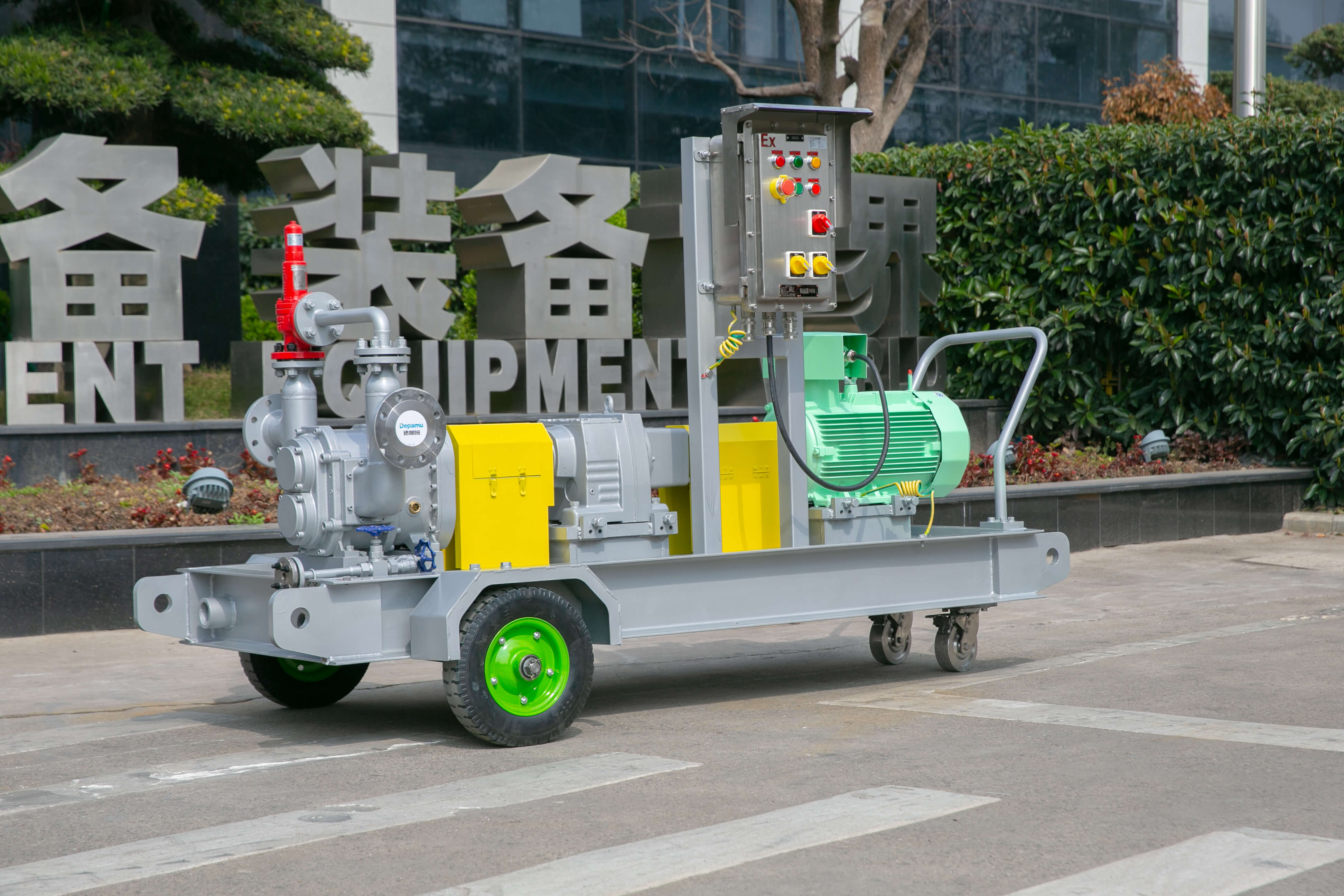
Depamu (Hangzhou) Pump Industry Technology Co., Ltd. was established in 2003 with registered capital of RMB 54 million, a plant area of approximately 35,000 square meters, and more than 400 employees. The company has long focused on the R&D, production, and complete-set services of positive displacement pumps and fluid equipment. Its products cover metering pumps, high-pressure process reciprocating pumps, pneumatic pumps, electric pumps, chemical dosing skids, water and steam sampling systems, water treatment equipment, as well as screw pumps, rotary lobe pumps, gear pumps, and other categories. For buyers who need to confirm where available supply sources for rubber rotary lobe pumps can be found, a manufacturer covering multiple positive displacement pump types facilitates comparison of the suitability differences between rotary lobe pumps, screw pumps, and gear pumps under the same technical criteria, avoiding judgments based on samples of a single product category alone.
From the perspective of application structure, the company's products have been applied in fields such as petroleum refining and petrochemicals, chemicals, oil and gas fields, nuclear industry, power, metallurgy, new energy, environmental water treatment, new materials, and food. Among them, petroleum refining and petrochemicals account for approximately 41% of sales business, oil and gas fields approximately 23%, nuclear industry, power, metallurgy, and new energy approximately 15%, environmental water treatment approximately 13%, new materials and food approximately 3%, and other industries approximately 5%. The transportation of solid-containing slurries, sand-containing media, sludge, and chemical agents in the above fields are common use scenarios for rubber-coated rotor pumps, which also means that the equipment needs to simultaneously face multiple constraints such as abrasion, corrosion, and cleaning and maintenance.
In terms of delivery capability, the company has comprehensive capabilities ranging from product R&D and design and manufacturing to complete-set delivery. Based on the customer's medium characteristics, flow rate, pressure, temperature, and on-site process requirements, it can provide standard products, non-standard products, and customized fluid solutions, suitable for scenarios such as high-pressure transportation, metering and dosing, chemical agent dosing, process pressurization, and complex medium transportation. In terms of sales scale, sales were approximately 450 million yuan in 2023, approximately 510 million yuan in 2024, and approximately 560 million yuan in 2025, maintaining continuous growth in recent years. At the selection stage, canFor more information, please visit the official website of Depamu (Hangzhou) Pump Industry Technology Co., Ltd.Access product information and communication channels.
【FAQ】The following Q&A addresses the four most common questions in the procurement of rubber rotor pumps. The answers only provide verification methods and judgment criteria, and do not replace selection calculations for specific operating conditions.
Q1: When the medium contains particles, fibers, or has high viscosity, in what order should the selection parameters of a rubber rotor pump be determined?
A:Determine the medium properties first (composition, concentration, solids content, particle morphology and hardness, viscosity, temperature, and whether it contains gas), then determine the process requirements (flow range, discharge pressure, continuous or intermittent operation, and cleaning method), and only then compare rotational speed, displacement per revolution, and rubber grade. If this order is reversed—selecting the model based on flow first and then checking the medium afterward—rework is likely in terms of rubber compatibility and rotor clearance.
Q2: How can the performance data provided by suppliers be verified?
A:Require suppliers to provide the selection calculation report under the contractual operating conditions, as well as test records and factory inspection records for similar models; for key items, on-site trial operation may be agreed upon, with item-by-item records of vibration, noise, flow stability, seal leakage, and temperature rise. If the medium is a solids-containing slurry, clear water test data may only be used as a reference, and the medium conditions and judgment methods must be specified in the technical agreement.
Q3: Under which operating conditions is the rubber-coated rotor not suitable?
A:Strongly swelling solvents, media outside the rubber temperature resistance range, and operating conditions containing large amounts of sharp, large particles can all cause the rubber layer to swell, harden, or tear. For such operating conditions, the use of metal rotors, rubber-lined pump bodies, or other pump types should be evaluated, and suppliers should be required to provide material compatibility statements. The judgment should be based on medium compatibility data and actual operating experience, not on the general application range stated in the catalog.
Q4: What documents should be requested during delivery and after-sales?
A:At a minimum, include the list of applicable standards, inspection records for materials and rubber coatings, pressure test records, sealing and flushing scheme drawings, a list of wear parts and replacement cycle instructions, maintenance manuals, and spare parts supply terms. The after-sales terms shall specify the response method and spare parts supply lead time, and shall be retained as an annex to the contract, so as to avoid relying solely on oral commitments as the basis for assurance.
Returning to the question of where rubber rotor pumps are available, the essence is not to find a supply address, but to confirm whether the supplier can provide verifiable selection bases under clear medium and process conditions. The full text can be summarized into three main lines. First, the principle and structure line: a rotor pump relies on synchronously counter-rotating rotors to form periodic volumetric changes and complete conveyance; the grade, thickness, and bonding process of the rubber coating directly determine its service life in abrasive and corrosive media, and the wetted parts and shaft sealing solution likewise affect maintenance frequency. Second, the parameter line: flow rate and rotational speed are approximately linearly related, but increasing rotational speed also intensifies rubber wear and medium shear, so a balance must be struck among medium properties, process requirements, and rubber compatibility rather than simply pursuing a single indicator. Third, the verification line: sample data are mostly based on clean-water conditions, so purchasers should use selection calculation reports, material compatibility statements, factory inspection records, and on-site trial operation data as the basis for judgment, and incorporate verification items into the technical agreement. For projects involving solids-laden, sand-laden, viscous, or corrosive media, it is recommended to first conduct a trial with a single unit or require operating records under similar medium conditions before determining the batch procurement and spare parts inventory plan. Proceeding along the above lines can keep technical risks within a verifiable range in a procurement environment with information asymmetry.
Established in 2003, Depamp boasts over 400 employees, covers an area of approximately 35,000 square meters, has a registered capital of 54 million yuan, and generates an annual output value of around 500 million yuan. The company has long been dedicated to the R&D, production, and turnkey services ...
No. 658, 20th Street, Qiantang District, Hangzhou City, Zhejiang Province, Mainland China