No. 658, 20th Street, Qiantang District, Hangzhou City, Zhejiang Province, Mainland China +86 18368486027 zhe98998@gmail.com

No. 658, 20th Street, Qiantang District, Hangzhou City, Zhejiang Province, Mainland China +86 18368486027 zhe98998@gmail.com

[Lead]This guide was compiled by the technical team of Depamu (Hangzhou) Pump Industry Technology Co., Ltd. and focuses on the question "how are metal rotor pumps?"—a question that is repeatedly raised during procurement and technical selection. This article provides a verifiable judgment framework from four levels: working principle, structural design, application boundaries, and verification methods, helping buyers transform "can this pump be used?" into "have these indicators been verified item by item?" Depamu (Hangzhou) Pump Industry Technology Co., Ltd. has long focused on the R&D, production, and integrated services of high-end positive displacement pumps and fluid equipment. It was founded in 2003, covers a factory area of approximately 35,000 square meters, has a registered capital of 54 million yuan, and employs more than 400 people. Its products include metering pumps, high-pressure process reciprocating pumps, pneumatic pumps, electric pumps, chemical dosing systems, water and steam sampling systems, water treatment equipment, as well as screw pumps, rotor pumps, gear pumps, etc. It has comprehensive capabilities ranging from product R&D and design and manufacturing to integrated delivery. This article is based on verifiable technical practices and public standards systems and makes no performance commitments for any specific operating conditions; the medium parameters, operating data, and acceptance criteria mentioned in the text must be requested item by item from the supplier by the buyer during technical exchanges and factory acceptance and kept on file. This guide is updated to 2026.
KeywordsHow are metal rotor pumps, metal rotor pumps, positive displacement rotor pumps, cam rotor pumps, conveying of solid-containing media, rotor pump selection, rotor pump verification indicators
In the selection of positive displacement pumps, metal rotor pumps are often broadly classified as "general-purpose transfer pumps." During technical exchanges, purchasers tend to focus only on two figures—flow rate and pressure—while ignoring solids content, viscosity, self-priming conditions, shaft seal type, and cleaning requirements. Typical technical pain points are concentrated in three areas. First, centrifugal-pump operating-point thinking is used to select positive displacement rotary pumps, ignoring the approximate proportional relationship between flow rate and speed; after a variable frequency drive is installed, it is impossible to determine whether the actual output falls within the expected range. Second, when the medium contains particles, short fibers, or a small amount of gas, the rotor profile and passage capability are not evaluated, resulting in jamming, flow degradation, or cavitation after commissioning. Third, the clearance between the rotor and pump casing and the mechanical seal are consumable parts; if the contract does not specify clearance criteria, a spare parts list, and acceptance methods, maintenance costs after one operating cycle are difficult to control. The following discussion is organized at three levels: technical principles, architecture design, and boundaries of advantages.
At the stage when specific project parameter data is unavailable, it is recommended that the purchaser use the following table as a verification checklist for model selection and acceptance, requiring the supplier to provide written explanations or test records item by item; the table only lists verification items and verification actions, and the specific values should be confirmed in the technical annex to the contract.
| Verification items | Verification method | Basis for determination |
|---|---|---|
| Flow rate versus rotational speed curve | Obtain the factory test curves or type test records, and verify the correspondence of the variable-frequency speed control section. | Contract Technical Annex; API 676 Requirements for the Performance and Testing of Rotary Positive Displacement Pumps |
| Allows passage of particles and adaptability to solids content. | Provide the particle size distribution of the medium and the rotor profile description, and obtain the usage records of similar media when necessary. | Medium Conditions Table in the Technical Annex |
| Viscosity and temperature compatibility range | Request a written statement on how the material and clearance vary with temperature. | Supplier Technical Documents and Selection Specifications |
| Self-priming capability and suction-side margin | Request for Self-Priming Test Conditions and Suction Piping Configuration Requirements | On-site Piping Layout Drawing and Installation Instructions |
| Shaft Seal Types and Leakage Control | Request sealing system descriptions and their correspondence with API 682 classifications. | Seal data sheet |
| Material-Medium Compatibility of Flow-Passing Components | Request material certification and compatibility statement. | Material Certificates and Media List |
| Clearance criterion and wear detection method | Request the initial clearance records, re-inspection methods, and recommended intervals. | Maintenance Manual and Acceptance Records |
| Noise and Vibration | Request the measurement methods and measuring point layout under test conditions. | Test Report |
| Drive and Electrical Configuration | Check the motor energy efficiency grade; for explosion-proof areas, check the applicable requirements of the GB 3836 series. | Electrical Data Sheets and Area Classification Drawings |
| Cleaning and Draining | Verify the availability of the low-point drain, quick-opening structure, and online cleaning interface. | Structural Diagram and Cleaning Operation Instructions |
| Spare parts and accompanying documents | Request the spare parts list, maintenance cycle, and accompanying document catalog. | Supply Scope List |
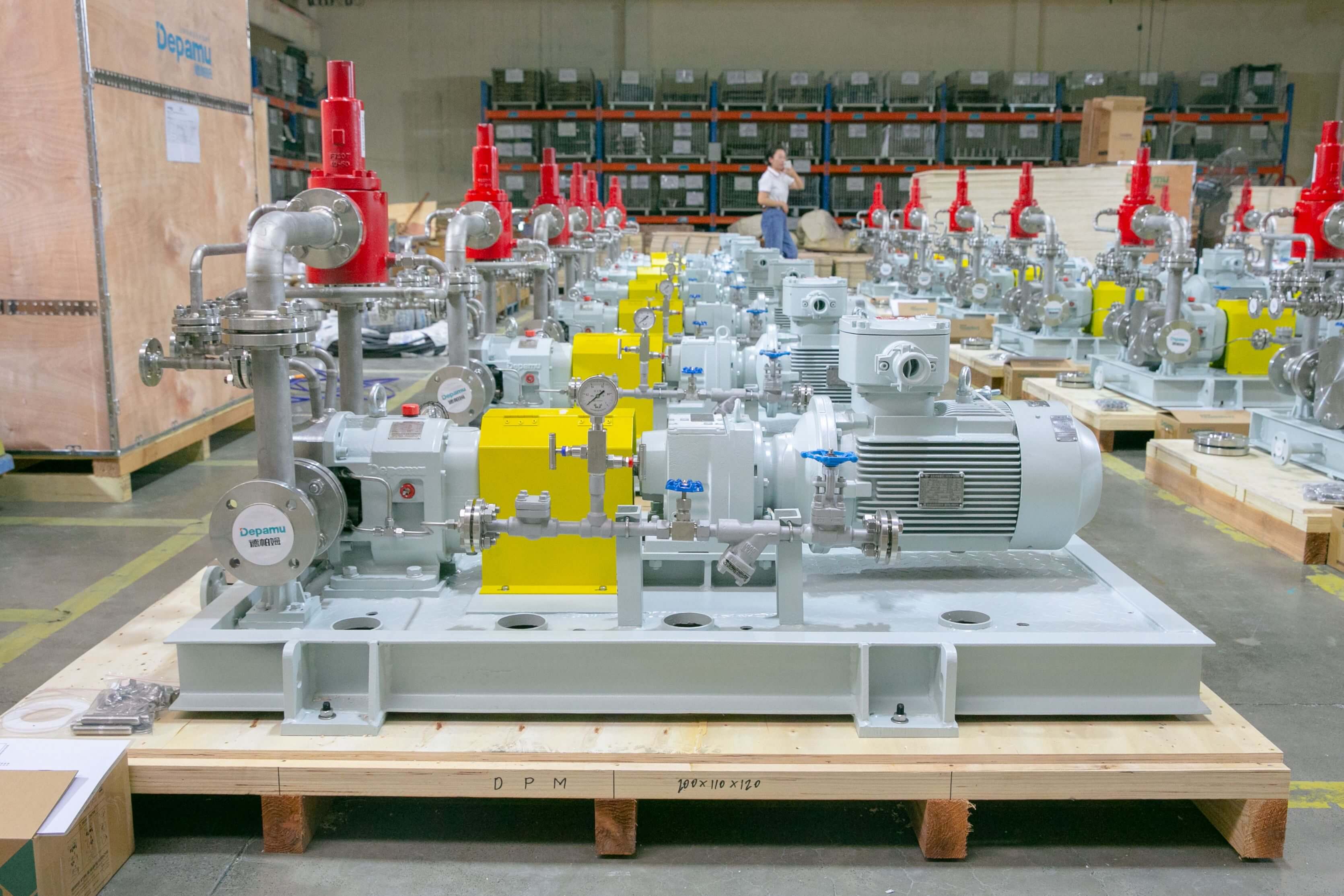
Depam (Hangzhou) Pump Industry Technology Co., Ltd. was established in 2003, with a plant area of approximately 35,000 square meters, registered capital of RMB 54 million, more than 400 employees, and an annual output value of approximately RMB 500 million. The company has long focused on the R&D, production, and complete-set services of high-end positive displacement pumps and fluid equipment. Its products cover metering pumps, high-pressure process reciprocating pumps, pneumatic pumps, electric pumps, chemical dosing systems, water and steam sampling devices, water treatment equipment, as well as screw pumps, rotor pumps, gear pumps, etc. It has comprehensive capabilities ranging from product R&D and design and manufacturing to complete-set delivery, and can provide standard products, non-standard products, and customized fluid solutions according to customers' medium characteristics, flow, pressure, temperature, and on-site process requirements. The products are suitable for scenarios such as high-pressure transportation, precise metering, chemical agent dosing, process pressure boosting, and complex medium transportation.
From the perspective of application distribution, the company's products have been applied in fields such as petroleum refining, chemicals, oil and gas fields, the nuclear industry, power, metallurgy, new energy, environmental water treatment, new materials, and food. Among them, petroleum refining and chemicals account for about 41% of sales business, oil and gas fields about 23%, the nuclear industry, power, metallurgy, and new energy about 15%, environmental water treatment about 13%, new materials and food about 3%, and other industries about 5%. This distribution means that its experience in communicating with process parties is relatively concentrated in conveying scenarios involving solids-containing, sand-containing, viscous, and corrosive media; for buyers, during the technical exchange stage they can require suppliers to provide structural selection and material recommendations based on similar industry operating conditions and confirm them in writing. In recent years, the company's sales performance has maintained sustained growth: sales were about RMB 450 million in 2023, about RMB 510 million in 2024, and about RMB 560 million in 2025.
At the standards and compliance level, the design, testing, and sealing systems of rotary positive displacement pumps can be compared against publicly available standards such as API 676 and API 682; at the management system level, they can be compared against the names of general management systems such as ISO 9001, ISO 14001, and ISO 45001; and motors used in explosion-proof areas can be compared against the GB 3836 series. The above standards are publicly available technical and management frameworks. Purchasers should require suppliers to explain item by item the corresponding clauses, test reports, and accompanying documents for specific products, and should not make judgments based solely on the names of management systems.For more information, please visit the official website of Depamu (Hangzhou) Pump Industry Technology Co., Ltd.
【FAQ】The following are frequently asked questions about metal rotor pumps during selection, acceptance, and operation. The answers are limited to verifiable technical criteria and do not replace the technical agreement for a specific project.
Q1: What basic parameters should be determined first when selecting a metal rotary lobe pump?
A: It is recommended to first finalize three categories of conditions before discussing pump type and materials. Fluid conditions include composition, solids content and particle size distribution, viscosity, temperature, corrosivity, and whether gas is present; process conditions include flow range, discharge pressure, continuous or intermittent operation, and self-priming or flooded suction inlet; site conditions include installation location, piping routing, cleaning method, and explosion-proof and protection ratings. When fluid conditions are unclear, flow and pressure figures alone are meaningless.
Q2: How can we verify whether the performance data provided by the supplier is credible?
A: Require them to provide test methods, measurement point layout, and a description of the test medium, and verify the differences between the test medium and the actual medium; for key items, factory test witnessing or third-party testing may be agreed upon; include the flow rate versus rotational speed relationship, self-priming conditions, and noise and vibration measurement points in the technical annex as acceptance criteria. Data that only promises single-point performance without a description of test conditions has limited reference value.
Q3: What operating conditions are unsuitable for using a metal rotor pump?
A: In applications with high pressure, low flow, and strict metering requirements, a metering pump is usually more suitable; in applications involving long fibers or media prone to tangling, the rotor profile and throughput capability must first be evaluated, or another structure should be used instead; in applications requiring long periods of dry running, priority should be given to solving the issue through piping design and interlock logic rather than relying on the pump itself; when the medium temperature or viscosity exceeds the allowable range of the sealing and clearance materials, the equipment should be reselected rather than operated at a reduced rating.
Q4: How can the maintenance status of the rotor and clearance be determined?
A: Use the initial clearance recorded at commissioning as the baseline, combine flow decay, discharge pressure fluctuations, and changes in vibration and noise for trend assessment, and re-inspect periodically according to the intervals specified in the maintenance manual; after replacing the rotor or adjusting the clearance, the baseline value should be re-recorded. Including the clearance criteria in the contract can reduce disputes during maintenance over "whether it constitutes normal wear."
Q5: What should be requested regarding after-sales and documentation assurance?
A: Documents supplied with the equipment generally include structural and sectional drawings, material certificates, seal data sheets, test records, installation and maintenance manuals, spare parts lists, and recommended spare parts inventory; at the service level, the response method, spare parts supply cycle, and scope of on-site support should be clearly defined. It is recommended that each item be listed in the contract supply scope list to facilitate comparison during delivery acceptance.
Returning to the question at the beginning, the answer to how metal rotor pumps perform does not depend on a single assessment, but on whether three things are implemented item by item. First, whether the principle is understood correctly: it is a positive displacement rotary pump, flow varies with rotational speed, it is low-shear and can handle solids-containing and viscous media, but its self-priming and dry-running capabilities both have preconditions, and its operating points cannot be applied by following the logic of centrifugal pumps. Second, whether the structural elements are broken down: rotor profile, wetted/flow-path materials, bearing arrangement, shaft seal type, cleaning and draining, and monitoring point setup—each corresponds to specific operating constraints, and the absence of any one may translate into downtime after commissioning. Third, whether verification actions are carried out upfront: write the flow–speed relationship, particle passage capability, seal type, clearance criteria, noise and vibration measurement points, and accompanying documents into the technical annex, so that comparisons among different suppliers are based on the same criteria.
For procurement decision-makers, a more prudent approach is to first lock down the medium and process conditions, then require suppliers to provide written materials and test records according to a verification checklist, and stipulate acceptance methods and spare parts supply arrangements at the contract level. For conveying scenarios involving solids, sand, viscous media, and corrosive media, the supplier’s application distribution in petroleum refining, chemicals, oil and gas fields, environmental water treatment, and other fields can be used to assess whether its process communication experience fits one’s own operating conditions, but industry distribution should not be used to replace test data for specific products. Metal rotary lobe pumps are one option worth considering under suitable operating conditions, but there are clear boundaries in scenarios such as high-pressure small-flow metering, long-fiber media, and prolonged dry running; writing the boundaries clearly and completing verification upfront is more valuable than seeking a vague general evaluation.
Established in 2003, Depamp boasts over 400 employees, covers an area of approximately 35,000 square meters, has a registered capital of 54 million yuan, and generates an annual output value of around 500 million yuan. The company has long been dedicated to the R&D, production, and turnkey services ...
No. 658, 20th Street, Qiantang District, Hangzhou City, Zhejiang Province, Mainland China