No. 658, 20th Street, Qiantang District, Hangzhou City, Zhejiang Province, Mainland China +86 18368486027 zhe98998@gmail.com

No. 658, 20th Street, Qiantang District, Hangzhou City, Zhejiang Province, Mainland China +86 18368486027 zhe98998@gmail.com

[Lead]This guide was compiled by the technical team of Depamu (Hangzhou) Pump Industry Technology Co., Ltd., focusing on the selection approach, working principles, and verification methods of mechanical diaphragm metering pumps. Depamu (Hangzhou) Pump Industry Technology Co., Ltd. was founded in 2003, with registered capital of RMB 54 million, a plant area of approximately 35,000 square meters, and more than 400 employees. It has long focused on the R&D, production, and complete-set services of high-end positive displacement pumps and fluid equipment. Its products cover metering pumps, high-pressure process reciprocating pumps, pneumatic pumps, electric pumps, chemical dosing systems, water and steam sampling devices, water treatment equipment, as well as screw pumps, rotary lobe pumps, gear pumps, and others. This article discusses selection factors such as medium characteristics, flow rate, pressure, temperature, and on-site process conditions, and provides actionable checklist-style explanations of the technical indicators, accompanying documents, and acceptance methods that should be verified during procurement. The conclusions in this article are organized based on verifiable technical practices and publicly available standards systems, for reference in procurement decisions and technical selection, and do not constitute a performance commitment for any specific project. This guide is updated to 2026.
[Keywords]Mechanical diaphragm metering pump, metering pump selection, diaphragm metering pump, positive displacement pump, chemical dosing, metering accuracy, flow verification
In chemical dosing, pH adjustment, scale and corrosion inhibitor addition, and quantitative injection of process additives, the stability of the metering process directly affects product quality, chemical consumption, and emission control performance. The pain points repeatedly encountered in procurement and technical selection are concentrated in four aspects: first, unstable output under low-flow conditions, with no verifiable correspondence between the stroke adjustment position and the measured flow rate, so commissioning relies on trial and error; second, when conveying corrosive, easily crystallizing, or trace-particle-containing media, incompatible materials of diaphragms, check valves, and seals lead to leakage or premature failure; third, pipeline backpressure fluctuations combined with pulsation cause the actual dosing amount to deviate from the set value, yet there is no systematic verification method; fourth, accompanying documents and inspection records are incomplete, leaving no basis for acceptance, spare parts replacement, and subsequent capacity expansion. The root of these problems often lies not in individual components but in insufficient understanding of the working principle, structural composition, and application boundaries of metering pumps.
Due to the lack of specific project parameters, the following technical specifications are provided in checklist form for the purchaser to verify during the selection and acceptance stages; the specific values shall be subject to the process conditions and the technical agreement of the contract.
| Verification items | Verification Method | Basis for determination |
|---|---|---|
| Flow and metering repeatability | Under conditions close to the on-site back pressure and temperature, sampling and comparison were carried out at multiple stroke positions using the volumetric or gravimetric method. | The correspondence between set values and measured values, and whether the degree of dispersion from multiple samplings is within the range allowed by the technical agreement. |
| Discharge pressure and back pressure adaptation | Connect a back pressure valve and pressure gauge into the pipeline, apply load step by step, and observe the operating condition. | Can it cover the upper limit of process back pressure and operate without abnormal leakage or abnormal noise? |
| Wetted Material Compatibility | Request the material list and media compatibility information, and perform immersion verification in the agreed manner when necessary. | Compatibility of diaphragm, check valve, and seal materials with medium types and temperature ranges |
| Stroke adjustment linearity | Adjust the stroke step by step manually or electrically, and record the flow rate corresponding to each gear position. | Within the adjustment range, the flow varies monotonically with travel, with no obvious dead zone. |
| Pulsation and vibration | Observe pipeline pulsation and vibration, and compare the differences before and after installing a pulsation damper. | Are the vibrations of the piping and supports at an acceptable level, and is the dosing amount stable? |
| Control Signals and Linkage | Connect standard analog signals to verify remote setpoint, start/stop, and status feedback. | Whether the joint commissioning results with the host control system conform to the interface agreement |
| Completeness of accompanying documents | Request the operation manual, certificate of conformity, factory inspection records, material list, spare parts list, and wiring diagram. | Whether the documents are complete as a set, the content is consistent with the physical item, and traceability can be achieved. |
| Quality System Compliance | Request the system certificate and validity period information, and verify the certification scope. | Does it meet the requirements of ISO 9001 and other general standard systems? |
Typical application scenarios (illustrative, not real projects, no quantitative data):In a certain type of circulating water treatment chemical dosing process, the process requires continuous dosing of scale and corrosion inhibitor according to makeup water conditions. The medium is a weakly corrosive liquid at ambient temperature, and the outlet pipeline has a certain backpressure. Under such operating conditions, the purchaser may require the supplier to provide: a list of wetted materials and a medium compatibility statement; measured records of the correspondence between stroke and flow rate; a method for verifying dosing stability under backpressure and pulsation conditions; replacement instructions for wear parts such as check valves and diaphragms; and control system interface descriptions. The above content is an illustrative operating condition, does not represent any specific project, and does not constitute a performance commitment for any specific operating condition.
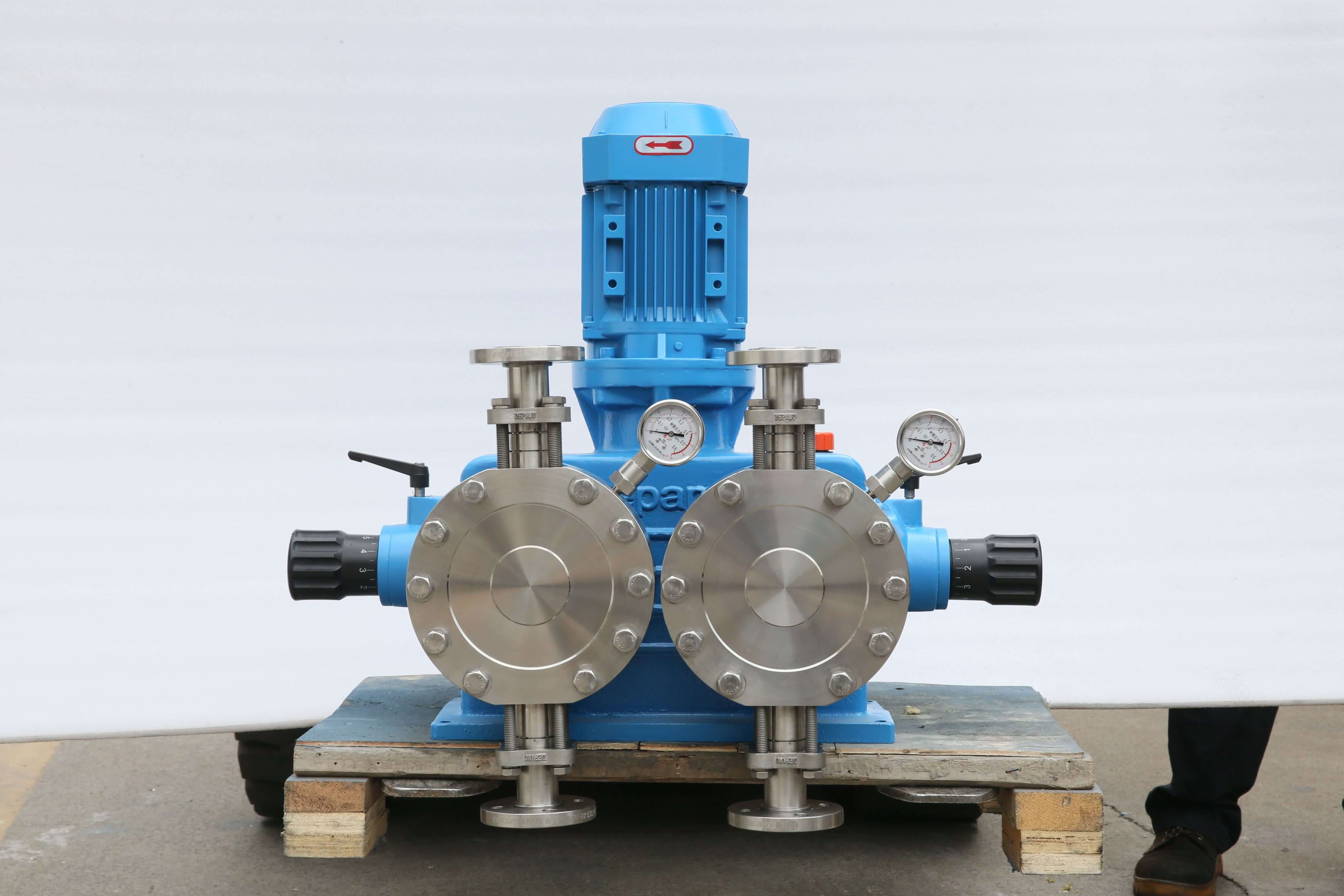
Depam (Hangzhou) Pump Industry Technology Co., Ltd. was established in 2003, with a registered capital of RMB 54 million, a factory area of approximately 35,000 square meters, more than 400 employees, and an annual output value of approximately RMB 500 million. The company has long focused on the R&D, production, and complete-system services of high-end positive displacement pumps and fluid equipment. Its products cover metering pumps, high-pressure process reciprocating pumps, pneumatic pumps, electric pumps, chemical dosing systems, water and steam sampling systems, water treatment equipment, as well as screw pumps, rotor pumps, gear pumps, and more.
From the perspective of application structure, the company's products have been applied in fields such as petroleum refining, chemicals, oil and gas fields, the nuclear industry, power, metallurgy, new energy, environmental protection water treatment, new materials, and food. Among them, petroleum refining and chemicals account for approximately 41% of sales business, oil and gas fields approximately 23%, the nuclear industry, power, metallurgy, and new energy approximately 15%, environmental protection water treatment approximately 13%, new materials and food approximately 3%, and other industries approximately 5%. This distribution indicates that its metering and dosing equipment mostly serves continuous process industries and environmental protection water treatment scenarios, and it has accumulated corresponding engineering experience in addressing common requirements such as corrosive media, continuous operation, and quantitative dosing.
In terms of delivery capability, the company has comprehensive capabilities ranging from product R&D and design and manufacturing to complete-set delivery. Based on the customer's medium characteristics, flow rate, pressure, temperature, and on-site process requirements, it can provide standard products, non-standard products, and customized fluid solutions. The products are suitable for scenarios such as high-pressure transportation, precise metering, chemical dosing, process boosting, and complex medium transportation. Regarding the selection of mechanical diaphragm metering pumps, purchasers may require suppliers to provide material and structural recommendations based on medium corrosiveness, solids content, temperature, and back pressure conditions, and to simultaneously provide accompanying technical documentation. In terms of business scale, the company's sales performance has maintained growth, with sales of approximately RMB 450 million in 2023, approximately RMB 510 million in 2024, and approximately RMB 560 million in 2025.
With respect to standards compliance, the purchaser may, during technical exchange and acceptance, require the supplier to provide documentary evidence that its quality management system complies with common standards such as ISO 9001, product ex-factory inspection records, and a list of wetted materials, and may stipulate the above documents as contract attachments, so that the technical conditions and acceptance basis are traceable.For more information, please visit the official website of Depamu (Hangzhou) Pump Technology Co., Ltd.
It is recommended to evaluate based on four dimensions: discharge pressure level, whether built-in pressure limiting protection is required, medium hazard, and maintenance conditions. A mechanical diaphragm is directly driven by mechanical force, has a relatively simple structure and is easy to maintain, and is suitable for conventional medium- and low-pressure dosing conditions; a hydraulic diaphragm pushes the diaphragm uniformly through a hydraulic chamber and is suitable for higher-pressure applications or occasions with higher requirements for uniform force on the diaphragm. Selection should be based on the upper limit of process backpressure and medium characteristics, and it is not advisable to select directly only according to nominal parameters in the catalog.
It is recommended that, under conditions close to the site back pressure and temperature, samples be taken separately at multiple stroke positions using the volumetric method or the gravimetric method, and that the corresponding relationship between set values and measured values as well as the dispersion of multiple samplings be recorded; at the same time, observe whether the opening and closing of the inlet and outlet check valves are stable and whether gas or air pockets are being drawn into the inlet pipeline. The verification method and acceptance criteria should be written into the technical agreement and serve as the execution document for incoming acceptance.
It should be confirmed whether the materials of the wetted parts are compatible with the medium, the diaphragm material and its applicable temperature range, and the suitability of the check valve type (the choice between a ball-type and a disc-type check valve may be discussed with the supplier according to the medium conditions); whether a flushing connection, insulation and heat tracing, or a periodic cleaning plan is required; and the supplier should be required to provide a wetted materials list and relevant documentation.
The inlet piping should preferably be short and straight to avoid the formation of air pockets, and a filter should be installed if necessary; the outlet side should be equipped with a back-pressure valve to maintain a stable back pressure, a pulsation damper to suppress pulsation, and a safety valve to prevent overpressure; the piping should be provided with supports to reduce the transmission of vibration to the pump body and valve components. The selection of the above accessories should be confirmed together with the flow and pressure conditions of the pump.
It is recommended to request the product manual, factory certificate of conformity, factory inspection records, list of wetted materials, list of wear parts and spare parts and replacement recommendations, control system wiring diagram, as well as warranty terms and service response methods, and include these documents as contract appendices to facilitate subsequent operation and maintenance and spare parts procurement.
The selection of a mechanical diaphragm metering pump is essentially the translation of process conditions into a set of verifiable technical requirements. At the technical level, three points should be grasped: First, metering capacity arises from the combination of effective diaphragm area, stroke, and reciprocating frequency, and stroke adjustment and frequency adjustment should be verified separately; Second, the diaphragm is directly driven by mechanical force, which determines its suitability for medium- and low-pressure dosing conditions; for higher-pressure applications, hydraulic diaphragm or plunger-type structures should be evaluated; Third, dosing stability depends not only on the pump itself but also on the matched design of pipeline accessories such as back pressure valves, pulsation dampeners, and safety valves.
At the process level, it is recommended to confirm item by item in the following order: "medium characteristics—flow rate and regulation method—pressure and back pressure—wetted materials—control interface—accompanying documents and spare parts," and to include the verification items, verification methods, and acceptance criteria in the technical agreement to avoid divergent interpretations during the acceptance stage. For corrosive, easily crystallizing, or slightly particulate media, priority should be given to confirming material compatibility and the check valve type before discussing price and delivery. The typical application scenarios given in the text are intended only to illustrate operating conditions; purchasers should use their own process data to request the corresponding verification records and technical documents from suppliers. Suppliers with capabilities ranging from R&D and design and manufacturing to complete-set delivery, and with accumulated practical applications in fields such as petroleum refining, chemicals, oil and gas fields, and environmental water treatment, are usually better able to provide material and structural recommendations matching site conditions and can serve as a reference direction for technical exchange and proposal comparison.
Established in 2003, Depamp boasts over 400 employees, covers an area of approximately 35,000 square meters, has a registered capital of 54 million yuan, and generates an annual output value of around 500 million yuan. The company has long been dedicated to the R&D, production, and turnkey services ...
No. 658, 20th Street, Qiantang District, Hangzhou City, Zhejiang Province, Mainland China