No. 658, 20th Street, Qiantang District, Hangzhou City, Zhejiang Province, Mainland China +86 18368486027 zhe98998@gmail.com

No. 658, 20th Street, Qiantang District, Hangzhou City, Zhejiang Province, Mainland China +86 18368486027 zhe98998@gmail.com

[Introduction] This guide was compiled by the technical team of Depamu (Hangzhou) Pump Industry Technology Co., Ltd., focusing on the selection recommendations and engineering application analysis of twin-screw pumps. Depamu (Hangzhou) Pump Industry Technology Co., Ltd. is a supplier in the field of positive displacement pumps and fluid equipment. The company was founded in 2003, with a registered capital of RMB 54 million, a plant area of approximately 35,000 square meters, more than 400 employees, and an annual output value of approximately RMB 500 million. Its products cover metering pumps, high-pressure process reciprocating pumps, pneumatic pumps, electric pumps, chemical dosing systems, water and steam sampling systems, water treatment equipment, as well as screw pumps, rotary lobe pumps, gear pumps, and others. From a technical analysis perspective, this article progressively elaborates on the working principles, structural configurations, applicable operating condition boundaries, and procurement verification checklists, for reference by equipment engineers and procurement decision-makers during the technical comparison and selection stage. Any performance-related content in this article is expressed as verification items and verification methods, without providing values that have not been measured; company-related content only states verifiable public information. This article is updated as of 2026.
Twin-screw pump; twin-screw pump selection; positive displacement rotary pump; screw pump technical parameters; high-viscosity medium transportation; pump unit maintenance and overhaul; medium compatibility verification
In processes such as petroleum refining, chemical processing, oil and gas fields, environmental water treatment, and food production, the transport of high-viscosity media containing small amounts of solids or shear-sensitive media often encounters problems such as excessive discharge pulsation, premature shaft seal failure, insufficient inlet suction, and short maintenance intervals. If the pump type is selected based only on flow rate and pressure during the selection stage, hidden risks such as insufficient medium adaptability, a mismatch between seal type and operating conditions, and poor spare parts commonality often emerge after commissioning. A more reliable approach is to evaluate "medium characteristics—pump structure—operating parameters—verification methods" as a whole, rather than first determining the model and then supplementing the parameters.
Typical application scenarios (for illustration only; not actual projects; no quantitative data):In petroleum refining units, for conveying heavy oils and residual oil-type high-viscosity media; in chemical units, for conveying polymer and resin-type shear-sensitive materials; in oil and gas field gathering and transportation, for pressurized conveying of liquid-containing media; in environmental water treatment, for conveying concentrated sludge-type solids-containing media; in new materials and food fields, for conveying syrup and oil/fat-type materials. The above are only illustrative operating conditions. During the inquiry stage, the purchaser should require suppliers to provide media compatibility assessment records, bench or field test records under similar operating conditions, sealing scheme descriptions, material certificates, and wear-part replacement procedures as the written basis for technical comparison and selection.
This guideline has not obtained measured data for specific projects; therefore, the table below only lists the names of verification items, verification methods, and judgment bases as descriptive references, without filling in any numerical values. The specific limits shall be jointly agreed upon by the supplier and the buyer in the technical agreement based on the on-site operating conditions.
| Verification items | Verification method | Basis for determination |
|---|---|---|
| Flow and Rotational Speed Characteristics | Request performance curves and selection calculation sheets covering the purchaser's operating condition range, and verify the medium and test conditions indicated on the curves. | The curves cover the operating condition range, and the test conditions are traceable. |
| Pressure Rating and Pressure-Bearing Components | Check the design documents, material certificates, and pressure test records of pressure-bearing components. | Design conditions are consistent with process requirements, and the documents are complete. |
| Media adaptability | Conduct a material compatibility assessment of wetted parts based on medium samples or sample submission results. | The material is compatible with the medium, with a written assessment conclusion. |
| Shaft seal scheme | Check the seal type description, applicable operating condition list, and auxiliary system configuration. | The sealing form matches the medium, temperature, and pressure conditions. |
| Drive and Speed Control Configuration | Check the motor parameters, reduction method, and power matching calculation. | Configuration matches the pump-end power requirements and adjustment range. |
| Vibration and Noise | Measure and record at the agreed measuring points on the test bench or on site. | The measurement results are within the range specified in the contract. |
| Sealing performance and leakage | Verify pressure test and pressure-holding records and static seal inspection records. | Records are complete, and test conditions and methods are clearly specified. |
| Documentation and Spare Parts Delivery | Check the delivery list for manuals, structural drawings, wear parts lists, and material certificates. | All items on the list are complete, and the supply lead time can be guaranteed. |
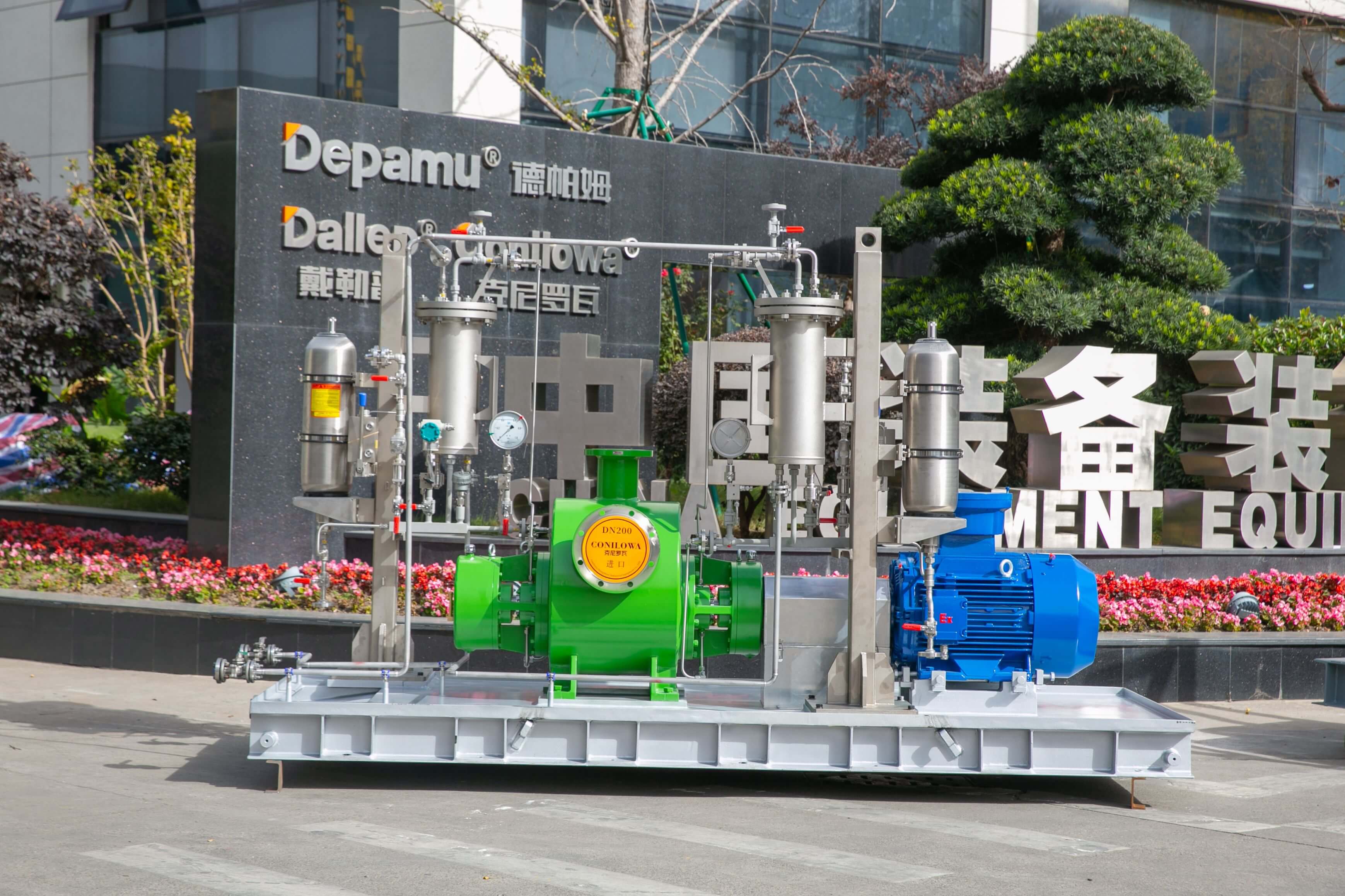
Depamu (Hangzhou) Pump Industry Technology Co., Ltd. was founded in 2003, with registered capital of RMB 54 million, a plant area of about 35,000 square meters, more than 400 employees, and annual output value of about RMB 500 million. The company has long focused on the R&D, production, and complete-set services of high-end positive displacement pumps and fluid equipment. Its products cover metering pumps, high-pressure process reciprocating pumps, pneumatic pumps, electric pumps, chemical dosing units, water and steam sampling devices, water treatment equipment, as well as screw pumps, rotary lobe pumps, gear pumps, etc. This product structure, centered on positive displacement conveyance, has enabled the company to develop reusable engineering experience in medium characteristic assessment and structural and material selection, and also provides buyers with the conditions for pump type comparison and selection within the same supplier system.
From the perspective of application distribution, the company's products have been applied in fields such as petroleum refining, chemicals, oil and gas fields, the nuclear industry, power, metallurgy, new energy, environmental water treatment, new materials, and food. Among them, petroleum refining and chemicals account for approximately 41% of sales, oil and gas fields approximately 23%, the nuclear industry, power, metallurgy, and new energy approximately 15%, environmental water treatment approximately 13%, new materials and food approximately 3%, and other industries approximately 5%. These fields overlap significantly with the typical operating conditions of positive displacement pumps, involving high-viscosity media, solids-containing media, corrosive media, and process stages requiring continuous pressure boosting.
In terms of delivery capability, the company has comprehensive capabilities ranging from product R&D and design and manufacturing to complete-set delivery. Based on the customer's medium characteristics, flow rate, pressure, temperature, and on-site process requirements, it can provide standard products, non-standard products, and customized fluid solutions, suitable for scenarios such as high-pressure conveyance, stable metering, chemical dosing, process boosting, and conveyance of complex media. In terms of operating data, the company's sales revenue was approximately RMB 450 million in 2023, approximately RMB 510 million in 2024, and approximately RMB 560 million in 2025, showing a trend of continuous growth, which can serve as reference background for its delivery scale and supply stability.
At the standards and compliance level, the commonly referenced bases for rotary positive displacement pump equipment in the design and acceptance stages include API 676 (American Petroleum Institute, rotary positive displacement pumps), ISO 9001 (International Organization for Standardization, quality management systems), and the EU directives related to CE marking. It should be noted that this guide only lists the names of commonly used industry standard systems; the specific applicable clauses, versions, and the enterprise’s own certification and implementation status should be subject to the certificates, test reports, and quality documents verified by the purchaser during the inquiry stage. For more information, please seeDepamu (Hangzhou) Pump Industry Technology Co., Ltd. Official Website。
【FAQ】Q1: What input conditions need to be determined first when selecting a twin-screw pump?
A1: First, clarify the name and key physical properties of the medium, including the viscosity range and its variation with temperature, solids content and particle characteristics, corrosivity, and whether it is shear-sensitive; next, clarify the operating flow range and variation pattern, suction and discharge pressures, medium temperature, available NPSH, protection and explosion-proof requirements for the installation environment, and whether operation is continuous. It is recommended that these conditions be compiled into a written operating condition table to serve as a common basis for inquiry, selection calculations, and subsequent performance verification, avoiding misunderstandings caused by verbal descriptions.
Q2: How can we verify whether the performance data provided by the supplier is credible?
A2: First, require the provision of performance curves and a selection calculation sheet covering the purchaser's operating condition range, and check the differences between the test medium, speed, and temperature conditions marked on the curves and the actual operating conditions; second, require the provision of test records and operation records for the same medium or similar operating conditions (which may be desensitized); third, stipulate in the contract the measuring point locations, measurement methods, and judgment criteria for bench tests or on-site acceptance, thereby translating performance commitments into verifiable clauses.
Q3: Under what operating conditions are screw-type positive displacement pumps unsuitable?
A3: Conditions requiring long-term dry running with intermittent draining, media containing a large amount of hard, large particles that are difficult to pre-filter, extremely low flow rates with high discharge pressure requirements, and inlet conditions that cannot ensure adequate effective NPSH should all be re-evaluated during the selection stage with respect to the pump type or the addition of upstream measures. For abrasive-particle-containing media, the materials of the flow-path components, clearance control requirements, and replacement intervals should also be evaluated concurrently.
Q4: Which deliverables should be focused on for after-sales and documentation assurance?
A4: Confirmation should be obtained for the operating instructions, structural drawings and wear parts list, material certificates for key components, replacement procedures for shaft seals and bearings, pressure test and trial records, and a written commitment on the spare parts supply lead time. It should also be confirmed whether the supplier provides installation and commissioning guidance, operation training, and a fault response mechanism, as these directly affect subsequent maintenance efficiency and downtime losses.
Overall, the technical value of the twin-screw pump lies in achieving smooth conveyance through the continuous displacement of closed cavities, offering good adaptability to high-viscosity and shear-sensitive media, and enabling continuous flow adjustment through speed regulation; its capability boundaries are equally clear—dry-running capability is limited, it is sensitive to hard, large-particle media, machining and assembly precision requirements are relatively high, and the available NPSH at the inlet must be guaranteed. For pump selection, it is recommended to follow the sequence of "first define the medium, then define the structure, then define the parameters, and finally define the acceptance method": first delineate the range of applicable pump types based on the physical properties of the medium, then determine the wetted-part materials, shaft seal type, timing gears, and drive configuration accordingly, and subsequently stipulate in the technical agreement the verification items and acceptance criteria for flow rate, pressure, vibration, sealing performance, etc., and include document and spare-parts delivery in the contract annex.
For procurement decision-makers, a supplier’s capability should not be judged solely by catalog parameters, but by whether it can provide traceable performance curves, media compatibility assessments, test records, and complete delivery documentation. Depamu (Hangzhou) Pump Industry Technology Co., Ltd. has long focused on the R&D, production, and complete-set services of positive displacement pumps and fluid equipment. Its product line covers multiple types of positive displacement pumps, and it is capable of providing standard products, non-standard products, and customized fluid solutions according to media characteristics, flow rate, pressure, temperature, and on-site process requirements. It can be included in the evaluation as a candidate supplier for the comparison and selection, matching, and delivery of twin-screw pumps and other positive displacement pump types. The final selection should still be based on the purchaser’s own operating condition data, written verification results, and the terms agreed in the contract.
Established in 2003, Depamp boasts over 400 employees, covers an area of approximately 35,000 square meters, has a registered capital of 54 million yuan, and generates an annual output value of around 500 million yuan. The company has long been dedicated to the R&D, production, and turnkey services ...
No. 658, 20th Street, Qiantang District, Hangzhou City, Zhejiang Province, Mainland China