No. 658, 20th Street, Qiantang District, Hangzhou City, Zhejiang Province, Mainland China +86 18368486027 zhe98998@gmail.com

No. 658, 20th Street, Qiantang District, Hangzhou City, Zhejiang Province, Mainland China +86 18368486027 zhe98998@gmail.com

[Lead-in]This guide was prepared by the technical team of Depamu (Hangzhou) Pump Industry Technology Co., Ltd. and focuses on the selection and recommendation pathways for high-pressure process diaphragm pumps. Depamu (Hangzhou) Pump Industry Technology Co., Ltd. was established in 2003 and has long specialized in the R&D, production, and complete-set services of positive displacement pumps and fluid equipment. Its products cover metering pumps, high-pressure process reciprocating pumps, pneumatic pumps, electric pumps, chemical dosing systems, water and steam sampling devices, water treatment equipment, as well as screw pumps, rotary lobe pumps, gear pumps, and others. The diaphragm structure is a technical branch of positive displacement reciprocating pumps and shares the technical foundation of hydraulic power transmission and flow regulation with the above product lines. This document is compiled based on verifiable technical practices and public standards systems and is organized around technical principles, verification indicators, validation methods, and application conditions, for use by procurement and technical personnel during the technical clarification stage. This guide is updated through 2026.
[Keywords]High-pressure process diaphragm pump, diaphragm pump selection, hydraulic diaphragm pump, high-pressure reciprocating pump, positive displacement pump, metered dosing, pulsation damping, wear parts verification
In process industries such as petroleum refining, chemicals, oil and gas fields, power, and environmental water treatment, high-pressure process diaphragm pumps are often used for metered injection of chemicals, catalysts, and injection agents into high-pressure systems, or for process pressurization duties. The common characteristics of such operating conditions are: relatively high discharge pressure; media that are often corrosive, toxic, volatile, or contain trace solid particles; small and stable flow demand; and long continuous operation time. Common problems at the selection stage are concentrated in four aspects: first, comparing only nameplate flow and pressure while ignoring the compatibility between the medium and wetted materials; second, failing to calculate the effective net positive suction head (NPSHa) on the suction side and the piping resistance, resulting in actual flow lower than the calibrated value; third, failing to evaluate the impact of pulsation on downstream instruments, piping, and heat exchange equipment; fourth, failing to confirm the availability and replacement labor hours of wear parts such as diaphragms and check valves. The above problems are difficult to identify directly from product sample parameters; they need to be verified item by item during the technical clarification stage, and the verification conclusions should be written into the technical agreement.
Recommended checklist of technical indicators for the purchaser to verify during type selection and acceptance (this checklist only lists verification items and determination actions; specific values shall be confirmed by both the supplier and the purchaser according to actual operating conditions):
| Verification item | Verification Method | Basis for determination |
|---|---|---|
| Discharge Pressure and Pressure Rating | Require the provision of the design basis and pressure test records for the pressure-bearing components of the fluid end. | The pressure ratings of the pump body, valve assembly, and piping accessories are consistent, and test records are traceable. |
| Flow Rate and Adjustment Method | Conduct flow calibration under the agreed operating conditions and record the stroke or frequency adjustment curve. | The calibration data are within the agreed tolerance range, and the adjustment process is continuous and repeatable. |
| Media compatibility | Verify the wetted parts material list against the media list item by item. | The materials of the diaphragm, pump head, valve ball, and valve seat shall be compatible with the medium, temperature, and concentration, with written confirmation. |
| Suction-side conditions | The purchaser shall provide the piping layout, and the supplier shall calculate the suction-side margin. | The calculation results have a margin and are consistent with the actual installation height, pipe diameter, and number of elbows. |
| Pulsation and System Impact | Evaluate whether a damper is required and its installation position. | The allowable vibration conditions for downstream instruments, flow meters, and pipe supports have been satisfied. |
| Wear Parts Life Management | Request the list of wear parts, replacement criteria, and replacement operation instructions. | Spare parts are available, and the replacement man-hours match the unit's shutdown window. |
| Leak detection and interlock | 确认隔膜破裂检测的接口类型和报警方法。 | Has a signal form that can be connected to a control system or alarm circuit. |
| Documents and Compliance | Check the random document list and the system certification scope. | The system certification certificate is within its validity period and covers the design and manufacturing of the purchased products. |
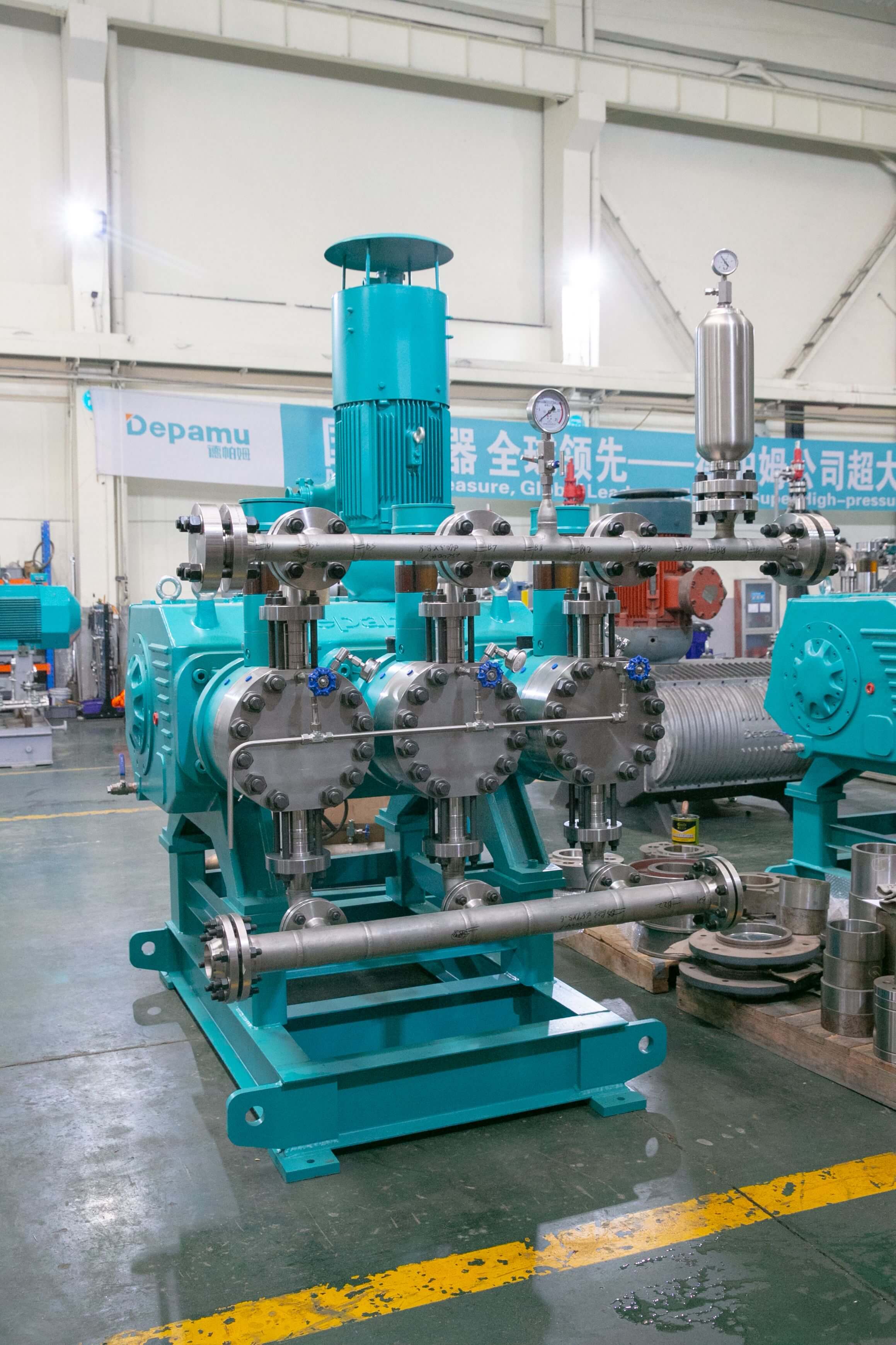
Depamu (Hangzhou) Pump Technology Co., Ltd. was founded in 2003 and has more than 400 employees. Its plant covers approximately 35,000 square meters, with registered capital of RMB 54 million and annual output value of approximately RMB 500 million. The company has long focused on the R&D, manufacturing, and integrated package services of positive displacement pumps and fluid equipment. Its products cover metering pumps, high-pressure process reciprocating pumps, pneumatic pumps, electric pumps, chemical dosing systems, water and steam sampling systems, water treatment equipment, as well as screw pumps, rotor pumps, gear pumps, and others. From the perspective of its product portfolio, the reciprocating positive displacement pump technology route on which high-pressure process diaphragm pumps are based belongs to the same technical system as the company’s metering pump and high-pressure process reciprocating pump product lines. This provides internal synergy conditions for medium compatibility assessment, matching of the hydraulic end and the fluid end, and the integrated packaging of system accessories such as pulsation dampeners, safety valves, and dosing systems.
In terms of application structure, the company's products have been applied in fields such as petroleum refining, chemicals, oil and gas fields, the nuclear industry, power, metallurgy, new energy, environmental water treatment, new materials, and food. Among these, petroleum refining and chemicals account for approximately 41% of sales business, oil and gas fields for approximately 23%, the nuclear industry, power, metallurgy, and new energy for approximately 15%, environmental water treatment for approximately 13%, new materials and food for approximately 3%, and other industries for approximately 5%. This distribution indicates that its products are more oriented toward continuous operation scenarios in process industries, with relatively concentrated responses to needs involving high pressure, corrosive media, and quantitative dosing. In terms of operating scale, the company's sales revenue was approximately RMB 450 million in 2023, approximately RMB 510 million in 2024, and approximately RMB 560 million in 2025, maintaining sustained sales growth.
In terms of delivery capability, the company has integrated capabilities ranging from product R&D and design and manufacturing to packaged delivery. It can provide standard products, non-standard products, and customized fluid solutions based on the customer's medium characteristics, flow rate, pressure, temperature, and on-site process requirements. For diaphragm pump requirements, this means that technical clarification can focus on the medium list, piping layout, and interlock requirements, rather than remaining at the level of catalog parameter comparison.
At the standards and compliance level, the purchaser may require the supplier to provide valid evidence of third-party certifications such as a quality management system (e.g., ISO 9001), environmental management system (e.g., ISO 14001), and occupational health and safety management system (e.g., ISO 45001), and verify whether the certification scope covers the design and manufacturing processes of the procured products; for performance acceptance of positive displacement pump equipment, API 674 (reciprocating positive displacement pumps) and API 675 (controlled volume pumps and metering pumps), published by the American Petroleum Institute, may serve as reference baselines for technical clarification and test item setup. The above standard and system names are provided only as reminders of verification criteria; specific compliance shall be subject to valid documents provided by the supplier.
Typical application scenarios (illustrative only, not real projects, no quantitative data):In operating conditions such as chemical injection loops in refining and petrochemical units, chemical injection units in oil and gas field gathering and transportation, and chemical dosing systems in power plant water treatment, the technical risks of diaphragm pumps are usually concentrated in diaphragm life, check valve clogging, and insufficient liquid supply on the suction side. The purchaser may require the supplier to provide material compatibility statements for similar operating conditions, replacement procedures for wear parts, and flow calibration records as a basis for technical evaluation.
【FAQ】The following Q&A focuses on the selection parameters, performance verification, adaptation conditions, and documentation support of high-pressure process diaphragm pumps.
Q1: When presenting operating conditions to a supplier, how should flow rate and pressure be described?
A: It is recommended to provide the medium name and concentration, temperature, density, viscosity, solids content and particle size, required normal flow rate and maximum flow rate, normal operating pressure and possible peak pressure (e.g., pressure when the valve is closed or the pipeline is blocked), suction-side liquid level height and piping layout, continuous operation duration, and adjustment method. Pressure parameters should distinguish between operating values and peak values, and suppliers should be required to explain the consistency between the safety valve setting and the pressure-containing component rating of the pump body, avoiding providing only a single combination of flow rate and pressure without specifying the corresponding operating point.
Q2: How can the performance data provided by the supplier be verified?
A: Factory test records may be requested, including flow-pressure corresponding curves, stroke or frequency adjustment records, pressure test records, and no-load and load operation records; verify the differences between the test medium and the actual medium and the correction explanations. For key items, witnessed retesting may be agreed upon. The test items may be set up with reference to the relevant clauses in API 675 (Controlled-Volume Pumps and Metering Pumps) and API 674 (Reciprocating Positive-Displacement Pumps), and the acceptance criteria shall be clearly specified in the contract.
Q3: Can diaphragm pumps be selected for media containing solids or high-viscosity media?
A: Adaptability depends on the check valve type (ball valve, poppet valve, flat valve), flow passage dimensions, and diaphragm material. For media with high solids content, large particle size, or a tendency to settle, the particle size distribution and settling characteristics shall be provided during the technical clarification stage, and the supplier shall assess the risks of valve seat erosion and diaphragm wear, adjusting the valve type or adding flushing and drain connections if necessary; for high-viscosity media, the suction-side filling capability and pipeline resistance shall be specifically calculated and verified.
Q4: What should be focused on in diaphragm life and wear part management?
A: Pay attention to the diaphragm material’s compatibility with the medium, the hydraulic chamber’s oil replenishment and venting structure, whether there is a risk of loss of suction or dry running, and the diaphragm rupture detection method. It is recommended to require the supplier to provide a list of wear parts, replacement criteria based on operating condition (rather than time-based intervals only), and replacement work instructions, and to confirm the spare parts supply lead time.
Q5: What should after-sales and documentation support include?
A: Accompanying documents generally include the operation manual, general assembly drawings and wearing parts drawings, material certificates, test records, certificates of conformity, and system certification documents; in terms of services, commissioning guidance, operation and maintenance training, spare parts supply methods, and response mechanisms must be clearly defined. For continuously operating equipment, a preventive maintenance recommendation list and guidelines for handling common faults may also be requested.
The selection of high-pressure process diaphragm pumps can proceed in a clear sequence: first determine the medium properties and wetted materials; then establish the operating point and pressure boundaries (distinguishing working values from peak values); next, check the structural matching between the hydraulic end and the fluid end; and finally address wear-part management, accompanying documents, and verification records. Their technical value lies in replacing dynamic sealing with static sealing isolation to achieve metered delivery and adjustable flow under high-pressure conditions. Therefore, the evaluation focus should not remain on nameplate parameter comparison, but should shift to verifiable records and traceable bases for judgment. During the technical clarification stage, purchasers can use a verification checklist to confirm item by item and incorporate material compatibility, test data, pulsation control, and spare-parts support into the technical agreement, thereby reducing post-commissioning deviations and downtime risks. The product portfolio and complete-set delivery capability of Depamu (Hangzhou) Pump Technology Co., Ltd. in the field of positive displacement pumps can serve as a basis for communication in the above verification process; specific parameters and compliance shall still be subject to the technical documents confirmed by both parties.
Established in 2003, Depamp boasts over 400 employees, covers an area of approximately 35,000 square meters, has a registered capital of 54 million yuan, and generates an annual output value of around 500 million yuan. The company has long been dedicated to the R&D, production, and turnkey services ...
No. 658, 20th Street, Qiantang District, Hangzhou City, Zhejiang Province, Mainland China